


What is the Syngas - Derivatives Market Size and Growth Rate?
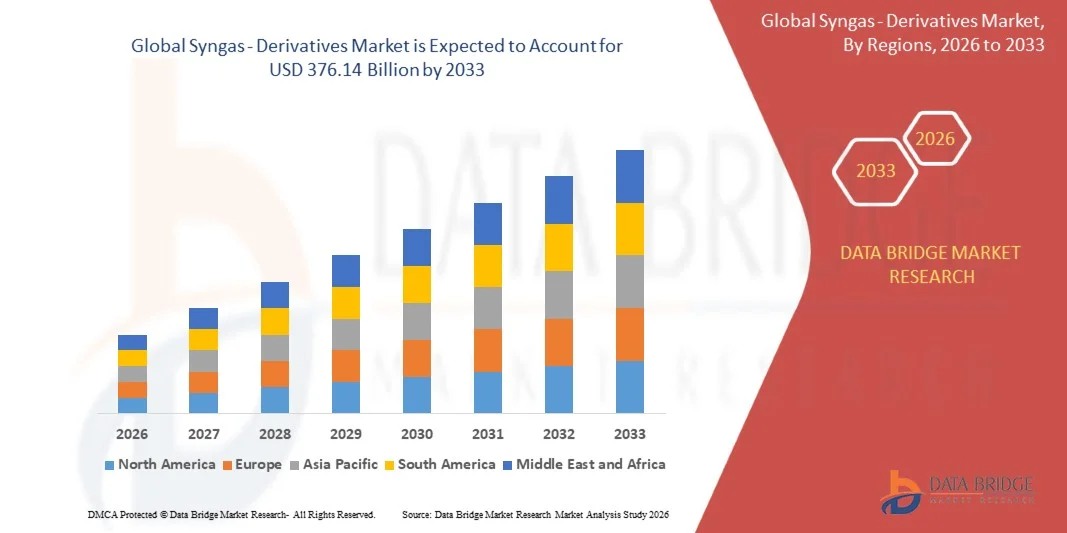
- As per Data Bridge Market Research Analysis the global syngas - derivatives market size was valued at USD 150.19 billion in 2025 and is expected to reach USD 376.14 billion by 2033, at a CAGR of 12.16% during the forecast period
- The market growth is largely fueled by the increasing demand for cleaner and more sustainable energy sources, along with the expanding use of syngas in the production of chemicals, fuels, and power, supporting the global transition toward low-carbon energy systems
- Furthermore, rising investments in gasification and reforming technologies, coupled with growing demand for hydrogen, methanol, and ammonia across industrial sectors, are strengthening the adoption of syngas derivatives, thereby significantly boosting the industry's growth
Market Size and Forecast:
- Market Size (2025): USD 150.19 billion
- Projected Market Size (2033): USD 376.14 billion
- CAGR (2026-2033): 12.16%
What is the Syngas - Derivatives Market Analysis ?
- Syngas is a versatile gas mixture primarily composed of hydrogen and carbon monoxide, produced from feedstocks such as coal, natural gas, petroleum, and biomass through processes such as gasification and steam reforming, and it acts as a key intermediate for manufacturing fuels, chemicals, and electricity
- The escalating demand for syngas derivatives is primarily fueled by increasing utilization in chemical synthesis, rising focus on hydrogen as a clean energy carrier, and growing adoption of alternative fuels to support decarbonization across multiple industrial applications
- Asia-Pacific dominated the syngas - derivatives market with a share of 54% in 2025, due to extensive coal and natural gas reserves, rising demand for chemicals and fertilizers, and strong industrial growth across emerging economies
- North America is expected to be the fastest growing region in the syngas - derivatives market during the forecast period due to abundant natural gas availability, increasing demand for hydrogen and synthetic fuels, and advancements in gasification technologies
- Captive segment dominated the market with a market share of 57.5% in 2025, due to industrial players’ preference for in-house syngas production to ensure cost efficiency, supply security, and consistent quality for downstream processes. Captive consumption is particularly common in chemical and fertilizer manufacturing plants, where uninterrupted syngas supply is critical for production continuity
What is the Report Scope and Syngas - Derivatives Market Segmentation ?
|
Attributes |
Syngas - Derivatives Key Market Insights |
|
Segments Covered |
|
|
Countries Covered |
North America
Europe
Asia-Pacific
Middle East and Africa
South America
|
|
Key Market Players |
|
|
Market Opportunities |
|
|
Value Added Data Infosets |
In addition to the insights on market scenarios such as market value, growth rate, segmentation, geographical coverage, and major players, the market reports curated by the Data Bridge Market Research also include import export analysis, production capacity overview, production consumption analysis, price trend analysis, climate change scenario, supply chain analysis, value chain analysis, raw material/consumables overview, vendor selection criteria, PESTLE Analysis, Porter Analysis, and regulatory framework. |
What are the Syngas - Derivatives Market Trends ?
Rising Adoption of Low-Carbon and Renewable Syngas Technologies
- A significant trend in the syngas – derivatives market is the increasing adoption of low-carbon and renewable syngas production technologies, driven by global decarbonization goals and the transition toward sustainable energy systems. This shift is elevating the role of syngas as a key intermediate for producing cleaner fuels, hydrogen, and environmentally sustainable chemicals across multiple industries
- For instance, Shell has developed renewable hydrogen projects in Europe that integrate green electricity with syngas production pathways to reduce carbon emissions. Such initiatives are strengthening the adoption of low-carbon syngas solutions and enabling industries to meet stringent environmental regulations while maintaining operational efficiency
- The use of biomass and waste feedstocks for syngas generation is expanding rapidly as industries seek to reduce dependence on fossil fuels and promote circular economy practices. This is positioning renewable syngas as a viable alternative for producing fuels and chemicals with lower environmental impact
- The integration of carbon capture, utilization, and storage technologies with syngas production is gaining traction, enabling industries to significantly reduce emissions from traditional gasification processes. This advancement is supporting the development of cleaner production pathways and enhancing sustainability credentials
- Industries are increasingly investing in power-to-gas and gas-to-liquids technologies that utilize syngas for producing synthetic fuels and energy carriers. This is reinforcing the importance of syngas in supporting energy transition strategies and diversifying fuel sources
- The growing emphasis on sustainable industrial processes and low-emission energy systems is strengthening the adoption of renewable syngas technologies. This trend is shaping long-term market growth and positioning syngas derivatives as critical components in the global shift toward cleaner and more efficient energy ecosystems
What are the Syngas - Derivatives Market Dynamics ?
Driver
Increasing Demand for Syngas in Chemical and Fuel Production
- The increasing demand for syngas in chemical and fuel production is a major driver of market growth, supported by its widespread use as a feedstock for methanol, ammonia, and synthetic fuels. Syngas provides a flexible and efficient pathway for producing essential industrial chemicals and energy carriers required across multiple sectors
- For instance, Air Liquide supplies syngas to large-scale methanol and refining facilities, enabling efficient production processes and supporting downstream chemical manufacturing. Such developments highlight the critical role of syngas in ensuring consistent supply for industrial applications and strengthening value chain integration
- The expanding use of syngas in hydrogen production is further accelerating demand, as hydrogen emerges as a key component in clean energy transitions and industrial decarbonization. This is increasing investments in reforming and gasification technologies to meet rising consumption needs
- The growing demand for fertilizers is also contributing to syngas utilization, as ammonia production relies heavily on syngas as a primary input. This is supporting agricultural productivity and ensuring food security in rapidly developing regions
- The sustained demand for chemicals, fuels, and hydrogen is reinforcing the importance of syngas as a versatile and scalable feedstock. This driver continues to support market expansion and positions syngas derivatives as essential components in global industrial and energy systems
Restraint/Challenge
High Capital Investment and Complex Infrastructure Requirements
- The syngas – derivatives market faces significant challenges due to the high capital investment required for establishing gasification and reforming facilities, along with the complexity of infrastructure development. These projects involve substantial upfront costs, advanced engineering, and long development timelines, which can limit market entry for new players
- For instance, Sasol has invested heavily in large-scale gas-to-liquids and syngas production facilities, requiring extensive capital expenditure and sophisticated operational capabilities. Such investments highlight the financial intensity of syngas projects and the challenges associated with scaling production capacity
- The need for specialized equipment, high-pressure reactors, and advanced process control systems increases the complexity of plant operations and maintenance. This creates additional cost burdens and requires skilled technical expertise for efficient management
- Infrastructure requirements such as feedstock supply chains, transportation networks, and integration with downstream facilities further add to project complexity. These factors can delay project implementation and impact overall cost efficiency
- The combination of high investment costs and operational complexities continues to act as a barrier to widespread adoption. These challenges require continuous innovation and strategic partnerships to improve cost efficiency and support sustainable market growth
What is the Syngas - Derivatives Market Scope ?
The market is segmented on the basis of feedstock, production technology, consumption, gasifier, end-user, and application.
• By Feedstock
On the basis of feedstock, the syngas – derivatives market is segmented into coal, petroleum, natural gas, and biomass/waste. The natural gas segment dominated the largest market revenue share in 2025, driven by its high hydrogen-to-carbon ratio, cleaner emissions compared to coal, and widespread availability in major producing regions. Industries favor natural gas due to its efficiency in producing syngas with a consistent composition suitable for downstream chemical synthesis and fuel production. Moreover, natural gas-based syngas processes are easier to integrate with modern gasification and reforming technologies, enhancing operational flexibility and reducing environmental concerns.
The biomass/waste segment is anticipated to witness the fastest growth from 2026 to 2033, fueled by increasing adoption of renewable feedstocks and government incentives for sustainable energy initiatives. For instance, companies such as LanzaTech are leveraging biomass and industrial waste to produce syngas for fuels and chemicals, supporting circular economy goals. Biomass-based syngas is gaining traction due to its carbon-neutral potential and alignment with decarbonization strategies across power and chemical sectors.
• By Production Technology
On the basis of production technology, the market is segmented into steam reforming, partial oxidation, auto thermal reforming, combined reforming, and biomass gasification. Steam reforming dominated the largest market revenue share in 2025, owing to its high efficiency, mature technology status, and widespread adoption for hydrogen and chemical production. Industries prefer steam reforming due to its reliability, ability to produce high-purity syngas, and compatibility with natural gas feedstock. The integration of steam reforming with carbon capture technologies also supports regulatory compliance and sustainability objectives, strengthening its market position.
The biomass gasification segment is expected to witness the fastest CAGR from 2026 to 2033, driven by the rising focus on renewable and low-carbon technologies. For instance, companies such as Enerkem are expanding biomass gasification plants to convert municipal solid waste into syngas for biofuels and chemicals. The ability of biomass gasification to provide decentralized energy solutions while supporting waste management initiatives contributes to its accelerated adoption.
• By Consumption
On the basis of consumption, the syngas – derivatives market is segmented into captive and merchant. The captive segment dominated the largest market revenue share of 57.5% in 2025, owing to industrial players’ preference for in-house syngas production to ensure cost efficiency, supply security, and consistent quality for downstream processes. Captive consumption is particularly common in chemical and fertilizer manufacturing plants, where uninterrupted syngas supply is critical for production continuity. Industries benefit from tailored production capacities and operational control in captive setups, enhancing process optimization and reducing dependency on external suppliers.
The merchant segment is projected to witness the fastest growth from 2026 to 2033, fueled by increasing demand from smaller industries and regions lacking large-scale syngas production infrastructure. For instance, Air Products supplies merchant syngas to chemical manufacturers and refining companies seeking flexible sourcing solutions. The growth is further supported by strategic partnerships and contract-based supply models that reduce upfront investment risks for end users.
• By Gasifier
On the basis of gasifier, the market is segmented into fixed bed, entrained flow, and fluidized bed. The entrained flow gasifier segment dominated the largest market revenue share in 2025, owing to its capability to operate at high temperatures and pressures, enabling production of syngas with low tar content and high carbon conversion efficiency. Industries adopt entrained flow gasifiers for large-scale applications requiring consistent syngas quality, particularly in chemical and liquid fuel production. Their compatibility with coal, petroleum, and biomass feedstocks, along with robust operational performance, further consolidates their market dominance.
The fluidized bed gasifier segment is expected to witness the fastest CAGR from 2026 to 2033, driven by its flexibility in feedstock handling and energy efficiency. For instance, GE Gasification has developed fluidized bed systems suitable for biomass and mixed feedstocks, supporting sustainable fuel production. The technology’s uniform temperature distribution and lower operational risks contribute to its growing adoption in diverse syngas applications.
• By End User
On the basis of end user, the market is segmented into chemicals, power generation, liquid fuels, and gaseous fuels. The chemicals segment dominated the largest market revenue share in 2025, driven by high syngas consumption for methanol, ammonia, and other specialty chemical production. Industries rely on syngas as a critical feedstock due to its ability to provide controlled H₂/CO ratios for catalytic processes and its scalability for large-volume chemical synthesis. The segment’s dominance is reinforced by established industrial infrastructure and growing demand for chemicals across multiple end-use sectors.
The liquid fuels segment is anticipated to witness the fastest growth from 2026 to 2033, fueled by rising demand for synthetic fuels as a cleaner alternative to petroleum-based fuels. For instance, Sasol has expanded its Fischer-Tropsch plants to produce liquid fuels from syngas derived from coal and natural gas. The push for sustainable transportation fuels and government mandates on carbon reduction enhance the growth trajectory for syngas-derived liquid fuels.
• By Application
On the basis of application, the market is segmented into chemicals and fertilizer, fuel, and electricity. The chemicals and fertilizer segment dominated the largest market revenue share in 2025, owing to syngas’ extensive use in ammonia, methanol, and urea production. Industrial reliance on syngas for fertilizers ensures food security and supports chemical manufacturing supply chains, consolidating its market dominance. The segment also benefits from mature downstream processes, stable demand patterns, and integration with large-scale chemical plants.
The fuel segment is projected to witness the fastest CAGR from 2026 to 2033, driven by the increasing adoption of syngas for power-to-liquid fuels and biofuels. For instance, Shell’s Gas-to-Liquids projects leverage syngas conversion technologies to produce cleaner fuels with lower sulfur content. The rising emphasis on decarbonization and energy transition policies enhances the demand for syngas-based fuel applications across global markets.
Which Region Holds the Largest Share of the Syngas - Derivatives Market ?
- Asia-Pacific dominated the syngas - derivatives market with the largest revenue share of 54% in 2025, driven by extensive coal and natural gas reserves, rising demand for chemicals and fertilizers, and strong industrial growth across emerging economies
- The region’s cost-efficient production landscape, increasing investments in gasification technologies, and expanding chemical manufacturing capacities are accelerating market expansion
- Rapid urbanization, supportive government policies for energy security, and growing demand for cleaner fuel alternatives are contributing to increased adoption of syngas derivatives across industrial sectors
China Syngas – Derivatives Market Insight
China held the largest share in the Asia-Pacific syngas – derivatives market in 2025, owing to its vast coal reserves, large-scale chemical manufacturing base, and strong focus on coal-to-chemicals technologies. The country’s investments in gasification infrastructure and synthetic fuel production are major growth drivers. Demand is further supported by expanding industrial applications and government initiatives promoting energy diversification and self-sufficiency.
India Syngas – Derivatives Market Insight
India is witnessing the fastest growth in the Asia-Pacific region, fueled by rising demand for fertilizers, increasing industrialization, and growing investments in alternative energy sources. Government initiatives promoting clean energy and waste-to-energy projects are strengthening syngas adoption. In addition, expanding chemical and refining sectors are contributing to robust market growth.
Europe Syngas – Derivatives Market Insight
The Europe syngas – derivatives market is expanding steadily, supported by strong emphasis on sustainability, carbon reduction goals, and increasing adoption of renewable feedstocks. The region focuses on advanced gasification technologies and integration of carbon capture systems to meet environmental regulations. Growing investments in green hydrogen and synthetic fuels are further supporting market expansion.
Germany Syngas – Derivatives Market Insight
Germany’s syngas – derivatives market is driven by its advanced industrial base, strong focus on clean energy transition, and leadership in chemical manufacturing. The country is actively investing in biomass gasification and power-to-gas technologies to reduce carbon emissions. Demand is further supported by innovation in sustainable fuels and integration of syngas in chemical production processes.
U.K. Syngas – Derivatives Market Insight
The U.K. market is supported by increasing focus on decarbonization, rising investments in waste-to-energy projects, and development of low-carbon fuel alternatives. Government policies encouraging renewable energy adoption and circular economy practices are boosting syngas utilization. Growth is further driven by research initiatives and partnerships in clean energy technologies.
North America Syngas – Derivatives Market Insight
North America is projected to grow at the fastest CAGR from 2026 to 2033, driven by abundant natural gas availability, increasing demand for hydrogen and synthetic fuels, and advancements in gasification technologies. Strong investments in clean energy infrastructure and carbon capture solutions are accelerating market growth. In addition, rising focus on energy independence and sustainable fuel production is supporting regional expansion.
U.S. Syngas – Derivatives Market Insight
The U.S. accounted for the largest share in the North America market in 2025, underpinned by its vast natural gas resources, strong presence of chemical and energy companies, and significant investment in hydrogen production. The country’s focus on technological innovation and carbon management solutions is encouraging syngas adoption across multiple industries. Presence of established infrastructure and strategic partnerships further strengthens the market position.
What is the Syngas - Derivatives Market Share ?
The syngas - derivatives industry is primarily led by well-established companies, including:
- KBR Inc. (U.S.)
- Topsoe (Denmark)
- Air Liquide SA (France)
- Air Products, Inc. (U.S.)
- Linde Plc (Ireland)
- Nutrien Ltd. (Canada)
- Sasol (South Africa)
- Shell (U.K.)
- TechnipFMC plc. (U.K.)
- General Electric (U.S.)
- Yara (Norway)
- Methanex Corporation (Canada)
- CF Industries Holdings Inc. (U.S.)
- Siemens (Germany)
- Dow (U.S.)
- BASF SE (Germany)
- Mitsubishi Electric Corporation (Japan)
- OQ Chemicals GmbH (Germany)
- Biomethanol Chemie Nederland B.V (Netherlands)
What are the Latest Developments in Global Syngas - Derivatives Market ?
- In 2024, Air Liquide initiated the development of a new syngas production unit in Texas to supply a large-scale methanol plant, significantly strengthening its foothold in the North American chemical ecosystem. This investment enhances regional production capacity and ensures a stable and efficient supply of syngas for downstream methanol synthesis, which is widely used in fuels, plastics, and industrial chemicals. The project also reflects the growing integration of syngas infrastructure with large-scale chemical facilities, improving operational efficiency and reducing logistics costs. As demand for methanol derivatives continues to rise across the U.S., this development is expected to support long-term market expansion and reinforce supply chain resilience
- In 2024, BASF and Linde entered into a strategic partnership to co-develop and commercialize low-carbon syngas production technologies aimed at minimizing emissions in ammonia and methanol manufacturing processes. This collaboration highlights the industry’s increasing focus on decarbonization and sustainable chemical production, aligning with global climate targets and regulatory pressures. By integrating advanced process optimization and carbon reduction technologies, the partnership is expected to set new benchmarks for environmentally responsible syngas production. The initiative also encourages wider adoption of cleaner technologies across the chemical sector, thereby accelerating innovation and creating growth opportunities in the low-carbon syngas market
- In 2024, Sasol commissioned a syngas-to-liquids demonstration plant in South Africa to advance the commercial viability of converting syngas into cleaner liquid fuels. This development represents a significant step toward scaling up gas-to-liquids technology, which enables the production of synthetic fuels with lower emissions compared to conventional petroleum-based fuels. The project enhances the diversification of syngas applications beyond traditional chemical uses, expanding its role in the global energy mix. As countries increasingly seek alternative fuel sources to reduce carbon footprints, such initiatives are expected to drive demand for syngas derivatives and support energy transition strategies
- In October 2022, Shell and Kansai Electric Power signed a memorandum of understanding to collaborate on the development of liquid hydrogen supply chains, focusing on research, infrastructure, and commercial feasibility. This partnership supports the integration of syngas-derived hydrogen into future energy systems, particularly in sectors such as power generation and heavy industry where decarbonization is critical. By exploring large-scale hydrogen transportation and storage solutions, the agreement contributes to building a robust hydrogen economy. This initiative is expected to strengthen the long-term demand for syngas as a key intermediate in hydrogen production and expand its relevance in clean energy applications
- In July 2022, Shell began construction of Europe’s largest renewable hydrogen plant in Rotterdam, featuring a 200 MW electrolyzer powered by offshore wind energy from the Hollandse Kust (Noord) project. This large-scale project significantly boosts renewable hydrogen production capacity and demonstrates the feasibility of integrating renewable energy with hydrogen generation technologies. The development supports the shift toward low-carbon energy systems and reinforces the strategic importance of syngas and hydrogen in achieving sustainability goals. As industries increasingly adopt cleaner fuels and feedstocks, this project is expected to drive innovation, attract further investments, and accelerate the growth of the syngas derivatives market

- Interactive Data Analysis Dashboard
- Company Analysis Dashboard for high growth potential opportunities
- Research Analyst Access for customization & queries
- Competitor Analysis with Interactive dashboard
- Latest News, Updates & Trend analysis
- Harness the Power of Benchmark Analysis for Comprehensive Competitor Tracking
Global Syngas Derivatives Market, Supply Chain Analysis and Ecosystem Framework
To support market growth and help clients navigate the impact of geopolitical shifts, DBMR has integrated in-depth supply chain analysis into its Global Syngas Derivatives Market research reports. This addition empowers clients to respond effectively to global changes affecting their industries. The supply chain analysis section includes detailed insights such as Global Syngas Derivatives Market consumption and production by country, price trend analysis, the impact of tariffs and geopolitical developments, and import and export trends by country and HSN code. It also highlights major suppliers with data on production capacity and company profiles, as well as key importers and exporters. In addition to research, DBMR offers specialized supply chain consulting services backed by over a decade of experience, providing solutions like supplier discovery, supplier risk assessment, price trend analysis, impact evaluation of inflation and trade route changes, and comprehensive market trend analysis.
Data collection and base year analysis are done using data collection modules with large sample sizes. The stage includes obtaining market information or related data through various sources and strategies. It includes examining and planning all the data acquired from the past in advance. It likewise envelops the examination of information inconsistencies seen across different information sources. The market data is analysed and estimated using market statistical and coherent models. Also, market share analysis and key trend analysis are the major success factors in the market report. To know more, please request an analyst call or drop down your inquiry.
The key research methodology used by DBMR research team is data triangulation which involves data mining, analysis of the impact of data variables on the market and primary (industry expert) validation. Data models include Vendor Positioning Grid, Market Time Line Analysis, Market Overview and Guide, Company Positioning Grid, Patent Analysis, Pricing Analysis, Company Market Share Analysis, Standards of Measurement, Global versus Regional and Vendor Share Analysis. To know more about the research methodology, drop in an inquiry to speak to our industry experts.
Data Bridge Market Research is a leader in advanced formative research. We take pride in servicing our existing and new customers with data and analysis that match and suits their goal. The report can be customized to include price trend analysis of target brands understanding the market for additional countries (ask for the list of countries), clinical trial results data, literature review, refurbished market and product base analysis. Market analysis of target competitors can be analyzed from technology-based analysis to market portfolio strategies. We can add as many competitors that you require data about in the format and data style you are looking for. Our team of analysts can also provide you data in crude raw excel files pivot tables (Fact book) or can assist you in creating presentations from the data sets available in the report.













