Synthetic Crop Protection Chemicals Market Size
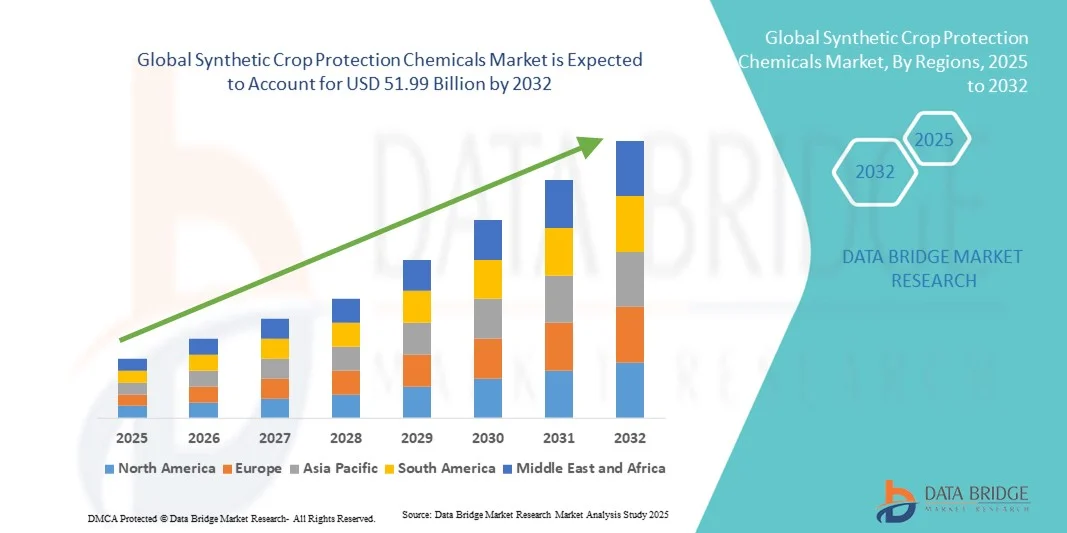
- The global synthetic crop protection chemicals market size was valued at USD 34.92 billion in 2024 and is expected to reach USD 51.99 billion by 2032, at a CAGR of 5.10% during the forecast period
- The market growth is largely fuelled by the increasing global demand for higher agricultural productivity and crop yield to meet the rising food consumption
- The growing prevalence of pest infestations and plant diseases, coupled with the need to ensure food security, is boosting the adoption of synthetic crop protection products across major crop types
Synthetic Crop Protection Chemicals Market Analysis
- The global market for synthetic crop protection chemicals is witnessing steady growth due to advancements in formulation technologies, enabling better pest control while minimizing environmental impact
- Growing adoption among farmers for herbicides, insecticides, and fungicides in cereal, fruit, and vegetable cultivation is driving consistent market demand across both developed and emerging economies
- North America dominated the synthetic crop protection chemicals market with the largest revenue share of 38.24% in 2024, driven by extensive adoption of modern farming techniques, high awareness of crop protection practices, and the presence of leading agrochemical manufacturers in the region
- Asia-Pacific region is expected to witness the highest growth rate in the global synthetic crop protection chemicals market, driven by expanding agricultural activities, increasing population-driven food demand, and growing adoption of modern pest control solutions
- The herbicides segment held the largest market revenue share in 2024, driven by the increasing demand for effective weed control solutions across major crops such as cereals, oilseeds, and pulses. Herbicides are widely used to improve crop productivity by reducing competition for nutrients, water, and sunlight, making them a vital component of modern farming systems
Report Scope and Synthetic Crop Protection Chemicals Market Segmentation
|
Attributes |
Synthetic Crop Protection Chemicals Key Market Insights |
|
Segments Covered |
|
|
Countries Covered |
North America
Europe
Asia-Pacific
Middle East and Africa
South America
|
|
Key Market Players |
|
|
Market Opportunities |
|
|
Value Added Data Infosets |
In addition to the insights on market scenarios such as market value, growth rate, segmentation, geographical coverage, and major players, the market reports curated by the Data Bridge Market Research also include import export analysis, production capacity overview, production consumption analysis, price trend analysis, climate change scenario, supply chain analysis, value chain analysis, raw material/consumables overview, vendor selection criteria, PESTLE Analysis, Porter Analysis, and regulatory framework. |
Synthetic Crop Protection Chemicals Market Trends
Shift Toward Next-Generation Formulations and Precision Application
- The growing adoption of next-generation crop protection formulations, such as nano-based and encapsulated chemicals, is transforming the synthetic crop protection chemicals market. These advanced solutions offer controlled release, higher efficacy, and reduced environmental impact, aligning with sustainable agricultural practices and evolving regulatory standards. They also extend product longevity in the field, enhance pest resistance management, and minimize the frequency of chemical applications, improving cost-efficiency for farmers
- Precision agriculture technologies are increasingly being integrated with synthetic crop protection products to enhance targeted application. The use of drones, AI-based sensors, and GPS-guided spraying systems allows farmers to optimize chemical usage, minimize wastage, and improve crop yield and profitability. This integration supports real-time pest monitoring, data-driven decision-making, and customized dosage adjustments to achieve maximum efficiency and environmental compliance
- The emphasis on residue-free and efficient pest management solutions is driving innovation among major agrochemical manufacturers. Companies are investing heavily in R&D to develop safer, long-lasting, and more crop-specific synthetic products that comply with global food safety regulations. These advancements are helping reduce chemical residues on food crops while maintaining yield quality and addressing consumer concerns about pesticide safety
- For instance, in 2023, several European chemical producers launched microencapsulated insecticides and herbicides designed to improve pest control efficiency while minimizing environmental runoff, demonstrating a significant advancement in sustainable crop protection technology. These products not only enhance target precision but also contribute to better soil health and water conservation, aligning with eco-friendly farming initiatives
- While the trend toward precision-driven synthetic formulations is gaining momentum, its success depends on farmer education, affordability, and availability of precision farming tools. Ongoing technological collaboration between agrochemical manufacturers and agri-tech firms is expected to accelerate this transformation globally. Furthermore, government incentives promoting smart farming are likely to strengthen adoption and expand the reach of advanced chemical technologies in developing markets
Synthetic Crop Protection Chemicals Market Dynamics
Driver
Growing Global Food Demand and Expansion of High-Value Crops
The rising global population and increasing food security concerns are driving demand for effective crop protection solutions to ensure higher yields and prevent pest-induced losses. Synthetic chemicals remain vital for controlling a wide range of crop diseases and pests that threaten food production. Their efficiency, scalability, and versatility make them indispensable in both large-scale industrial farming and smallholder agricultural systems
The expansion of high-value crops such as fruits, vegetables, and oilseeds has intensified the need for efficient synthetic protection products, as these crops are highly susceptible to pest and disease attacks. The use of advanced fungicides, herbicides, and insecticides ensures consistent quality and marketable yield. This trend is particularly prominent in export-oriented agricultural economies where crop appearance and uniformity are crucial for market competitiveness
Governments and agricultural organizations are promoting improved pest management practices and modern crop protection technologies to enhance food productivity, especially in developing economies. This is further supported by favorable agricultural subsidies and R&D investments in crop protection chemistry. As a result, farmers are gaining easier access to improved formulations and technical training, boosting long-term market adoption
For instance, in 2023, the U.S. Department of Agriculture expanded funding for pest resistance management programs that integrate modern synthetic pesticides, leading to improved yield performance across key cereal and oilseed crops. Similar initiatives in Asia and Latin America have promoted sustainable chemical use while minimizing resistance buildup among pest populations
As global agricultural output becomes increasingly dependent on efficient pest control, the demand for synthetic crop protection chemicals will continue to rise, driven by innovation and the need to balance productivity with environmental sustainability. This dynamic growth is also supported by strategic partnerships between agrochemical companies and digital agriculture providers to enhance precision-based crop protection
Restraint/Challenge
Stringent Regulatory Frameworks and Environmental Concerns
- Increasing environmental and health-related concerns regarding synthetic pesticide use have led to stricter regulatory controls in several regions. The introduction of new policies limiting active ingredient usage and requiring additional safety testing has slowed product approvals and increased compliance costs for manufacturers. These regulations are also compelling companies to reformulate legacy products to meet emerging eco-toxicity and residue standards
- The rising consumer preference for organic and chemical-free food products is pressuring the synthetic crop protection industry to adapt. Farmers are gradually transitioning to integrated pest management systems that combine reduced chemical use with biological alternatives, impacting overall synthetic chemical demand. This shift has encouraged innovation in hybrid solutions, combining traditional chemical performance with environmentally conscious formulations
- Manufacturers face significant challenges in developing new active ingredients that meet evolving global safety standards. The process of product registration and environmental assessment often takes several years, delaying market entry and affecting profitability. Moreover, the increasing R&D costs associated with meeting stringent regulations limit smaller firms’ participation in the market, leading to consolidation among major agrochemical players
- For instance, in 2023, the European Union imposed restrictions on certain neonicotinoid insecticides due to their adverse effects on pollinators, compelling producers to reformulate or withdraw affected products from the market. Similar regulatory tightening is being observed in North America and Asia-Pacific, reshaping the global competitive landscape
- To mitigate these challenges, leading companies are focusing on developing eco-efficient, low-toxicity formulations and investing in biochemistry and digital application solutions to maintain competitiveness in an increasingly regulated environment. The push toward sustainability is fostering the rise of integrated solutions combining synthetic chemistry, data analytics, and green innovation to ensure compliance without sacrificing efficacy
Synthetic Crop Protection Chemicals Market Scope
The market is segmented on the basis of type, formulation, application, and crop type.
- By Type
On the basis of type, the synthetic crop protection chemicals market is segmented into herbicides, insecticides, fungicides, and others. The herbicides segment held the largest market revenue share in 2024, driven by the increasing demand for effective weed control solutions across major crops such as cereals, oilseeds, and pulses. Herbicides are widely used to improve crop productivity by reducing competition for nutrients, water, and sunlight, making them a vital component of modern farming systems.
The insecticides segment is expected to witness the fastest growth rate from 2025 to 2032, driven by the rising incidence of pest infestations due to changing climatic conditions and expanding cultivation of high-value crops. Continuous innovation in broad-spectrum and targeted insecticide formulations is further supporting market growth across both developed and developing agricultural regions.
- By Formulation
On the basis of formulation, the synthetic crop protection chemicals market is segmented into liquid formulation and solid formulation. The liquid formulation segment held the largest market revenue share in 2024, attributed to its ease of application, uniform coverage, and compatibility with modern spraying equipment. Liquid formulations are preferred for their quick absorption, higher efficiency, and suitability for both foliar and soil applications.
The solid formulation segment is expected to witness the fastest growth rate from 2025 to 2032, driven by its longer shelf life, reduced transportation costs, and growing adoption in dryland farming regions. Powder and granular forms are increasingly favored for their stability and ability to provide controlled release under diverse climatic conditions.
- By Application
On the basis of application, the synthetic crop protection chemicals market is segmented into foliar spray, seed treatment, soil treatment, and others. The foliar spray segment dominated the market in 2024, owing to its widespread usage for immediate pest control and nutrient absorption. Foliar spraying enables efficient contact with plant surfaces, offering rapid action and high effectiveness against fungal and insect attacks.
The seed treatment segment is expected to register the fastest growth from 2025 to 2032, fuelled by the increasing focus on early-stage crop protection and cost-effective pest prevention. This approach helps improve seed germination, enhance disease resistance, and reduce the need for multiple field applications throughout the growing season.
- By Crop Type
On the basis of crop type, the synthetic crop protection chemicals market is segmented into cereals and oilseeds, fruits and vegetables, and others. The cereals and oilseeds segment held the largest market share in 2024, driven by the extensive cultivation of crops such as wheat, maize, soybean, and rice, which require consistent pest and disease management. Rising global demand for staple crops and biofuel production further contributes to the dominance of this segment.
The fruits and vegetables segment is expected to witness the fastest growth rate from 2025 to 2032, supported by increasing consumer demand for high-value crops and export-quality produce. The vulnerability of horticultural crops to fungal infections and pest attacks necessitates precise and frequent use of synthetic crop protection products to maintain quality and yield consistency.
Synthetic Crop Protection Chemicals Market Regional Analysis
- North America dominated the synthetic crop protection chemicals market with the largest revenue share of 38.24% in 2024, driven by extensive adoption of modern farming techniques, high awareness of crop protection practices, and the presence of leading agrochemical manufacturers in the region
- Farmers across North America are increasingly using advanced herbicides, fungicides, and insecticides to combat pest resistance and enhance yield efficiency. The adoption of precision agriculture and data-driven crop management solutions further strengthens the use of synthetic crop protection products
- The region’s strong regulatory support, coupled with ongoing investments in R&D and sustainable chemical formulations, is fostering innovation and reinforcing North America’s position as a leader in the global synthetic crop protection chemicals market
U.S. Synthetic Crop Protection Chemicals Market Insight
The U.S. synthetic crop protection chemicals market captured the largest revenue share in 2024 within North America, driven by high agricultural productivity, robust R&D infrastructure, and growing demand for high-value crops. Farmers are rapidly integrating advanced pesticide formulations with smart application technologies to improve yield and reduce wastage. The increasing need to combat pest resistance and meet export quality standards is further boosting product demand. In addition, strong collaborations between agrochemical producers and digital farming solution providers are enhancing precision-driven crop protection strategies across U.S. farmlands.
Europe Synthetic Crop Protection Chemicals Market Insight
The Europe synthetic crop protection chemicals market is expected to witness significant growth from 2025 to 2032, primarily driven by the rising demand for sustainable pest control solutions and stringent food safety regulations. The region is focusing on reducing pesticide residues while maintaining productivity, leading to the development of eco-friendly synthetic formulations. The European agricultural sector is also witnessing a growing integration of precision spraying systems and smart farming practices to optimize chemical use. Furthermore, regional initiatives promoting integrated pest management (IPM) are encouraging farmers to adopt new-generation synthetic products that balance efficacy with environmental responsibility.
U.K. Synthetic Crop Protection Chemicals Market Insight
The U.K. synthetic crop protection chemicals market is projected to grow steadily from 2025 to 2032, driven by the country’s increasing focus on food security and sustainable agriculture. Farmers are adopting advanced herbicides and fungicides to manage emerging pest threats and ensure consistent crop output. Moreover, government efforts to support agricultural innovation and develop alternative chemical solutions are boosting market growth. The U.K.’s emphasis on balancing productivity with environmental conservation is encouraging the use of low-toxicity and residue-efficient synthetic products across major crop categories.
Germany Synthetic Crop Protection Chemicals Market Insight
The Germany synthetic crop protection chemicals market is expected to witness robust growth from 2025 to 2032, fuelled by strong agricultural research, technological advancements, and an emphasis on sustainable farming practices. Germany’s leading chemical industry continues to drive innovation in formulation technologies, including controlled-release and nano-encapsulated solutions. The country’s policies promoting integrated pest management and reduced chemical usage are prompting companies to develop more efficient and safer synthetic products. In addition, the widespread use of digital farming platforms is improving chemical application accuracy and reducing environmental risks.
Asia-Pacific Synthetic Crop Protection Chemicals Market Insight
The Asia-Pacific synthetic crop protection chemicals market is expected to witness the fastest growth rate from 2025 to 2032, driven by rising food demand, expanding agricultural land, and increasing farmer awareness of modern pest control methods. Countries such as China, India, and Japan are experiencing rapid agricultural modernization, supported by government programs promoting crop protection efficiency. The growing focus on maximizing crop yields and preventing pest outbreaks is boosting the use of advanced synthetic pesticides. Furthermore, the rise of agri-tech startups and local chemical manufacturing capacity is improving accessibility and affordability across the region.
Japan Synthetic Crop Protection Chemicals Market Insight
The Japan synthetic crop protection chemicals market is expected to witness substantial growth from 2025 to 2032, supported by advanced agricultural technologies and a strong emphasis on food quality and safety. Japanese farmers are adopting precision application systems and next-generation chemical formulations to manage pest resistance and enhance productivity. The market is also benefiting from continuous innovation in smart farming equipment and the integration of AI and robotics in pest control. Moreover, Japan’s stringent environmental standards are encouraging the use of eco-efficient synthetic products that minimize soil and water contamination.
China Synthetic Crop Protection Chemicals Market Insight
The China synthetic crop protection chemicals market accounted for the largest revenue share in Asia-Pacific in 2024, attributed to large-scale agricultural production, expanding use of hybrid seeds, and growing government focus on crop protection modernization. China’s agrochemical industry is rapidly evolving, with domestic manufacturers investing in high-performance synthetic pesticides and digital application technologies. The nation’s ongoing initiatives to reduce pest damage and improve export competitiveness are fostering demand for efficient, residue-controlled chemical products. Furthermore, rising consumer awareness and government-led sustainability programs are prompting companies to focus on innovation and safe pesticide management practices.
Synthetic Crop Protection Chemicals Market Share
The Synthetic Crop Protection Chemicals industry is primarily led by well-established companies, including:
• BASF SE (Germany)
• DOW (U.S.)
• DuPont (U.S.)
• Sumitomo Chemical Co., Ltd. (Japan)
• Syngenta (Switzerland)
• Bayer AG (Germany)
• FMC Corporation (U.S.)
• Nufarm (Australia)
• ADAMA India Private Limited (India)
• ChemChina (China)
• Corteva (U.S.)
• UPL (India)
• AMVAC Chemical Corporation (U.S.)
• LUMITOS AG (Germany)
• Cheminova A/S (Denmark)
• Rainbow Agro (China)
• Red Sun Group (China)
• Oxon Italia S.p.A (Italy)
• Nissan Chemical Corporation (Japan)
• Arysta LifeScience Corporation (U.K.)

- Interactive Data Analysis Dashboard
- Company Analysis Dashboard for high growth potential opportunities
- Research Analyst Access for customization & queries
- Competitor Analysis with Interactive dashboard
- Latest News, Updates & Trend analysis
- Harness the Power of Benchmark Analysis for Comprehensive Competitor Tracking
Data collection and base year analysis are done using data collection modules with large sample sizes. The stage includes obtaining market information or related data through various sources and strategies. It includes examining and planning all the data acquired from the past in advance. It likewise envelops the examination of information inconsistencies seen across different information sources. The market data is analysed and estimated using market statistical and coherent models. Also, market share analysis and key trend analysis are the major success factors in the market report. To know more, please request an analyst call or drop down your inquiry.
The key research methodology used by DBMR research team is data triangulation which involves data mining, analysis of the impact of data variables on the market and primary (industry expert) validation. Data models include Vendor Positioning Grid, Market Time Line Analysis, Market Overview and Guide, Company Positioning Grid, Patent Analysis, Pricing Analysis, Company Market Share Analysis, Standards of Measurement, Global versus Regional and Vendor Share Analysis. To know more about the research methodology, drop in an inquiry to speak to our industry experts.
Data Bridge Market Research is a leader in advanced formative research. We take pride in servicing our existing and new customers with data and analysis that match and suits their goal. The report can be customized to include price trend analysis of target brands understanding the market for additional countries (ask for the list of countries), clinical trial results data, literature review, refurbished market and product base analysis. Market analysis of target competitors can be analyzed from technology-based analysis to market portfolio strategies. We can add as many competitors that you require data about in the format and data style you are looking for. Our team of analysts can also provide you data in crude raw excel files pivot tables (Fact book) or can assist you in creating presentations from the data sets available in the report.