


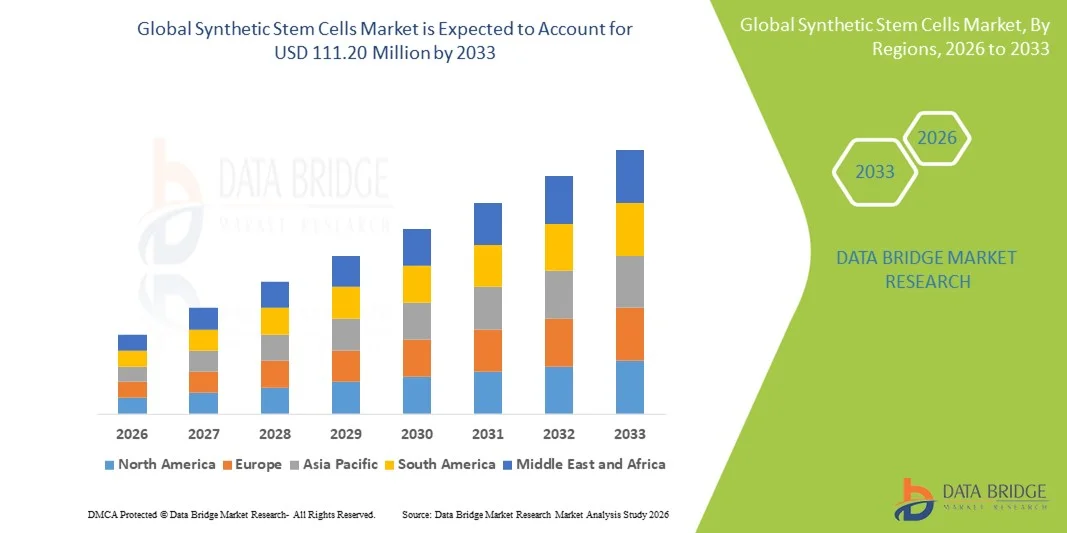
Synthetic Stem Cells Market Size
- The global synthetic stem cells market size was valued at USD 35.26 million in 2025 and is expected to reach USD 111.20 million by 2033, at a CAGR of 15.44% during the forecast period
- The market growth is largely fueled by advancements in regenerative medicine, biomaterial engineering, and biotechnology, which are driving broader adoption of synthetic stem cells as scalable, safer alternatives to traditional stem cell therapies for applications in cardiovascular, neurological, oncology, and other disease areas
- Furthermore, rising demand for cell-free therapeutic solutions, increasing research investments, and growing integration of synthetic stem cells in preclinical and drug screening models are establishing synthetic stem cells as a key enabling technology in next‑generation tissue repair, disease modeling, and personalized medicine. These converging factors are accelerating the uptake of synthetic stem cell solutions, thereby significantly boosting the industry’s growth
Synthetic Stem Cells Market Analysis
- Synthetic stem cells, designed to mimic natural stem cell functions for tissue regeneration, disease modeling, and drug testing, are increasingly vital components of regenerative medicine, biotechnology, and pharmaceutical research due to their scalability, reduced ethical concerns, and enhanced safety compared to traditional stem cells
- The escalating demand for synthetic stem cells is primarily fueled by advancements in regenerative medicine, increasing research investments, and a rising preference for safer, standardized, and cell-free therapeutic solutions in preclinical and clinical applications
- North America dominated the synthetic stem cells market with the largest revenue share of 40.2% in 2025, characterized by high R&D expenditure, early adoption of advanced biotechnologies, and a strong presence of key industry players, with the U.S. experiencing substantial growth in synthetic stem cell applications in cardiovascular and neurological research, tissue engineering, and drug screening driven by innovations from both established biotech firms and startups
- Asia-Pacific is expected to be the fastest growing region in the synthetic stem cells market during the forecast period due to increasing investments in biotechnology, rapid urbanization, expanding healthcare infrastructure, and growing adoption of synthetic stem cells in pharmaceutical, academic, and research applications
- Cardiovascular diseases segment dominated the market with a share of 44.9% in 2025, driven by the high prevalence of heart disorders, extensive research focus on cardiac tissue regeneration, and the increasing use of synthetic stem cells for preclinical drug testing and therapy development
Report Scope and Synthetic Stem Cells Market Segmentation
|
Attributes |
Synthetic Stem Cells Key Market Insights |
|
Segments Covered |
|
|
Countries Covered |
North America
Europe
Asia-Pacific
Middle East and Africa
South America
|
|
Key Market Players |
|
|
Market Opportunities |
|
|
Value Added Data Infosets |
In addition to the insights on market scenarios such as market value, growth rate, segmentation, geographical coverage, and major players, the market reports curated by the Data Bridge Market Research also include in-depth expert analysis, patient epidemiology, pipeline analysis, pricing analysis, and regulatory framework |
Synthetic Stem Cells Market Trends
Integration in Advanced Drug Screening and Disease Modeling
- A significant and accelerating trend in the global synthetic stem cells market is their increasing integration into high-throughput drug screening platforms and disease modeling systems, providing safer, reproducible, and scalable alternatives to conventional stem cells
- For instance, synthetic stem cells are being used in organ-on-chip platforms to model cardiovascular and neurological disorders, enabling precise evaluation of drug efficacy and toxicity before clinical trials
- Integration in preclinical testing allows features such as real-time monitoring of cell behavior, predictive modeling of disease progression, and more reliable identification of therapeutic targets. For instance, some companies utilize synthetic stem cells to reduce batch variability and improve reproducibility in drug discovery assays
- The seamless adoption of synthetic stem cells in academic and pharmaceutical research enables consolidated workflows for regenerative medicine, preclinical studies, and personalized therapy development, facilitating efficiency across laboratories and institutions
- This trend towards more standardized, predictive, and scalable stem cell solutions is fundamentally reshaping expectations for regenerative medicine research. Consequently, companies are developing synthetic stem cells with enhanced stability and disease-specific functionality
- The demand for synthetic stem cells integrated into drug screening and disease modeling platforms is growing rapidly across pharmaceutical, biotechnology, and academic sectors, as researchers increasingly prioritize reproducibility, safety, and translational relevance
- Emerging AI-based analytics integrated with synthetic stem cell platforms is enabling predictive modeling and optimization of therapeutic strategies, allowing researchers to identify high-potential candidates faster and more efficiently
Synthetic Stem Cells Market Dynamics
Driver
Rising Investment in Regenerative Medicine and Biotechnology
- The increasing prevalence of chronic diseases and the rising demand for regenerative therapies are significant drivers for the heightened adoption of synthetic stem cells
- For instance, in March 2025, a leading biotech firm announced funding for synthetic stem cell-based cardiovascular therapy research, highlighting growing investment in scalable and reproducible therapeutic alternatives
- As researchers and companies seek safer, ethically unencumbered alternatives to natural stem cells, synthetic stem cells offer controlled production, reduced immunogenicity, and customizable functionality
- Furthermore, the growing adoption of synthetic stem cells in drug discovery and preclinical testing is making them an integral component of modern pharmaceutical R&D, accelerating the development of new therapies
- The ability to precisely model disease conditions, perform high-throughput screening, and generate tissue-specific cell types is a key factor propelling adoption, particularly in academic and contract research organizations
- Increasing collaborations between biotech companies and hospitals or research institutions are expanding the clinical and preclinical applications of synthetic stem cells, driving market demand
- Government grants and public-private funding initiatives supporting regenerative medicine and advanced therapeutics are further encouraging investment in synthetic stem cell research and commercialization
Restraint/Challenge
High Production Costs and Regulatory Hurdles
- The challenges such as high manufacturing costs, complex synthesis protocols, and strict regulatory requirements pose significant barriers to broader market penetration
- For instance, stringent guidelines for clinical applications of synthetic stem cells in the U.S. and EU have slowed commercialization despite promising preclinical results
- Addressing these challenges through optimized production methods, scalable manufacturing technologies, and adherence to regulatory standards is crucial for market growth. For instance, companies are investing in automation and quality control systems to reduce production costs and ensure compliance
- In addition, limited awareness and adoption among small research labs and emerging biotechnology firms can restrict market expansion, as the perceived cost and technical complexity remain high
- Overcoming these challenges through cost reduction, process standardization, and regulatory guidance will be vital for sustained growth in the global synthetic stem cells market
- Intellectual property complexities and licensing issues for proprietary synthetic stem cell technologies can slow adoption, particularly for smaller companies and startups
- Supply chain challenges related to specialized raw materials and high-purity reagents can affect production consistency, posing additional barriers to large-scale commercialization
Synthetic Stem Cells Market Scope
The market is segmented on the basis of application and end user.
- By Application
On the basis of application, the synthetic stem cells market is segmented into cardiovascular diseases, neurological disorders, and other applications. The cardiovascular diseases segment dominated the market with the largest revenue share of 44.9% in 2025, driven by the high prevalence of heart-related disorders and increasing demand for regenerative therapies. Synthetic stem cells are widely used in preclinical cardiac tissue regeneration and drug testing, offering reproducible results without the ethical concerns of natural stem cells. Researchers often prefer synthetic stem cells to model myocardial infarction and heart failure, which improves predictive accuracy for therapy development. Advanced synthetic stem cell lines designed specifically for cardiac repair further support adoption in pharmaceutical and biotechnology R&D. Collaborations between hospitals, academic institutes, and biotech companies strengthen the application of synthetic stem cells in cardiovascular research. Government funding for cardiovascular disease research also accelerates market growth for this segment.
The neurological disorders segment is anticipated to witness the fastest growth from 2026 to 2034, fueled by the rising prevalence of neurodegenerative diseases such as Alzheimer’s and Parkinson’s. Synthetic stem cells are increasingly applied in neurological disease modeling and high-throughput drug screening, providing safer and scalable alternatives to primary neural stem cells. Companies are developing synthetic stem cell platforms tailored for neural differentiation, enabling researchers to study disease progression and evaluate potential neurotherapeutics effectively. Academic and research institutes are actively adopting these cells to understand neural mechanisms and develop personalized treatment solutions. Integration with organ-on-chip technology and advanced analytics further enhances their utility in predictive modeling. The growing demand for reproducible and standardized preclinical models in neurology continues to drive the rapid growth of this segment.
- By End User
On the basis of end user, the synthetic stem cells market is segmented into pharmaceutical and biotechnology companies, hospitals and surgical centers, academic institutes, research laboratories, contract research organizations, and other end users. The pharmaceutical and biotechnology companies segment dominated the market with the largest share in 2025, due to extensive R&D investments and integration of synthetic stem cells into drug discovery and preclinical testing. Companies use synthetic stem cells to model human tissues, improve reproducibility, and reduce reliance on animal models. The scalability, safety, and standardization of synthetic stem cells make them highly suitable for large-scale screening and pharmaceutical pipelines. Collaborations with hospitals and academic institutes further strengthen their application in translational research. Advanced synthetic stem cell lines enable rapid identification of therapeutic candidates, accelerating development timelines. Regulatory support for ethically compliant alternatives also reinforces this segment’s dominance.
The academic institutes, research laboratories, and contract research organizations (CROs) segment is expected to witness the fastest growth from 2026 to 2034, driven by increasing adoption of synthetic stem cells in preclinical studies, high-throughput screening, and disease modeling. Standardized and reproducible cell lines reduce experimental variability, making them ideal for research labs and CROs. CROs increasingly provide synthetic stem cell-based services to pharmaceutical clients, supporting faster and safer drug testing. Academic institutes are integrating these cells into regenerative medicine and tissue engineering programs to accelerate innovation. Automated culture platforms and AI-driven predictive models further facilitate segment growth. Rising focus on personalized medicine and predictive disease models ensures sustained adoption and rapid expansion of this end-user segment.
Synthetic Stem Cells Market Regional Analysis
- North America dominated the synthetic stem cells market with the largest revenue share of 40.2% in 2025, characterized by high R&D expenditure, early adoption of advanced biotechnologies, and a strong presence of key industry players
- Researchers and companies in the region highly value the reproducibility, scalability, and ethical advantages offered by synthetic stem cells compared to traditional stem cell sources, enabling accelerated drug discovery and tissue engineering applications
- This widespread adoption is further supported by high R&D expenditure, the presence of leading pharmaceutical and biotechnology companies, and government initiatives promoting regenerative medicine research, establishing synthetic stem cells as a preferred choice for academic, clinical, and industrial research
U.S. Synthetic Stem Cells Market Insight
The U.S. synthetic stem cells market captured the largest revenue share of 40% in 2025 within North America, fueled by significant investments in biotechnology, regenerative medicine, and preclinical research. Researchers and pharmaceutical companies increasingly prioritize synthetic stem cells for reproducible, scalable, and ethically compliant alternatives to natural stem cells. The growing adoption of synthetic stem cells in cardiovascular, neurological, and other disease modeling applications further propels the market. Moreover, collaborations between academic institutes, hospitals, and biotech firms enhance research capabilities and accelerate therapeutic innovation. Advanced synthetic stem cell lines optimized for drug screening and tissue regeneration are driving strong demand. The U.S. also benefits from supportive regulatory frameworks and government funding, reinforcing market leadership.
Europe Synthetic Stem Cells Market Insight
The Europe synthetic stem cells market is projected to expand at a substantial CAGR during the forecast period, primarily driven by increasing research funding, rising investments in regenerative medicine, and collaborations between biotech firms and academic institutes. The adoption of synthetic stem cells is supported by growing awareness of ethical and reproducible research methods. European pharmaceutical companies are leveraging these cells for drug discovery, tissue engineering, and disease modeling. The region is witnessing growth across cardiovascular, neurological, and oncology research applications, with synthetic stem cells being incorporated into both established laboratories and new research initiatives. Government initiatives promoting biotechnology innovation and clinical research further boost market expansion.
U.K. Synthetic Stem Cells Market Insight
The U.K. synthetic stem cells market is anticipated to grow at a noteworthy CAGR during the forecast period, driven by the increasing emphasis on regenerative medicine, advanced preclinical research, and ethical therapeutic alternatives. Rising investment in academic research and pharmaceutical R&D supports the adoption of synthetic stem cells for disease modeling and drug screening. In addition, collaborations between hospitals, research laboratories, and biotech firms are enhancing the translational applications of synthetic stem cells. The U.K.’s strong biotechnology ecosystem, coupled with government grants and private funding initiatives, is expected to continue stimulating market growth. Growing interest in personalized medicine also contributes to rising demand for synthetic stem cell platforms.
Germany Synthetic Stem Cells Market Insight
The Germany synthetic stem cells market is expected to expand at a considerable CAGR during the forecast period, fueled by increasing awareness of regenerative medicine, strong research infrastructure, and technological advancements. Germany’s emphasis on innovation and quality research promotes the adoption of synthetic stem cells in pharmaceutical, academic, and contract research applications. The integration of synthetic stem cells into preclinical studies for cardiovascular, neurological, and other therapeutic areas is becoming increasingly prevalent. In addition, supportive government policies and research funding programs encourage the development of advanced cell-based platforms. Growing collaborations between research institutes and biotech companies further drive the market, with a focus on reproducible, safe, and scalable synthetic stem cell solutions.
Asia-Pacific Synthetic Stem Cells Market Insight
The Asia-Pacific synthetic stem cells market is poised to grow at the fastest CAGR during the forecast period, driven by rapid investments in biotechnology, increasing healthcare infrastructure, and rising prevalence of chronic diseases. Countries such as China, Japan, and India are witnessing growing adoption of synthetic stem cells for preclinical research, drug discovery, and regenerative medicine applications. Government initiatives promoting digitalization and scientific innovation are supporting market expansion. The region’s growing academic and industrial research capabilities, combined with increasing collaborations with global pharmaceutical companies, enhance accessibility and adoption of synthetic stem cells. Furthermore, the availability of cost-effective synthetic stem cell platforms in APAC is expanding their use across research institutions and pharmaceutical companies.
Japan Synthetic Stem Cells Market Insight
The Japan synthetic stem cells market is gaining momentum due to the country’s advanced biotechnology infrastructure, emphasis on precision medicine, and increasing research investments. Japanese pharmaceutical and academic institutions are adopting synthetic stem cells for cardiovascular, neurological, and oncology research. Integration with automated culture platforms and predictive modeling tools is accelerating preclinical testing and disease modeling. Growing collaborations between research institutes and biotech firms enhance innovation and translational applications. In addition, the government’s focus on regenerative medicine and clinical research fosters market growth. Japan’s aging population also creates demand for innovative therapeutic research, further boosting the adoption of synthetic stem cells.
India Synthetic Stem Cells Market Insight
The India synthetic stem cells market accounted for the largest market revenue share in Asia-Pacific in 2025, attributed to the country’s rapidly growing biotechnology sector, expanding research infrastructure, and rising investments in regenerative medicine. India is emerging as a hub for preclinical studies and drug discovery using synthetic stem cells. Academic and research institutes, alongside pharmaceutical companies, are increasingly adopting synthetic stem cells for cardiovascular, neurological, and oncology applications. Government initiatives supporting biotech innovation and the development of smart laboratories are key factors driving market growth. In addition, collaborations with global pharmaceutical firms and CROs are expanding access to advanced synthetic stem cell platforms. Affordability, availability of trained workforce, and a focus on ethical research further contribute to the rapid adoption of synthetic stem cells in India.
Synthetic Stem Cells Market Share
The Synthetic Stem Cells industry is primarily led by well-established companies, including:
- Sana Biotechnology (U.S.)
- Cellino (U.S.)
- U.S. Stem Cell, Inc. (U.S.)
- Celularity Inc. (U.S.)
- InGeneron, Inc. (U.S.)
- Pluri Inc. (Israel)
- Athersys, Inc. (U.S.)
- BlueRock Therapeutics (U.S.)
- STEMCELL Technologies (Canada)
- SMSBiotech (U.S.)
- Hope Biosciences (U.S.)
- Lineage Cell Therapeutics (U.S.)
- Fate Therapeutics (U.S.)
- Gamida Cell Ltd. (Israel)
- Vericel Corporation (U.S.)
- BrainStorm Cell Therapeutics (U.S.)
- Caladrius Biosciences (U.S.)
- Cesca Therapeutics (U.S.)
- Vistagen Therapeutics (U.S.)
- Century Therapeutics (U.S.)
What are the Recent Developments in Global Synthetic Stem Cells Market?
- In October 2025, scientists at the University of Cambridge developed lab‑grown human embryo‑such as models that produced blood stem cells, demonstrating structures that mimicked early human development without eggs or sperm and generated cells capable of differentiating into red and white blood cells a major advance for regenerative medicine and blood‑related therapies
- In July 2025, researchers reported the creation of advanced lab‑grown mini amniotic sacs using stem cells, producing 3D structures that replicate early human amniotic sac development far beyond previous models offering new tools for studying early development and potentially informing regenerative treatments
- In June 2025, Chinese researchers successfully grew beating hearts containing human cells inside pig embryos, a pioneering step toward addressing organ shortages and advancing regenerative medicine using stem‑cell‑based chimeric growth models a breakthrough with implications for synthetic biology and tissue engineering
- In April 2025, scientists at Stanford University recreated a functional sensory brain circuit in the lab using human stem cells, combining different neuron types into a working pathway that provides a powerful model for studying neurological diseases and developing targeted therapeutics
- In August 2022, scientists created “synthetic” mouse embryos from stem cells that developed complex organs including a beating heart and brain structures, bypassing eggs and sperm a foundational advance in stem cell research that continues to influence synthetic stem cell and embryo model developments

- Interactive Data Analysis Dashboard
- Company Analysis Dashboard for high growth potential opportunities
- Research Analyst Access for customization & queries
- Competitor Analysis with Interactive dashboard
- Latest News, Updates & Trend analysis
- Harness the Power of Benchmark Analysis for Comprehensive Competitor Tracking
Data collection and base year analysis are done using data collection modules with large sample sizes. The stage includes obtaining market information or related data through various sources and strategies. It includes examining and planning all the data acquired from the past in advance. It likewise envelops the examination of information inconsistencies seen across different information sources. The market data is analysed and estimated using market statistical and coherent models. Also, market share analysis and key trend analysis are the major success factors in the market report. To know more, please request an analyst call or drop down your inquiry.
The key research methodology used by DBMR research team is data triangulation which involves data mining, analysis of the impact of data variables on the market and primary (industry expert) validation. Data models include Vendor Positioning Grid, Market Time Line Analysis, Market Overview and Guide, Company Positioning Grid, Patent Analysis, Pricing Analysis, Company Market Share Analysis, Standards of Measurement, Global versus Regional and Vendor Share Analysis. To know more about the research methodology, drop in an inquiry to speak to our industry experts.
Data Bridge Market Research is a leader in advanced formative research. We take pride in servicing our existing and new customers with data and analysis that match and suits their goal. The report can be customized to include price trend analysis of target brands understanding the market for additional countries (ask for the list of countries), clinical trial results data, literature review, refurbished market and product base analysis. Market analysis of target competitors can be analyzed from technology-based analysis to market portfolio strategies. We can add as many competitors that you require data about in the format and data style you are looking for. Our team of analysts can also provide you data in crude raw excel files pivot tables (Fact book) or can assist you in creating presentations from the data sets available in the report.













