


What is the Synthetically Modified Natural Market Size and Overview?
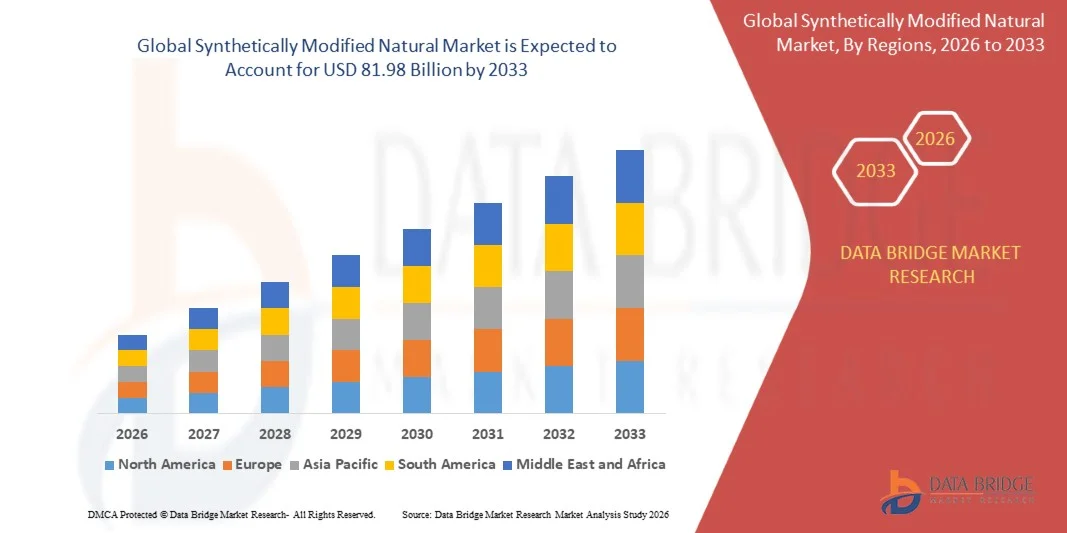
As per Data Bridge Market Research Analysis the Synthetically Modified Natural Market was valued at USD 50.67 billion in 2025 and is projected to reach USD 81.98 billion by 2033, growing at a CAGR of 6.20% from 2026 to 2033. The market is experiencing steady growth driven by rising demand for bio-based and high-performance materials, increasing consumer preference for sustainable and eco-friendly ingredients, and expanding applications across food & beverages, pharmaceuticals, cosmetics, and industrial formulations.
The growing shift toward clean-label products and environmentally responsible sourcing is encouraging manufacturers to adopt synthetically modified natural ingredients that enhance stability, functionality, and shelf life without compromising natural origin perception. In addition, advancements in biotechnology and green chemistry are enabling improved modification techniques that enhance performance characteristics such as emulsification, texture, and bioavailability across multiple end-use industries.
Key Market Trends & Insights
- North America dominated the synthetically modified natural market with the largest revenue share in 2025, supported by strong demand for clean-label products, advanced biotechnology infrastructure, high R&D investments, and widespread adoption of functional bio-modified ingredients across food and pharmaceutical sectors.
- Asia-Pacific is expected to be the fastest-growing region, recording a strong CAGR from 2026 to 2033. Growth is driven by rapid urbanization, rising disposable incomes, expanding food processing industries, and increasing demand for functional and processed food products across China, India, and Japan.
- The Starch segment held the largest market revenue share of approximately 46.2% in 2025, driven by its wide usage in food processing, pharmaceuticals, and industrial formulations due to its strong thickening, stabilizing, and biodegradable properties. Modified starches are extensively used in clean-label food products and pharmaceutical excipients, improving texture, stability, and shelf life. Growing demand for plant-based and sustainable ingredients is further strengthening segment dominance.
- The Lignin segment is projected to register the fastest growth at a CAGR of 7.4% from 2026 to 2033, driven by increasing utilization in bio-based adhesives, dispersants, and industrial resins. Rising demand for sustainable alternatives to petroleum-based chemicals and expanding applications in construction and material sciences are accelerating segment growth.
- The Carboxy Methylcellulose (CMC) segment held the largest market revenue share of approximately 59.7% in 2025, driven by its extensive use in food, pharmaceuticals, cosmetics, and oilfield applications. CMC is widely preferred due to its high viscosity control, water retention capability, and stability under varying processing conditions. Increasing demand for processed foods and pharmaceutical formulations is further supporting segment expansion.
- The Polyanionic Cellulose (PAC) segment is projected to grow at the fastest CAGR of 6.9% from 2026 to 2033, driven by rising adoption in drilling fluids and enhanced oil recovery applications. PAC offers superior filtration control and rheology modification, making it highly suitable for oil & gas exploration activities in high-pressure environments.
- The Drilling Fluid segment held the largest market revenue share of approximately 71.5% in 2025, driven by strong demand from oil & gas exploration and drilling operations. Synthetically modified natural additives are widely used in drilling fluids to improve viscosity, reduce fluid loss, and enhance borehole stability in complex geological formations.
- The Cement Slurry segment is projected to register steady growth at a CAGR of 6.3% from 2026 to 2033, driven by increasing oilfield cementing activities and the need for high-performance sealing materials in well construction. Growing offshore exploration projects and deepwater drilling activities are further supporting adoption of advanced modified natural additives in cement slurry formulations.
Market Size & Forecast
- Global Market Value (2025): USD 50.67 Billion
- Expected Market Value (2033): USD 81.98 Billion
- Forecast CAGR (2026–2033): 6.20%
- Leading Region in 2025: North America
- Fastest Growing Region: Asia-Pacific
Report Scope and Synthetically Modified Natural Market Segmentation
|
Attributes |
Synthetically Modified Natural Key Market Insights |
|
Segments Covered |
|
|
Countries Covered |
North America
Europe
Asia-Pacific
Middle East and Africa
South America
|
|
Key Market Players |
• Valero (U.S.) |
|
Market Opportunities |
|
|
Value Added Data Infosets |
In addition to the insights on market scenarios such as market value, growth rate, segmentation, geographical coverage, and major players, the market reports curated by the Data Bridge Market Research also include import export analysis, production capacity overview, production consumption analysis, price trend analysis, climate change scenario, supply chain analysis, value chain analysis, raw material/consumables overview, vendor selection criteria, PESTLE Analysis, Porter Analysis, and regulatory framework. |
What is the Key Trend in the Synthetically Modified Natural Market?
Trend: Growth In Bio-Based Modification Technologies And Functional Ingredient Innovation
Increasing demand for sustainable, high-performance, and clean-label ingredients is driving the adoption of synthetically modified natural compounds across food, pharmaceutical, cosmetic, and industrial applications. Traditional synthetic additives are being replaced due to growing health concerns, regulatory restrictions, and consumer preference for naturally derived formulations with enhanced functionality.
In modern food and beverage formulations, manufacturers are increasingly using modified natural starches, proteins, and lipids, For instance in plant-based dairy alternatives and bakery products, to improve texture, stability, and shelf life while maintaining clean-label positioning. Companies in Europe and North America are expanding enzymatic modification processes to enhance ingredient performance without altering natural origin perception.
The rapid expansion of nutraceuticals and functional foods is further accelerating demand for bio-modified natural compounds with improved bioavailability and absorption efficiency. In addition, cosmetic manufacturers are integrating synthetically modified botanical extracts into skincare formulations to enhance moisture retention and active ingredient delivery. Industry adoption of green chemistry-based modification techniques in 2025 has demonstrated up to 15–20% improvement in ingredient stability under high-temperature processing conditions.
Synthetically Modified Natural Market Dynamics
Key Market Driver: Rising Demand For Clean Label And Functional Ingredients
Consumers and industries worldwide are increasingly prioritizing transparency, sustainability, and health-focused formulations, driving strong demand for synthetically modified natural ingredients. Food processors, pharmaceutical companies, and personal care manufacturers are shifting toward bio-enhanced natural compounds that offer improved functionality without compromising natural positioning.
Food and beverage companies are actively reformulating products using modified natural ingredients, For instance in sugar reduction, fat replacement, and texture enhancement applications, to meet regulatory guidelines and consumer health expectations. Pharmaceutical firms are also adopting modified natural excipients to improve drug solubility and controlled release mechanisms.
Similarly, increasing regulatory pressure on artificial additives in regions such as Europe and North America is accelerating substitution with modified natural alternatives. Industry reports from 2024 indicate that clean-label ingredient adoption in packaged foods has increased by nearly 18–22% globally, driven by rising consumer awareness and product transparency initiatives.
Key Restraint/Challenge: High Processing Complexity And Regulatory Compliance Barriers
The production of synthetically modified natural ingredients requires advanced processing technologies, including enzymatic treatment, fermentation, and chemical modification, which increases operational complexity and production costs. Maintaining consistency in functional performance while preserving natural origin labeling also presents technical challenges for manufacturers.
In addition, stringent regulatory frameworks governing food additives, pharmaceuticals, and cosmetic ingredients create lengthy approval cycles and compliance burdens across different regions. Variations in regulatory standards between the U.S., Europe, and Asia-Pacific further complicate global commercialization strategies.
Industry assessments indicate that regulatory approval timelines for modified natural ingredients can extend up to 12–24 months in certain markets, increasing time-to-market and development costs for manufacturers, particularly for novel bio-modified formulations.
Key Market Opportunity: Expansion In Functional Foods And Sustainable Industrial Applications
The growing demand for functional foods, nutraceuticals, and sustainable industrial materials is creating significant opportunities for synthetically modified natural ingredients. Manufacturers are increasingly targeting health-conscious consumers seeking fortified foods with enhanced nutritional and functional benefits.
Companies are integrating modified natural compounds, For instance in protein enrichment, fiber fortification, and probiotic delivery systems, to improve product efficacy and consumer appeal. In the cosmetics industry, demand for bio-active modified extracts is rising due to increasing preference for natural anti-aging and skin-repair formulations.
In addition, advancements in biotechnology and precision fermentation are enabling scalable production of high-purity modified natural ingredients, opening new applications across biodegradable packaging, pharmaceuticals, and specialty chemicals. Market adoption trials in 2025 across Japan and Germany reported up to 20–25% improvement in formulation stability and performance consistency after integrating synthetically modified natural compounds in industrial and food applications.
How is the Synthetically Modified Natural Market Segmented?
The market is segmented on the basis of nature, type, and application.
• By Nature
On the basis of nature, the Synthetically Modified Natural Market is segmented into Starch, Lignin, and Bentonite. The Starch segment held the largest market revenue share of approximately 46.2% in 2025, driven by its wide usage in food processing, pharmaceuticals, and industrial formulations due to its strong thickening, stabilizing, and biodegradable properties. Modified starches are extensively used in clean-label food products and pharmaceutical excipients, improving texture, stability, and shelf life. Growing demand for plant-based and sustainable ingredients is further strengthening segment dominance.
The Lignin segment is projected to register the fastest growth at a CAGR of 7.4% from 2026 to 2033, driven by increasing utilization in bio-based adhesives, dispersants, and industrial resins. Rising demand for sustainable alternatives to petroleum-based chemicals and expanding applications in construction and material sciences are accelerating segment growth.
• By Type
On the basis of type, the market is segmented into Polyanionic Cellulose (PAC) and Carboxy Methylcellulose (CMC). The Carboxy Methylcellulose (CMC) segment held the largest market revenue share of approximately 59.7% in 2025, driven by its extensive use in food, pharmaceuticals, cosmetics, and oilfield applications. CMC is widely preferred due to its high viscosity control, water retention capability, and stability under varying processing conditions. Increasing demand for processed foods and pharmaceutical formulations is further supporting segment expansion.
The Polyanionic Cellulose (PAC) segment is projected to grow at the fastest CAGR of 6.9% from 2026 to 2033, driven by rising adoption in drilling fluids and enhanced oil recovery applications. PAC offers superior filtration control and rheology modification, making it highly suitable for oil & gas exploration activities in high-pressure environments.
• By Application
On the basis of application, the market is segmented into Drilling Fluid and Cement Slurry. The Drilling Fluid segment held the largest market revenue share of approximately 71.5% in 2025, driven by strong demand from oil & gas exploration and drilling operations. Synthetically modified natural additives are widely used in drilling fluids to improve viscosity, reduce fluid loss, and enhance borehole stability in complex geological formations.
The Cement Slurry segment is projected to register steady growth at a CAGR of 6.3% from 2026 to 2033, driven by increasing oilfield cementing activities and the need for high-performance sealing materials in well construction. Growing offshore exploration projects and deepwater drilling activities are further supporting adoption of advanced modified natural additives in cement slurry formulations.
Which Region Holds the Largest Share of the Synthetically Modified Natural Market?
North America Synthetically Modified Natural Market Insight
North America dominated the synthetically modified natural market with the largest revenue share of approximately 38.6% in 2025, supported by strong demand for clean-label ingredients, advanced food processing industries, and increasing adoption of bio-based functional materials across pharmaceuticals and personal care applications. Consumers in the region are highly focused on product transparency, sustainability, and health-oriented formulations, driving manufacturers to adopt modified natural ingredients with improved functionality. This widespread adoption is further supported by high R&D investments, advanced biotechnology infrastructure, and strong presence of leading ingredient manufacturers, establishing synthetically modified natural compounds as a key component in modern formulation development.
U.S. Synthetically Modified Natural Market Insight
The U.S. synthetically modified natural market captured the largest revenue share in 2025 within North America, fueled by rapid expansion of clean-label food products, functional beverages, and nutraceutical formulations. Consumers are increasingly prioritizing minimally processed ingredients with enhanced performance such as improved texture, stability, and bioavailability. The growing demand for plant-based diets and protein alternatives is further accelerating adoption of modified starches, cellulose derivatives, and bio-enhanced natural compounds. In addition, strong integration of biotechnology innovations and food innovation startups is significantly contributing to market expansion across the country.
Europe Synthetically Modified Natural Market Insight
The Europe synthetically modified natural market is expected to witness the fastest growth rate from 2026 to 2033, primarily driven by stringent food safety regulations, rising demand for sustainable ingredients, and strong consumer preference for clean-label products. The region is experiencing increasing substitution of artificial additives with bio-modified natural ingredients across food, cosmetics, and pharmaceutical industries. European manufacturers are also investing heavily in green chemistry and enzymatic modification techniques to improve ingredient performance while meeting strict regulatory standards. In addition, growing awareness regarding environmental sustainability is further accelerating adoption across multiple end-use sectors.
U.K. Synthetically Modified Natural Market Insight
The U.K. synthetically modified natural market is expected to witness steady growth from 2026 to 2033, driven by increasing consumer preference for natural and functional food ingredients and rising demand for premium clean-label products. Growing health consciousness and concerns over artificial additives are encouraging food and beverage manufacturers to adopt modified natural formulations. The country’s strong retail infrastructure and expanding e-commerce grocery sector are further supporting market penetration. In addition, increasing innovation in plant-based and fortified food products is driving broader adoption across the food processing industry.
Germany Synthetically Modified Natural Market Insight
The Germany synthetically modified natural market is expected to witness strong growth from 2026 to 2033, fueled by increasing demand for sustainable industrial materials and high-quality functional ingredients. Germany’s strong emphasis on environmental responsibility and chemical safety is driving the adoption of bio-based modified compounds across food, pharmaceutical, and cosmetic applications. Manufacturers are increasingly focusing on enzyme-based modification technologies to improve ingredient efficiency and reduce environmental impact. In addition, strong industrial R&D capabilities and advanced manufacturing infrastructure are supporting continued market expansion.
Asia-Pacific Synthetically Modified Natural Market Insight
The Asia-Pacific synthetically modified natural market is expected to witness the fastest growth rate from 2026 to 2033, supported by rising population, rapid urbanization, and increasing demand for processed and functional foods in countries such as China, Japan, and India. The region is experiencing strong growth in food processing, nutraceuticals, and personal care industries, driving adoption of modified natural ingredients. Government initiatives promoting food safety and industrial modernization are further supporting market expansion. In addition, Asia-Pacific is emerging as a key manufacturing hub for bio-based ingredients, improving affordability and accessibility across global supply chains.
Japan Synthetically Modified Natural Market Insight
The Japan synthetically modified natural market is expected to witness steady growth from 2026 to 2033 due to high consumer preference for functional foods, advanced food technology adoption, and strong demand for health-oriented ingredients. The Japanese market places significant emphasis on product quality, safety, and innovation, encouraging the use of modified natural compounds in food, cosmetics, and pharmaceuticals. Increasing aging population is also driving demand for nutraceuticals and easily digestible functional foods. In addition, strong R&D capabilities in biotechnology are supporting continuous innovation in ingredient modification techniques.
China Synthetically Modified Natural Market Insight
The China synthetically modified natural market accounted for the largest revenue share in Asia-Pacific in 2025, attributed to rapid industrialization, expanding food processing sector, and strong growth in consumer demand for packaged and functional foods. China is one of the largest markets for food additives and functional ingredients, with increasing adoption of modified starches, cellulose derivatives, and bio-based additives in multiple industries. Government support for food safety standards and domestic production capabilities is further strengthening market growth. In addition, rising middle-class population and urbanization are significantly contributing to demand expansion across food, pharmaceutical, and cosmetic applications.
Which are the Top Companies in Synthetically Modified Natural Market?
The Synthetically Modified Natural industry is primarily led by well-established companies, including:
- Valero (U.S.)
- NuStar Energy L.P (U.S.)
- Suncor Energy Inc, (Canada)
- Athabasca Oil Corporation (Canada)
- Imperial Oil Limited (Canada)
- Syncrude Canada Ltd. (Canada)
- Indian Oil Corporation Ltd (India)
- ENEOS Corporation (Japan)
- ExxonMobil Coroporation (U.S.)
- Shell Bitumen (U.K.)
- Petróleos Mexicanos (Mexico)
- Nynas AB (Sweden)
- Marathon Oil Company (U.S.)
- Bp p.l.c (U.K.)
- Royal Dutch Shell plc (U.K.)
- Total Energy (France)
- Sinopec Corporation (China)
- Chevron Corporation (U.S.)
- Bouygues Groups (France)
- Villas Austria GmbH (Austria)
- Gazprom- Neft (Russia)

- Interactive Data Analysis Dashboard
- Company Analysis Dashboard for high growth potential opportunities
- Research Analyst Access for customization & queries
- Competitor Analysis with Interactive dashboard
- Latest News, Updates & Trend analysis
- Harness the Power of Benchmark Analysis for Comprehensive Competitor Tracking
Global Synthetically Modified Natural Market, Supply Chain Analysis and Ecosystem Framework
To support market growth and help clients navigate the impact of geopolitical shifts, DBMR has integrated in-depth supply chain analysis into its Global Synthetically Modified Natural Market research reports. This addition empowers clients to respond effectively to global changes affecting their industries. The supply chain analysis section includes detailed insights such as Global Synthetically Modified Natural Market consumption and production by country, price trend analysis, the impact of tariffs and geopolitical developments, and import and export trends by country and HSN code. It also highlights major suppliers with data on production capacity and company profiles, as well as key importers and exporters. In addition to research, DBMR offers specialized supply chain consulting services backed by over a decade of experience, providing solutions like supplier discovery, supplier risk assessment, price trend analysis, impact evaluation of inflation and trade route changes, and comprehensive market trend analysis.
Data collection and base year analysis are done using data collection modules with large sample sizes. The stage includes obtaining market information or related data through various sources and strategies. It includes examining and planning all the data acquired from the past in advance. It likewise envelops the examination of information inconsistencies seen across different information sources. The market data is analysed and estimated using market statistical and coherent models. Also, market share analysis and key trend analysis are the major success factors in the market report. To know more, please request an analyst call or drop down your inquiry.
The key research methodology used by DBMR research team is data triangulation which involves data mining, analysis of the impact of data variables on the market and primary (industry expert) validation. Data models include Vendor Positioning Grid, Market Time Line Analysis, Market Overview and Guide, Company Positioning Grid, Patent Analysis, Pricing Analysis, Company Market Share Analysis, Standards of Measurement, Global versus Regional and Vendor Share Analysis. To know more about the research methodology, drop in an inquiry to speak to our industry experts.
Data Bridge Market Research is a leader in advanced formative research. We take pride in servicing our existing and new customers with data and analysis that match and suits their goal. The report can be customized to include price trend analysis of target brands understanding the market for additional countries (ask for the list of countries), clinical trial results data, literature review, refurbished market and product base analysis. Market analysis of target competitors can be analyzed from technology-based analysis to market portfolio strategies. We can add as many competitors that you require data about in the format and data style you are looking for. Our team of analysts can also provide you data in crude raw excel files pivot tables (Fact book) or can assist you in creating presentations from the data sets available in the report.













