


What is the System Infrastructure Software Market Size and Growth Rate?
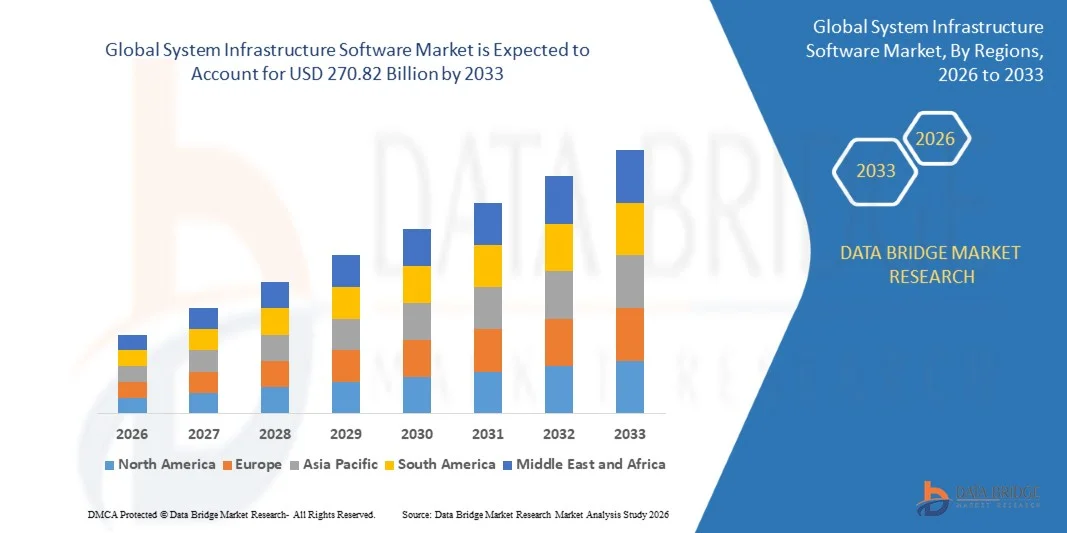
- As per Data Bridge Market Research analysis, the system infrastructure software market was valued at USD 172.50 billion in 2025 and is projected to reach USD 270.82 billion by 2033, growing at a CAGR of 5.80% from 2026 to 2033.
- The market is experiencing steady growth driven by the rapid expansion of hybrid and multi-cloud IT environments, rising enterprise investment in automation and AI-enabled operations, and the increasing modernization of legacy data center infrastructure across industries.
- The rising frequency of cyberattacks, combined with growing regulatory emphasis on data protection and operational resilience, is compelling enterprises across IT & telecom, BFSI, healthcare, and manufacturing sectors to adopt integrated infrastructure software that unifies storage, network, and security management. Network & system management and cloud integration platforms are increasingly replacing siloed, single-purpose IT tools, offering centralized, cost-effective, and scalable environments for enterprise infrastructure management.
Market Size & Forecast
- Global Market Value (2025): USD 172.50 Billion
- Expected Market Value (2033): USD 270.82 Billion
- Forecast CAGR (2026–2033): 5.80%
- Leading Region in 2025: North America
- Fastest Growing Region: Asia-Pacific
What are the Major Takeaways of the System Infrastructure Software Market?
- North America dominated the global system infrastructure software market with the largest revenue share of 36.75% in 2025, supported by the presence of leading technology vendors, extensive hyperscale data center infrastructure, and high enterprise spending on cloud, security, and automation platforms.
- Asia-Pacific is expected to be the fastest-growing region at a CAGR of 7.90% from 2026 to 2033, fueled by rapid digital transformation, expanding data center investments, and growing enterprise cloud adoption across China, India, and Japan.
- The network & system management segment led the market with a 44.30% share in 2025, driven by widespread enterprise reliance on centralized platforms for provisioning, monitoring, and orchestrating servers, networks, and virtualized resources.
- The security segment is the fastest-growing type category, projected to register a CAGR of 7.60%, reflecting rising cyber threats and growing enterprise investment in integrated identity, access, and threat management software.
- The data center infrastructure segment dominated the application category with a 33.80% revenue share in 2025, led by rising investments in hyperscale and colocation data centers requiring centralized power, cooling, and compute management software.
- Cloud integrations is the fastest-growing application segment, with a CAGR of 8.20%, driven by increasing enterprise adoption of hybrid and multi-cloud strategies requiring seamless interoperability between on-premises and public cloud platforms.
- The IT & telecom segment dominated the end use category with a share of 27.90% in 2025, owing to the sector's extensive reliance on data centers, network operations centers, and cloud service infrastructure requiring continuous monitoring and management.
Report Scope and System Infrastructure Software Market Segmentation
|
Attributes |
System Infrastructure Software Key Market Insights |
|
Segments Covered |
|
|
Countries Covered |
North America
Europe
Asia-Pacific
Middle East and Africa
South America
|
|
Key Market Players |
|
|
Market Opportunities |
|
|
Value Added Data Infosets |
In addition to the insights on market scenarios such as market value, growth rate, segmentation, geographical coverage, and major players, the market reports curated by the Data Bridge Market Research also include in-depth expert analysis, geographically represented company-wise production and capacity, network layouts of distributors and partners, detailed and updated price trend analysis and deficit analysis of supply chain and demand. |
What is the Key Trend in the System Infrastructure Software Market?
- Enterprises are increasingly integrating artificial intelligence and machine learning into infrastructure management platforms to enable predictive monitoring, automated resource allocation, and self-healing systems, reducing downtime and improving operational efficiency across hybrid IT environments.
- For instance, in October 2024, Cisco Systems introduced new AI-focused infrastructure solutions, including AI-optimized server families and AI PODs, designed to simplify the deployment of GPU-intensive workloads for enterprises adopting AI-driven infrastructure management.
- Growing adoption of hyperconverged infrastructure (HCI) and software-defined data centers is enabling organizations to consolidate compute, storage, and networking resources under a single unified management layer, reducing capital expenditure and simplifying IT operations.
- For instance, in November 2024, Microsoft made Windows Server 2025 generally available alongside Microsoft System Center 2025, extending Azure-based governance, security, and monitoring capabilities to on-premises server estates.
- As enterprises continue to modernize legacy IT environments and prioritize automation, the adoption of AI-enabled, software-defined infrastructure platforms is expected to accelerate, reinforcing infrastructure software as a foundational layer of digital transformation strategies.
What are the Key Drivers of the System Infrastructure Software Market?
- The rapid expansion of hybrid and multi-cloud environments is driving demand for infrastructure software capable of unifying management, security, and orchestration across on-premises and public cloud workloads.
- For instance, in August 2024, Broadcom unveiled VMware Cloud Foundation 9 at VMware Explore 2024, a private cloud platform designed to simplify the deployment, security, and operations of unified infrastructure across data center and edge environments.
- Increasing frequency of cyberattacks and stringent data protection regulations are compelling enterprises to invest in integrated security and system management software to safeguard critical IT infrastructure.
- For instance, in March 2025, IBM introduced IBM Storage Ceph as a Service, expanding its as-a-service infrastructure portfolio to help enterprises modernize storage operations while enhancing scalability and data protection across hybrid environments.
- With enterprises accelerating digital transformation and cloud-native adoption, demand for centralized, automated, and secure infrastructure software platforms is expected to remain a critical growth driver for the market.
Which Factors are Challenging the Growth of the System Infrastructure Software Market?
- High implementation and licensing costs associated with comprehensive infrastructure software suites, along with the complexity of integrating new platforms with legacy IT systems, continue to limit adoption among small and mid-sized enterprises.
- For instance, following its shift toward subscription-based software bundles, enterprise customers migrating from perpetual VMware licenses have reported notable increases in total cost of ownership, slowing infrastructure modernization timelines for cost-sensitive organizations.
- The shortage of skilled IT professionals capable of managing complex, multi-vendor infrastructure environments, combined with a widening cybersecurity talent gap, is restricting the pace of infrastructure software deployment, particularly among smaller organizations and in emerging markets.
How is the System Infrastructure Software Market Segmented?
The system infrastructure software market is segmented on the basis of type, application, and end use.
- By Type
On the basis of type, the global system infrastructure software market is segmented into storage, network & system management, and security. The network & system management segment dominated the market with a share of 44.30% in 2025, owing to widespread enterprise reliance on centralized platforms for provisioning, monitoring, and orchestrating servers, networks, and virtualized resources across increasingly complex hybrid IT environments. Growing adoption of automation and AI-enabled IT operations (AIOps) tools is further reinforcing demand for this segment.
The security segment is projected to register the fastest growth at a CAGR of 7.60% from 2026 to 2033, driven by the rising frequency of cyberattacks, growing regulatory emphasis on data protection, and increasing enterprise investment in identity, access, and threat management software integrated directly into infrastructure platforms.
- By Application
On the basis of application, the global system infrastructure software market is segmented into building management, integrated communication, data center infrastructure, and cloud integrations. The data center infrastructure segment dominated the market with a share of 33.80% in 2025, attributed to rising investments in hyperscale and colocation data centers, growing demand for workload consolidation, and the need for centralized software to manage power, cooling, and compute resources efficiently.
The cloud integrations segment is expected to witness the fastest CAGR of 8.20% from 2026 to 2033, driven by increasing enterprise adoption of hybrid and multi-cloud strategies that require seamless interoperability between on-premises systems and public cloud platforms.
- By End Use
On the basis of end use, the global system infrastructure software market is segmented into IT & telecom, BFSI, retail, healthcare, manufacturing, transportation & logistics, and others. The IT & telecom segment dominated the market with a share of 27.90% in 2025, due to the sector's extensive reliance on data centers, network operations centers, and cloud service infrastructure that require continuous monitoring, orchestration, and security management.
The BFSI segment is anticipated to witness the fastest CAGR of 7.70% from 2026 to 2033, driven by increasing digitization of banking and financial services, stringent regulatory compliance requirements, and rising investment in secure, resilient infrastructure to support real-time transaction processing and fraud prevention.
Which Region Holds the Largest Share of the System Infrastructure Software Market?
- North America dominated the system infrastructure software market and accounted for the largest revenue share of 36.75% in 2025, supported by the presence of leading technology vendors, extensive hyperscale data center infrastructure, and high enterprise spending on cloud, security, and automation platforms.
- The region also benefits from early adoption of AI-enabled infrastructure management tools, robust cybersecurity investment, and a mature regulatory environment that continues to support demand for advanced system infrastructure software across industries such as IT & telecom, BFSI, and healthcare.
U.S. System Infrastructure Software Market Insight
The U.S. system infrastructure software market continues to lead global adoption, supported by the concentration of major technology vendors, extensive hyperscale and colocation data center capacity, and high enterprise spending on cloud, cybersecurity, and automation platforms. Rising investments in AI-enabled infrastructure management and continued modernization of legacy IT environments across BFSI, healthcare, and manufacturing sectors are further reinforcing market growth.
Canada System Infrastructure Software Market Insight
The Canada system infrastructure software market is growing steadily, driven by increasing enterprise cloud migration, rising government investment in digital infrastructure, and growing adoption of unified network and security management platforms among mid-sized and large enterprises. Expanding data center capacity and strong regulatory focus on data sovereignty are further supporting market expansion.
Asia-Pacific System Infrastructure Software Market Insight
The Asia-Pacific system infrastructure software market is expected to witness rapid growth, driven by expanding data center investments, rising enterprise cloud adoption, and increasing digitization initiatives across countries such as China, India, and Japan. Growing government focus on digital infrastructure modernization and rising demand for cost-effective, scalable IT management platforms are supporting regional market expansion.
India System Infrastructure Software Market Insight
The India system infrastructure software market is expanding rapidly, supported by large-scale digital transformation initiatives, growing hyperscale data center investments, and rising enterprise adoption of hybrid cloud and cybersecurity platforms. Increasing government emphasis on data localization and digital infrastructure development is further accelerating demand for system infrastructure software across BFSI, IT & telecom, and manufacturing sectors.
China System Infrastructure Software Market Insight
The China system infrastructure software market is growing steadily, driven by extensive investments in data center infrastructure, rising enterprise cloud adoption, and increasing government focus on digital economic development. Growing adoption of AI-enabled network and security management platforms across manufacturing, retail, and telecom sectors is significantly boosting market demand.
Which are the Top Companies in System Infrastructure Software Market?
The system infrastructure software industry is primarily led by well-established companies, including:
- Microsoft Corporation (U.S.)
- IBM (U.S.)
- Oracle Corporation (U.S.)
- Broadcom Inc. (U.S.)
- Cisco Systems, Inc. (U.S.)
- Amazon Web Services, Inc. (U.S.)
- Dell Technologies Inc. (U.S.)
- Hewlett Packard Enterprise (U.S.)
- VMware, Inc. (U.S.)
- Red Hat, Inc. (U.S.)
- BMC Software, Inc. (U.S.)
- ServiceNow, Inc. (U.S.)
- SolarWinds Corporation (U.S.)
- Nutanix, Inc. (U.S.)
- Citrix Systems, Inc. (U.S.)
- Splunk Inc. (U.S.)
- Palo Alto Networks, Inc. (U.S.)
- Fortinet, Inc. (U.S.)
- Check Point Software Technologies Ltd. (Israel)
- Trend Micro Incorporated (Japan)
- TIBCO Software Inc. (U.S.)
- NetApp, Inc. (U.S.)
- Schneider Electric SE (France)
- Honeywell International Inc. (U.S.)
- Johnson Controls International plc (Ireland)
- Siemens AG (Germany)
- Vertiv Holdings Co. (U.S.)
- ManageEngine (Zoho Corporation) (India)
- Micro Focus International plc (U.K.)
What are Latest Developments in System Infrastructure Software Market?
- In March 2025, IBM introduced IBM Storage Ceph as a Service, a fully managed, software-defined storage offering that unifies block, file, and object data, expanding IBM's as-a-service infrastructure portfolio and enabling enterprises to modernize on-premises storage operations with cloud-like scalability, flexibility, and cost efficiency.
- In December 2024, Schneider Electric introduced EcoStruxure Building Activate, an energy management and automation platform for small and mid-size buildings, enabling remote monitoring, control, and optimization of building systems without requiring an on-site facilities manager, strengthening the company's building management software portfolio.
- In November 2024, Microsoft made Windows Server 2025 generally available alongside Microsoft System Center 2025, introducing enhanced Active Directory security, storage, and hybrid cloud management capabilities that extend Azure governance and monitoring tools to on-premises server environments.
- In October 2024, Cisco Systems introduced new AI-focused infrastructure solutions, including AI-optimized server families and AI PODs designed to simplify enterprise deployment of GPU-intensive workloads, reinforcing Cisco's position in AI-ready network and system management infrastructure.
- In August 2024, Broadcom unveiled VMware Cloud Foundation 9 at VMware Explore 2024, a private cloud platform designed to simplify the deployment, consumption, and operations of secure, cost-effective private cloud infrastructure spanning data centers and edge environments.

- Interactive Data Analysis Dashboard
- Company Analysis Dashboard for high growth potential opportunities
- Research Analyst Access for customization & queries
- Competitor Analysis with Interactive dashboard
- Latest News, Updates & Trend analysis
- Harness the Power of Benchmark Analysis for Comprehensive Competitor Tracking
Data collection and base year analysis are done using data collection modules with large sample sizes. The stage includes obtaining market information or related data through various sources and strategies. It includes examining and planning all the data acquired from the past in advance. It likewise envelops the examination of information inconsistencies seen across different information sources. The market data is analysed and estimated using market statistical and coherent models. Also, market share analysis and key trend analysis are the major success factors in the market report. To know more, please request an analyst call or drop down your inquiry.
The key research methodology used by DBMR research team is data triangulation which involves data mining, analysis of the impact of data variables on the market and primary (industry expert) validation. Data models include Vendor Positioning Grid, Market Time Line Analysis, Market Overview and Guide, Company Positioning Grid, Patent Analysis, Pricing Analysis, Company Market Share Analysis, Standards of Measurement, Global versus Regional and Vendor Share Analysis. To know more about the research methodology, drop in an inquiry to speak to our industry experts.
Data Bridge Market Research is a leader in advanced formative research. We take pride in servicing our existing and new customers with data and analysis that match and suits their goal. The report can be customized to include price trend analysis of target brands understanding the market for additional countries (ask for the list of countries), clinical trial results data, literature review, refurbished market and product base analysis. Market analysis of target competitors can be analyzed from technology-based analysis to market portfolio strategies. We can add as many competitors that you require data about in the format and data style you are looking for. Our team of analysts can also provide you data in crude raw excel files pivot tables (Fact book) or can assist you in creating presentations from the data sets available in the report.













