


What is the Table Butter Market Size and Growth Rate?
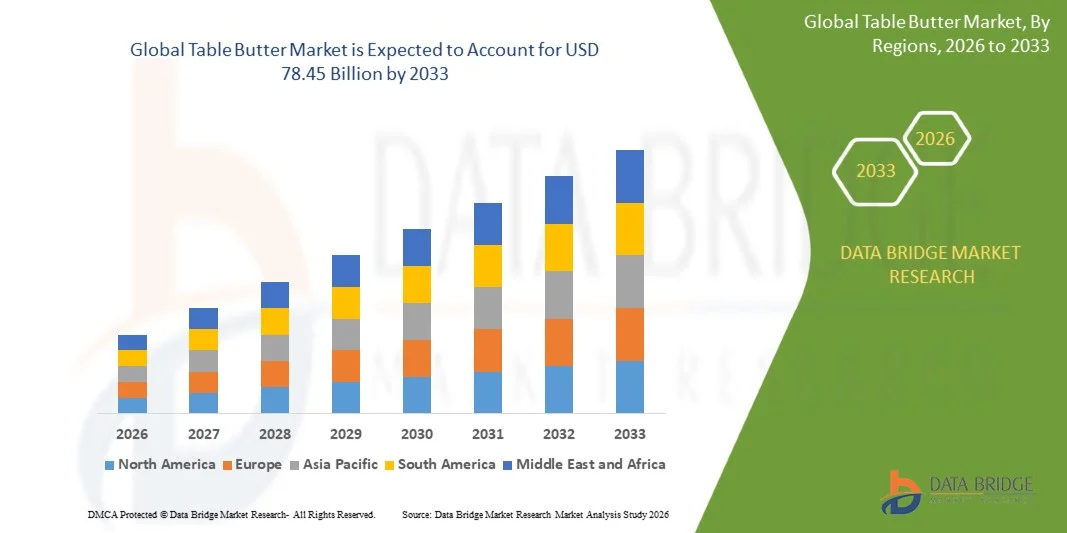
- As per Data Bridge Market Research analysis, the table butter market was valued at USD 54.96 billion in 2025 and is projected to reach USD 78.45 billion by 2033, growing at a CAGR of 4.55% from 2026 to 2033.
- The market is experiencing consistent growth driven by rising consumer demand for premium and natural dairy products, increasing consumption of butter in households and foodservice applications, and growing preference for clean-label and minimally processed butter products.
- The expanding bakery and confectionery industry, combined with rising disposable incomes and changing dietary preferences, is encouraging manufacturers, retailers, and foodservice operators to adopt and offer a wider range of table butter products. Conventional and specialty butter varieties are gaining traction across developed and emerging markets, supported by premiumization, product innovation, and growing demand for convenient and high-quality dairy products.
Market Size & Forecast
- Global Market Value (2025): USD 54.96 Billion
- Expected Market Value (2033): USD 78.45 Billion
- Forecast CAGR (2026–2033): 4.55%
- Leading Region in 2025: North America
- Fastest Growing Region: Asia Pacific
What are the Major Takeaways of the Table Butter Market?
- North America dominated the table butter market with the largest revenue share of 35.7% in 2025, supported by high butter consumption, established dairy processing infrastructure, and strong demand across household and foodservice applications.
- Asia-Pacific is expected to be the fastest-growing region at a CAGR of 4.5% from 2026 to 2033, fueled by rising disposable incomes, expanding dairy consumption, changing dietary preferences, and growing demand in China, India, and Japan.
- The conventional segment led the market with a 70% share in 2025, driven by its broad availability, established dairy-processing infrastructure, competitive pricing, and strong consumer familiarity
- Organic are the fastest-growing nature type, projected to register a CAGR of 5.6%, reflecting the surge in consumer preference for natural, clean-label, and sustainably produced dairy products.
- The salted butter segment dominated the product category with a 60% revenue share in 2025, led by its widespread consumption, distinctive taste, longer shelf life, and extensive availability through retail and foodservice channels.
- Regular accounted for 80% of the market share in 2025, preferred by its widespread household consumption, familiar taste, and broad applicability across cooking and baking.
- The spreadable segment is the fastest-growing format category, with a CAGR of 5.5%, driven by increasing demand for convenient and ready-to-use dairy spreads.
Report Scope and Table Butter Market Segmentation
|
Attributes |
Table Butter Key Market Insights |
|
Segments Covered |
|
|
Countries Covered |
North America
Europe
Asia-Pacific
Middle East and Africa
South America
|
|
Key Market Players |
|
|
Market Opportunities |
|
|
Value Added Data Infosets |
In addition to the insights on market scenarios such as market value, growth rate, segmentation, geographical coverage, and major players, the market reports curated by the Data Bridge Market Research also include in-depth expert analysis, pricing analysis, brand share analysis, consumer survey, demography analysis, supply chain analysis, value chain analysis, raw material/consumables overview, vendor selection criteria, PESTLE Analysis, Porter Analysis, and regulatory framework. |
What is the Key Trend in the Table Butter Market?
- Consumers are increasingly shifting toward premium, natural, organic, and specialty butter products, with clean-label positioning, distinctive flavrs, and higher-quality dairy ingredients becoming important purchase factors.
- For instance, in January 2026, Lifeway Foods announced the launch of Probiotic Kefir Butter, a hand-churned European-style cultured butter in Unsalted, Sea Salt, and Honey Butter varieties, demonstrating growing innovation toward premium and specialty cultured butter products
- Manufacturers are responding through organic certification, transparent sourcing, specialty formulations, and fortified butter varieties designed to address changing consumer preferences for natural and higher-value dairy products.
- Flavored and specialty butter is gaining traction as consumers increasingly use butter for gourmet cooking, baking, spreading, and culinary experimentation, creating opportunities for differentiated premium products.
- For instance, in June 2026, Organic Valley introduced Organic Butter with Olive Oil, combining organic butter with organic olive oil to create a spreadable premium product, reflecting consumer demand for organic, convenient, and differentiated butter formats.
- As consumers increasingly prioritize quality, natural ingredients, product differentiation, and premium culinary experiences, manufacturers are expected to expand organic, specialty, flavored, and artisanal butter offerings, reinforcing premiumization as a key trend shaping the table butter market.
What are the Key Drivers of the Table Butter Market?
- The growing consumption of butter across households, bakeries, restaurants, cafés, and packaged foods is significantly increasing demand for table butter as consumers seek versatile dairy ingredients for cooking, spreading, baking, and food preparation.
- For instance, in October 2025, Fonterra announced approximately USD 43 million investment to expand butter production at its Clandeboye facility in New Zealand, increasing capacity by up to 50,000 metric tonnes annually and supporting growing demand for high-value dairy products.
- Rising urbanization and disposable incomes are encouraging consumers to spend more on premium and high-quality dairy products, while changing dietary preferences and the influence of Western food culture are expanding butter consumption across emerging markets.
- The expansion of modern retail, supermarkets, and e-commerce platforms is improving product availability and enabling manufacturers to reach consumers with salted, unsalted, organic, flavored, and specialty butter varieties.
- For instance, in September 2025, Hatsun Agro Products reported that India’s reduction in consumption taxes on butter and other dairy products was expected to benefit the dairy industry, while the company targeted about 15% revenue growth and continued expanding its retail network, highlighting how improved affordability and distribution can stimulate dairy-product demand.
- The increasing adoption of butter in bakery products, ready-to-eat meals, sauces, pasta, noodles, and spreads is further broadening its application base and supporting sustained consumption across both retail and foodservice channels.
Which Factors are Challenging the Growth of the Table Butter Market?
- Fluctuations in milk, cream, and milk-fat prices create significant cost pressures for butter manufacturers because raw-material expenses directly influence production costs, wholesale pricing, and consumer prices.
- For instance, in October 2024, European butter prices reached a record USD 8,706 per metric ton, up 83% year over year, as tight milk supplies, low butter stocks, strong demand, and dairy processors prioritizing cheese production increased raw-material and production costs.
- Volatility in dairy supply can also affect manufacturers' ability to maintain stable margins and consistent product pricing, particularly when milk-fat availability changes across major producing regions.
- Competition from margarine, plant-based spreads, and other butter substitutes further challenges table butter manufacturers as health-conscious and price-sensitive consumers increasingly evaluate alternatives with different nutritional and sustainability profiles.
- For instance, in August 2025, Arla Foods reported that sales of its Lurpak butter and other branded products declined 1.5% year over year, with high commodity prices and geopolitical uncertainty weakening consumer sentiment and putting pressure on branded dairy-product demand
- Environmental concerns associated with dairy production and changing consumer perceptions regarding saturated-fat consumption can also influence purchasing behavior and encourage demand for alternative spreads.
How is the Table Butter Market Segmented?
The table butter market is segmented on the basis of nature, product, flavour, format, end-use, and distribution channel.
- By Nature
On the basis of nature, the table butter market is segmented into organic and conventional. The conventional segment dominated the market with an estimated share of 70% in 2025, owing to its broad availability, established dairy-processing infrastructure, competitive pricing, and strong consumer familiarity. Conventional butter is extensively consumed across households, restaurants, bakeries, and food-processing facilities. Its lower production cost compared with organic butter makes it accessible to a wider consumer base. Large-scale dairy manufacturers and established cold-chain networks also support its widespread distribution. Conventional products remain particularly important in price-sensitive emerging markets where affordability influences purchasing decisions.
The organic segment is projected to register the fastest growth at an estimated CAGR of 5.6% from 2026 to 2033, supported by rising consumer preference for natural, clean-label, and sustainably produced dairy products. Organic butter is increasingly positioned as a premium product among health-conscious consumers. Growing awareness of sustainable farming, animal welfare, and ingredient transparency is supporting demand. Premium retailers and e-commerce platforms are also expanding their organic dairy selections. Manufacturers are introducing certified organic and grass-fed butter products to capture higher-value consumers. Increasing willingness to pay for differentiated dairy products is expected to support the segment's faster growth.
- By Product
On the basis of product, the table butter market is segmented into salted butter, unsalted butter, cultured butter, sweet cream butter, and clarified butter. The salted butter segment dominated the market with an estimated share of 60% in 2025, driven by its widespread consumption, distinctive taste, longer shelf life, and extensive availability through retail and foodservice channels. Salted butter is extensively used for spreading, cooking, baking, sauces, and prepared foods. Its familiar taste makes it a preferred product among household consumers. Foodservice operators also widely use salted butter because of its versatility and flavor profile. Broad retail availability and competitive pricing further strengthen its market position. These factors continue to make salted butter the leading product segment.
The cultured butter segment is projected to register the fastest growth at a CAGR of 5.7% from 2026 to 2033, reflecting increasing demand for premium, artisanal, and traditionally processed butter products. Cultured butter is produced using fermented cream, providing a richer and tangier flavor profile. Growing consumer interest in European-style and specialty dairy products is supporting adoption. Premium restaurants, bakeries, specialty retailers, and gourmet consumers represent important growth opportunities. Manufacturers are also introducing grass-fed and specialty cultured butter products to strengthen premium positioning. Rising consumer willingness to pay for distinctive flavors and higher-quality dairy products is expected to accelerate segment expansion.
- By Flavour
On the basis of flavour, the table butter market is segmented into regular and flavoured. The regular segment dominated the market with an estimated share of 80% in 2025, supported by its widespread household consumption, familiar taste, and broad applicability across cooking and baking. Regular butter remains the standard choice for everyday use because it can be incorporated into a wide range of recipes. It is extensively distributed through supermarkets, convenience stores, and other mass-market retail outlets. Large dairy manufacturers maintain strong production capacity for conventional regular butter. Its affordability and availability across multiple pack sizes further support demand.
The flavoured segment is projected to witness the fastest growth at a CAGR of 6% from 2026 to 2033, driven by growing consumer interest in differentiated and premium culinary products. Flavoured butter varieties include garlic, herb, honey, spice, and other specialty formulations. These products are increasingly used in restaurants, cafés, bakeries, and gourmet home cooking. Manufacturers are developing innovative flavour combinations to differentiate their portfolios and support premium pricing. Growing interest in cooking experimentation and gourmet food experiences is further encouraging adoption. Specialty stores and online retail platforms are also improving access to niche flavoured products. This combination of premiumization and product innovation is expected to support rapid segment growth.
- By Format
On the basis of format, the table butter market is segmented into spreadable and non-spreadable. The non-spreadable segment dominated the market with an estimated share of 65% in 2025, supported by extensive use of blocks and sticks in household cooking, baking, foodservice, and food processing. Solid butter formats are particularly suitable for accurate measurement and recipe preparation. Commercial bakeries and food manufacturers widely use non-spreadable butter because it provides consistent handling and portion control. Established packaging and cold-chain infrastructure also supports widespread distribution. These formats are available across supermarkets, grocery stores, and foodservice suppliers. Their versatility across household and commercial applications continues to support segment dominance.
The spreadable segment is expected to register the fastest growth at a CAGR of 5.5% from 2026 to 2033, driven by increasing demand for convenient and ready-to-use dairy spreads. Spreadable butter can be applied directly to bread, toast, crackers, and other foods without requiring extensive softening. Manufacturers are increasingly developing butter-oil blends and innovative formulations to improve spreadability. Urban consumers with limited preparation time are particularly receptive to convenient formats. Premium packaging and specialty formulations are also supporting product differentiation. Expansion through supermarkets, convenience stores, and online grocery platforms is improving accessibility.
- By End-Use
On the basis of end-use, the table butter market is segmented into household, foodservice, bakery & confectionery, food processing, and others. The household segment dominated the market with an estimated share of 55% in 2025, supported by widespread butter consumption for spreading, cooking, baking, and meal preparation. Butter remains an important refrigerated staple across major butter-consuming markets. Growing home cooking and breakfast consumption continue to support household demand. Retailers offer different pack sizes and formats to meet household requirements. Increasing preference for packaged and branded butter is also strengthening retail purchases. Strong consumer familiarity and recurring household consumption therefore sustain the segment's leading position.
The foodservice segment is projected to register the fastest growth at a CAGR of 5.6% from 2026 to 2033, supported by expanding restaurants, cafés, hotels, catering businesses, bakeries, and quick-service restaurants. Butter is extensively used in sauces, bakery products, grilled foods, breakfast preparations, and premium culinary applications. The growth of organized foodservice in emerging economies is expanding the commercial customer base. Premium restaurants are also creating demand for cultured, specialty, and flavoured butter. Increasing dining-out activity and food-delivery services are supporting commercial food preparation. Tourism and hospitality expansion are providing additional demand opportunities.
- By Distribution Channel
On the basis of distribution channel, the table butter market is segmented into supermarkets & hypermarkets, convenience stores, specialty stores, online retail, foodservice, and others. The supermarkets & hypermarkets segment dominated the market with an estimated share of 45% in 2025, supported by extensive product variety, refrigerated infrastructure, competitive pricing, and high consumer traffic. These outlets provide consumers with multiple brands, formats, pack sizes, and price categories. Promotional activities and private-label offerings further encourage purchases. Established cold-chain infrastructure helps maintain product quality and shelf life. Supermarkets and hypermarkets also provide strong visibility for premium, organic, and specialty butter products. Their widespread presence continues to make organized retail the leading distribution channel.
The online retail segment is projected to register the fastest growth at a CAGR of 4.8% from 2026 to 2033, supported by rising e-commerce penetration, online grocery adoption, and demand for convenient home delivery. Online platforms provide consumers with access to a broader assortment of premium, organic, cultured, and specialty butter products. Digital channels also allow consumers to compare prices, brands, ingredients, and product formats. Improvements in refrigerated delivery and last-mile cold-chain infrastructure are reducing barriers to online dairy purchases. Quick-commerce platforms are further supporting frequent replenishment of refrigerated staples in urban markets. The ability to discover niche and premium products online is expected to support continued channel expansion.
Which Region Holds the Largest Share of the Table Butter Market?
- North America dominated the table butter market with the largest revenue share of 35.7% in 2025, supported by high butter consumption, established dairy processing infrastructure, and strong demand across household and foodservice applications
- The region also benefits from strong demand for butter across household cooking, baking, foodservice, and processed-food applications, while increasing consumer interest in premium, natural, organic, and specialty butter products continues to strengthen regional demand. The U.S. remains the principal market within North America, supported by its large consumer base and established dairy industry.
U.S. Table Butter Market Insight
The U.S. table butter market is witnessing steady growth due to strong household consumption, established dairy-processing infrastructure, and widespread use of butter across cooking and baking applications. The country’s mature dairy and foodservice ecosystem, along with increasing demand for premium, organic, and specialty butter products, is supporting market expansion. In addition, strong supermarket, convenience-store, and online grocery networks are improving consumer access to different butter varieties and formats. Growing interest in clean-label ingredients, grass-fed dairy, and high-quality food products is encouraging manufacturers to expand premium offerings. Rising demand from bakeries, restaurants, cafés, and packaged-food manufacturers is further supporting butter consumption across commercial applications.
Asia-Pacific Table Butter Market Insight
The Asia-Pacific table butter market is expected to witness rapid growth, driven by increasing urbanization, rising disposable incomes, expanding dairy consumption, and growing demand for Western-style food products across countries such as China, India, and Japan. Growing bakery, confectionery, restaurant, and café industries are increasing the use of butter across both household and commercial applications. Rising awareness of premium dairy products and changing dietary preferences are also supporting market development. In addition, expansion of modern retail, supermarkets, online grocery platforms, and cold-chain infrastructure is improving butter availability across emerging economies. Increasing investments in food processing and dairy production are further creating opportunities for table butter manufacturers throughout the region.
Japan Table Butter Market Insight
The Japan table butter market is witnessing consistent growth due to established dairy consumption patterns, strong demand for high-quality food ingredients, and extensive use of butter across households, bakeries, confectioneries, and foodservice establishments. Japanese consumers increasingly value premium, specialty, and high-quality dairy products, supporting demand for differentiated butter offerings. Automotive-style efficiency is not relevant here; instead, highly developed food-processing and retail infrastructure enables manufacturers to maintain broad product availability and quality standards. Growing interest in premium bakery products, gourmet cooking, and specialty food products is further supporting consumption. Moreover, strong supermarket, convenience-store, and foodservice networks continue to facilitate distribution of table butter throughout the country.
China Table Butter Market Insight
The China table butter market is growing rapidly, driven by increasing urbanization, rising disposable incomes, expanding bakery and confectionery industries, and changing dietary preferences. Growing popularity of Western-style baked foods, cafés, restaurants, and premium food products is increasing demand for butter across household and commercial applications. The expanding food-processing industry is also creating greater demand for butter as an ingredient in bakery products, sauces, desserts, and prepared foods. In addition, rapid development of supermarkets, e-commerce, food-delivery platforms, and modern cold-chain logistics is improving access to packaged butter products. Rising consumer interest in premium dairy products and continued development of the foodservice sector are expected to further support market growth in China.
U.K. Table Butter Market Insight
The U.K. table butter market is experiencing steady growth, supported by strong consumer familiarity with butter, established household consumption, and extensive applications across baking, cooking, and foodservice. Increasing demand for premium, organic, natural, and specialty dairy products is influencing purchasing patterns as consumers place greater emphasis on product quality and ingredient transparency. The country’s mature supermarket, convenience-store, specialty retail, and online grocery networks provide broad distribution for branded and private-label butter products. Growing interest in home baking and premium culinary ingredients is also supporting retail consumption. Furthermore, restaurants, cafés, bakeries, and food manufacturers continue to provide stable commercial demand for table butter across the U.K.
Germany Table Butter Market Insight
The Germany table butter market is expanding steadily due to strong dairy consumption, a well-developed food-processing industry, and extensive use of butter across household, bakery, confectionery, and foodservice applications. German consumers increasingly value premium quality, organic certification, sustainable sourcing, and transparent product information, supporting demand for differentiated butter products. The country’s extensive supermarket, discount-store, specialty retail, and online distribution networks provide broad access to various butter formats and product types. Germany’s strong bakery and confectionery sector is also generating consistent demand for butter as an essential ingredient. Furthermore, established dairy-processing capabilities and continued product innovation are supporting the development of premium and specialty table butter offerings.
Which are the Top Companies in Table Butter Market?
The table butter industry is primarily led by well-established companies, including:
- Arla Foods amba (Denmark)
- Fonterra Co-operative Group Limited (New Zealand)
- LACTALIS (France)
- Royal FrieslandCampina (Netherlands)
- Ornua Co-operative Limited (Ireland)
- Kerry Group plc (Ireland)
- Agropur cooperative (Canada)
- Saputo Inc. (Canada)
- DMK GROUP (Germany)
- SODIAAL (France)
- Dairy Farmers of America, Inc. (U.S.)
- Land O’Lakes, Inc. (U.S.)
- CROPP Cooperative (U.S.)
- Tillamook County Creamery Association (U.S.)
- Agri-Mark, Inc. (U.S.)
- California Dairies, Inc. (U.S.)
- Darigold, Inc. (U.S.)
- Gujarat Cooperative Milk Marketing Federation Limited. (India)
- Mother Dairy Fruit & Vegetable Pvt. Ltd. (India)
- Westland Milk Products (New Zealand)
What are Latest Developments in Table Butter Market?
- In October 2025, Fonterra announced a USD 75 million investment to expand butter production at its Clandeboye site in South Canterbury, New Zealand. The project includes a new butter production line that will increase site capacity by up to 50,000 metric tonnes annually and enable production of multiple butter formats for global ingredients customers and professional kitchens. The facility will also support products meeting Halal and Kosher requirements, strengthening Fonterra’s ability to serve international markets. Construction was scheduled to begin in December 2025, with commissioning planned for early 2027.
- In July 2024, Bunge launched Beleaf PlantBetter in North America, a plant-based butter alternative developed to replicate the sensory qualities and functionality of dairy butter. The product was designed for food manufacturers and bakers seeking alternatives that can perform in applications such as croissants and cakes while fitting existing production processes. Bunge highlighted the product’s processing characteristics, taste, and functionality as key differentiators.
- In May 2024, Arla launched Anchor Squeezy, a new squeezable butter product combining Anchor butter with rapeseed oil. The product was designed to provide a more convenient alternative to traditional block butter, particularly for consumers preparing baked foods at home. Arla positioned the product around ease of use because consumers do not need to wait for refrigerated butter to soften before using it. Anchor Squeezy was scheduled for retail availability in the U.K. from July 2024.
- In June 2023, Kerrygold announced the launch of its new Butter Blends range in the U.S., introducing savory flavored butter varieties designed to offer consumers more convenient and versatile options for cooking and spreading. The range included flavored products made without artificial flavors or preservatives and was scheduled for U.S. retail distribution beginning in July 2023, with national availability expected by September. The launch demonstrates increasing innovation in the traditional butter category through flavor diversification and premium positioning.
- In March 2021, Arla announced the launch of a new Lurpak Lighter block butter in the U.K., formulated with only butter, water, and salt. The reduced-fat product was developed in response to consumer research indicating that shoppers could perceive reduced-fat products as less natural because of lengthy ingredient lists. Lurpak positioned the new formulation around simplicity and natural ingredients while maintaining the core characteristics of butter.

- Interactive Data Analysis Dashboard
- Company Analysis Dashboard for high growth potential opportunities
- Research Analyst Access for customization & queries
- Competitor Analysis with Interactive dashboard
- Latest News, Updates & Trend analysis
- Harness the Power of Benchmark Analysis for Comprehensive Competitor Tracking
Global Table Butter Market, Supply Chain Analysis and Ecosystem Framework
To support market growth and help clients navigate the impact of geopolitical shifts, DBMR has integrated in-depth supply chain analysis into its Global Table Butter Market research reports. This addition empowers clients to respond effectively to global changes affecting their industries. The supply chain analysis section includes detailed insights such as Global Table Butter Market consumption and production by country, price trend analysis, the impact of tariffs and geopolitical developments, and import and export trends by country and HSN code. It also highlights major suppliers with data on production capacity and company profiles, as well as key importers and exporters. In addition to research, DBMR offers specialized supply chain consulting services backed by over a decade of experience, providing solutions like supplier discovery, supplier risk assessment, price trend analysis, impact evaluation of inflation and trade route changes, and comprehensive market trend analysis.
Data collection and base year analysis are done using data collection modules with large sample sizes. The stage includes obtaining market information or related data through various sources and strategies. It includes examining and planning all the data acquired from the past in advance. It likewise envelops the examination of information inconsistencies seen across different information sources. The market data is analysed and estimated using market statistical and coherent models. Also, market share analysis and key trend analysis are the major success factors in the market report. To know more, please request an analyst call or drop down your inquiry.
The key research methodology used by DBMR research team is data triangulation which involves data mining, analysis of the impact of data variables on the market and primary (industry expert) validation. Data models include Vendor Positioning Grid, Market Time Line Analysis, Market Overview and Guide, Company Positioning Grid, Patent Analysis, Pricing Analysis, Company Market Share Analysis, Standards of Measurement, Global versus Regional and Vendor Share Analysis. To know more about the research methodology, drop in an inquiry to speak to our industry experts.
Data Bridge Market Research is a leader in advanced formative research. We take pride in servicing our existing and new customers with data and analysis that match and suits their goal. The report can be customized to include price trend analysis of target brands understanding the market for additional countries (ask for the list of countries), clinical trial results data, literature review, refurbished market and product base analysis. Market analysis of target competitors can be analyzed from technology-based analysis to market portfolio strategies. We can add as many competitors that you require data about in the format and data style you are looking for. Our team of analysts can also provide you data in crude raw excel files pivot tables (Fact book) or can assist you in creating presentations from the data sets available in the report.













