


What is the Tactical Military Vehicle Market Size and Growth Rate?
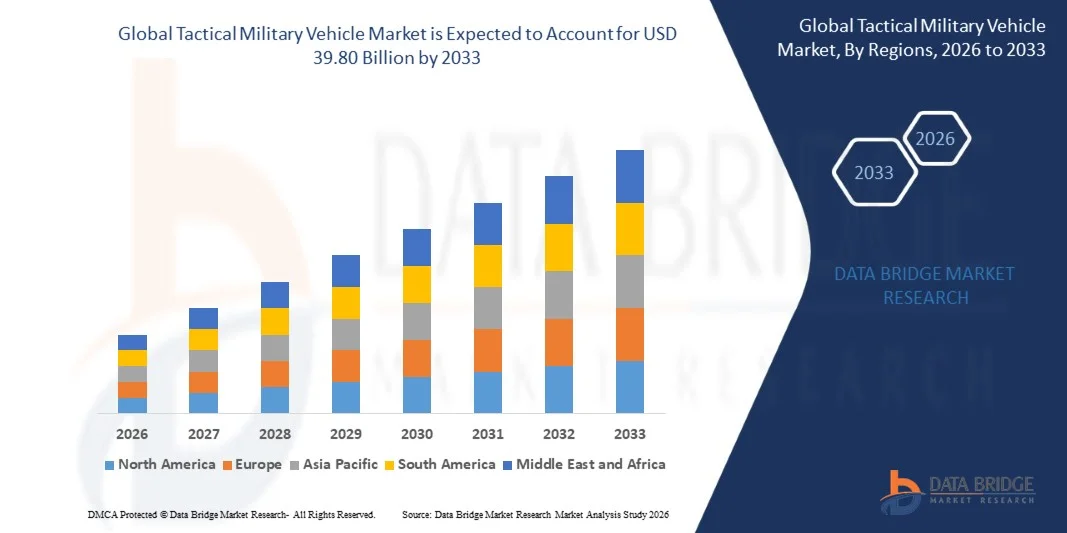
- As per Data Bridge Market Research analysis the tactical military vehicle market was valued at USD 34.80 billion in 2025 and is projected to reach USD 39.80 billion by 2033, growing at a CAGR of 5.90% from 2026 to 2033.
- The market is experiencing steady growth driven by increasing defense modernization programs, rising military expenditures, and growing demand for highly mobile and mission-capable vehicles across combat, reconnaissance, logistics, and troop transportation operations.
- The evolving nature of modern warfare, increasing geopolitical tensions, and the need for enhanced battlefield mobility and force protection are compelling defense organizations worldwide to invest in advanced tactical military vehicles equipped with improved armor, communication systems, autonomous capabilities, and next-generation propulsion technologies.
Market Size & Forecast
- Global Market Value (2025): USD 34.80 Billion
- Expected Market Value (2033): USD 39.80 Billion
- Forecast CAGR (2026–2033): 5.90%
What are the Major Takeaways of the Tactical Military Vehicle Market?
- North America dominated the tactical military vehicle market with the largest revenue share in 2025, supported by substantial defense spending, continuous military modernization programs, and strong demand for advanced armored and tactical mobility platforms.
- Asia-Pacific tactical military vehicle market is expected to witness substantial growth from 2026 to 2033, supported by rising military expenditures, increasing geopolitical tensions, and expanding defense modernization programs across major economies.
- The light tactical vehicles segment dominated the market in 2025 due to its extensive deployment in reconnaissance, patrol, troop transport, and rapid-response operations. Armed forces increasingly prefer these vehicles because they offer high mobility, operational flexibility, lower maintenance costs, and suitability across diverse terrains. Their ability to support multiple mission profiles while maintaining speed and maneuverability continues to drive widespread procurement globally.
- The heavy tactical vehicles segment is projected to register the fastest growth at a CAGR from 2026 to 2033, driven by rising demand for armored transport, logistics support, missile carriers, and battlefield sustainment vehicles. Increasing military modernization programs and investments in heavy-duty combat support platforms are further contributing to segment expansion.
- Wheeled tactical vehicles accounted for the largest share in 2025 of the market due to their superior road mobility, lower operating costs, easier maintenance, and suitability for rapid deployment missions. These vehicles are widely used for troop transport, logistics, border security, and peacekeeping operations.
- Hybrid mobility vehicles is projected to register the fastest growth at a CAGR from 2026 to 2033 as defense organizations seek platforms capable of operating across complex terrains while improving fuel efficiency and operational endurance. Growing investments in next-generation mobility technologies are expected to support future segment growth.
Report Scope and Tactical Military Vehicle Market Segmentation
|
Attributes |
Tactical Military Vehicle Key Market Insights |
|
Segments Covered |
|
|
Countries Covered |
North America
Europe
Asia-Pacific
Middle East and Africa
South America
|
|
Key Market Players |
|
|
Market Opportunities |
|
|
Value Added Data Infosets |
In addition to the market insights such as market value, growth rate, market segments, geographical coverage, market players, and market scenario, the market report curated by the Data Bridge Market Research team includes in-depth expert analysis, import/export analysis, pricing analysis, production consumption analysis, and pestle analysis. |
What is the Key Trend in the Tactical Military Vehicle Market?
- Defense forces are increasingly adopting autonomous, digitally connected, and hybrid-powered tactical military vehicles to improve battlefield mobility, operational effectiveness, and soldier protection while reducing personnel exposure in high-risk missions.
- For instance, in September 2024, BAE Systems Australia unveiled the Autonomous Tactical Light Armour System (ATLAS) Collaborative Combat Variant (CCV), an advanced uncrewed ground vehicle designed to support autonomous and human-machine teamed operations across future battlefields. The platform combines armored protection, autonomous navigation, and modular mission capabilities.
- Military organizations are increasingly integrating artificial intelligence, advanced communications systems, and autonomous technologies into tactical vehicle fleets to enhance situational awareness and mission flexibility across complex operational environments.
- For instance, in January 2026, Oshkosh Defense showcased its combat-proven Joint Light Tactical Vehicle (JLTV) platform at the International Armoured Vehicles Conference, highlighting modernization capabilities, digital integration, enhanced survivability, and adaptability for evolving military missions.
- As armed forces continue prioritizing network-centric warfare, autonomous operations, and next-generation battlefield mobility, demand for technologically advanced tactical military vehicles is expected to accelerate, reinforcing their role as critical assets in modern defense operations.
What are the Key Drivers of the Tactical Military Vehicle Market?
- Rising geopolitical tensions, military modernization initiatives, and growing defense budgets are significantly increasing demand for advanced tactical military vehicles capable of supporting combat, logistics, reconnaissance, and homeland security missions.
- For instance, in June 2025, Oshkosh Defense secured a three-year extension for the U.S. Army's Family of Medium Tactical Vehicles A2 (FMTV A2) program, enabling continued fleet modernization with improved payload capacity, protection, mobility, and mission adaptability.
- Governments worldwide are investing heavily in modern armored vehicle fleets to strengthen military readiness, enhance force mobility, and support multi-domain operations across increasingly contested environments.
- For instance, in June 2025, the Netherlands Ministry of Defence signed an agreement with Oshkosh Defense for 150 Dutch Expeditionary Patrol Vehicles (DXPV) derived from the JLTV platform, supporting modernization of the Dutch Marines' expeditionary capabilities.
- As defense organizations continue prioritizing rapid deployment, troop protection, and operational mobility, tactical military vehicles will remain essential components of future force modernization strategies and battlefield effectiveness.
Which Factors are Challenging the Growth of the Tactical Military Vehicle Market?
- Advanced tactical military vehicles require substantial investment due to sophisticated armor systems, integrated electronics, advanced communication networks, autonomous capabilities, and increasingly complex mission requirements.
- High procurement, maintenance, and lifecycle support costs can place significant pressure on defense budgets, particularly for developing nations and smaller military organizations with limited modernization resources.
- For instance, in March 2024, the U.S. Army awarded BAE Systems a contract worth approximately USD 754 million for the continued production of Armored Multi-Purpose Vehicles (AMPVs), highlighting the significant capital requirements associated with large-scale tactical vehicle procurement and fleet modernization programs.
- In addition, supply chain constraints, long procurement cycles, regulatory approvals, and integration challenges associated with advanced digital and autonomous technologies can delay deployment timelines and increase overall program costs.
- These financial and operational challenges continue to limit adoption among budget-constrained defense organizations, slowing fleet replacement programs despite growing global demand for advanced tactical military vehicles.
How is the Tactical Military Vehicle Market Segmented?
The market is segmented on the basis of vehicle type, mobility configuration, mission type, protection level, propulsion type, payload capacity, application, end user, technology integration, operational environment, and distribution channel.
- By Vehicle Type
On the basis of vehicle type, the tactical military vehicle market is segmented into light tactical vehicles, medium tactical vehicles, and heavy tactical vehicles. The light tactical vehicles segment dominated the market in 2025 due to its extensive deployment in reconnaissance, patrol, troop transport, and rapid-response operations. Armed forces increasingly prefer these vehicles because they offer high mobility, operational flexibility, lower maintenance costs, and suitability across diverse terrains. Their ability to support multiple mission profiles while maintaining speed and maneuverability continues to drive widespread procurement globally.
The heavy tactical vehicles segment is projected to register the fastest growth at a CAGR from 2026 to 2033, driven by rising demand for armored transport, logistics support, missile carriers, and battlefield sustainment vehicles. Increasing military modernization programs and investments in heavy-duty combat support platforms are further contributing to segment expansion.
- By Mobility Configuration
On the basis of mobility configuration, the tactical military vehicle market is segmented into wheeled tactical vehicles, tracked tactical vehicles, and hybrid mobility vehicles. Wheeled tactical vehicles accounted for the largest share in 2025 of the market due to their superior road mobility, lower operating costs, easier maintenance, and suitability for rapid deployment missions. These vehicles are widely used for troop transport, logistics, border security, and peacekeeping operations.
Hybrid mobility vehicles is projected to register the fastest growth at a CAGR from 2026 to 2033 as defense organizations seek platforms capable of operating across complex terrains while improving fuel efficiency and operational endurance. Growing investments in next-generation mobility technologies are expected to support future segment growth.
- By Mission Type
On the basis of mission type, the tactical military vehicle market is segmented into combat operations, combat support, combat service support, and security operations. The combat operations segment held the dominant position in 2025 due to increasing procurement of armored and protected vehicles for frontline missions. Rising geopolitical tensions and military readiness initiatives continue to support demand for combat-capable platforms.
The security operations segment is projected to register the fastest growth at a CAGR from 2026 to 2033 owing to increasing border surveillance requirements, counterterrorism activities, homeland security missions, and peacekeeping deployments. Governments are investing heavily in tactical mobility assets to strengthen national security capabilities.
- By Protection Level
On the basis of protection level, the tactical military vehicle market is segmented into unarmored vehicles, light armored vehicles, medium armored vehicles, and heavy armored vehicles. Light armored vehicles dominated the market in 2025 due to their ability to balance protection, mobility, and operational efficiency. These vehicles are extensively deployed in reconnaissance, patrol, convoy escort, and troop transport missions.
Heavy armored vehicles is projected to register the fastest growth at a CAGR from 2026 to 2033 increasing adoption as military forces prioritize crew survivability against improvised explosive devices (IEDs), mines, ballistic threats, and modern battlefield weapon systems. Growing focus on force protection is supporting investments in advanced armor technologies.
- By Propulsion Type
On the basis of propulsion type, the tactical military vehicle market is segmented into diesel powered vehicles, gasoline powered vehicles, hybrid electric vehicles, and battery electric vehicles. Diesel powered vehicles dominated the market in 2025 due to their high torque output, operational reliability, fuel efficiency, and established military logistics infrastructure. Most global military fleets continue to rely on diesel-powered platforms for both combat and support missions.
Hybrid electric vehicles is projected to register the fastest growth at a CAGR from 2026 to 2033 as a key area of innovation, supported by military efforts to reduce fuel consumption, improve operational range, lower thermal signatures, and enhance silent mobility capabilities. Defense agencies are increasingly evaluating hybrid solutions for future battlefield applications.
- By Payload Capacity
On the basis of payload capacity, the tactical military vehicle market is segmented into less than one ton, one ton to three tons, three tons to five tons, and five tons to ten tons. The one ton to three tons segment held a significant share of the market in 2025 due to its versatility across troop transportation, reconnaissance, logistics, and command support missions. These vehicles provide an optimal balance between mobility, payload capability, and operational efficiency.
The five tons to ten tons segment is projected to register the fastest growth at a CAGR from 2026 to 2033 as military organizations continue to invest in heavy logistics platforms, equipment transport vehicles, and mission-specific support systems capable of operating in challenging environments.
- By Application
On the basis of application, the tactical military vehicle market is segmented into personnel transportation, cargo transportation, weapon system carrier, and command and control. Personnel transportation represented the largest segment in 2025 due to increasing demand for secure and efficient troop mobility across military operations. Modern tactical vehicles are being equipped with enhanced protection systems, communication technologies, and mobility features to support personnel movement.
The command-and-control segment is projected to register the fastest growth at a CAGR from 2026 to 2033 as military organizations adopt network-centric warfare strategies and invest in advanced battlefield communication and coordination capabilities.
- By End User
On the basis of end user, the tactical military vehicle market is segmented into army, marine forces, air force, and joint defense forces. The army segment dominated the market in 2025 owing to extensive utilization of tactical vehicles across combat, logistics, reconnaissance, engineering, and support operations. Continuous fleet modernization programs and increasing defense budgets are further supporting demand from army forces worldwide.
Joint defense forces is projected to register the fastest growth at a CAGR from 2026 to 2033 due to increasing emphasis on integrated military operations, interoperability, and coordinated multi-domain missions involving land, air, naval, cyber, and space assets.
- By Technology Integration
On the basis of technology integration, the tactical military vehicle market is segmented into conventional tactical vehicles, digitally connected vehicles, autonomous ready vehicles, and artificial intelligence enabled vehicles. Conventional tactical vehicles currently account for the largest share in 2025 due to their widespread deployment across global military inventories and proven operational performance.
Artificial intelligence enabled vehicles is projected to register the fastest growth at a CAGR from 2026 to 2033 as defense organizations increasingly invest in autonomous navigation, predictive maintenance, sensor fusion, threat detection, and human-machine teaming technologies. These advancements are transforming the future battlefield mobility landscape.
- By Operational Environment
On the basis of operational environment, the tactical military vehicle market is segmented into land operations, amphibious operations, and multi domain operations. Land operations dominated the market in 2025 due to the extensive deployment of tactical vehicles in conventional ground warfare, border security, counterinsurgency operations, and military logistics missions.
Multi domain operations is projected to register the fastest growth at a CAGR from 2026 to 2033 as modern military strategies increasingly integrate land, air, maritime, cyber, and space capabilities. Tactical vehicles are evolving to support interconnected and highly coordinated operational environments.
- By Distribution Channel
On the basis of distribution channel, the tactical military vehicle market is segmented into direct sales, channel partner sales, project-based procurement, and online sales. Direct sales dominated the market in 2025 due to the prevalence of government-to-manufacturer contracts, long-term defense procurement programs, and customized vehicle acquisition agreements. Defense agencies typically prefer direct engagement with manufacturers to ensure compliance with operational requirements and security standards.
Project-based procurement is projected to register the fastest growth at a CAGR from 2026 to 2033 as governments launch large-scale modernization initiatives, fleet replacement programs, and strategic defense acquisition projects. Increasing investments in military mobility and battlefield modernization continue to create opportunities across this segment.
Which Region Holds the Largest Share of the Tactical Military Vehicle Market?
- North America dominated the tactical military vehicle market with the largest revenue share in 2025, supported by substantial defense spending, continuous military modernization programs, and strong demand for advanced armored and tactical mobility platforms.
- The region benefits from the presence of leading defense manufacturers, extensive research and development activities, and ongoing investments in next-generation combat vehicles. The growing focus on force protection, rapid deployment capabilities, and network-centric warfare continues to drive procurement of advanced tactical military vehicles across military branches.
U.S. Tactical Military Vehicle Market Insight
The U.S. tactical military vehicle market captured the largest revenue share in 2025 within North America, fueled by large-scale defense modernization initiatives and sustained investments in battlefield mobility solutions. The U.S. Department of Defense continues to prioritize fleet upgrades, autonomous vehicle technologies, survivability enhancements, and advanced command-and-control capabilities. Ongoing procurement programs involving Joint Light Tactical Vehicles (JLTVs), Armored Multi-Purpose Vehicles (AMPVs), and future combat systems are further supporting market expansion across the country.
Europe Tactical Military Vehicle Market Insight
The Europe tactical military vehicle market is expected to witness the fastest growth rate from 2026 to 2033, primarily driven by increasing defense budgets, heightened regional security concerns, and accelerated military modernization efforts. Governments across the region are investing in new armored vehicle fleets, tactical transport platforms, and advanced battlefield mobility systems. Growing emphasis on NATO interoperability requirements and enhanced force readiness is further stimulating demand for next-generation tactical military vehicles.
U.K. Tactical Military Vehicle Market Insight
The U.K. tactical military vehicle market is expected to witness significant growth from 2026 to 2033, driven by ongoing military modernization programs and investments in armored mobility capabilities. The country's focus on expeditionary warfare, rapid deployment forces, and integrated defense operations is increasing demand for highly mobile and protected tactical platforms. Continued investments in advanced vehicle technologies and battlefield communications systems are expected to support long-term market growth.
Germany Tactical Military Vehicle Market Insight
The Germany tactical military vehicle market is expected to witness strong growth from 2026 to 2033, fueled by rising defense expenditures and extensive efforts to modernize military equipment and ground force capabilities. Germany's emphasis on strengthening defense preparedness, enhancing NATO commitments, and upgrading armored vehicle fleets is driving procurement activities. The increasing adoption of digitally connected and technologically advanced tactical vehicles is further contributing to market expansion across the country.
Asia-Pacific Tactical Military Vehicle Market Insight
The Asia-Pacific tactical military vehicle market is expected to witness substantial growth from 2026 to 2033, supported by rising military expenditures, increasing geopolitical tensions, and expanding defense modernization programs across major economies. Countries such as China, India, Japan, South Korea, and Australia are investing heavily in advanced military mobility solutions to strengthen national security capabilities. Growing domestic defense manufacturing and technology development initiatives are further supporting regional market growth.
Japan Tactical Military Vehicle Market Insight
The Japan tactical military vehicle market is expected to witness significant growth from 2026 to 2033 due to increasing investments in defense modernization and enhanced military mobility capabilities. The country is focusing on strengthening rapid response forces, improving operational readiness, and upgrading tactical ground transportation systems. Rising demand for advanced reconnaissance vehicles, armored platforms, and next-generation defense technologies is expected to contribute significantly to market expansion.
China Tactical Military Vehicle Market Insight
The China tactical military vehicle market accounted for the largest market revenue share in Asia-Pacific in 2025, attributed to substantial defense investments, large-scale military modernization programs, and continuous expansion of domestic defense manufacturing capabilities. China remains one of the world's largest producers and users of tactical military vehicles, supporting a broad range of land combat, logistics, reconnaissance, and security operations. Increasing investments in intelligent warfare systems, autonomous military platforms, and advanced armored vehicles continue to strengthen the country's position in the regional market.
Which are the Top Companies in Tactical Military Vehicle Market?
The tactical military vehicle industry is primarily led by well-established companies, including:
- Oshkosh Defense, LLC (U.S.)
- BAE Systems (U.K.)
- General Dynamics Land Systems (U.S.)
- IDV - Iveco Defence Vehicles S.p.A. (Italy)
- Textron Systems (U.S.)
- Leonardo S.p.A. (Italy)
- Hyundai Rotem Company (South Korea)
- Otokar Otomotiv ve Savunma Sanayi A.Ş. (Turkey)
- Tata Advanced Systems Limited (India)
- Ashok Leyland Defence Systems Limited (India)
- ST Engineering Ltd. (Singapore)
- Mitsubishi Heavy Industries, Ltd. (Japan)
- KNDS France S.A.S. (France)
- KNDS Deutschland GmbH & Co. KG (Germany)
- Arquus S.A.S. (France)
- AM General LLC (U.S.)
- Patria Oyj (Finland)
- NIMR Automotive LLC (U.A.E.)
- JCB Defence (U.K.)
- Streit Group FZC (U.A.E.)
- Sisu Auto Oy (Finland)
- Tatra Defence Vehicle a.s. (Czech Republic)
- Huta Stalowa Wola S.A. (Poland)
- John Cockerill Defense S.A. (Belgium)
- Mahindra Defence Systems Limited (India)
- Kalyani Strategic Systems Limited (Bharat Forge Defence) (India)
- Force Motors Limited (India)
- Dongfeng Mengshi Automobile Technology Company Limited (China)

- Interactive Data Analysis Dashboard
- Company Analysis Dashboard for high growth potential opportunities
- Research Analyst Access for customization & queries
- Competitor Analysis with Interactive dashboard
- Latest News, Updates & Trend analysis
- Harness the Power of Benchmark Analysis for Comprehensive Competitor Tracking
Data collection and base year analysis are done using data collection modules with large sample sizes. The stage includes obtaining market information or related data through various sources and strategies. It includes examining and planning all the data acquired from the past in advance. It likewise envelops the examination of information inconsistencies seen across different information sources. The market data is analysed and estimated using market statistical and coherent models. Also, market share analysis and key trend analysis are the major success factors in the market report. To know more, please request an analyst call or drop down your inquiry.
The key research methodology used by DBMR research team is data triangulation which involves data mining, analysis of the impact of data variables on the market and primary (industry expert) validation. Data models include Vendor Positioning Grid, Market Time Line Analysis, Market Overview and Guide, Company Positioning Grid, Patent Analysis, Pricing Analysis, Company Market Share Analysis, Standards of Measurement, Global versus Regional and Vendor Share Analysis. To know more about the research methodology, drop in an inquiry to speak to our industry experts.
Data Bridge Market Research is a leader in advanced formative research. We take pride in servicing our existing and new customers with data and analysis that match and suits their goal. The report can be customized to include price trend analysis of target brands understanding the market for additional countries (ask for the list of countries), clinical trial results data, literature review, refurbished market and product base analysis. Market analysis of target competitors can be analyzed from technology-based analysis to market portfolio strategies. We can add as many competitors that you require data about in the format and data style you are looking for. Our team of analysts can also provide you data in crude raw excel files pivot tables (Fact book) or can assist you in creating presentations from the data sets available in the report.












