


Tactical UAV Market Size
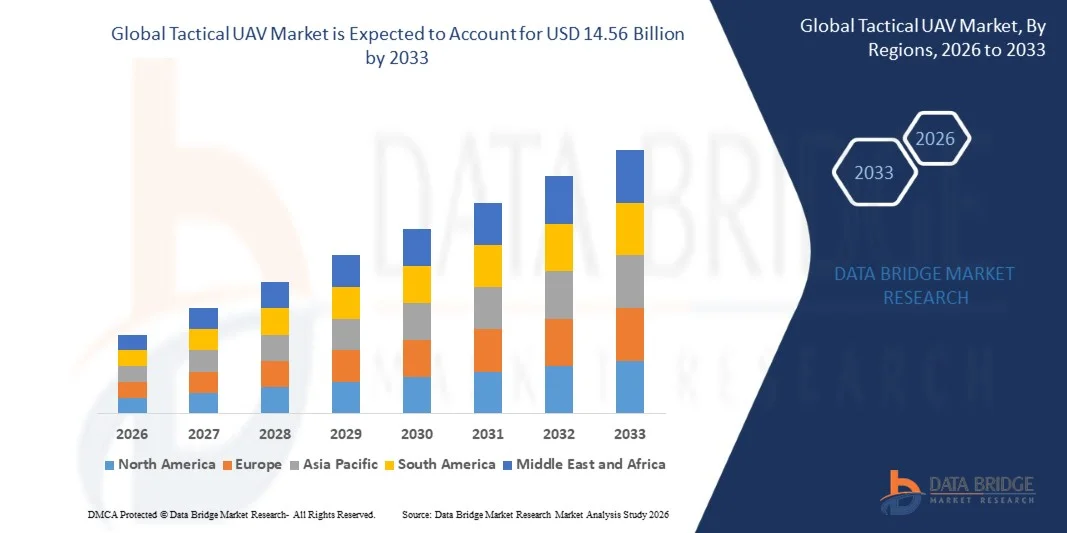
- The global tactical UAV market size was valued at USD 5.99 billion in 2025and is expected to reach USD 14.56 billion by 2033, at a CAGR of 11.75% during the forecast period
- The market growth is largely fuelled by rising defense modernization programs, increasing demand for real-time intelligence, surveillance, and reconnaissance (ISR) capabilities, and growing adoption of unmanned systems for border monitoring and tactical operations
- In addition, the integration of advanced technologies such as AI-based autonomy, improved communication systems, and lightweight high-endurance platforms is accelerating deployment across military missions
Tactical UAV Market Analysis
- The tactical UAV market is witnessing strong expansion due to the rising need for persistent battlefield awareness and rapid decision-making support in modern warfare environments
- Increasing geopolitical tensions and the shift toward unmanned and network-centric defense strategies are driving procurement of advanced UAV systems with enhanced mobility and precision
- North America dominated the tactical UAV market with the largest revenue share in 2025, driven by significant defense modernization programs, strong investment in unmanned systems, and increasing demand for advanced intelligence, surveillance, and reconnaissance (ISR) capabilities
- Asia-Pacific region is expected to witness the highest growth rate in the global tactical UAV market, driven by rapid military modernization, increasing geopolitical tensions, and rising investments in advanced surveillance and unmanned defense systems across key countries such as China, India, and Japan
- The fixed-wing segment held the largest market revenue share in 2025 driven by its superior endurance, higher speed, and long-range operational capability, making it highly suitable for persistent surveillance and reconnaissance missions in large operational areas. Fixed-wing tactical UAVs are widely adopted by defense forces due to their ability to cover extended distances with improved fuel efficiency and stable flight performance, supporting continuous intelligence gathering and mission-critical operations
Report Scope and Tactical UAV Market Segmentation
|
Attributes |
Tactical UAV Key Market Insights |
|
Segments Covered |
· By Platform: Fixed-wing, Rotary-wing, and Hybrid · By Range: Short-range (less than 100 km), Medium-range (100-500 km), and Long-range (over 500 km) · By Payload: Lightweight (less than 10 kg), Medium-weight (10-50 kg), and Heavyweight (over 50 kg) · By Application: Surveillance and reconnaissance, Target acquisition, Electronic warfare, and Close air support |
|
Countries Covered |
North America · U.S. · Canada · Mexico Europe · Germany · France · U.K. · Netherlands · Switzerland · Belgium · Russia · Italy · Spain · Turkey · Rest of Europe Asia-Pacific · China · Japan · India · South Korea · Singapore · Malaysia · Australia · Thailand · Indonesia · Philippines · Rest of Asia-Pacific Middle East and Africa · Saudi Arabia · U.A.E. · South Africa · Egypt · Israel · Rest of Middle East and Africa South America · Brazil · Argentina · Rest of South America |
|
Key Market Players |
• General Atomics (U.S.) |
|
Market Opportunities |
• Expansion Of AI-Based Autonomous Flight Systems |
|
Value Added Data Infosets |
In addition to the market insights such as market value, growth rate, market segments, geographical coverage, market players, and market scenario, the market report curated by the Data Bridge Market Research team includes in-depth expert analysis, import/export analysis, pricing analysis, production consumption analysis, and pestle analysis. |
Tactical UAV Market Trends
“Rising Demand For Advanced Intelligence, Surveillance, And Reconnaissance (ISR) Capabilities”
- The increasing emphasis on real-time battlefield awareness is significantly shaping the tactical UAV market, as defense forces increasingly rely on unmanned systems for intelligence gathering, surveillance, and reconnaissance missions. Tactical UAVs are gaining traction due to their ability to deliver high-resolution imaging, extended operational endurance, and enhanced situational awareness without risking human life. This trend is strengthening their deployment across modern military operations, encouraging defense agencies to invest in next-generation UAV platforms with improved payload capacity and mission flexibility
- Growing focus on network-centric warfare and digital battlefield integration has accelerated the adoption of tactical UAVs in coordinated military operations. These systems are increasingly being integrated with command-and-control networks, enabling seamless data sharing and faster decision-making. This has led to stronger collaboration between defense contractors and technology providers to enhance communication systems, autonomous navigation, and multi-platform interoperability
- Rising geopolitical tensions and border security concerns are influencing procurement strategies, with governments prioritizing unmanned aerial systems for continuous monitoring and rapid response capabilities. Tactical UAVs are being deployed for border patrol, maritime surveillance, and counter-terrorism operations, driving demand for compact, high-performance, and rapidly deployable systems. Defense modernization programs are further reinforcing this trend by allocating higher budgets toward UAV integration
- For instance, in 2024, the U.S. Department of Defense and Israel Aerospace Industries expanded their tactical UAV deployment programs for enhanced ISR and reconnaissance missions across sensitive regions. These systems were introduced to improve mission accuracy, reduce operational risks, and support real-time intelligence sharing across military units. The deployments were further integrated with advanced sensor and communication technologies to strengthen operational efficiency and tactical response capabilities
- While demand for tactical UAVs is rising, sustained market expansion depends on continuous advancements in autonomy, endurance, and secure communication systems. Manufacturers are also focusing on improving electronic warfare resistance, reducing system costs, and enhancing multi-mission adaptability to meet evolving defense requirements
Tactical UAV Market Dynamics
Driver
“Rising Demand For Real-Time Battlefield Intelligence And Autonomous Defense Systems”
- Increasing need for rapid and accurate battlefield intelligence is a major driver for the tactical UAV market. Defense forces are increasingly adopting unmanned aerial systems to enhance surveillance efficiency, reduce human exposure to risk, and improve mission effectiveness in complex operational environments. This trend is also driving innovation in autonomous flight control, AI-based targeting systems, and advanced sensor integration
- Expanding military modernization programs and defense budget allocations are influencing procurement of tactical UAVs across multiple countries. Governments are prioritizing unmanned systems for border security, tactical reconnaissance, and counter-insurgency operations, supporting the transition toward advanced unmanned warfare capabilities. This is further encouraging investments in lightweight, high-endurance UAV platforms with improved operational range
- Defense manufacturers are actively enhancing UAV capabilities through product innovation, technological upgrades, and strategic partnerships. These developments are supported by rising demand for precision-based operations, and they are also encouraging integration of AI, machine learning, and secure communication networks to improve mission reliability and autonomy
- For instance, in 2023, General Atomics in the U.S. and Elbit Systems in Israel reported increased deployment of tactical UAV systems across defense programs focused on ISR and border surveillance operations. These deployments were driven by rising demand for persistent surveillance and improved tactical response capabilities, strengthening operational readiness and mission success rates
- Although rising defense investments support market growth, wider adoption depends on cost optimization, regulatory approvals, and technological standardization. Continued advancements in autonomy, cybersecurity, and payload efficiency will be essential for long-term scalability and global deployment
Restraint/Challenge
“High Development Costs And Complex Operational And Regulatory Requirements”
- The high cost of developing and deploying tactical UAV systems remains a key challenge, limiting adoption among budget-constrained defense programs. Advanced sensor integration, AI-based systems, and secure communication technologies significantly increase overall system costs, making procurement and maintenance expensive for several military organizations
- Regulatory restrictions and airspace management complexities also pose challenges for market expansion. Strict government policies regarding UAV operations, export controls, and cross-border usage limit deployment flexibility in certain regions. This also slows down procurement cycles and restricts international collaboration in UAV technology development
- Operational challenges such as limited endurance, vulnerability to electronic warfare, and dependence on secure communication links further impact performance reliability. Harsh environmental conditions and battlefield interference can reduce mission efficiency, requiring continuous technological improvements and system upgrades
- For instance, in 2024, several defense procurement programs in Europe and Asia reported delays in tactical UAV deployment due to certification requirements and integration challenges with existing defense infrastructure. High procurement costs and strict operational compliance standards further restricted large-scale adoption among smaller defense agencies
- Overcoming these challenges will require cost-efficient manufacturing, stronger international regulatory alignment, and continuous investment in resilient communication and autonomy technologies. Collaboration between defense organizations and UAV manufacturers will be critical to improving affordability, operational reliability, and global deployment potential
Tactical UAV Market Scope
The market is segmented on the basis of platform, range, payload, and application.
- By Platform
On the basis of platform, the tactical UAV market is segmented into fixed-wing, rotary-wing, and hybrid systems. The fixed-wing segment held the largest market revenue share in 2025 driven by its superior endurance, higher speed, and long-range operational capability, making it highly suitable for persistent surveillance and reconnaissance missions in large operational areas. Fixed-wing tactical UAVs are widely adopted by defense forces due to their ability to cover extended distances with improved fuel efficiency and stable flight performance, supporting continuous intelligence gathering and mission-critical operations.
The hybrid segment is expected to witness the fastest growth rate from 2026 to 2033, driven by its combined advantages of vertical take-off and landing capability along with extended flight endurance. Hybrid tactical UAVs are increasingly preferred for complex mission environments where flexibility, rapid deployment, and operational versatility are required, enabling seamless transition between confined-area operations and long-range surveillance tasks.
- By Range
On the basis of range, the tactical UAV market is segmented into short-range (less than 100 km), medium-range (100–500 km), and long-range (over 500 km). The medium-range segment held the largest market revenue share in 2025 driven by its balanced operational capability, cost-effectiveness, and suitability for most tactical missions such as border surveillance, battlefield monitoring, and reconnaissance operations. Medium-range UAVs are widely adopted due to their ability to provide extended coverage while maintaining operational efficiency and mission flexibility across diverse defense applications.
The long-range segment is expected to witness the fastest growth rate from 2026 to 2033, driven by increasing demand for deep surveillance, cross-border intelligence missions, and extended endurance operations. Long-range tactical UAVs are gaining traction as defense forces prioritize persistent monitoring capabilities and strategic reconnaissance over large geographic areas, supported by advancements in propulsion systems and communication technologies.
- By Payload
On the basis of payload, the tactical UAV market is segmented into lightweight (less than 10 kg), medium-weight (10–50 kg), and heavyweight (over 50 kg). The medium-weight segment held the largest market revenue share in 2025 driven by its optimal balance between endurance, payload capacity, and mission flexibility, enabling effective deployment for surveillance, target tracking, and electronic intelligence missions. Medium-weight UAVs are widely utilized due to their ability to carry advanced sensors and communication systems while maintaining stable operational performance.
The heavyweight segment is expected to witness the fastest growth rate from 2026 to 2033, driven by increasing demand for multi-mission platforms capable of carrying advanced payloads such as radar systems, electronic warfare modules, and precision strike capabilities. Heavyweight tactical UAVs are increasingly being developed to support complex military operations requiring enhanced endurance, higher payload integration, and extended operational reach.
- By Application
On the basis of application, the tactical UAV market is segmented into surveillance and reconnaissance, target acquisition, electronic warfare, and close air support. The surveillance and reconnaissance segment held the largest market revenue share in 2025 driven by rising demand for real-time intelligence, battlefield awareness, and continuous monitoring of strategic locations. Tactical UAVs are extensively deployed in surveillance missions due to their ability to provide high-resolution imagery, persistent observation, and rapid data transmission to command centers.
The electronic warfare segment is expected to witness the fastest growth rate from 2026 to 2033, driven by increasing adoption of unmanned systems for signal interception, jamming, and electronic countermeasure operations. Tactical UAVs equipped with electronic warfare capabilities are gaining importance in modern defense strategies as militaries focus on disrupting enemy communication systems and enhancing operational superiority in contested environments.
Tactical UAV Market Regional Analysis
- North America dominated the tactical UAV market with the largest revenue share in 2025, driven by significant defense modernization programs, strong investment in unmanned systems, and increasing demand for advanced intelligence, surveillance, and reconnaissance (ISR) capabilities
- Defense forces in the region highly value the operational efficiency, real-time situational awareness, and enhanced mission accuracy offered by tactical UAVs, along with their ability to reduce human risk in combat environments
- This widespread adoption is further supported by high defense spending, rapid integration of AI-enabled systems, and strong technological capabilities, establishing tactical UAVs as a critical component of modern military operations and border security strategies
U.S. Tactical UAV Market Insight
The U.S. tactical UAV market captured the largest revenue share in 2025 within North America, fueled by extensive military modernization initiatives and rapid adoption of next-generation unmanned aerial systems. The growing emphasis on battlefield intelligence, precision targeting, and autonomous operations is significantly boosting demand. In addition, strong integration of AI-based navigation systems, advanced sensor technologies, and secure communication networks is further propelling market expansion. The increasing deployment of tactical UAVs for ISR missions, electronic warfare, and border surveillance is also strengthening market growth across defense applications.
Europe Tactical UAV Market Insight
The Europe tactical UAV market is expected to witness the fastest growth rate from 2026 to 2033, primarily driven by rising defense budgets, increasing geopolitical tensions, and the need for enhanced border surveillance and reconnaissance capabilities. The region’s focus on strengthening military readiness and improving situational awareness is accelerating UAV adoption. Europe is also experiencing growing collaboration between defense agencies and technology providers to develop advanced unmanned systems with improved endurance and multi-mission capabilities, supporting expansion across strategic defense operations
U.K. Tactical UAV Market Insight
The U.K. tactical UAV market is expected to witness the fastest growth rate from 2026 to 2033, driven by rising investments in defense modernization and increasing demand for advanced surveillance and reconnaissance solutions. Concerns regarding national security, counter-terrorism operations, and border protection are encouraging the adoption of tactical UAV systems. The country’s strong focus on integrating autonomous technologies and secure communication platforms is further supporting market growth across military and defense applications.
Germany Tactical UAV Market Insight
The Germany tactical UAV market is expected to witness the fastest growth rate from 2026 to 2033, fueled by increasing emphasis on digital defense transformation and rising demand for technologically advanced surveillance systems. Germany’s strong industrial base and focus on innovation are supporting the development and deployment of next-generation UAV platforms. The growing integration of UAVs with command-and-control systems and electronic warfare capabilities is further enhancing operational efficiency across defense missions.
Asia-Pacific Tactical UAV Market Insight
The Asia-Pacific tactical UAV market is expected to witness the fastest growth rate from 2026 to 2033, driven by rapid military modernization, increasing border security concerns, and rising defense investments in countries such as China, India, and Japan. The region’s growing focus on strengthening surveillance capabilities and improving battlefield intelligence is accelerating UAV adoption. In addition, expanding domestic manufacturing capabilities and cost-effective production are making tactical UAV systems more accessible across defense forces in the region.
Japan Tactical UAV Market Insight
The Japan tactical UAV market is expected to witness the fastest growth rate from 2026 to 2033 due to the country’s advanced technological ecosystem, strong focus on security, and increasing adoption of autonomous defense systems. Japan’s emphasis on disaster monitoring, border surveillance, and maritime security is driving UAV deployment across multiple defense applications. The integration of UAVs with AI-enabled systems and smart defense infrastructure is further enhancing operational efficiency and mission accuracy.
China Tactical UAV Market Insight
The China tactical UAV market accounted for the largest market revenue share in Asia Pacific in 2025, attributed to rapid military modernization, strong domestic UAV manufacturing capabilities, and increasing deployment of unmanned systems for surveillance and reconnaissance missions. China’s focus on strengthening defense capabilities and expanding the use of UAVs in border security, electronic warfare, and strategic operations is significantly driving market growth. In addition, large-scale investments in drone technology development and smart defense initiatives are further supporting market expansion.
Tactical UAV Market Share
The Tactical UAV industry is primarily led by well-established companies, including:
- General Atomics (U.S.)
• Northrop Grumman (U.S.)
• Lockheed Martin (U.S.)
• Boeing (U.S.)
• AeroVironment (U.S.)
• Textron (U.S.)
• Kratos Defense & Security Solutions (U.S.)
• Elbit Systems (Israel)
• Israel Aerospace Industries (Israel)
• Rafael Advanced Defense Systems (Israel)
• BAE Systems (U.K.)
• Leonardo S.p.A. (Italy)
• Thales Group (France)
• Saab AB (Sweden)
• Airbus (France)
Latest Developments in Global Tactical UAV Market
- In September 2025, Northrop Grumman (U.S.) secured a contract with the U.S. Department of Defense for the supply of advanced UAV systems for intelligence, surveillance, and reconnaissance missions, strengthening its defense portfolio and ensuring stable revenue generation while reinforcing its position as a key defense UAV provider in the global market
- In August 2025, General Atomics (U.S.) announced a strategic partnership with a leading aerospace company to co-develop next-generation UAV systems, aiming to enhance platform capabilities with advanced technologies, accelerate innovation cycles, and strengthen its competitive position in the rapidly evolving tactical UAV market
- In July 2024, Elbit Systems (Israel) completed the acquisition of a drone technology startup, integrating artificial intelligence and machine learning capabilities into its UAV portfolio, improving operational efficiency and decision-making accuracy while enhancing its technological leadership in autonomous UAV systems

- Interactive Data Analysis Dashboard
- Company Analysis Dashboard for high growth potential opportunities
- Research Analyst Access for customization & queries
- Competitor Analysis with Interactive dashboard
- Latest News, Updates & Trend analysis
- Harness the Power of Benchmark Analysis for Comprehensive Competitor Tracking
Data collection and base year analysis are done using data collection modules with large sample sizes. The stage includes obtaining market information or related data through various sources and strategies. It includes examining and planning all the data acquired from the past in advance. It likewise envelops the examination of information inconsistencies seen across different information sources. The market data is analysed and estimated using market statistical and coherent models. Also, market share analysis and key trend analysis are the major success factors in the market report. To know more, please request an analyst call or drop down your inquiry.
The key research methodology used by DBMR research team is data triangulation which involves data mining, analysis of the impact of data variables on the market and primary (industry expert) validation. Data models include Vendor Positioning Grid, Market Time Line Analysis, Market Overview and Guide, Company Positioning Grid, Patent Analysis, Pricing Analysis, Company Market Share Analysis, Standards of Measurement, Global versus Regional and Vendor Share Analysis. To know more about the research methodology, drop in an inquiry to speak to our industry experts.
Data Bridge Market Research is a leader in advanced formative research. We take pride in servicing our existing and new customers with data and analysis that match and suits their goal. The report can be customized to include price trend analysis of target brands understanding the market for additional countries (ask for the list of countries), clinical trial results data, literature review, refurbished market and product base analysis. Market analysis of target competitors can be analyzed from technology-based analysis to market portfolio strategies. We can add as many competitors that you require data about in the format and data style you are looking for. Our team of analysts can also provide you data in crude raw excel files pivot tables (Fact book) or can assist you in creating presentations from the data sets available in the report.













