


What is the Tear Gas Market Size and Growth Rate?
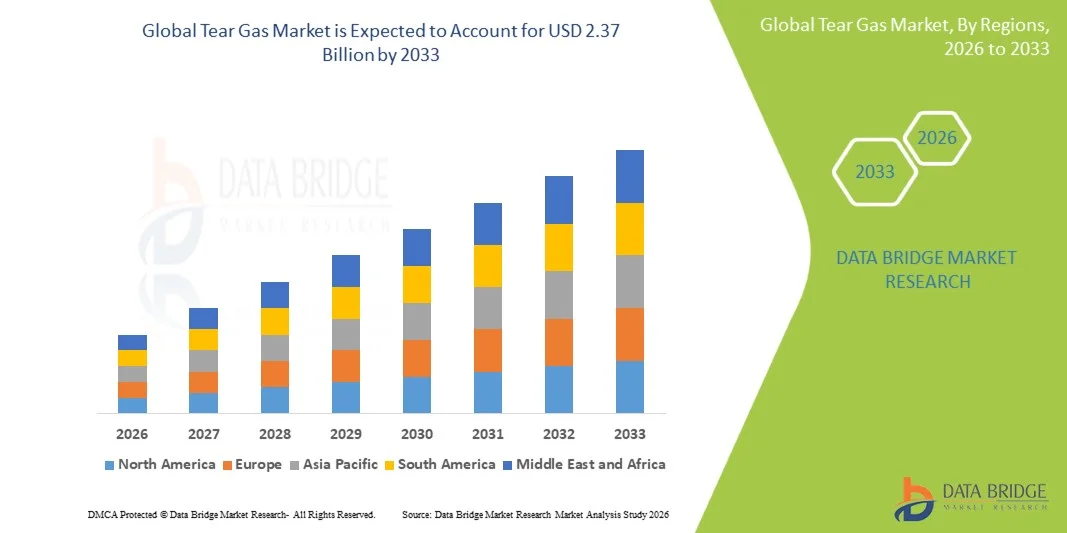
- The global tear gas market size was valued at USD 1.6 billion in 2025 and is expected to reach USD 2.37 billion by 2033, at a CAGR of 7.1% during the forecast period
- The market growth is largely fuelled by the rising need for non-lethal crowd control solutions and increasing security concerns in public and private sectors
- Growing adoption of tear gas by law enforcement agencies across regions for riot control and public safety is further boosting demand
Market Size & Forecast
- Global Market Value (2025): USD 1.6 billion
- Expected Market Value (2033): USD 2.37 billion
- Forecast CAGR (2026–2033): 7.1%
What are the Major Takeaways of Tear Gas Market?
- The increasing emphasis on public safety and law enforcement preparedness is shaping market dynamics
- Rising geopolitical tensions, civil unrest, and demand for non-lethal defense mechanisms are key factors supporting market growth
- North America dominated the tear gas market with the largest revenue share of 38.5% in 2025, driven by increasing civil unrest, rising security concerns, and the growing adoption of non-lethal crowd control measures
- Asia-Pacific region is expected to witness the highest growth rate in the global tear gas market, driven by rapid urbanization, expanding law enforcement capabilities, rising security investments, and increasing awareness about non-lethal public safety solutions
- The CS gas segment held the largest market revenue share in 2025, driven by its higher effectiveness, wider adoption by law enforcement agencies, and availability across multiple regions. CS gas is preferred for crowd control due to its rapid dispersal, low lethality, and established safety protocols, making it a standard choice for authorities worldwide
Report Scope and Tear Gas Market Segmentation
|
Attributes |
Tear Gas Key Market Insights |
|
Segments Covered |
|
|
Countries Covered |
North America
Europe
Asia-Pacific
Middle East and Africa
South America
|
|
Key Market Players |
|
|
Market Opportunities |
|
|
Value Added Data Infosets |
In addition to the insights on market scenarios such as market value, growth rate, segmentation, geographical coverage, and major players, the market reports curated by the Data Bridge Market Research also include import export analysis, production capacity overview, production consumption analysis, price trend analysis, climate change scenario, supply chain analysis, value chain analysis, raw material/consumables overview, vendor selection criteria, PESTLE Analysis, Porter Analysis, and regulatory framework. |
What is the Key Trend in the Tear Gas Market?
“Increasing Adoption of Non-Lethal Crowd Control Measures”
- The growing reliance on tear gas as a non-lethal solution is transforming the law enforcement and security landscape by enabling effective crowd management and riot control. Quick deployment and area coverage allow officers to disperse large gatherings and prevent escalation, reducing injuries and property damage. In addition, the development of multi-purpose devices that combine tear gas with other non-lethal deterrents is enhancing operational flexibility. The trend is supported by increasing urbanization, public gatherings, and global security awareness
- The high demand for non-lethal defense in urban, public, and sensitive areas is accelerating the adoption of advanced formulations and delivery systems. These tools are particularly useful where conventional firearms or physical intervention may cause higher risks or legal complications. Innovations in aerosol technology and canister design are improving dispersal efficiency, accuracy, and safety. Governments and private security agencies are increasingly investing in modern tear gas solutions to ensure crowd management without escalating violence
- The affordability, portability, and ease of use of modern tear gas devices are making them attractive for law enforcement, military, and private security personnel. Ready-to-use solutions and various delivery mechanisms enhance operational efficiency and situational control. Lightweight, compact, and ergonomically designed systems allow for rapid deployment during emergencies, while training modules ensure operators can use them safely and effectively. The growing focus on cost-effective yet reliable crowd control tools is boosting global demand
- For instance, in 2023, several law enforcement agencies in North America reported improved riot management outcomes after integrating handheld and launcher-based tear gas solutions, reducing property damage and public injuries while maintaining order. The successful implementation of these systems also highlighted the importance of coordinated deployment strategies and real-time situational monitoring. Consequently, other regions are adopting similar approaches to enhance operational efficiency during large-scale public events
- While tear gas adoption is expanding, its impact depends on regulatory compliance, operator training, and safety protocols. Manufacturers must focus on innovative, safe, and effective formulations to fully leverage the growing demand. Continuous research into eco-friendly, low-toxicity compounds and precision delivery technologies is also critical to enhance acceptance among both authorities and the public. Stakeholders are expected to invest heavily in product refinement, user education, and compliance management to sustain market growth
Tear Gas Market Dynamics
Driver
“Rising Security Concerns and Need for Non-Lethal Defense”
- Increasing civil unrest, protests, and security threats are pushing governments and private organizations to prioritize non-lethal crowd control solutions. Tear gas is recognized as an effective method for maintaining order without causing permanent harm, driving investments in product development. Furthermore, emerging technologies allow for targeted deployment, reducing collateral effects and increasing operational efficiency. The increasing frequency of public demonstrations globally is amplifying demand for such solutions
- Agencies and security personnel are increasingly aware of legal and ethical obligations to use non-lethal means for crowd control, prompting higher adoption rates. This shift is supported by public demand for safer, controlled intervention methods. Adoption of standardized protocols and certification programs ensures responsible usage, further encouraging market growth. Enhanced safety features, such as reduced chemical toxicity and controlled release, are attracting wider acceptance across law enforcement agencies
- Governments and international bodies are supporting standardization and training for tear gas use, enhancing operational efficiency and safety. Subsidized procurement programs and regulatory approvals encourage broader adoption across regions. Research grants and public-private partnerships are promoting innovation in delivery systems and chemical formulations, fostering sustainable growth. Collaborative initiatives are also being launched to share best practices and reduce risks associated with misuse
- For instance, in 2022, multiple European countries updated protocols for non-lethal crowd control, boosting demand for advanced tear gas formulations and delivery systems among law enforcement and private security agencies. The implementation of updated guidelines also highlighted the importance of operator training and controlled distribution to prevent accidents and legal disputes. This success is motivating other regions to revise policies and enhance operational preparedness
- While security concerns are propelling the market, continued innovation, adherence to safety standards, and operator training remain critical for sustained growth. Market participants are investing in smart deployment technologies, real-time monitoring systems, and improved chemical compositions. Integration with other non-lethal tools, such as sound or light deterrents, further strengthens the product portfolio and encourages adoption
Restraint/Challenge
“Regulatory Restrictions and Health Concerns”
- Strict regulatory frameworks in several regions limit the production, sale, and usage of tear gas, creating barriers to market expansion. Compliance with chemical safety, environmental, and public health standards increases operational costs and limits adoption in certain countries. Furthermore, frequent policy changes and regional restrictions create challenges in supply chain management and distribution planning. Manufacturers must navigate these legal constraints carefully to maintain compliance and market presence
- In some areas, public health and human rights concerns regarding tear gas exposure restrict its deployment. Misuse or overuse can lead to legal liabilities and negative public perception, impacting market acceptance. Continuous monitoring, awareness campaigns, and transparent reporting are necessary to mitigate backlash. The increasing attention on crowd safety and human rights is pushing manufacturers to innovate safer, less irritating formulations to balance efficacy and ethics
- Supply chain and logistical challenges, such as secure storage, transportation, and controlled distribution, can hamper market growth. Ensuring safe handling and consistent availability is crucial for widespread adoption. Limited access to reliable raw materials and specialized manufacturing equipment may also constrain production, particularly in emerging regions. Companies are increasingly investing in robust logistics, tracking, and inventory management systems to address these issues
- For instance, in 2023, several agencies in Asia-Pacific reported limited procurement due to regulatory approvals and compliance requirements, affecting availability and operational deployment. This underscored the importance of early regulatory engagement and local partnerships to facilitate market entry. The experience also highlighted the role of international standards in smoothing cross-border adoption
- While tear gas technology continues to evolve, addressing regulatory, safety, and ethical concerns remains critical. Stakeholders must focus on certified formulations, safe delivery systems, and proper training to unlock long-term market potential. Investment in R&D for environmentally friendly compounds, non-toxic alternatives, and controlled-release mechanisms will likely define future growth
How is the Tear Gas Market Segmented?
The market is segmented on the basis of tear gas type, application, mode of delivery, end user, and packaging type.
• By Tear Gas
On the basis of tear gas type, the global tear gas market is segmented into CS gas and CN gas. The CS gas segment held the largest market revenue share in 2025, driven by its higher effectiveness, wider adoption by law enforcement agencies, and availability across multiple regions. CS gas is preferred for crowd control due to its rapid dispersal, low lethality, and established safety protocols, making it a standard choice for authorities worldwide.
The CN gas segment is expected to witness the fastest growth rate from 2026 to 2033, driven by ongoing research into safer and more effective chemical formulations. CN gas is gaining popularity in specialized scenarios where slower-acting irritants are preferred, providing authorities with alternative solutions for crowd management. Innovations in chemical stability and reduced environmental impact are supporting this growth trend.
• By Application
On the basis of application, the tear gas market is segmented into law enforcement and military use. The law enforcement segment held the largest revenue share in 2025, fueled by increasing civil unrest, protests, and the growing need for non-lethal crowd control solutions. Agencies rely on tear gas for rapid, controlled dispersal in urban environments, reducing injuries and property damage.
The military segment is expected to witness the fastest growth rate from 2026 to 2033, driven by rising security threats, peacekeeping operations, and the need for non-lethal tactical solutions in conflict zones. Military adoption is supported by enhanced delivery systems, including grenades and advanced aerosol devices, enabling precise deployment in diverse operational scenarios.
• By Mode of Delivery
On the basis of mode of delivery, the market is segmented into aerosol canisters and grenades. The aerosol canisters segment held the largest revenue share in 2025, owing to ease of use, portability, and widespread adoption by law enforcement for quick deployment during riots and demonstrations. Aerosol systems allow controlled dispersal, ensuring effective coverage with minimal operator effort.
The grenade segment is expected to witness the fastest growth rate from 2026 to 2033, driven by technological advancements in delivery systems, higher operational range, and tactical applications in both law enforcement and military scenarios. Grenades offer rapid area coverage and precise control, making them suitable for large-scale operations and high-risk environments.
• By End User
On the basis of end user, the market is segmented into government agencies and military organizations. Government agencies held the largest market share in 2025, driven by increasing adoption of tear gas for crowd control, protests, and public security management. Authorities benefit from standardized training, regulatory compliance, and reliable supply chains that support widespread usage.
The military organizations segment is expected to witness the fastest growth rate from 2026 to 2033, fueled by heightened global security threats, anti-terrorism measures, and peacekeeping operations. Military adoption is supported by ongoing innovation in chemical formulations and delivery devices that enhance efficiency, precision, and safety during operations.
• By Packaging Type
On the basis of packaging type, the market is segmented into consumer packs and bulk packaging. The consumer packs segment held the largest revenue share in 2025, driven by ease of handling, portability, and adoption by law enforcement and private security agencies for quick deployment. Compact packaging ensures convenient storage, rapid accessibility, and operational efficiency during emergencies.
The bulk packaging segment is expected to witness the fastest growth rate from 2026 to 2033, driven by increasing demand from military organizations and large-scale security operations. Bulk packaging allows cost-efficient supply, longer storage life, and rapid replenishment, supporting large operational deployments and strategic stockpiling.
Which Region Holds the Largest Share of the Tear Gas Market?
- North America dominated the tear gas market with the largest revenue share of 38.5% in 2025, driven by increasing civil unrest, rising security concerns, and the growing adoption of non-lethal crowd control measures
- Law enforcement and security agencies in the region highly value the effectiveness, portability, and rapid deployment capabilities offered by modern tear gas solutions, supporting operational efficiency and public safety
- This widespread adoption is further fueled by regulatory approvals, high investment in security infrastructure, and increased training programs, establishing tear gas as a preferred non-lethal option for crowd management and riot control
U.S. Tear Gas Market Insight
The U.S. tear gas market captured the largest revenue share in 2025 within North America, propelled by the rising need for non-lethal crowd control solutions in urban and public settings. Government agencies and private security forces are increasingly prioritizing quick-response, safe, and legally compliant methods of dispersing gatherings. In addition, the integration of modern delivery mechanisms such as aerosol canisters and grenades, combined with enhanced formulations, is further driving market expansion. The growing focus on public safety, operational efficiency, and law enforcement training programs also supports sustained growth.
Europe Tear Gas Market Insight
The Europe tear gas market is expected to witness the fastest growth rate from 2026 to 2033, primarily driven by stringent security regulations and the rising frequency of protests and demonstrations. European agencies are increasingly adopting advanced tear gas formulations and deployment systems to ensure non-lethal, safe crowd control. The demand is further strengthened by government mandates for standardized training and regulatory approvals, fostering wider adoption across law enforcement and security agencies.
U.K. Tear Gas Market Insight
The U.K. tear gas market is expected to witness the fastest growth rate from 2026 to 2033, driven by rising concerns over public safety, civil unrest, and the growing adoption of non-lethal defense mechanisms. Law enforcement and private security organizations are increasingly deploying tear gas solutions due to their efficiency in controlling crowds while minimizing permanent harm. Supportive government policies and the availability of advanced tear gas devices are expected to continue stimulating market growth.
Germany Tear Gas Market Insight
The Germany tear gas market is expected to witness significant growth from 2026 to 2033, fueled by increasing security concerns, technological advancements in non-lethal formulations, and strong emphasis on operational safety. Government agencies are prioritizing standardized protocols and efficient crowd control methods, leading to higher adoption of modern tear gas solutions. The integration of training programs and compliance with safety regulations further drives market expansion, particularly in urban and high-risk areas.
Asia-Pacific Tear Gas Market Insight
The Asia-Pacific tear gas market is expected to witness the fastest growth rate from 2026 to 2033, driven by rising urbanization, increasing civil unrest, and the expanding need for law enforcement and military solutions. Countries such as China, Japan, and India are adopting advanced tear gas systems for efficient crowd control while ensuring non-lethal outcomes. Growing security investments, technological improvements, and government initiatives promoting safe public order management are contributing to the region’s rapid market growth.
Japan Tear Gas Market Insight
The Japan tear gas market is expected to witness robust growth from 2026 to 2033, attributed to rising public safety concerns, urban crowd management challenges, and increasing adoption of non-lethal defense measures. The Japanese government emphasizes safe deployment of tear gas for law enforcement and public protection. Advanced formulations, portable delivery systems, and enhanced operational training programs are driving adoption across governmental and security organizations.
China Tear Gas Market Insight
The China tear gas market accounted for the largest revenue share in Asia-Pacific in 2025, driven by rapid urbanization, increasing civil unrest, and a focus on modernizing law enforcement tools. The adoption of aerosol canisters and grenade-based delivery systems, coupled with government regulations promoting non-lethal crowd control, is accelerating market growth. The country’s strong manufacturing capabilities and availability of cost-effective tear gas solutions further strengthen its position as a leading market in the region.
Which are the Top Companies in Tear Gas Market?
The tear gas industry is primarily led by well-established companies, including:
- Combined Systems, Inc. (U.S.)
- Safariland (U.S.)
- AMTEC Less-Lethal Systems (U.S.)
- Condor Tecnologias Não-Letais (Brazil)
- DaeKwang Chemical Corporation (South Korea)
- Jiangsu Li'an Police Equipment (China)
- Alsetex (France)
- Nonlethal Technologies, Inc. (U.S.)
- Security Devices International (U.K.)

- Interactive Data Analysis Dashboard
- Company Analysis Dashboard for high growth potential opportunities
- Research Analyst Access for customization & queries
- Competitor Analysis with Interactive dashboard
- Latest News, Updates & Trend analysis
- Harness the Power of Benchmark Analysis for Comprehensive Competitor Tracking
Data collection and base year analysis are done using data collection modules with large sample sizes. The stage includes obtaining market information or related data through various sources and strategies. It includes examining and planning all the data acquired from the past in advance. It likewise envelops the examination of information inconsistencies seen across different information sources. The market data is analysed and estimated using market statistical and coherent models. Also, market share analysis and key trend analysis are the major success factors in the market report. To know more, please request an analyst call or drop down your inquiry.
The key research methodology used by DBMR research team is data triangulation which involves data mining, analysis of the impact of data variables on the market and primary (industry expert) validation. Data models include Vendor Positioning Grid, Market Time Line Analysis, Market Overview and Guide, Company Positioning Grid, Patent Analysis, Pricing Analysis, Company Market Share Analysis, Standards of Measurement, Global versus Regional and Vendor Share Analysis. To know more about the research methodology, drop in an inquiry to speak to our industry experts.
Data Bridge Market Research is a leader in advanced formative research. We take pride in servicing our existing and new customers with data and analysis that match and suits their goal. The report can be customized to include price trend analysis of target brands understanding the market for additional countries (ask for the list of countries), clinical trial results data, literature review, refurbished market and product base analysis. Market analysis of target competitors can be analyzed from technology-based analysis to market portfolio strategies. We can add as many competitors that you require data about in the format and data style you are looking for. Our team of analysts can also provide you data in crude raw excel files pivot tables (Fact book) or can assist you in creating presentations from the data sets available in the report.













