


What is the Technical Ceramic Market Size and Growth Rate?
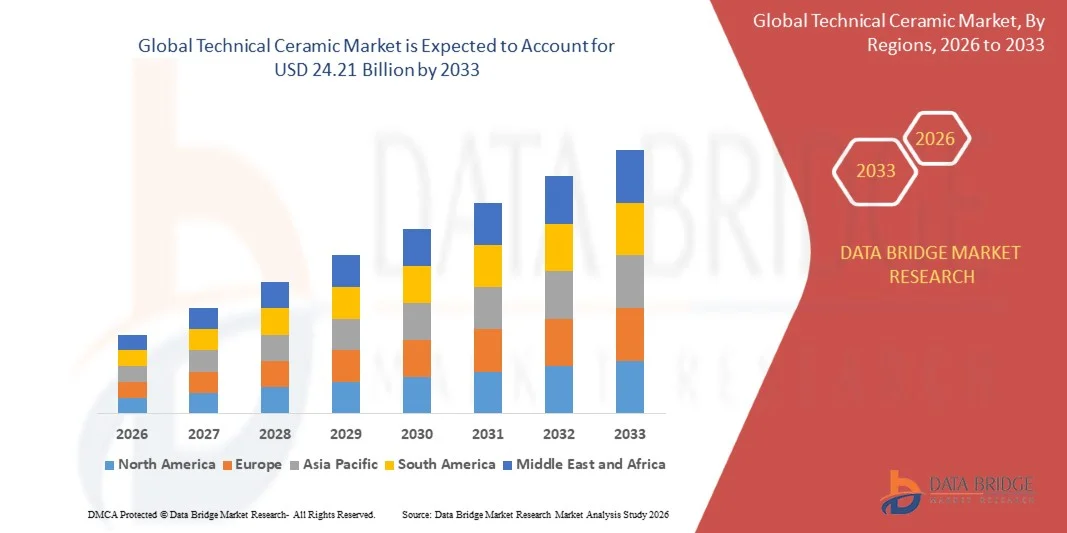
- As per Data Bridge Market Research analysis, the technical ceramic market was valued at USD 13.43 billion in 2025 and is projected to reach USD 24.21 billion by 2033, growing at a CAGR of 7.64% from 2026 to 2033.
- The market is experiencing consistent growth driven by rising demand for high-performance materials across electronics, automotive, medical, semiconductor manufacturing, and industrial machinery applications, supported by the superior thermal, wear, and electrical insulation properties of ceramics over metals and plastics.
- The increasing adoption of ceramic components in electric vehicles, semiconductor fabrication equipment, and medical implants, combined with growing miniaturization of electronic devices, is supporting market adoption. Technical ceramic materials are being applied across ceramic substrates, wear parts, bioceramics, and semiconductor packaging, offering greater thermal stability, durability, and reliability in demanding operating environments.
Market Size & Forecast
- Global Market Value (2025): USD 13.43 Billion
- Expected Market Value (2033): USD 24.21 Billion
- Forecast CAGR (2026–2033): 7.64%
- Leading Region in 2025: Asia-Pacific
- Fastest Growing Region: North America
What are the Major Takeaways of the Technical Ceramic Market?
- Asia-Pacific dominated the technical ceramic market with the largest revenue share of 41.85% in 2025, supported by large electronics and semiconductor manufacturing bases, expanding electric vehicle production, and a strong presence of ceramic component suppliers across China, Japan, and South Korea.
- North America is expected to be the fastest-growing region at a CAGR of 9.12% from 2026 to 2033, fueled by domestic semiconductor investments, aerospace and defense demand, and expanding medical device manufacturing.
- The oxide ceramics segment led the market with a 58.74% share in 2025, driven by the wide use of alumina and zirconia in electronics, medical, and industrial applications.
- Non-oxide ceramics are the fastest-growing material type, projected to register a CAGR of 9.35%, reflecting rising demand for silicon carbide and silicon nitride in power electronics and electric vehicles.
- The monolithic ceramics segment dominated the product category with a 66.20% revenue share in 2025, led by extensive use in substrates, insulators, bearings, and wear-resistant components.
- Electronic devices accounted for 31.45% of the market share in 2025, supported by demand for ceramic substrates, capacitors, and packages in 5G, computing, and power electronics.
- The bioceramics segment is the fastest-growing application category, with a CAGR of 9.60%, driven by increasing use of zirconia and alumina in joint replacements and dental implants.
Report Scope and Technical Ceramic Market Segmentation
|
Attributes |
Technical Ceramic Key Market Insights |
|
Segments Covered |
|
|
Countries Covered |
North America
Europe
Asia-Pacific
Middle East and Africa
South America
|
|
Key Market Players |
|
|
Market Opportunities |
|
|
Value Added Data Infosets |
In addition to the insights on market scenarios such as market value, growth rate, segmentation, geographical coverage, and major players, the market reports curated by the Data Bridge Market Research also include import export analysis, production capacity overview, production consumption analysis, price trend analysis, climate change scenario, supply chain analysis, value chain analysis, raw material/consumables overview, vendor selection criteria, PESTLE Analysis, Porter Analysis, and regulatory framework. |
What is the Key Trend in the Technical Ceramic Market?
- Technical ceramics are increasingly shifting from conventional pressed and sintered shapes toward precision-engineered, additively manufactured, and application-specific components, combining high-purity materials, tighter tolerances, and digital manufacturing methods to serve semiconductor, electric vehicle, and medical applications.
- For instance, in December 2024, according to the International Journal of Minerals, Metallurgy and Materials, researchers published a critical review of direct laser additive manufacturing of ceramics, covering Al2O3, ZrO2, SiC, and related systems and highlighting the ability to form ceramics without molds and adhesives in a single step, reflecting growing momentum behind additive manufacturing of high-performance ceramics
- Demand for silicon carbide, silicon nitride, and other non-oxide ceramics is rising as power electronics, electric drivetrains, and semiconductor processing equipment require materials that withstand extreme heat, plasma exposure, and wear.
- Medical and dental applications are emerging as an important growth area, as zirconia and alumina bioceramics combine biocompatibility with long service life in joint replacement, implant, and surgical device components.
- For instance, in July 2025, according to The American Ceramic Society (ACerS), Kyocera Fineceramics Europe introduced a process for additive manufacturing of silicon-infiltrated silicon carbide components at its Selb site in Germany, demonstrating the commercial adoption of 3D printing for complex technical ceramic parts
- As additive manufacturing, non-oxide material adoption, and application-specific engineering continue to advance, technical ceramics are expected to expand beyond conventional insulators and wear parts into power electronics, energy systems, and medical devices.
What are the Key Drivers of the Technical Ceramic Market?
- Rapid expansion of semiconductor manufacturing, electric vehicle production, and 5G electronics is increasing demand for ceramic components that offer thermal stability, electrical insulation, and resistance to wear and corrosion.
- For instance, in May 2025, according to the International Energy Agency (IEA), global electric car sales exceeded 17 million in 2024 and were expected to surpass 20 million in 2025, supporting demand for ceramic substrates, bearings, and thermal management components used in electric drivetrains and power electronics
- Semiconductor equipment makers, automotive suppliers, medical device companies, and industrial manufacturers are increasingly replacing metals and polymers with technical ceramics to improve component lifetime, reduce contamination, and withstand harsher operating conditions.
- For instance, in July 2025, according to SEMI, global sales of semiconductor manufacturing equipment were forecast to reach a record USD 125.5 billion in 2025, a 7.4% year-on-year increase, supporting demand for ceramic chamber components, wafer-handling parts, and insulators used in fabrication equipment
- With electrification, advanced electronics, and precision healthcare continuing to scale, technical ceramics are positioned as enabling materials across multiple high-growth industries.
What Factors Are Challenging the Growth of the Technical Ceramic Market?
- Technical ceramics require high-purity powders, high-temperature sintering, and precision finishing, which increase production costs and energy consumption compared with metals and polymers.
- For instance, in June 2024, according to Additive Manufacturing Frontiers, a review of ceramic additive manufacturing reported that deformation, cracking, and significant shrinkage during high-temperature sintering continue to limit shape accuracy and performance control, constraining wider adoption of 3D-printed ceramic components
- The brittleness of ceramics, the difficulty of machining sintered parts, and the need for tight dimensional tolerances can raise scrap rates and lengthen lead times, particularly for complex geometries.
- Energy-intensive kilns and exposure to carbon pricing also add cost pressure, especially for manufacturers operating in regions with high energy prices and tightening emission regulations.
- For instance, in December 2025, according to Cerame-Unie, the cumulative costs assessment presented at the European Ceramic Days in Brussels indicated that high energy costs, CO2 prices, and regulatory burdens are increasing pressure on the ceramic sector, with potential consequences for production levels and employment in Europe
- The combination of high manufacturing costs, energy dependence, and processing complexity can constrain adoption among cost-sensitive users, particularly where conventional metals and polymers already satisfy performance requirements.
How is the Technical Ceramic Market Segmented?
The technical ceramic market is segmented on the basis of material, product, application, and end-user.
- By Material
On the basis of material, the technical ceramic market is segmented into oxide ceramics, non-oxide ceramics, and others. The oxide ceramics segment dominated the market with 58.74% share in 2025, supported by widespread use of alumina, zirconia, and titanate ceramics in electronics, medical, and industrial applications. Oxide ceramics offer strong electrical insulation, chemical stability, and cost advantages over many non-oxide alternatives. They are widely used in substrates, insulators, wear parts, and implants. Mature manufacturing processes and broad supplier availability further strengthen demand. Established qualification across regulated medical and electronic uses also supports continued adoption.
The non-oxide ceramics segment is projected to register the fastest growth at a CAGR of 9.35% from 2026 to 2033, driven by increasing demand for silicon carbide, silicon nitride, and aluminum nitride in power electronics, electric vehicles, and semiconductor equipment. These materials provide high thermal conductivity, strength, and resistance to extreme temperatures and plasma. Silicon nitride is increasingly used in bearings and substrates for electric drivetrains, while silicon carbide supports wafer processing and high-temperature components. Advances in sintering and additive manufacturing are expanding available geometries. Growing investment in power semiconductors and electrified mobility is creating additional demand.
- By Product
On the basis of product, the technical ceramic market is segmented into monolithic ceramics, ceramic matrix composites, ceramic coatings, and others. The monolithic ceramics segment dominated the market with 66.20% share in 2025, supported by extensive use in substrates, insulators, seals, bearings, and wear-resistant components. Single-phase ceramic bodies can be produced in large volumes with consistent properties, making them suitable for electronics and industrial equipment. Their high hardness, dielectric strength, and chemical resistance support broad adoption. Established supply chains and well-understood processing routes continue to reinforce the segment.
The ceramic matrix composites segment is projected to register the fastest growth at a CAGR of 10.18% from 2026 to 2033, driven by increasing demand for lightweight, damage-tolerant materials in aerospace, defense, and energy applications. Fiber-reinforced ceramics can operate at temperatures beyond the limits of many metal alloys while reducing weight. Their use in turbine components, thermal protection systems, and braking systems is expanding. Progress in fiber production and matrix infiltration methods is improving performance and consistency. Rising investment in high-temperature propulsion and power generation technologies is creating further opportunities.
- By Application
On the basis of application, the technical ceramic market is segmented into electrical equipment, catalyst supports, electronic devices, wear parts, engine parts, filters, bioceramics, and others. The electronic devices segment dominated the application category with 31.45% share in 2025, supported by demand for ceramic substrates, capacitors, packages, and insulators in 5G equipment, computing, and power electronics. Ceramics provide stable dielectric behavior and efficient heat dissipation in miniaturized, high-frequency devices. Continued growth in connected devices and electrified systems is increasing component volumes. Semiconductor packaging requirements for reliability and thermal control further support demand.
The bioceramics segment is projected to register the fastest growth at a CAGR of 9.60% from 2026 to 2033, driven by increasing use of zirconia and alumina in joint replacements, dental implants, and bone graft applications. Bioceramics combine biocompatibility with high wear resistance and long service life. Aging populations and rising elective orthopedic and dental procedures are increasing implant volumes. Manufacturers are expanding dedicated medical ceramic production capacity to meet sustained demand. Improvements in material toughness and surface finishing are further strengthening clinical adoption and surgeon acceptance.
- By End-User
On the basis of end-user, the technical ceramic market is segmented into electrical and electronics, automotive, machinery, environmental, medical, and others. The electrical and electronics segment dominated the end-user category with 37.92% share in 2025, supported by extensive use of ceramics in substrates, insulators, capacitors, and semiconductor processing equipment. Electronics manufacturers rely on ceramics for thermal management, electrical insulation, and dimensional stability. Growth in data infrastructure, communications equipment, and power conversion systems is increasing consumption. Continued investment in semiconductor fabrication capacity is creating further demand for high-purity ceramic components.
The medical segment is projected to register the fastest growth at a CAGR of 9.84% from 2026 to 2033, driven by rising demand for ceramic implants, surgical components, and diagnostic equipment parts. Healthcare providers are adopting materials that offer biocompatibility, low wear, and durability. Expanding access to orthopedic and dental care in emerging economies is widening the patient base. Manufacturers are investing in cleanroom production and quality systems required for regulated medical products. Demand for long-lasting implants that reduce revision procedures is also supporting adoption across developed markets.
Which Region Holds the Largest Share of the Technical Ceramic Market?
- Asia-Pacific dominated the technical ceramic market with the largest revenue share of 41.85% in 2025, supported by large electronics and semiconductor manufacturing bases, expanding electric vehicle production, and a strong presence of ceramic component suppliers.
- The region also benefits from government support for advanced manufacturing, cost-efficient production capabilities, and growing investment in healthcare infrastructure. Increasing use of technical ceramics in power electronics, semiconductor equipment, medical implants, and industrial machinery continues to strengthen Asia-Pacific’s position in the global market.
China Technical Ceramic Market Insight
The China technical ceramic market is growing rapidly, driven by large-scale electronics manufacturing, the world’s largest electric vehicle market, and expanding semiconductor and renewable energy investments. Domestic producers are scaling output of alumina, silicon carbide, and silicon nitride components for substrates, bearings, and industrial equipment. Government support for advanced materials, strong supply chains, and competitive manufacturing costs are positioning China as the largest national contributor to regional demand and a key hub for ceramic component production.
North America Technical Ceramic Market Insight
The North America technical ceramic market is expected to witness the fastest growth, driven by investment in domestic semiconductor fabrication, aerospace and defense programs, and medical device manufacturing. Reshoring of electronics production and growing demand for high-performance materials in clean energy applications are increasing local consumption. The region’s strong research base and presence of established ceramic manufacturers are supporting innovation in advanced ceramics, including ceramic matrix composites and additively manufactured components.
U.S. Technical Ceramic Market Insight
The U.S. technical ceramic market is witnessing strong growth due to rising semiconductor manufacturing investment, defense and aerospace requirements, and expanding medical device production. Ceramic components are increasingly used in wafer processing equipment, armor systems, turbine components, and orthopedic implants. Growing focus on supply chain resilience and domestic advanced materials production is encouraging manufacturers to expand capacity, while research funding for high-temperature and lightweight ceramics is supporting further adoption.
Japan Technical Ceramic Market Insight
The Japan technical ceramic market is witnessing consistent growth owing to the country’s leadership in fine ceramics, electronic components, and semiconductor materials. Leading manufacturers are investing in new production capacity for semiconductor-related ceramic components and packages. Strong demand for precision, purity, and reliability from electronics, automotive, and industrial customers, along with continued innovation in materials such as silicon nitride, is contributing to market growth in Japan.
Germany Technical Ceramic Market Insight
The Germany technical ceramic market is expanding steadily due to the country’s strong automotive, machinery, and medical technology industries. German manufacturers produce advanced ceramics for hip implants, sensors, pumps, and industrial components, and are expanding medical ceramic production capacity. Emphasis on energy-efficient manufacturing, precision engineering, and export-oriented industry, along with demand from electric mobility and power electronics, is further driving market growth in the country.
U.K. Technical Ceramic Market Insight
The U.K. technical ceramic market is experiencing steady growth, supported by demand from aerospace, defense, energy, and medical applications. Established advanced materials companies supply piezoelectric, structural, and thermal ceramics to industrial and scientific customers. Growing interest in additive manufacturing, nuclear and clean energy components, and high-temperature materials is supporting wider adoption of technical ceramics, although higher energy costs remain an important consideration for domestic producers.
Which are the Top Companies in Technical Ceramic Market?
The technical ceramic industry is primarily led by well-established companies, including:
- CoorsTek, Inc. (U.S.)
- CeramTec GmbH (Germany)
- Kyocera Corporation (Japan)
- Morgan Advanced Materials (U.K.)
- Saint-Gobain (France)
- Niterra Co., Ltd. (Japan)
- 3M (U.S.)
- McDanel Advanced Ceramic Technologies (U.S.)
- Rauschert GmbH (Germany)
- STC Superior Technical Ceramics (U.S.)
- Elan Technology (U.S.)
- OC Oerlikon Management AG (Switzerland)
- Mingrui Ceramic (China)
- DuPont (U.S.)
- HOPE Microelectronics CO Ltd. (Japan)
- Honeywell International Inc. (U.S.)
- Shin-Etsu Chemical Co., Ltd. (Japan)
- Albemarle Corporation (U.S.)
- Materion Corporation (U.S.)
- Applied Ceramics (U.S.)
What are Latest Developments in Technical Ceramic Market?
- In August 2025, Niterra Co., Ltd. announced the establishment of Niterra Materials following its acquisition of Toshiba Materials Co., Ltd., which had been agreed in November 2024 at approximately USD 948.15 million. The integration is intended to expand investment in advanced materials, particularly silicon nitride components for e-mobility applications such as ceramic balls for electric powertrain bearings and heat dissipation substrates for power semiconductors.
- In January 2025, Kyocera made a EUR 5 million investment in TactoTek, a developer of in-mold structural electronics technology, marking a strategic partnership between the companies. Kyocera plans to incorporate its HAPTIVITY piezoceramic actuators into in-mold structural electronics-based human-machine interfaces, creating thinner and lighter tactile feedback solutions.
- In August 2024, Kyocera Corporation held a groundbreaking ceremony for a new production plant in Isahaya, Nagasaki Prefecture, Japan, designed to produce fine ceramic components for semiconductor-related applications and semiconductor packages. The company plans to invest approximately 429.82 million by the end of March 2028, with production targeted to begin in 2026.
- In September 2023, CeramTec held a ground-breaking ceremony for a new medical technology production building at its Marktredwitz site in Germany, citing sustained high demand for advanced ceramics for medical applications. The first construction phase covers around 11,000 m², with the building planned to be completed and fully commissioned by 2026.
- In July 2022, CoorsTek announced that its board of directors had approved a capital expenditure plan to expand its semiconductor ceramics business in Japan, adding manufacturing capabilities at existing facilities in Oguni, Yamagata Prefecture, and Kawatana, Nagasaki Prefecture, with start-up of the additional capacity planned for 2024.

- Interactive Data Analysis Dashboard
- Company Analysis Dashboard for high growth potential opportunities
- Research Analyst Access for customization & queries
- Competitor Analysis with Interactive dashboard
- Latest News, Updates & Trend analysis
- Harness the Power of Benchmark Analysis for Comprehensive Competitor Tracking
Global Technical Ceramic Market, Supply Chain Analysis and Ecosystem Framework
To support market growth and help clients navigate the impact of geopolitical shifts, DBMR has integrated in-depth supply chain analysis into its Global Technical Ceramic Market research reports. This addition empowers clients to respond effectively to global changes affecting their industries. The supply chain analysis section includes detailed insights such as Global Technical Ceramic Market consumption and production by country, price trend analysis, the impact of tariffs and geopolitical developments, and import and export trends by country and HSN code. It also highlights major suppliers with data on production capacity and company profiles, as well as key importers and exporters. In addition to research, DBMR offers specialized supply chain consulting services backed by over a decade of experience, providing solutions like supplier discovery, supplier risk assessment, price trend analysis, impact evaluation of inflation and trade route changes, and comprehensive market trend analysis.
Data collection and base year analysis are done using data collection modules with large sample sizes. The stage includes obtaining market information or related data through various sources and strategies. It includes examining and planning all the data acquired from the past in advance. It likewise envelops the examination of information inconsistencies seen across different information sources. The market data is analysed and estimated using market statistical and coherent models. Also, market share analysis and key trend analysis are the major success factors in the market report. To know more, please request an analyst call or drop down your inquiry.
The key research methodology used by DBMR research team is data triangulation which involves data mining, analysis of the impact of data variables on the market and primary (industry expert) validation. Data models include Vendor Positioning Grid, Market Time Line Analysis, Market Overview and Guide, Company Positioning Grid, Patent Analysis, Pricing Analysis, Company Market Share Analysis, Standards of Measurement, Global versus Regional and Vendor Share Analysis. To know more about the research methodology, drop in an inquiry to speak to our industry experts.
Data Bridge Market Research is a leader in advanced formative research. We take pride in servicing our existing and new customers with data and analysis that match and suits their goal. The report can be customized to include price trend analysis of target brands understanding the market for additional countries (ask for the list of countries), clinical trial results data, literature review, refurbished market and product base analysis. Market analysis of target competitors can be analyzed from technology-based analysis to market portfolio strategies. We can add as many competitors that you require data about in the format and data style you are looking for. Our team of analysts can also provide you data in crude raw excel files pivot tables (Fact book) or can assist you in creating presentations from the data sets available in the report.













