


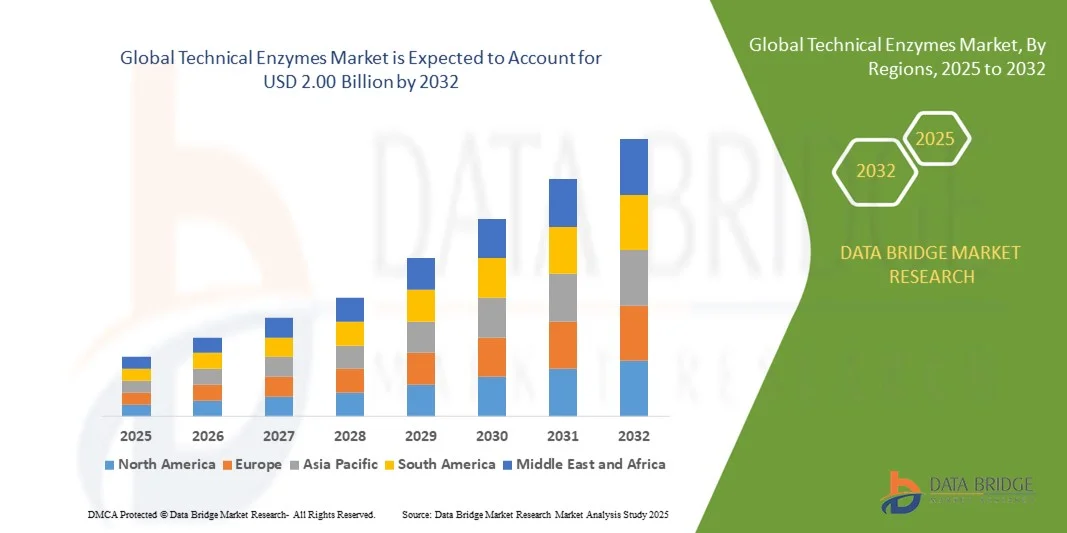
Technical Enzymes Market Size
- The global technical enzymes market size was valued at USD 1.37 billion in 2024 and is expected to reach USD 2.00 billion by 2032, at a CAGR of 4.82% during the forecast period
- The market growth is largely fuelled by increasing demand from various industrial applications, including biofuels, textiles, leather processing, and pulp & paper, where enzymes enhance efficiency, reduce energy consumption, and lower environmental impact
- In addition, technological advancements in enzyme engineering, such as protein modification and immobilization techniques, are enabling the development of more stable, efficient, and cost-effective enzymes for industrial use
Technical Enzymes Market Analysis
- The technical enzymes market is witnessing steady growth due to their ability to catalyze industrial processes under milder conditions, minimizing chemical usage and improving overall process sustainability
- Rising environmental regulations and the need for eco-friendly industrial processes are driving industries to adopt enzyme-based solutions that reduce waste, water usage, and greenhouse gas emissions
- North America dominated the technical enzymes market with the largest revenue share of 32.45% in 2024, driven by high adoption of enzyme-assisted industrial processes, stringent environmental regulations, and increasing focus on sustainable manufacturing practices
- Asia-Pacific region is expected to witness the highest growth rate in the global technical enzymes market, driven by rising industrialization, technological advancements, government initiatives promoting green manufacturing, and increasing demand for sustainable industrial processes in countries such as China, India, and Japan
- The amylases segment held the largest market revenue share in 2024, driven by their extensive use in starch processing, bioethanol production, and food industries. Amylases are preferred due to their efficiency in breaking down complex carbohydrates into simpler sugars, improving production yields and process efficiency across multiple industrial applications
Report Scope and Technical Enzymes Market Segmentation
|
Attributes |
Technical Enzymes Key Market Insights |
|
Segments Covered |
|
|
Countries Covered |
North America
Europe
Asia-Pacific
Middle East and Africa
South America
|
|
Key Market Players |
• BASF SE (Germany) |
|
Market Opportunities |
|
|
Value Added Data Infosets |
In addition to the insights on market scenarios such as market value, growth rate, segmentation, geographical coverage, and major players, the market reports curated by the Data Bridge Market Research also include in-depth expert analysis, pricing analysis, brand share analysis, consumer survey, demography analysis, supply chain analysis, value chain analysis, raw material/consumables overview, vendor selection criteria, PESTLE Analysis, Porter Analysis, and regulatory framework. |
Technical Enzymes Market Trends
Increasing Adoption of Enzymes for Industrial Process Optimization
- The growing shift toward enzyme-based solutions is transforming industrial processes across sectors such as biofuels, textiles, leather, and pulp & paper by improving efficiency, reducing energy consumption, and lowering environmental impact. The use of technical enzymes allows for milder reaction conditions, faster processing, and reduced chemical waste, resulting in cost savings and sustainable production. In addition, enzymes facilitate consistent product quality, reduce dependency on harsh chemicals, and enable industries to meet stricter environmental standards
- High demand for eco-friendly and sustainable industrial processes is accelerating the adoption of technical enzymes in emerging and traditional industries. These biocatalysts are particularly effective in replacing harsh chemicals and minimizing environmental footprint, which aligns with regulatory pressures and consumer preferences for green products. The increasing focus on corporate sustainability goals and green manufacturing certifications is further encouraging industries to incorporate enzyme-based technologies
- The ease of integration and operational efficiency of modern enzymes makes them attractive for routine industrial applications, enhancing product quality and process consistency. Companies benefit from higher yields, reduced downtime, and lower operational costs, supporting overall industrial competitiveness. Moreover, the flexibility of enzyme formulations allows for customization to meet specific industrial process requirements, improving efficiency and scalability
- For instance, in 2023, several biofuel and textile manufacturers in Europe reported significant reductions in energy usage and chemical consumption after adopting immobilized enzyme technologies for production. These enzymes improved process efficiency while maintaining product quality, resulting in lower operational expenses and environmental benefits. Adoption of enzyme solutions also led to faster process turnaround, reduced waste generation, and enhanced regulatory compliance
- While technical enzymes are enabling sustainable and efficient industrial processes, their impact depends on continued R&D, scalability, and affordability. Manufacturers must focus on developing tailored enzyme solutions and deployment strategies to fully leverage market growth. Investments in innovative enzyme engineering, such as protein modification and thermostable variants, are critical to enhancing functionality and expanding industrial applications
Technical Enzymes Market Dynamics
Driver
Increasing Demand for Sustainable and Eco-Friendly Industrial Processes
- Rising environmental regulations and sustainability initiatives are pushing industries to adopt enzyme-based solutions over traditional chemical catalysts. Enzymes help reduce water usage, chemical waste, and greenhouse gas emissions, supporting compliance and sustainable operations. The growing emphasis on ESG (Environmental, Social, Governance) initiatives is also driving companies to implement greener technologies and reduce their ecological footprint
- Industrial players are increasingly aware of the operational and financial benefits of enzyme adoption, including enhanced efficiency, lower energy costs, and improved product quality. This awareness is driving wider adoption across multiple sectors, including textiles, biofuels, detergents, and leather processing. The cost-effectiveness and performance reliability of enzymes compared to chemical alternatives are encouraging long-term investment in enzyme technologies
- Government incentives, green certifications, and industrial collaborations are strengthening the adoption framework for technical enzymes. Policies promoting eco-friendly manufacturing and sustainable practices provide an enabling environment for enzyme market growth. Strategic partnerships between enzyme manufacturers and end-user industries are facilitating innovation, knowledge transfer, and customized enzyme solutions
- For instance, in 2022, several European chemical and textile manufacturers received government grants to implement enzyme-assisted processing technologies, boosting the adoption of technical enzymes and enhancing industrial sustainability. These initiatives also encouraged R&D in enzyme optimization and industrial-scale application, increasing overall market penetration and efficiency
- While demand and institutional support are strong, there is still a need to improve enzyme cost-effectiveness, operational stability, and sector-specific customization to sustain long-term adoption. Continuous education, training programs, and awareness campaigns are also essential to expand enzyme utilization across small and medium-sized enterprises
Restraint/Challenge
High Cost of Advanced Enzyme Technologies and Limited Industrial Awareness
- The high cost of specialized enzymes, including immobilized and genetically engineered variants, limits accessibility for small and medium-sized enterprises. These advanced enzyme technologies are often deployed only in large-scale industrial operations, creating a barrier for widespread adoption. High initial capital investment, coupled with ongoing operational costs, restricts the market potential for smaller players
- In many regions, there is limited awareness and technical expertise regarding enzyme application and optimization, reducing uptake and process efficiency. The absence of trained personnel and advisory support can hinder effective implementation. This knowledge gap also slows the adoption of advanced enzyme formulations and limits innovation in local industrial processes
- Supply chain challenges, including availability of specific enzyme formulations and storage conditions, further restrict market penetration in developing and remote industrial regions. Dependence on imports for high-quality enzymes adds to costs and delays. Inconsistent supply and logistical challenges can also impact production schedules, reducing reliability and confidence in enzyme adoption
- For instance, in 2023, several small-scale textile and leather manufacturers in Southeast Asia reported limited access to specialized enzyme solutions, citing high costs and insufficient technical support as primary barriers. The lack of local distributors, coupled with limited technical training, constrained the effective utilization of enzyme technologies and delayed process modernization
- While enzyme technologies continue to evolve, addressing cost, availability, and technical knowledge gaps remains crucial. Stakeholders must focus on decentralized enzyme production, training programs, and scalable, sector-specific solutions to unlock long-term industrial adoption. Strategic collaborations, innovation in cost-effective formulations, and localized support services are essential to expand market growth and maximize industrial benefits
Technical Enzymes Market Scope
The market is segmented on the basis of type, form, application, and source.
- By Type
On the basis of type, the technical enzymes market is segmented into amylases, cellulases, proteases, lipases, and other. The amylases segment held the largest market revenue share in 2024, driven by their extensive use in starch processing, bioethanol production, and food industries. Amylases are preferred due to their efficiency in breaking down complex carbohydrates into simpler sugars, improving production yields and process efficiency across multiple industrial applications.
The proteases segment is expected to witness the fastest growth rate from 2025 to 2032, driven by rising adoption in detergents, leather, and textile industries. Proteases offer high catalytic activity, cost-effectiveness, and eco-friendly alternatives to chemical treatments, making them increasingly popular for industrial processes requiring precise protein degradation.
- By Form
On the basis of form, the market is segmented into liquid and dry. The liquid enzymes segment dominated the market in 2024 due to their ease of handling, immediate solubility, and rapid action in industrial processes. Liquid formulations are widely used in bioethanol and food processing sectors for efficient and consistent enzymatic activity.
The dry enzymes segment is expected to witness rapid growth from 2025 to 2032, owing to their stability, longer shelf life, and suitability for transport in bulk quantities. Dry formulations are particularly favored in applications such as detergents, paper and pulp, and textile processing where controlled dosage and storage stability are critical.
- By Application
On the basis of application, the market is segmented into bioethanol, paper and pulp, textile and leather, starch processing, and other. The starch processing segment held the largest market revenue share in 2024, driven by the growing demand for sugar syrups, sweeteners, and biofuels. Technical enzymes improve process efficiency, reduce energy consumption, and enhance yield in starch-based industries.
The bioethanol segment is expected to witness the fastest growth rate from 2025 to 2032, driven by increasing global emphasis on renewable energy and sustainable fuel alternatives. Enzyme-assisted bioethanol production offers faster saccharification and fermentation, higher ethanol yield, and lower environmental impact compared to conventional chemical processes.
- By Source
On the basis of source, the market is segmented into animals, micro-organisms, and plants. The micro-organisms segment dominated the market in 2024, owing to high enzyme yield, ease of production, cost-effectiveness, and versatility across multiple industrial applications. Microbial enzymes are preferred due to their stability, scalability, and ability to be genetically engineered for improved performance.
The plant-derived enzymes segment is expected to witness significant growth from 2025 to 2032, driven by increasing preference for natural and sustainable enzyme sources in food, pharmaceutical, and cosmetic industries. Plant-based enzymes are valued for their biodegradability, eco-friendliness, and suitability for organic and green industrial processes.
Technical Enzymes Market Regional Analysis
- North America dominated the technical enzymes market with the largest revenue share of 32.45% in 2024, driven by high adoption of enzyme-assisted industrial processes, stringent environmental regulations, and increasing focus on sustainable manufacturing practices
- Consumers and industrial players in the region highly value the efficiency, eco-friendliness, and cost-saving benefits offered by technical enzymes across sectors such as bioethanol, textile, paper and pulp, and starch processing
- This widespread adoption is further supported by strong industrial infrastructure, high R&D investment, and growing demand for green technologies, establishing technical enzymes as a preferred solution for both large-scale and small-to-medium industrial operations
U.S. Technical Enzymes Market Insight
The U.S. technical enzymes market captured the largest revenue share in 2024 within North America, fueled by the rapid adoption of enzyme-based solutions in biofuel production, textile processing, and food industries. Companies are increasingly focusing on process optimization, cost reduction, and environmental sustainability, which is driving demand for customized and high-performance enzyme formulations. Moreover, government incentives, green certifications, and industrial collaborations are significantly contributing to market expansion.
Europe Technical Enzymes Market Insight
The Europe technical enzymes market is expected to witness the fastest growth rate from 2025 to 2032, primarily driven by stringent environmental regulations and the rising emphasis on sustainable and energy-efficient industrial processes. The adoption of enzymes in bioethanol, pulp & paper, and textile industries is increasing due to regulatory compliance, eco-conscious consumer demand, and operational efficiency improvements.
U.K. Technical Enzymes Market Insight
The U.K. technical enzymes market is expected to witness robust growth from 2025 to 2032, driven by increasing adoption of eco-friendly industrial processes and focus on reducing carbon footprint across manufacturing sectors. Government policies promoting sustainable production, along with industrial investment in enzyme-based solutions, are boosting market penetration.
Germany Technical Enzymes Market Insight
The Germany technical enzymes market is expected to witness substantial growth from 2025 to 2032, fueled by the country’s strong emphasis on industrial innovation, sustainability, and energy-efficient manufacturing. German industries are increasingly adopting technical enzymes to enhance process efficiency, reduce chemical usage, and meet strict environmental standards. The integration of enzyme solutions with advanced industrial processes is also becoming more prevalent.
Asia-Pacific Technical Enzymes Market Insight
The Asia-Pacific technical enzymes market is expected to witness the fastest growth rate from 2025 to 2032, driven by rapid industrialization, rising disposable incomes, and technological advancements in countries such as China, India, and Japan. The region’s growing focus on sustainable industrial practices and government initiatives promoting green manufacturing are supporting the adoption of technical enzymes.
Japan Technical Enzymes Market Insight
The Japan technical enzymes market is expected to witness strong growth from 2025 to 2032 due to the country’s advanced industrial infrastructure, high technological adoption, and emphasis on eco-friendly manufacturing. The use of enzymes in bioethanol production, food processing, and textiles is accelerating, supported by a focus on efficiency, quality, and sustainability.
China Technical Enzymes Market Insight
The China technical enzymes market accounted for the largest revenue share in Asia-Pacific in 2024, driven by rapid industrial growth, expanding bio-based industries, and rising environmental awareness. China’s emphasis on sustainable industrial processes, combined with a strong domestic enzyme manufacturing base, is facilitating wider adoption across bioethanol, textile, and paper and pulp sectors, propelling overall market growth.
Technical Enzymes Market Share
The Technical Enzymes industry is primarily led by well-established companies, including:
• BASF SE (Germany)
• DuPont (U.S.)
• Associated British Foods plc (U.K.)
• DSM (Netherlands)
• Novozymes (Denmark)
• Dyadic International Inc (U.S.)
• Advanced Enzyme Technologies (India)
• Maps Enzymes Ltd. (U.K.)
• EPYGEN LABS LLC. (U.S.)
• Megazyme (Ireland)
• Noor Enzymes Pvt Ltd (India)
• Nature BioScience Pvt. L.T.D. (India)
• Biocatalysts (U.K.)
• Amano Enzyme Inc. (Japan)
• Aumgene Biosciences (India)
• AB Enzymes (Germany)
• Biolaxi Corporation (U.S.)
• Deerland Probiotics & Enzymes, Inc. (U.S.)

- Interactive Data Analysis Dashboard
- Company Analysis Dashboard for high growth potential opportunities
- Research Analyst Access for customization & queries
- Competitor Analysis with Interactive dashboard
- Latest News, Updates & Trend analysis
- Harness the Power of Benchmark Analysis for Comprehensive Competitor Tracking
Global Technical Enzymes Market, Supply Chain Analysis and Ecosystem Framework
To support market growth and help clients navigate the impact of geopolitical shifts, DBMR has integrated in-depth supply chain analysis into its Global Technical Enzymes Market research reports. This addition empowers clients to respond effectively to global changes affecting their industries. The supply chain analysis section includes detailed insights such as Global Technical Enzymes Market consumption and production by country, price trend analysis, the impact of tariffs and geopolitical developments, and import and export trends by country and HSN code. It also highlights major suppliers with data on production capacity and company profiles, as well as key importers and exporters. In addition to research, DBMR offers specialized supply chain consulting services backed by over a decade of experience, providing solutions like supplier discovery, supplier risk assessment, price trend analysis, impact evaluation of inflation and trade route changes, and comprehensive market trend analysis.
Data collection and base year analysis are done using data collection modules with large sample sizes. The stage includes obtaining market information or related data through various sources and strategies. It includes examining and planning all the data acquired from the past in advance. It likewise envelops the examination of information inconsistencies seen across different information sources. The market data is analysed and estimated using market statistical and coherent models. Also, market share analysis and key trend analysis are the major success factors in the market report. To know more, please request an analyst call or drop down your inquiry.
The key research methodology used by DBMR research team is data triangulation which involves data mining, analysis of the impact of data variables on the market and primary (industry expert) validation. Data models include Vendor Positioning Grid, Market Time Line Analysis, Market Overview and Guide, Company Positioning Grid, Patent Analysis, Pricing Analysis, Company Market Share Analysis, Standards of Measurement, Global versus Regional and Vendor Share Analysis. To know more about the research methodology, drop in an inquiry to speak to our industry experts.
Data Bridge Market Research is a leader in advanced formative research. We take pride in servicing our existing and new customers with data and analysis that match and suits their goal. The report can be customized to include price trend analysis of target brands understanding the market for additional countries (ask for the list of countries), clinical trial results data, literature review, refurbished market and product base analysis. Market analysis of target competitors can be analyzed from technology-based analysis to market portfolio strategies. We can add as many competitors that you require data about in the format and data style you are looking for. Our team of analysts can also provide you data in crude raw excel files pivot tables (Fact book) or can assist you in creating presentations from the data sets available in the report.













