


Technical Illustration Software Market Size
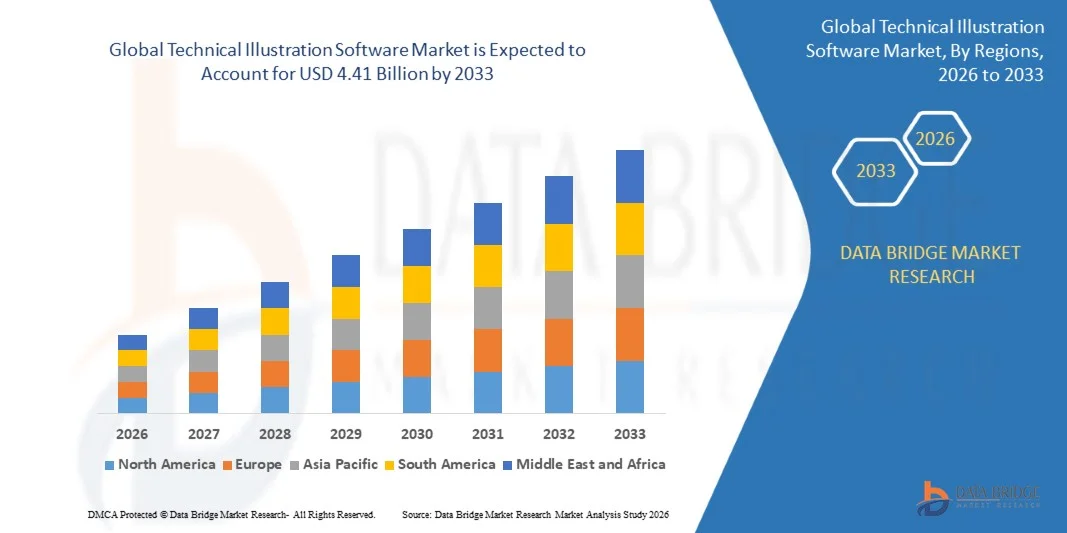
- The global technical illustration software market size was valued at USD 2.78 billion in 2025 and is expected to reach USD 4.41 billion by 2033, at a CAGR of 5.95% during the forecast period
- The market growth is largely fueled by the increasing adoption of digital engineering workflows and advanced visualization tools across industries such as aerospace, automotive, healthcare, and manufacturing, leading to improved accuracy in product representation and technical communication
- Furthermore, rising demand for high-quality visual documentation, complex product design requirements, and the integration of AI-driven illustration tools is encouraging organizations to replace traditional manual drafting methods with automated technical illustration software solutions, significantly improving productivity and design efficiency
Technical Illustration Software Market Analysis
- Technical illustration software, enabling precise creation of diagrams, schematics, and instructional visuals, is becoming an essential component of modern product design, engineering documentation, and training material development across both industrial and enterprise applications due to its ability to enhance clarity and standardization
- The escalating demand for technical illustration software is primarily driven by the expansion of digital product development cycles, increasing complexity of engineered products, and a growing preference for cloud-based collaborative platforms that support real-time editing, sharing, and version control across distributed teams
- North America dominated the technical illustration software market with a share of5% in 2025, due to the strong presence of advanced manufacturing industries, aerospace sector, and early adoption of digital design technologies
- Asia-Pacific is expected to be the fastest growing region in the technical illustration software market during the forecast period due to rapid industrialization, increasing adoption of digital technologies, and expansion of manufacturing activities across emerging economies
- Vector segment dominated the market with a market share of 59.1% in 2025, due to its ability to create scalable, high-precision illustrations without loss of quality, which is critical for technical documentation and engineering drawings. Organizations prefer vector-based tools due to their efficiency in handling complex diagrams, schematics, and product manuals with accuracy and clarity
Report Scope and Technical Illustration Software Market Segmentation
|
Attributes |
Technical Illustration Software Key Market Insights |
|
Segments Covered |
|
|
Countries Covered |
North America · U.S. · Canada · Mexico Europe · Germany · France · U.K. · Netherlands · Switzerland · Belgium · Russia · Italy · Spain · Turkey · Rest of Europe Asia-Pacific · China · Japan · India · South Korea · Singapore · Malaysia · Australia · Thailand · Indonesia · Philippines · Rest of Asia-Pacific Middle East and Africa · Saudi Arabia · U.A.E. · South Africa · Egypt · Israel · Rest of Middle East and Africa South America · Brazil · Argentina · Rest of South America |
|
Key Market Players |
· ASA Computers, Inc. (U.S.) · QuadriSpace Corporation (U.S.) · PTC Inc. (U.S.) · Corel Corporation (Canada) · Canvas GFX Inc. (U.S.) · Cyient (India) · Ignite Technologies, Inc. (U.S.) · Dassault Systèmes (France) · Autodesk Inc. (U.S.) · Siemens Industry Software Inc. (Germany) · Quark Software Inc. (U.S.) · Harita Techserv Limited (India) · The Technical Drawing Company (U.S.) · O’Neil & Associates, Inc. (U.S.) · Maa Illustrations (India) · Adobe Inc. (U.S.) · NBG Drafting & Design (U.S.) · Lattice Technology, Inc. (Japan) |
|
Market Opportunities |
· Expansion of Cloud-Based Collaborative Illustration Platforms · Growing Use in AR/VR-Based Technical Training and Simulation Solutions |
|
Value Added Data Infosets |
In addition to the market insights such as market value, growth rate, market segments, geographical coverage, market players, and market scenario, the market report curated by the Data Bridge Market Research team includes in-depth expert analysis, import/export analysis, pricing analysis, production consumption analysis, and pestle analysis. |
Technical Illustration Software Market Trends
“Increasing Adoption of AI-Powered Illustration and Automation Toolss”
- A significant trend in the technical illustration software market is the rising integration of AI-powered design assistance and automation features that streamline the creation of complex technical diagrams, 3D illustrations, and interactive manuals across engineering and industrial applications. This advancement is enhancing design speed, improving consistency, and reducing manual drafting effort in documentation workflows across multiple sectors
- For instance, Adobe provides advanced illustration capabilities through Adobe Illustrator that are widely used by engineering and product design teams to create precise technical visuals, while Dassault Systèmes offers 3DEXPERIENCE solutions that integrate intelligent design visualization tools for industrial documentation. These platforms support improved visualization accuracy and enable faster production of standardized technical content
- The adoption of AI-enabled illustration tools is expanding in manufacturing and aerospace industries where complex assemblies require highly detailed and error-free technical representations. This is improving design communication between engineering teams and reducing interpretation errors in product development cycles
- Industries such as automotive and mechanical engineering are increasingly using automated illustration features to convert CAD models into technical drawings and service manuals. This is accelerating documentation workflows and ensuring consistency across global production and maintenance operations
- The growing need for interactive and digital-first documentation is encouraging organizations to adopt software that supports animation, 3D rendering, and dynamic illustration capabilities. This is reshaping traditional manual illustration processes into more efficient and scalable digital systems
- The market is witnessing continuous advancement in AI-based visualization technologies that assist in auto-labeling, diagram generation, and content reuse across documentation platforms. This is strengthening the overall shift toward intelligent and automated technical communication systems across industries
Technical Illustration Software Market Dynamics
Driver
“Rising Demand for Digital Technical Documentation Across Engineering Industries”
- The increasing complexity of modern engineering systems and products is driving the demand for accurate and standardized digital technical documentation that supports manufacturing, maintenance, and training activities. This is pushing organizations to adopt technical illustration software to ensure clarity and consistency in visual communication across product lifecycles
- For instance, Siemens uses advanced digital documentation and visualization solutions to support engineering design and maintenance workflows across its industrial automation and energy systems. These tools enable precise technical communication and improve efficiency in large-scale industrial operations
- The expansion of global manufacturing and industrial automation is increasing the need for structured technical manuals and visual guides that can be easily updated and shared across distributed teams. This is reinforcing the adoption of software-based illustration tools in engineering documentation processes
- The aerospace and defense sector is increasingly relying on detailed technical illustrations for assembly instructions, safety manuals, and maintenance procedures. This is enhancing operational accuracy and reducing dependency on traditional paper-based documentation systems
- The growing shift toward digital transformation in engineering workflows continues to strengthen this driver, as organizations prioritize efficient, scalable, and reusable documentation systems. This is positioning technical illustration software as a critical tool for modern industrial communication needs
Restraint/Challenge
“High Cost and Skill Requirement Associated with Advanced Illustration Software”
- The technical illustration software market faces challenges due to the high cost of advanced design tools and licensing models, which can limit adoption among small and medium-sized enterprises. These cost barriers often restrict access to premium features such as 3D modeling, automation, and cloud collaboration capabilities
- For instance, Autodesk provides professional-grade tools such as AutoCAD and related visualization software that require significant investment and trained personnel to operate effectively. These solutions demand both financial resources and skilled users, increasing the overall implementation burden for organizations
- The requirement for specialized technical expertise to operate advanced illustration platforms creates a shortage of skilled professionals capable of handling complex design and visualization tasks. This slows down adoption rates and increases dependency on trained engineers and designers
- Organizations often face additional training costs to upskill employees in using sophisticated illustration and CAD-integrated software systems. This increases operational expenses and extends the time required to fully implement digital documentation solutions
- The market continues to face pressure from cost-sensitive industries that seek simplified and affordable alternatives to advanced illustration platforms. This challenge is influencing software providers to develop more accessible and scalable solutions while maintaining functionality and performance standards
Technical Illustration Software Market Scope
The market is segmented on the basis of type, technology, component, deployment, organization size, and end-user.
- By Type
On the basis of type, the technical illustration software market is segmented into bitmap/raster and vector. The vector segment dominated the market with the largest market revenue share of 59.1% in 2025, driven by its ability to create scalable, high-precision illustrations without loss of quality, which is critical for technical documentation and engineering drawings. Organizations prefer vector-based tools due to their efficiency in handling complex diagrams, schematics, and product manuals with accuracy and clarity. The increasing demand for detailed visual communication in industries such as manufacturing and aerospace further strengthens the adoption of vector illustration software across professional environments.
The bitmap/raster segment is anticipated to witness the fastest growth rate from 2026 to 2033, fueled by rising use in digital content creation and image-based technical documentation. Raster tools are gaining traction for their ability to handle rich visuals, textures, and photorealistic elements, which are increasingly required in training materials and marketing-oriented technical visuals. Advancements in image editing capabilities and integration with AI-based tools are further enhancing their usability in modern technical workflows.
- By Technology
On the basis of technology, the technical illustration software market is segmented into 2D technology and 3D technology. The 2D technology segment dominated the market with the largest market revenue share in 2025, driven by its widespread use in traditional technical documentation, schematics, and instruction manuals. Many industries continue to rely on 2D illustrations due to their simplicity, lower cost, and ease of interpretation for end users. The compatibility of 2D tools with legacy systems and established workflows also supports their continued dominance in sectors such as manufacturing and construction.
The 3D technology segment is expected to witness the fastest growth rate from 2026 to 2033, fueled by increasing adoption of advanced visualization techniques and demand for immersive product representation. 3D illustrations provide enhanced clarity, enabling users to better understand complex assemblies and operational processes. The integration of augmented reality and virtual reality technologies is further accelerating the adoption of 3D illustration tools across industries requiring detailed visual simulations.
- By Component
On the basis of component, the technical illustration software market is segmented into solution, services, and software. The software segment dominated the market with the largest market revenue share in 2025, driven by the core requirement of illustration tools for creating, editing, and managing technical graphics. Continuous innovation in software features, including automation, AI-assisted design, and cloud integration, enhances user productivity and drives widespread adoption across industries. The growing demand for user-friendly and efficient design platforms further contributes to the dominance of the software segment.
The services segment is anticipated to witness the fastest growth rate from 2026 to 2033, fueled by increasing demand for consulting, training, and support services associated with software deployment and optimization. Organizations seek specialized services to maximize the efficiency of technical illustration tools and ensure seamless integration with existing systems. The rising complexity of illustration workflows and need for customization are further boosting the demand for professional services.
- By Deployment
On the basis of deployment, the technical illustration software market is segmented into on-cloud and on-premises. The on-premises segment dominated the market with the largest market revenue share in 2025, driven by concerns related to data security, control, and compliance, especially in industries such as aerospace and defense. Organizations prefer on-premises solutions to maintain strict control over sensitive design data and ensure adherence to regulatory standards. The presence of established IT infrastructure in large enterprises also supports the continued use of on-premises deployment models.
The on-cloud segment is expected to witness the fastest growth rate from 2026 to 2033, fueled by increasing demand for scalability, remote accessibility, and cost-effective deployment solutions. Cloud-based platforms enable real-time collaboration among teams across different locations, enhancing productivity and workflow efficiency. Continuous advancements in cloud security and performance are further encouraging organizations to transition toward cloud-based technical illustration solutions.
- By Organization Size
On the basis of organization size, the technical illustration software market is segmented into large enterprise and small and medium enterprises. The large enterprise segment dominated the market with the largest market revenue share in 2025, driven by significant investments in advanced software solutions and the need for high-quality technical documentation at scale. Large organizations often require comprehensive illustration tools to manage complex projects, extensive product portfolios, and global operations. Their ability to invest in premium solutions and integrate them across departments further strengthens segment growth.
The small and medium enterprises segment is anticipated to witness the fastest growth rate from 2026 to 2033, fueled by increasing digital transformation and growing awareness of the importance of effective technical communication. SMEs are adopting cost-effective and scalable illustration solutions to enhance product documentation and customer engagement. The availability of subscription-based models and cloud solutions is further lowering entry barriers for smaller organizations.
- By End-User
On the basis of end-user, the technical illustration software market is segmented into high-tech and telecommunications, aerospace and defense, automotive and machinery, architecture, engineering and construction, energy, oil and gas, and others. The automotive and machinery segment dominated the market with the largest market revenue share in 2025, driven by the high demand for detailed product manuals, assembly instructions, and maintenance documentation. The complexity of mechanical systems and increasing focus on precision engineering require advanced illustration tools for accurate visual representation. Continuous product innovation and global manufacturing activities further support segment dominance.
The architecture, engineering and construction segment is expected to witness the fastest growth rate from 2026 to 2033, fueled by increasing adoption of digital design tools and the need for clear visualization of complex building structures. Technical illustration software supports enhanced project communication, planning, and execution through detailed visual representations. The growing integration of building information modeling and digital workflows is further accelerating demand within this segment.
Technical Illustration Software Market Regional Analysis
- North America dominated the technical illustration software market with the largest revenue share of 38.5% in 2025, driven by the strong presence of advanced manufacturing industries, aerospace sector, and early adoption of digital design technologies
- Organizations in the region prioritize high-quality technical documentation and visualization tools to enhance product development, training, and maintenance processes across complex industrial environments
- This widespread adoption is further supported by high technology investments, availability of skilled professionals, and increasing integration of illustration software with product lifecycle management systems, strengthening its role across industrial and commercial applications
U.S. Technical Illustration Software Market Insight
The U.S. technical illustration software market captured the largest revenue share in 2025 within North America, fueled by rapid digital transformation across industries such as aerospace, automotive, and high-tech manufacturing. Companies increasingly rely on advanced illustration tools to improve operational efficiency and ensure accurate technical communication. The growing adoption of automation, cloud-based platforms, and integration with engineering software is further driving market growth. Moreover, the presence of leading software providers and continuous innovation in visualization technologies significantly contribute to market expansion.
Europe Technical Illustration Software Market Insight
The Europe technical illustration software market is projected to expand at a substantial CAGR throughout the forecast period, primarily driven by strong industrial base and increasing emphasis on precision engineering and compliance standards. The rising demand for accurate technical documentation in sectors such as automotive and machinery is supporting adoption. European organizations focus on improving operational efficiency and reducing errors through advanced visualization tools. The growing trend of digitalization and Industry 4.0 initiatives is further accelerating market growth across the region.
U.K. Technical Illustration Software Market Insight
The U.K. technical illustration software market is anticipated to grow at a noteworthy CAGR during the forecast period, driven by increasing adoption of digital engineering solutions and the need for efficient technical communication across industries. Businesses are focusing on improving product documentation and enhancing customer understanding through detailed illustrations. The expansion of the manufacturing and construction sectors is further contributing to demand. The country’s strong technological ecosystem and growing investments in digital tools continue to support market development.
Germany Technical Illustration Software Market Insight
The Germany technical illustration software market is expected to expand at a considerable CAGR during the forecast period, fueled by the country’s strong manufacturing sector and emphasis on engineering excellence. German industries require highly detailed and accurate technical illustrations for machinery, automotive systems, and industrial equipment. The adoption of advanced software solutions is supported by ongoing digital transformation initiatives and Industry 4.0 strategies. The integration of technical illustration tools with CAD and PLM systems is further enhancing efficiency and driving growth.
Asia-Pacific Technical Illustration Software Market Insight
The Asia-Pacific technical illustration software market is poised to grow at the fastest CAGR during the forecast period of 2026 to 2033, driven by rapid industrialization, increasing adoption of digital technologies, and expansion of manufacturing activities across emerging economies. China is expected to be the fastest growing country in the region, fueled by strong growth in manufacturing, increasing investments in digital infrastructure, and rising demand for advanced technical documentation solutions. The region is witnessing rising demand for technical illustration software due to increasing focus on product visualization, training, and maintenance documentation across industries such as automotive, construction, and energy
Japan Technical Illustration Software Market Insight
The Japan technical illustration software market is gaining momentum due to the country’s advanced technological landscape and strong focus on precision and quality. Industries in Japan rely heavily on detailed technical documentation to support complex manufacturing and engineering processes. The increasing adoption of 3D visualization and digital tools is enhancing product development and operational efficiency. The integration of illustration software with advanced technologies is further supporting market growth.
China Technical Illustration Software Market Insight
The China technical illustration software market accounted for the largest market revenue share in Asia Pacific in 2025, attributed to rapid industrial expansion, strong manufacturing base, and increasing adoption of digital engineering tools. The demand for technical illustration software is growing across industries to support efficient product design, training, and maintenance processes. Government initiatives promoting digital transformation and smart manufacturing are further accelerating adoption. The availability of cost-effective solutions and expanding industrial ecosystem continue to drive market growth in China.
Technical Illustration Software Market Share
The technical illustration software industry is primarily led by well-established companies, including:
- ASA Computers, Inc. (U.S.)
- QuadriSpace Corporation (U.S.)
- PTC Inc. (U.S.)
- Corel Corporation (Canada)
- Canvas GFX Inc. (U.S.)
- Cyient (India)
- Ignite Technologies, Inc. (U.S.)
- Dassault Systèmes (France)
- Autodesk Inc. (U.S.)
- Siemens Industry Software Inc. (Germany)
- Quark Software Inc. (U.S.)
- Harita Techserv Limited (India)
- The Technical Drawing Company (U.S.)
- O’Neil & Associates, Inc. (U.S.)
- Maa Illustrations (India)
- Adobe Inc. (U.S.)
- NBG Drafting & Design (U.S.)
- Lattice Technology, Inc. (Japan)
Latest Developments in Global Technical Illustration Software Market
- In February 2025, Autodesk expanded its cloud-based illustration and design ecosystem by strengthening integration between Fusion 360 and technical documentation tools, enabling faster conversion of 3D models into precise technical illustrations. This advancement reduces product development timelines and enhances workflow efficiency, thereby accelerating the adoption of integrated technical illustration platforms across engineering and manufacturing industries
- In January 2025, Siemens upgraded its Teamcenter platform with AI-assisted visualization and illustration capabilities that automate the creation of interactive technical content from complex engineering datasets. This innovation improves accuracy and consistency in technical communication, supporting digital transformation initiatives and increasing reliance on intelligent illustration solutions
- In November 2024, Dassault Systèmes enhanced its 3DEXPERIENCE platform with advanced 3D illustration and collaborative documentation features, enabling real-time editing and cloud-based sharing of technical visuals. This development strengthens cross-functional collaboration and boosts enterprise productivity, driving wider adoption of cloud-based technical illustration tools
- In September 2024, PTC Inc. entered into a strategic collaboration with Amazon Web Services to enhance its Onshape cloud-native CAD and product data management solutions through improved scalability, AI-driven capabilities, and customer-focused innovation programs. This partnership accelerates cloud adoption and enables faster, more efficient product design and technical visualization processes in a competitive market environment
- In March 2024, Spare Parts 3D introduced the beta version of Théia, an AI-powered tool that converts 2D technical drawings into 3D printable models within minutes using deep learning integration with DigiPart software. This breakthrough significantly reduces design conversion time and supports the growing demand for digital inventory and on-demand manufacturing, thereby advancing the role of automated technical illustration in supply chain optimization

- Interactive Data Analysis Dashboard
- Company Analysis Dashboard for high growth potential opportunities
- Research Analyst Access for customization & queries
- Competitor Analysis with Interactive dashboard
- Latest News, Updates & Trend analysis
- Harness the Power of Benchmark Analysis for Comprehensive Competitor Tracking
Data collection and base year analysis are done using data collection modules with large sample sizes. The stage includes obtaining market information or related data through various sources and strategies. It includes examining and planning all the data acquired from the past in advance. It likewise envelops the examination of information inconsistencies seen across different information sources. The market data is analysed and estimated using market statistical and coherent models. Also, market share analysis and key trend analysis are the major success factors in the market report. To know more, please request an analyst call or drop down your inquiry.
The key research methodology used by DBMR research team is data triangulation which involves data mining, analysis of the impact of data variables on the market and primary (industry expert) validation. Data models include Vendor Positioning Grid, Market Time Line Analysis, Market Overview and Guide, Company Positioning Grid, Patent Analysis, Pricing Analysis, Company Market Share Analysis, Standards of Measurement, Global versus Regional and Vendor Share Analysis. To know more about the research methodology, drop in an inquiry to speak to our industry experts.
Data Bridge Market Research is a leader in advanced formative research. We take pride in servicing our existing and new customers with data and analysis that match and suits their goal. The report can be customized to include price trend analysis of target brands understanding the market for additional countries (ask for the list of countries), clinical trial results data, literature review, refurbished market and product base analysis. Market analysis of target competitors can be analyzed from technology-based analysis to market portfolio strategies. We can add as many competitors that you require data about in the format and data style you are looking for. Our team of analysts can also provide you data in crude raw excel files pivot tables (Fact book) or can assist you in creating presentations from the data sets available in the report.













