


Telecom Application Programming Interface (API) Market Size
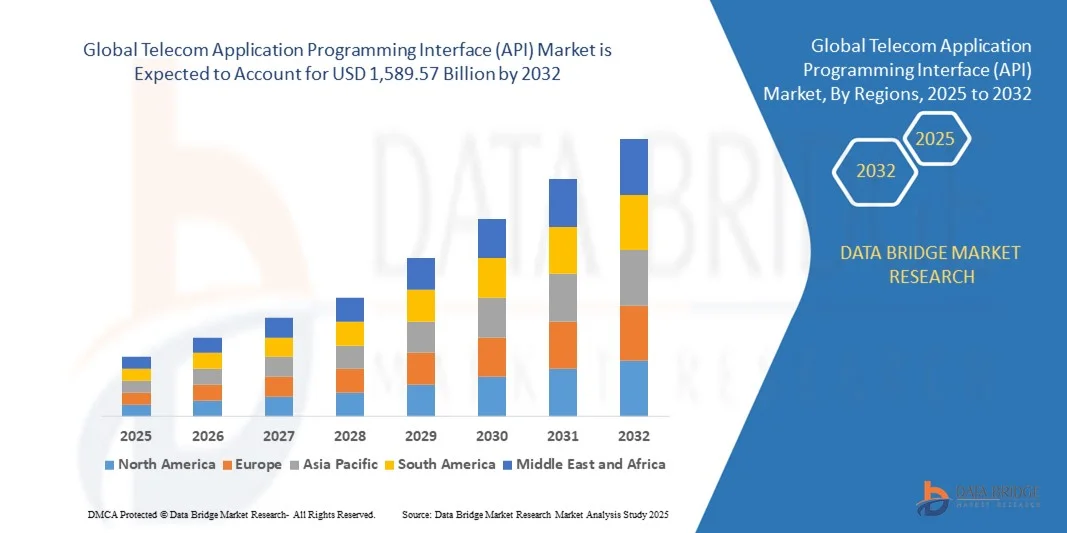
- The global telecom application programming interface (API) market size was valued at USD 434.53 billion in 2024 and is expected to reach USD 1,589.57 billion by 2032, at a CAGR of 17.60% during the forecast period
- The market growth is largely fuelled by the rising demand for digital services, increased mobile and internet penetration, and the growing adoption of APIs by telecom operators to enable service integration, automation, and enhanced customer experiences
- The increasing use of cloud computing, IoT, and 5G networks is accelerating the deployment of telecom APIs, allowing developers and enterprises to build innovative communication applications and streamline network operations
Telecom Application Programming Interface (API) Market Analysis
- Telecom APIs are transforming the industry by enabling real-time communication, improved service delivery, and faster go-to-market for new applications and digital offerings
- The market is witnessing growth across mobile, cloud, and enterprise platforms, with telecom operators increasingly investing in developer-friendly APIs to attract third-party application development
- North America dominated the telecom API market with the largest revenue share of 38.5% in 2024, driven by rapid digitalization, the growing adoption of cloud communications, and increased investment in network automation
- Asia-Pacific region is expected to witness the highest growth rate in the global telecom application programming interface (API) market, driven by rapid digital transformation, increasing investments in 5G networks, and the expansion of telecom service providers offering API-based solutions. Rising demand for mobile applications, IoT connectivity, and cloud communication platforms is further fueling market growth
- The Messaging API segment held the largest market revenue share in 2024, driven by the widespread adoption of chatbots, automated notifications, and customer communication platforms. Messaging APIs enable enterprises to integrate SMS, email, and push messaging seamlessly into their services, enhancing engagement and operational efficiency
Report Scope and Telecom Application Programming Interface (API) Market Segmentation
|
Attributes |
Telecom Application Programming Interface (API) Key Market Insights |
|
Segments Covered |
|
|
Countries Covered |
North America
Europe
Asia-Pacific
Middle East and Africa
South America
|
|
Key Market Players |
|
|
Market Opportunities |
|
|
Value Added Data Infosets |
In addition to the market insights such as market value, growth rate, market segments, geographical coverage, market players, and market scenario, the market report curated by the Data Bridge Market Research team includes in-depth expert analysis, import/export analysis, pricing analysis, production consumption analysis, and pestle analysis. |
Telecom Application Programming Interface (API) Market Trends
Increasing Adoption of APIs for Enhanced Connectivity and Service Integration
- The growing adoption of telecom APIs is transforming the communications landscape by enabling seamless integration of services, applications, and platforms. APIs allow businesses to automate workflows, enhance customer experience, and accelerate time-to-market for new digital offerings. This results in improved operational efficiency and greater service flexibility
- The rising demand for cloud-based communication, unified messaging, and programmable networks is accelerating the deployment of telecom APIs across enterprises, startups, and service providers. APIs facilitate interoperability between legacy systems and modern applications, ensuring smoother operations and faster service delivery
- The scalability, accessibility, and ease of implementation of modern telecom APIs are making them attractive for businesses of all sizes. Companies benefit from rapid integration capabilities, reduced development costs, and enhanced digital transformation initiatives, driving wider adoption
- For instance, in 2023, several global enterprises integrated telecom APIs to automate customer service workflows, enable multi-channel communication, and streamline billing processes, leading to enhanced productivity and improved customer satisfaction
- While telecom APIs are accelerating digital service delivery and network programmability, their impact depends on continuous innovation, robust security protocols, and regulatory compliance. Providers must focus on scalable, secure, and easy-to-integrate solutions to fully leverage market opportunities
Telecom Application Programming Interface (API) Market Dynamics
Driver
Rising Demand for Digital Communication and Network Automation
- The surge in mobile applications, cloud communications, and Internet of Things (IoT) devices is driving the adoption of telecom APIs to improve connectivity, streamline service delivery, and enable real-time data exchange. APIs allow enterprises to quickly roll out digital services with minimal operational disruptions, supporting digital transformation strategies across industries. Increased adoption of 5G networks further accelerates the need for programmable and interoperable API solutions, enhancing scalability and responsiveness
- Businesses increasingly recognize the strategic value of APIs in optimizing communication workflows, reducing costs, and improving customer engagement. API-driven solutions allow rapid deployment of programmable messaging, voice, and video services, enabling enterprises to launch innovative offerings and strengthen competitive advantage. Moreover, APIs facilitate integration with CRM, ERP, and analytics platforms, helping organizations derive actionable insights from customer and operational data
- Telecom providers are investing in API platforms to support automation, enhance service monetization, and enable third-party integrations, fostering a more dynamic digital ecosystem. These investments allow providers to create developer-friendly platforms that encourage innovation and attract a broader partner ecosystem. In additionlly, APIs enable cross-industry collaborations, allowing telecom companies to enter new verticals such as healthcare, fintech, and smart cities efficiently
- For instance, in 2022, several cloud communication companies implemented API-based solutions to enable automated customer interactions, integrate billing systems, and launch new digital services, significantly improving service efficiency and scalability. These implementations reduced manual interventions, improved customer satisfaction, and shortened service rollout times. The adoption also facilitated advanced analytics and reporting, helping companies optimize resources and plan for future growth
- While digitalization and network automation drive growth, challenges remain in API security, system integration, and compliance with regional telecom regulations, necessitating ongoing innovation and investment. Organizations must continuously update their API management frameworks, monitor traffic for anomalies, and ensure adherence to local privacy laws. Failure to address these challenges can lead to reputational damage, financial penalties, and operational setbacks, highlighting the importance of comprehensive risk management strategies
Restraint/Challenge
High Implementation Costs and Security Concerns
- The deployment of telecom APIs often requires significant investment in development, integration, and maintenance, making adoption challenging for small and mid-sized organizations. High costs can limit access to advanced API functionalities, and recurring licensing or subscription fees add to operational expenditure. Budget constraints may force smaller companies to delay digital initiatives, reducing competitiveness and slowing innovation in telecom services
- Integrating APIs with legacy telecom infrastructure and enterprise applications can be complex, requiring technical expertise and robust IT support. Without proper integration, businesses may face service disruptions, downtime, and inefficiencies in communication workflows. Organizations often need to redesign network architecture, implement middleware solutions, and conduct extensive testing, all of which increase project timelines and costs
- Security and privacy concerns remain a major challenge, as APIs expose networks and data to potential vulnerabilities. Organizations must implement stringent authentication, encryption, and monitoring measures to mitigate cyber risks, alongside compliance with global data protection regulations such as GDPR or CCPA. Failure to address these issues can lead to data breaches, financial losses, and reputational damage, impacting both customer trust and regulatory standing
- For instance, in 2023, several regional telecom providers in Asia faced delays in API adoption due to integration challenges and concerns over data security, slowing digital transformation initiatives. These delays impacted service delivery, limited the rollout of new digital offerings, and increased operational inefficiencies. Companies had to invest in staff training, external consulting, and robust cybersecurity frameworks to overcome these barriers effectively
- While telecom API technologies continue to evolve, addressing cost, security, and integration complexities is critical. Stakeholders must focus on scalable, secure, and interoperable solutions to unlock the full potential of the market. Proactive planning, adoption of API management platforms, and investment in automation and monitoring tools are essential to ensure smooth implementation and long-term adoption
Telecom Application Programming Interface (API) Market Scope
The telecom API market is segmented on the basis of type, deployment mode, user type, and industry vertical.
- By Type
On the basis of type, the telecom API market is segmented into Messaging API, WebRTC API, Payment API, IVR API, Location API, Content Delivery API, and Others. The Messaging API segment held the largest market revenue share in 2024, driven by the widespread adoption of chatbots, automated notifications, and customer communication platforms. Messaging APIs enable enterprises to integrate SMS, email, and push messaging seamlessly into their services, enhancing engagement and operational efficiency.
The WebRTC API segment is expected to witness the fastest growth rate from 2025 to 2032, fueled by the rising demand for real-time voice and video communication solutions. WebRTC APIs are particularly valuable for enabling low-latency, browser-based communication across devices, supporting virtual meetings, telehealth, and customer support applications. Their flexibility and ease of integration make them a preferred choice for developers and telecom operators.
- By Deployment Mode
On the basis of deployment mode, the market is segmented into Hybrid, Multi-Cloud, and On-Premise. The Multi-Cloud segment held the largest share in 2024 due to its ability to provide scalability, reliability, and flexibility for API management. Multi-cloud deployment allows enterprises to distribute workloads across multiple providers, ensuring uninterrupted service delivery and higher system resilience.
The Hybrid segment is expected to witness the fastest growth rate from 2025 to 2032, driven by organizations seeking a combination of cloud scalability and on-premise security. Hybrid deployment enables sensitive data processing locally while leveraging cloud resources for high-volume operations, balancing performance, compliance, and cost-effectiveness.
- By User Type
On the basis of user type, the market is segmented into Enterprise Developer, Internal Telecom Developer, Partner Developer, and Long Tail Developer. Enterprise Developers dominated the market in 2024, leveraging APIs to build custom communication solutions, integrate third-party services, and enhance customer engagement across digital channels. Their expertise drives faster time-to-market and higher operational efficiency.
Long Tail Developers is expected to witness the fastest growth rate from 2025 to 2032, as the proliferation of APIs, low-code platforms, and developer-friendly documentation empowers smaller enterprises and startups to innovate rapidly. This democratization of API usage is enabling new service models and expanding the telecom API ecosystem.
- By Industry Vertical
On the basis of industry vertical, the telecom API market is segmented into BFSI, Healthcare, IT and Telecom, Retail, Government, Manufacturing, Transportation, and Others. The BFSI segment held the largest revenue share in 2024, driven by the need for secure, automated communication, real-time transaction notifications, and digital banking services. APIs facilitate seamless integration with mobile apps, CRM systems, and payment platforms.
The Healthcare segment is expected to witness the fastest growth rate from 2025 to 2032, propelled by telemedicine, remote patient monitoring, and secure patient data exchange. APIs enable healthcare providers to integrate communication services with EMR/EHR systems, ensuring timely, accurate, and efficient interactions between patients and medical professionals.
Telecom Application Programming Interface (API) Market Regional Analysis
- North America dominated the telecom API market with the largest revenue share of 38.5% in 2024, driven by rapid digitalization, the growing adoption of cloud communications, and increased investment in network automation
- Enterprises and telecom providers in the region are leveraging APIs to enhance connectivity, improve service delivery, and enable real-time data integration across multiple platforms
- This widespread adoption is further supported by advanced IT infrastructure, high digital literacy, and the presence of key technology providers, establishing North America as a leader in telecom API deployment
U.S. Telecom API Market Insight
The U.S. telecom API market captured the largest revenue share in 2024 within North America, fueled by the increasing demand for programmable voice, messaging, and video services. Telecom operators and enterprises are prioritizing API-based solutions to automate workflows, enhance customer engagement, and support rapid deployment of new digital offerings. The integration of APIs with cloud communications, IoT platforms, and enterprise systems is further accelerating market expansion.
Europe Telecom API Market Insight
The Europe telecom API market is expected to witness the fastest growth rate from 2025 to 2032, primarily driven by regulatory support for digital communications and growing investments in 5G and cloud infrastructure. Organizations are adopting APIs to enhance network interoperability, optimize service delivery, and develop innovative applications for enterprise and consumer use. The increasing focus on digital transformation initiatives is fostering adoption across telecom and IT sectors.
U.K. Telecom API Market Insight
The U.K. telecom API market is expected to witness the fastest growth rate from 2025 to 2032, driven by the rising trend of digital services, cloud communications, and network automation. Businesses are increasingly leveraging APIs for faster service deployment, integration with partner applications, and improved operational efficiency. In additionlly, government initiatives supporting smart city and digital infrastructure projects are expected to stimulate further adoption.
Germany Telecom API Market Insight
The Germany telecom API market is expected to witness the fastest growth rate from 2025 to 2032, fueled by strong IT infrastructure, increasing adoption of 5G networks, and demand for digitalized telecom services. Enterprises and telecom providers are implementing APIs to enhance network programmability, improve data interoperability, and offer scalable communication solutions. The country’s emphasis on cybersecurity and compliance is also driving secure API adoption.
Asia-Pacific Telecom API Market Insight
The Asia-Pacific telecom API market is expected to witness the fastest growth rate from 2025 to 2032, driven by the rapid adoption of mobile applications, IoT solutions, and cloud communications across countries such as China, India, and Japan. Telecom providers are increasingly offering API platforms to support automation, third-party integrations, and innovative digital services. Growing digital literacy, supportive government policies, and the emergence of API-focused startups are further accelerating regional market growth.
Japan Telecom API Market Insight
The Japan telecom API market is expected to witness the fastest growth rate from 2025 to 2032 due to the country’s high digital adoption, advanced IT infrastructure, and strong enterprise demand for programmable communications. API integration with IoT, cloud platforms, and enterprise applications is enabling automation, enhanced service delivery, and improved operational efficiency. The focus on smart technologies and digital transformation across industries is expected to fuel growth.
China Telecom API Market Insight
The China telecom API market accounted for the largest market revenue share in Asia-Pacific in 2024, driven by rapid urbanization, growing smartphone penetration, and high adoption of digital services. Telecom operators and enterprises are leveraging APIs to automate workflows, enhance customer engagement, and deploy innovative communication solutions. The government’s push toward smart cities and digital infrastructure, along with the presence of strong local API solution providers, are key factors propelling market growth.
Telecom Application Programming Interface (API) Market Share
The Telecom Application Programming Interface (API) industry is primarily led by well-established companies, including:
- AT&T Inc. (U.S.)
- Twilio Inc. (U.S.)
- Telefonica S.A. (Spain)
- Verizon Communications Inc. (U.S.)
- Vodafone Group PLC (U.K.)
- Orange S.A. (France)
- Cisco Systems, Inc. (U.S.)
- Nokia Corporation (Finland)
- Alcatel-Lucent S.A. (France)
- Apigee Corp. (U.S.)
Latest Developments in Global Telecom Application Programming Interface (API) Market
- In March 2024, China Mobile, China Telecom, and China Unicom launched the GSMA Open Gateway OTP API, a security-focused development aimed at combating mobile fraud. The API enhances real-time authentication, strengthens network security, and improves trust in mobile services, positively impacting the adoption of API-driven solutions across the telecom sector
- In February 2024, AWS partnered with Verizon, T-Mobile, and Telefonica to introduce network APIs for developers. This collaboration enables seamless cloud-based API integration, accelerates digital service deployment, and fosters innovation in telecom applications, driving broader adoption of programmable communication services
- In September 2023, Deutsche Telekom rolled out the MagentaBusiness API platform powered by Vonage. The platform provides developers with access to communication and network APIs, facilitating automation, improving service efficiency, and enabling faster rollout of digital offerings, thereby strengthening the overall telecom API ecosystem

- Interactive Data Analysis Dashboard
- Company Analysis Dashboard for high growth potential opportunities
- Research Analyst Access for customization & queries
- Competitor Analysis with Interactive dashboard
- Latest News, Updates & Trend analysis
- Harness the Power of Benchmark Analysis for Comprehensive Competitor Tracking
Data collection and base year analysis are done using data collection modules with large sample sizes. The stage includes obtaining market information or related data through various sources and strategies. It includes examining and planning all the data acquired from the past in advance. It likewise envelops the examination of information inconsistencies seen across different information sources. The market data is analysed and estimated using market statistical and coherent models. Also, market share analysis and key trend analysis are the major success factors in the market report. To know more, please request an analyst call or drop down your inquiry.
The key research methodology used by DBMR research team is data triangulation which involves data mining, analysis of the impact of data variables on the market and primary (industry expert) validation. Data models include Vendor Positioning Grid, Market Time Line Analysis, Market Overview and Guide, Company Positioning Grid, Patent Analysis, Pricing Analysis, Company Market Share Analysis, Standards of Measurement, Global versus Regional and Vendor Share Analysis. To know more about the research methodology, drop in an inquiry to speak to our industry experts.
Data Bridge Market Research is a leader in advanced formative research. We take pride in servicing our existing and new customers with data and analysis that match and suits their goal. The report can be customized to include price trend analysis of target brands understanding the market for additional countries (ask for the list of countries), clinical trial results data, literature review, refurbished market and product base analysis. Market analysis of target competitors can be analyzed from technology-based analysis to market portfolio strategies. We can add as many competitors that you require data about in the format and data style you are looking for. Our team of analysts can also provide you data in crude raw excel files pivot tables (Fact book) or can assist you in creating presentations from the data sets available in the report.













