


What is the Telecom Billing Outsourcing Market Size and Overview?
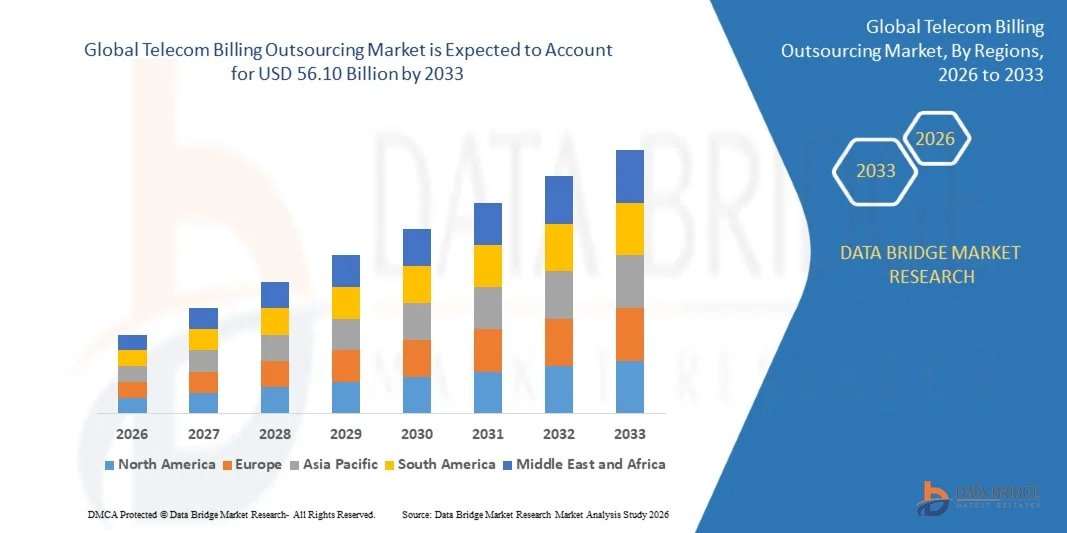
As per Data Bridge Market Research Analysis the Telecom Billing Outsourcing Market was valued at USD 28.99 billion in 2025 and is projected to reach USD 56.10 billion by 2033, growing at a CAGR of 8.60% from 2026 to 2033. The market is witnessing strong growth driven by increasing complexity of telecom billing operations, rapid expansion of 5G and digital communication services, and rising demand among telecom operators for cost-efficient and scalable billing management solutions.
The growing subscriber base for mobile data, broadband, cloud communication, and bundled digital services is compelling telecom companies to modernize their billing infrastructure and outsource operational processes to specialized service providers. Telecom billing outsourcing enables operators to improve billing accuracy, reduce operational costs, accelerate revenue assurance, and enhance customer experience through automated and real-time billing systems. In addition, increasing adoption of AI-driven analytics, cloud-based billing platforms, and convergent billing systems is further supporting market expansion across developed and emerging telecom markets worldwide.
Key Market Trends & Insights
- North America dominated the telecom billing outsourcing market with the largest revenue share of 39.8% in 2025, supported by rapid adoption of 5G services, strong digital transformation initiatives, and increasing demand for advanced telecom revenue management solutions.
- Asia-Pacific is expected to be the fastest-growing region, recording a CAGR of from 2026 to 2033. Growth is driven by rapid telecom subscriber expansion, increasing smartphone penetration, large-scale 5G deployment projects, and growing demand for scalable billing management solutions across China, India, Japan, and Southeast Asian countries.
- The Long Term segment held the largest market revenue share of approximately 68.5% in 2025 driven by increasing preference among telecom operators for multi-year outsourcing contracts that provide operational stability, long-term cost optimization, and continuous billing management support. Long-term outsourcing agreements are widely adopted because they enable telecom companies to streamline revenue assurance, improve customer management efficiency, and reduce infrastructure maintenance costs across large subscriber bases.
- The Short Term segment is projected to register the fastest growth at a CAGR of 9.4% from 2026 to 2033, driven by rising demand for flexible outsourcing arrangements supporting temporary network expansions, 5G deployment projects, and short-duration telecom transformation initiatives. Increasing adoption among small and mid-sized telecom operators seeking scalable and low-risk billing management solutions is accelerating segment expansion globally.
- The Individuals segment accounted for the largest market revenue share of nearly 61.7% in 2025 driven by the rapidly expanding global mobile subscriber base, increasing smartphone penetration, and rising consumption of prepaid and postpaid telecom services. Telecom operators are increasingly outsourcing billing operations for individual subscribers to improve billing accuracy, reduce payment disputes, and strengthen customer experience management.
- The Enterprises segment is anticipated to witness the fastest growth at a CAGR of 9.1% from 2026 to 2033, supported by rising adoption of cloud communication, IoT connectivity, and enterprise mobility services across large organizations. Increasing demand for customized billing management, real-time usage analytics, and integrated telecom expense management solutions is further contributing to segment expansion.
- The Wireless segment held the largest market revenue share of approximately 74.2% in 2025 driven by rapid expansion of mobile data services, 5G subscriber growth, and increasing adoption of digital communication platforms worldwide. Wireless telecom operators continue to dominate billing outsourcing demand because of high transaction volumes, dynamic pricing models, and rising demand for real-time charging and prepaid billing systems.
- The Fixed Line segment is projected to register the fastest growth at a CAGR of 7.8% from 2026 to 2033, driven by modernization of broadband infrastructure, increasing fiber-optic network deployments, and growing demand for bundled telecom and internet service packages. Rising adoption of convergent billing systems across fixed-line broadband and enterprise communication services is supporting segment expansion.
- The On-Premise segment held the largest market revenue share of approximately 57.6% in 2025 driven by strong preference among telecom operators for greater control over sensitive subscriber data, billing infrastructure, and regulatory compliance management. Large telecom companies continue to rely on on-premise billing systems because of their high customization capabilities and integration flexibility with legacy telecom infrastructure.
- The Cloud segment is projected to witness the fastest growth at a CAGR of 10.3% from 2026 to 2033, supported by increasing adoption of scalable, cost-efficient, and AI-enabled billing platforms across telecom operators globally. Cloud-based deployment models are gaining strong traction because they enable real-time billing analytics, faster service deployment, lower operational costs, and improved scalability for managing rapidly growing 5G and digital service ecosystems.
Market Size & Forecast
- Global Market Value (2025): USD 28.99 Billion
- Expected Market Value (2033): USD 56.10 Billion
- Forecast CAGR (2026–2033): 8.60%
- Leading Region in 2025: North America
- Fastest Growing Region: Asia-Pacific
Report Scope and Telecom Billing Outsourcing Market Segmentation
|
Attributes |
Telecom Billing Outsourcing Key Market Insights |
|
Segments Covered |
|
|
Countries Covered |
North America
Europe
Asia-Pacific
Middle East and Africa
South America
|
|
Key Market Players |
• Amdocs (Israel) |
|
Market Opportunities |
• Rising Adoption Of Cloud-Based Convergent Billing Platforms |
|
Value Added Data Infosets |
In addition to the market insights such as market value, growth rate, market segments, geographical coverage, market players, and market scenario, the market report curated by the Data Bridge Market Research team includes in-depth expert analysis, import/export analysis, pricing analysis, production consumption analysis, and pestle analysis. |
What is the Key Trend in the Telecom Billing Outsourcing Market?
Trend: Rising Adoption Of Cloud-Based And AI-Driven Billing Platforms
Increasing demand for real-time billing accuracy, automated customer management, and scalable digital monetization solutions across telecom operators is accelerating adoption of cloud-based and AI-enabled telecom billing outsourcing services worldwide. Traditional legacy billing systems often face limitations in handling complex pricing structures, high subscriber volumes, and bundled digital services, encouraging telecom providers to outsource billing operations to specialized technology partners with advanced automation capabilities.
Telecom operators are increasingly integrating AI-driven billing platforms, For instance for real-time charging, fraud detection, and revenue assurance, to improve operational efficiency and customer experience while reducing billing errors and service delays. In modern 5G networks, outsourced billing systems are being utilized to manage dynamic pricing models, subscription-based services, and high-volume data transactions more efficiently.
The rapid expansion of digital communication services, IoT connectivity, and cloud-based telecom infrastructure is also increasing demand for flexible and scalable billing management systems capable of supporting multi-service environments. In addition, telecom service providers continue to invest in convergent billing platforms integrating mobile, broadband, OTT, and enterprise services into unified billing ecosystems. Industry deployments during 2025 integrating AI-powered telecom billing analytics across North American and European operators demonstrated reductions of nearly 20–25% in billing disputes and customer service response times.
Telecom Billing Outsourcing Market Dynamics
Key Market Driver: Increasing Complexity Of Telecom Billing And Revenue Management
Telecom operators worldwide are facing growing operational pressure to manage rising subscriber volumes, complex pricing structures, bundled service offerings, and real-time digital transactions across multi-network environments. Increasing adoption of 5G, IoT, cloud communication, and subscription-based digital services is creating strong demand for advanced billing management systems capable of supporting accurate and scalable revenue operations.
Telecom companies are increasingly outsourcing billing functions to specialized service providers to improve operational efficiency, reduce infrastructure costs, and strengthen revenue assurance processes. Service providers are actively deploying automated billing systems, For instance for prepaid and postpaid subscriber management, to support faster transaction processing and improved customer retention.
Similarly, telecom operators are utilizing outsourced billing analytics and AI-powered fraud management tools to identify revenue leakage and optimize customer lifecycle management. Real-world telecom transformation projects implemented across Asia-Pacific and Europe during 2024 integrating cloud-based billing outsourcing platforms reported operational cost reductions of around 15–18% while improving billing cycle efficiency and revenue accuracy.
Key Restraint/Challenge: Data Security Concerns And Integration Complexity
Telecom billing systems manage highly sensitive subscriber information, payment records, and transactional data, creating major concerns regarding cybersecurity risks, regulatory compliance, and data privacy management. Increasing frequency of cyberattacks and strict data protection regulations are creating operational challenges for telecom operators outsourcing critical billing and customer management functions to third-party service providers.
In addition, integration of outsourced billing platforms with existing legacy telecom infrastructure often requires complex migration processes, high implementation costs, and extensive system customization. Compatibility challenges between old and modern billing architectures can increase deployment timelines and disrupt operational continuity during digital transformation projects.
Commercial telecom industry assessments indicate that telecom operators experienced increasing cybersecurity spending growth of nearly 12–14% during 2024 to strengthen protection of outsourced billing systems and subscriber databases against evolving cyber threats and regulatory risks. Limited technical interoperability across legacy networks continues to remain a major operational challenge for several telecom service providers globally.
Key Market Opportunity: Expansion Of 5G Networks And Digital Service Monetization
Modern telecom operators are increasingly launching 5G services, cloud communication platforms, OTT subscriptions, and IoT-based connectivity solutions requiring highly scalable and flexible billing infrastructures capable of managing dynamic pricing and real-time service monetization. Conventional billing systems often lack the capability to efficiently process high-volume digital transactions and multi-service billing environments, creating significant opportunities for advanced telecom billing outsourcing providers.
Telecom companies are increasingly adopting outsourced convergent billing platforms, For instance for integrated mobile, broadband, enterprise, and streaming service billing, to improve customer experience and support digital revenue growth. In enterprise telecom services, demand for automated billing analytics and AI-enabled customer engagement tools is accelerating adoption of cloud-native billing ecosystems across developed and emerging telecom markets.
In addition, advancements in AI-driven analytics, blockchain-based transaction validation, and cloud-based billing automation are improving billing transparency and operational scalability, opening opportunities across smart cities, connected mobility, and industrial IoT applications. Telecom operators conducting 5G monetization trials during 2025 across South Korea, the U.S., and China reported billing processing efficiency improvements of nearly 25–30% after deploying cloud-based outsourced convergent billing systems.
How is the Telecom Billing Outsourcing Market Segmented?
The market is segmented on the basis of type, application, customer type, and deployment model.
• By Type
On the basis of type, the Telecom Billing Outsourcing Market is segmented into Long Term and Short Term. The Long Term segment held the largest market revenue share of approximately 68.5% in 2025 driven by increasing preference among telecom operators for multi-year outsourcing contracts that provide operational stability, long-term cost optimization, and continuous billing management support. Long-term outsourcing agreements are widely adopted because they enable telecom companies to streamline revenue assurance, improve customer management efficiency, and reduce infrastructure maintenance costs across large subscriber bases.
The Short Term segment is projected to register the fastest growth at a CAGR of 9.4% from 2026 to 2033, driven by rising demand for flexible outsourcing arrangements supporting temporary network expansions, 5G deployment projects, and short-duration telecom transformation initiatives. Increasing adoption among small and mid-sized telecom operators seeking scalable and low-risk billing management solutions is accelerating segment expansion globally.
• By Application
On the basis of application, the Telecom Billing Outsourcing Market is segmented into Individuals and Enterprises. The Individuals segment accounted for the largest market revenue share of nearly 61.7% in 2025 driven by the rapidly expanding global mobile subscriber base, increasing smartphone penetration, and rising consumption of prepaid and postpaid telecom services. Telecom operators are increasingly outsourcing billing operations for individual subscribers to improve billing accuracy, reduce payment disputes, and strengthen customer experience management.
The Enterprises segment is anticipated to witness the fastest growth at a CAGR of 9.1% from 2026 to 2033, supported by rising adoption of cloud communication, IoT connectivity, and enterprise mobility services across large organizations. Increasing demand for customized billing management, real-time usage analytics, and integrated telecom expense management solutions is further contributing to segment expansion.
• By Customer Type
On the basis of customer type, the Telecom Billing Outsourcing Market is segmented into Wireless and Fixed Line. The Wireless segment held the largest market revenue share of approximately 74.2% in 2025 driven by rapid expansion of mobile data services, 5G subscriber growth, and increasing adoption of digital communication platforms worldwide. Wireless telecom operators continue to dominate billing outsourcing demand because of high transaction volumes, dynamic pricing models, and rising demand for real-time charging and prepaid billing systems.
The Fixed Line segment is projected to register the fastest growth at a CAGR of 7.8% from 2026 to 2033, driven by modernization of broadband infrastructure, increasing fiber-optic network deployments, and growing demand for bundled telecom and internet service packages. Rising adoption of convergent billing systems across fixed-line broadband and enterprise communication services is supporting segment expansion.
• By Deployment Model
On the basis of deployment model, the Telecom Billing Outsourcing Market is segmented into On-Premise and Cloud. The On-Premise segment held the largest market revenue share of approximately 57.6% in 2025 driven by strong preference among telecom operators for greater control over sensitive subscriber data, billing infrastructure, and regulatory compliance management. Large telecom companies continue to rely on on-premise billing systems because of their high customization capabilities and integration flexibility with legacy telecom infrastructure.
The Cloud segment is projected to witness the fastest growth at a CAGR of 10.3% from 2026 to 2033, supported by increasing adoption of scalable, cost-efficient, and AI-enabled billing platforms across telecom operators globally. Cloud-based deployment models are gaining strong traction because they enable real-time billing analytics, faster service deployment, lower operational costs, and improved scalability for managing rapidly growing 5G and digital service ecosystems.
Which Region Holds the Largest Share of the Telecom Billing Outsourcing Market
North America Telecom Billing Outsourcing Market Insight
North America dominated the telecom billing outsourcing market with the largest revenue share of 39.8% in 2025, supported by rapid adoption of 5G services, strong digital transformation initiatives, and increasing demand for advanced telecom revenue management solutions. Telecom operators in the region highly prioritize automated billing systems, AI-driven analytics, and cloud-based billing infrastructure to improve operational efficiency and customer experience. The widespread adoption of bundled telecom services, high smartphone penetration, and increasing investments in digital communication infrastructure are further strengthening demand for outsourced telecom billing solutions across residential and enterprise applications.
U.S. Telecom Billing Outsourcing Market Insight
The U.S. telecom billing outsourcing market captured the largest revenue share in 2025 within North America, fueled by the rapid expansion of 5G networks, cloud communication services, and digital subscriber management platforms. Telecom companies are increasingly outsourcing billing operations to improve revenue assurance, reduce operational costs, and strengthen real-time customer management capabilities. The growing demand for convergent billing systems integrating mobile, broadband, OTT, and enterprise communication services is further propelling market growth. Moreover, increasing adoption of AI-powered customer analytics and automated billing fraud detection systems is significantly contributing to industry expansion across the U.S. telecom sector.
Europe Telecom Billing Outsourcing Market Insight
The Europe telecom billing outsourcing market is expected to witness the fastest growth rate from 2026 to 2033, primarily driven by increasing investments in 5G infrastructure, strict telecom compliance regulations, and rising demand for cloud-based billing platforms. The growing adoption of digital communication services and IoT connectivity solutions is fostering the need for advanced billing management systems capable of handling complex telecom service ecosystems. European telecom operators are increasingly outsourcing billing and revenue management functions to improve efficiency, reduce infrastructure costs, and accelerate digital transformation initiatives. The region is also witnessing significant growth in enterprise communication and convergent billing applications across residential and commercial telecom networks.
U.K. Telecom Billing Outsourcing Market Insight
The U.K. telecom billing outsourcing market is expected to witness the fastest growth rate from 2026 to 2033, driven by increasing adoption of cloud-native telecom platforms and growing demand for automated customer billing management systems. Telecom service providers across the U.K. are increasingly prioritizing digital monetization strategies, real-time billing analytics, and AI-powered customer engagement solutions to strengthen operational performance and subscriber retention. In addition, expanding 5G deployments and rising enterprise demand for integrated communication services are accelerating adoption of outsourced billing platforms. The country’s strong digital infrastructure and rapid cloud transformation initiatives continue to support market growth.
Germany Telecom Billing Outsourcing Market Insight
The Germany telecom billing outsourcing market is expected to witness the fastest growth rate from 2026 to 2033, fueled by increasing demand for secure telecom billing infrastructure and advanced digital communication management systems. Germany’s strong industrial digitization initiatives, combined with growing adoption of IoT and enterprise connectivity services, are supporting increased deployment of outsourced telecom billing solutions. Telecom operators are increasingly integrating AI-driven billing analytics and automated revenue assurance platforms to improve billing transparency and operational efficiency. The country’s strong emphasis on cybersecurity, regulatory compliance, and data privacy is also encouraging investment in secure cloud-based billing technologies.
Asia-Pacific Telecom Billing Outsourcing Market Insight
The Asia-Pacific telecom billing outsourcing market is expected to witness the fastest growth rate from 2026 to 2033, supported by rapid smartphone adoption, expanding telecom subscriber bases, and increasing deployment of 5G infrastructure across China, India, Japan, and Southeast Asian countries. The region’s growing digital economy and rising consumption of mobile data, broadband, and OTT services are driving strong demand for scalable billing management platforms. Furthermore, telecom operators across Asia-Pacific are increasingly outsourcing billing functions to reduce operational costs, improve revenue management efficiency, and accelerate digital service monetization initiatives.
Japan Telecom Billing Outsourcing Market Insight
The Japan telecom billing outsourcing market is expected to witness the fastest growth rate from 2026 to 2033 due to the country’s advanced telecom infrastructure, increasing 5G adoption, and rising demand for high-quality digital communication services. Japanese telecom operators are actively investing in AI-enabled billing systems and cloud-native revenue management platforms to improve customer experience and support real-time digital transactions. The integration of telecom billing systems with IoT devices, enterprise communication platforms, and smart city infrastructure is further fueling market growth. Moreover, Japan’s increasing focus on operational automation and digital transformation is accelerating adoption of outsourced telecom billing services.
China Telecom Billing Outsourcing Market Insight
The China telecom billing outsourcing market accounted for the largest market revenue share in Asia-Pacific in 2025, attributed to the country’s massive telecom subscriber base, rapid 5G expansion, and strong government support for digital infrastructure development. China remains one of the world’s largest telecom and mobile internet markets, generating substantial demand for cloud-based billing systems, real-time charging platforms, and automated revenue assurance solutions. The growing popularity of digital payment ecosystems, enterprise cloud communication services, and IoT-enabled connectivity solutions is significantly supporting market growth. In addition, the presence of large domestic telecom operators and technology providers is further accelerating telecom billing outsourcing adoption across the country.
Which are the Top Companies in Telecom Billing Outsourcing Market?
The Telecom Billing Outsourcing industry is primarily led by well-established companies, including:
- Amdocs (Israel)
- Ericsson (Sweden)
- Huawei Technologies (China)
- ZTE Corporation (China)
- IBM Corporation (U.S.)
- Cognizant Technology Solutions (U.S.)
- Accenture (Ireland)
- Infosys Limited (India)
- Tech Mahindra (India)
- Tata Consultancy Services (TCS) (India)
- Oracle Corporation (U.S.)
- Netcracker Technology (U.S.)
- Comarch SA (Poland)
- Capgemini (France)
- Nokia Corporation (Finland)
- Hewlett Packard Enterprise (HPE) (U.S.)
- Sitel Group (U.S.)
- Sierra Wireless (Canada)
- Fujitsu (Japan)
- Voxbone (Belgium)

- Interactive Data Analysis Dashboard
- Company Analysis Dashboard for high growth potential opportunities
- Research Analyst Access for customization & queries
- Competitor Analysis with Interactive dashboard
- Latest News, Updates & Trend analysis
- Harness the Power of Benchmark Analysis for Comprehensive Competitor Tracking
Data collection and base year analysis are done using data collection modules with large sample sizes. The stage includes obtaining market information or related data through various sources and strategies. It includes examining and planning all the data acquired from the past in advance. It likewise envelops the examination of information inconsistencies seen across different information sources. The market data is analysed and estimated using market statistical and coherent models. Also, market share analysis and key trend analysis are the major success factors in the market report. To know more, please request an analyst call or drop down your inquiry.
The key research methodology used by DBMR research team is data triangulation which involves data mining, analysis of the impact of data variables on the market and primary (industry expert) validation. Data models include Vendor Positioning Grid, Market Time Line Analysis, Market Overview and Guide, Company Positioning Grid, Patent Analysis, Pricing Analysis, Company Market Share Analysis, Standards of Measurement, Global versus Regional and Vendor Share Analysis. To know more about the research methodology, drop in an inquiry to speak to our industry experts.
Data Bridge Market Research is a leader in advanced formative research. We take pride in servicing our existing and new customers with data and analysis that match and suits their goal. The report can be customized to include price trend analysis of target brands understanding the market for additional countries (ask for the list of countries), clinical trial results data, literature review, refurbished market and product base analysis. Market analysis of target competitors can be analyzed from technology-based analysis to market portfolio strategies. We can add as many competitors that you require data about in the format and data style you are looking for. Our team of analysts can also provide you data in crude raw excel files pivot tables (Fact book) or can assist you in creating presentations from the data sets available in the report.













