


Telemetric Devices Market Overview
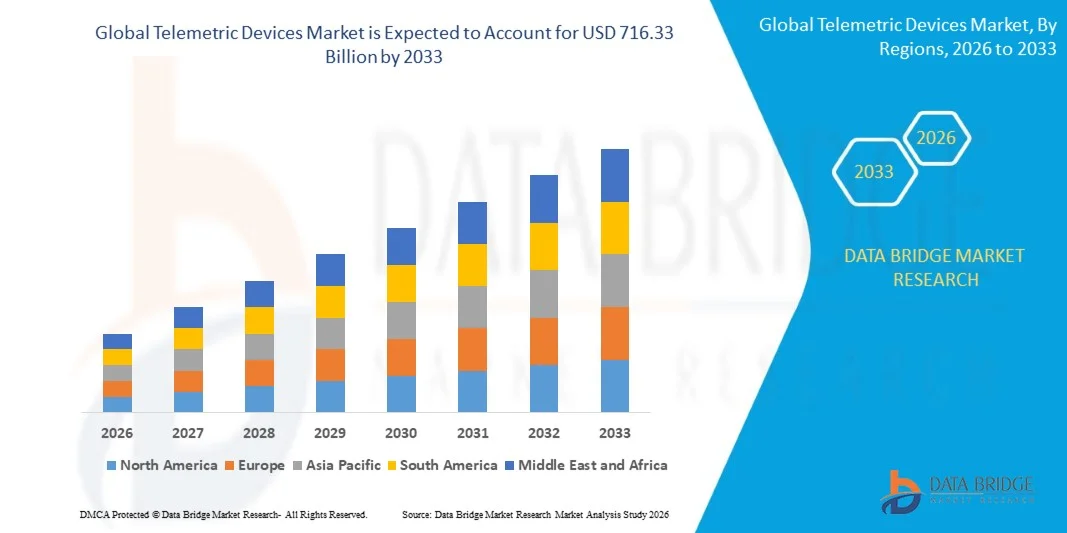
The Telemetric Devices Market was valued at USD 218.50 billion in 2025 and is projected to reach USD 716.33 billion by 2033, growing at a CAGR of 16.00% from 2026 to 2033. The market is experiencing strong growth driven by increasing adoption of IoT-enabled connectivity solutions, rising demand for real-time data monitoring, and expanding applications across automotive, healthcare, aerospace, and industrial automation sectors. Growing integration of advanced communication technologies such as 5G, cloud computing, and edge analytics is further accelerating the deployment of telemetric devices globally.
The increasing need for real-time remote monitoring and predictive analytics, combined with rising demand for operational efficiency and asset tracking, is compelling industries to adopt advanced telemetric solutions. These devices are increasingly replacing traditional manual monitoring systems by enabling continuous data collection, remote diagnostics, and performance optimization across critical infrastructure. In addition, growing use of telematics in connected vehicles, smart healthcare monitoring systems, logistics tracking, and industrial equipment management is expanding market adoption. Rising focus on safety, cost reduction, and data-driven decision-making is further driving integration of telemetric devices across both developed and emerging economies.
Key Market Trends & Insights
- North America dominated the telemetric devices market with the largest revenue share of approximately 38.7% in 2025, supported by strong penetration of connected vehicle technologies, advanced healthcare monitoring systems, and widespread industrial IoT deployment. The region benefits from robust digital infrastructure, high technology adoption rates, and significant investments in smart mobility, smart grids, and enterprise-level predictive maintenance solutions, which collectively strengthen market leadership.
- Asia-Pacific is expected to be the fastest-growing region, recording a CAGR of approximately 17.6% from 2026 to 2033. Growth is driven by rapid industrialization, expansion of smart city initiatives, increasing adoption of IoT-enabled devices, and strong growth in automotive telematics and digital healthcare systems across countries such as China, India, and Japan. Rising investments in 5G infrastructure and cloud-based platforms are further accelerating regional market expansion.
- The Wireless segment held the largest market revenue share of approximately 52.6% in 2025 driven by its strong adoption in connected vehicles, remote patient monitoring, and industrial IoT applications. Wireless telemetric systems are preferred due to their flexibility, real-time data transmission capabilities, and ease of deployment across large-scale distributed networks such as smart cities and logistics operations.
- The Digital segment is projected to register the fastest growth at a CAGR of 17.9% from 2026 to 2033, driven by increasing integration of AI-based analytics, cloud connectivity, and edge computing capabilities. Rising demand for high-precision data processing in autonomous systems, aerospace communication, and predictive maintenance applications is further accelerating segment expansion.
- The Industrial segment held the largest market revenue share of approximately 34.2% in 2025 driven by widespread deployment of condition monitoring systems, equipment diagnostics, and predictive maintenance solutions across manufacturing and energy-intensive industries. Industrial telemetric systems enable real-time performance tracking and operational optimization, reducing downtime and improving asset efficiency.
- The Healthcare segment is projected to register the fastest growth at a CAGR of 18.4% from 2026 to 2033, driven by rising adoption of remote patient monitoring devices, wearable health trackers, and telemedicine solutions. Increasing prevalence of chronic diseases and growing demand for home-based healthcare monitoring systems are further supporting rapid segment expansion across both developed and emerging economies.
Market Size & Forecast
- Global Market Value (2025): USD 218.50 Billion
- Expected Market Value (2033): USD 716.33 Billion
- Forecast CAGR (2026–2033): 16.00%
- Leading Region in 2025: North America
- Fastest Growing Region: Asia-Pacific
Report Scope and Telemetric Devices Market Segmentation
|
Attributes |
Telemetric Devices Key Market Insights |
|
Segments Covered |
· By Type: Wire Links, Wireless, Analog, and Digital · By End User: Healthcare, Industrial, Oil and Gas, Aerospace and Defense, and Others |
|
Countries Covered |
North America · U.S. · Canada · Mexico Europe · Germany · France · U.K. · Netherlands · Switzerland · Belgium · Russia · Italy · Spain · Turkey · Rest of Europe Asia-Pacific · China · Japan · India · South Korea · Singapore · Malaysia · Australia · Thailand · Indonesia · Philippines · Rest of Asia-Pacific Middle East and Africa · Saudi Arabia · U.A.E. · South Africa · Egypt · Israel · Rest of Middle East and Africa South America · Brazil · Argentina · Rest of South America |
|
Key Market Players |
• Siemens (Germany) |
|
Market Opportunities |
• Expansion Of IoT-Enabled Remote Monitoring Systems • Rising Adoption Of AI-Powered Predictive Maintenance Solutions |
|
Value Added Data Infosets |
In addition to the insights on market scenarios such as market value, growth rate, segmentation, geographical coverage, and major players, the market reports curated by the Data Bridge Market Research also include in-depth expert analysis, geographically represented company-wise production and capacity, network layouts of distributors and partners, detailed and updated price trend analysis and deficit analysis of supply chain and demand. |
Telemetric Devices Market Trends
Trend: Growth In IoT-Enabled Real-Time Data Monitoring And Edge Analytics Integration
Increasing demand for real-time visibility, predictive analytics, and seamless connectivity across automotive, healthcare, industrial, and logistics ecosystems is accelerating adoption of advanced telemetric devices. Traditional monitoring systems are being replaced by intelligent, connected solutions that enable continuous data acquisition, remote diagnostics, and automated decision-making. Rising integration of IoT, 5G networks, and cloud-based platforms is further strengthening the capability of telemetric systems to process high-volume data streams with low latency and improved accuracy.
In modern connected vehicles, manufacturers are increasingly integrating telemetric devices, For instance for fleet tracking, driver behavior monitoring, and fuel efficiency optimization, enabling real-time operational intelligence and reducing maintenance downtime. In healthcare, wearable telemetric systems are being used for continuous patient monitoring such as ECG tracking, glucose level monitoring, and remote critical care supervision, improving response times and reducing hospital dependency. Industrial sectors are deploying telemetric sensors in machinery and production lines to enable predictive maintenance and minimize unplanned shutdowns through early fault detection.
The rapid expansion of smart cities, logistics automation, and autonomous systems is also increasing demand for high-precision telemetric devices capable of operating in complex, distributed environments. In addition, aerospace and defense sectors continue to rely on advanced telemetry for mission-critical communication, satellite tracking, and remote system control, where uninterrupted data transmission is essential. Growing validation through large-scale fleet digitalization programs in 2025 across Europe and North America, including telemetric integration in logistics fleets and public transport systems, has demonstrated operational cost reductions of nearly 12–18% through improved route optimization and predictive maintenance accuracy.
Telemetric Devices Market Dynamics
Key Market Driver: Rising Demand For Real-Time Asset Tracking And Predictive Analytics
Industries worldwide are increasingly focused on improving operational efficiency, reducing downtime, and enabling data-driven decision-making, which is significantly driving demand for telemetric devices. Large-scale deployment of connected sensors in vehicles, industrial machinery, and healthcare systems is enabling continuous monitoring of asset performance and environmental conditions.
Automotive and logistics companies are increasingly deploying telemetric systems for real-time fleet management, For instance in long-haul transportation networks for route optimization, fuel tracking, and driver safety monitoring, helping reduce operational costs and improve delivery efficiency. In industrial environments, telemetric devices are being used to monitor equipment health, energy consumption, and production efficiency to support predictive maintenance strategies and minimize unexpected failures.
Similarly, smart infrastructure and energy utilities are adopting telemetric solutions to monitor grid performance, water distribution systems, and renewable energy assets in real time. Large-scale deployments in the U.S. and Germany in 2024 integrating telemetric monitoring into utility networks demonstrated a reduction of nearly 8–12% in system downtime through early fault detection and automated alerts.
Key Restraint/Challenge: Data Security Risks And High System Integration Complexity
Despite strong adoption, telemetric devices face challenges related to cybersecurity vulnerabilities, data privacy concerns, and complex system integration requirements. The continuous transmission of sensitive operational and personal data increases exposure to cyberattacks, unauthorized access, and data breaches, particularly in connected automotive and healthcare applications.
In addition, integrating telemetric systems with legacy infrastructure, cloud platforms, and multi-vendor IoT ecosystems increases deployment complexity and implementation costs. Many small and mid-sized enterprises face difficulties in managing interoperability standards and ensuring seamless data synchronization across distributed networks.
Industry assessments indicate that while telemetric systems significantly improve operational visibility, cybersecurity incidents in IoT-enabled monitoring systems increased by over 20% between 2023 and 2025 in connected infrastructure environments, highlighting the need for stronger encryption, authentication, and regulatory compliance frameworks.
Key Market Opportunity: Expansion Of Autonomous Systems And Smart Infrastructure Ecosystems
The growing development of autonomous vehicles, smart cities, and Industry 4.0 ecosystems is creating substantial opportunities for advanced telemetric devices. These systems require continuous real-time data exchange between sensors, control units, and centralized platforms to enable automated decision-making and system optimization.
Automotive companies are increasingly integrating telemetric platforms into autonomous driving systems, For instance for real-time navigation updates, vehicle-to-cloud communication, and safety monitoring, improving driving accuracy and system responsiveness. In smart cities, telemetric devices are being deployed in traffic management systems, public transportation networks, and environmental monitoring stations to enhance urban efficiency and sustainability.
In addition, advancements in AI-driven analytics, edge computing, and miniaturized sensor technologies are improving device performance and reducing latency, opening new opportunities across aerospace, defense, and industrial automation sectors in Asia-Pacific and North America. Large-scale smart mobility pilot projects conducted in 2025 across China and Singapore demonstrated traffic flow optimization improvements of around 15–20% through integrated telemetric data systems used in intelligent transport infrastructure.
Telemetric Devices Market Scope
The market is segmented on the basis of type, connectivity, functionality, offering, and end-use application.
- By Type
On the basis of type, the telemetric devices market is segmented into Wire Links, Wireless, Analog, and Digital. The Wireless segment held the largest market revenue share of approximately 52.6% in 2025 driven by its strong adoption in connected vehicles, remote patient monitoring, and industrial IoT applications. Wireless telemetric systems are preferred due to their flexibility, real-time data transmission capabilities, and ease of deployment across large-scale distributed networks such as smart cities and logistics operations.
The Digital segment is projected to register the fastest growth at a CAGR of 17.9% from 2026 to 2033, driven by increasing integration of AI-based analytics, cloud connectivity, and edge computing capabilities. Rising demand for high-precision data processing in autonomous systems, aerospace communication, and predictive maintenance applications is further accelerating segment expansion.
- By End User
On the basis of end user, the telemetric devices market is segmented into Healthcare, Industrial, Oil and Gas, Aerospace and Defense, and Others. The Industrial segment held the largest market revenue share of approximately 34.2% in 2025 driven by widespread deployment of condition monitoring systems, equipment diagnostics, and predictive maintenance solutions across manufacturing and energy-intensive industries. Industrial telemetric systems enable real-time performance tracking and operational optimization, reducing downtime and improving asset efficiency.
The Healthcare segment is projected to register the fastest growth at a CAGR of 18.4% from 2026 to 2033, driven by rising adoption of remote patient monitoring devices, wearable health trackers, and telemedicine solutions. Increasing prevalence of chronic diseases and growing demand for home-based healthcare monitoring systems are further supporting rapid segment expansion across both developed and emerging economies.
Telemetric Devices Market Regional Analysis
North America Telemetric Devices Market Insight
North America dominated the telemetric devices market with the largest revenue share of approximately 38.7% in 2025, supported by strong adoption of IoT-enabled monitoring systems, advanced connectivity infrastructure, and high investment in digital transformation across industries. The region benefits from widespread deployment of connected vehicles, industrial automation systems, and remote healthcare monitoring solutions, enabling real-time data acquisition and predictive analytics. In addition, strong presence of technology providers and early adoption of 5G-enabled telematics platforms further strengthens market expansion across automotive, healthcare, and logistics sectors.
U.S. Telemetric Devices Market Insight
The U.S. telemetric devices market captured the largest revenue share in 2025 within North America, driven by rapid integration of connected vehicle technologies, expanding use of wearable healthcare monitoring systems, and growing demand for industrial IoT solutions. Enterprises across logistics, energy, and manufacturing sectors are increasingly adopting telemetric systems for real-time asset tracking and predictive maintenance. Moreover, strong investment in smart infrastructure, combined with advancements in AI-based analytics and cloud computing, is significantly enhancing data-driven operational efficiency across industries.
Europe Telemetric Devices Market Insight
The Europe telemetric devices market is expected to witness the fastest growth rate from 2026 to 2033, primarily driven by increasing adoption of Industry 4.0 technologies, rising demand for smart mobility solutions, and strong regulatory support for digital healthcare and energy efficiency initiatives. The region is experiencing rapid deployment of telemetric systems in automotive safety monitoring, smart grids, and industrial automation. Growing focus on sustainability and data-driven decision-making is further accelerating adoption across transportation, healthcare, and manufacturing sectors.
U.K. Telemetric Devices Market Insight
The U.K. telemetric devices market is expected to witness strong growth from 2026 to 2033, driven by increasing adoption of connected fleet management systems, rising demand for remote healthcare monitoring, and expansion of smart city initiatives. Businesses are increasingly leveraging telemetric solutions to improve operational efficiency, reduce costs, and enhance real-time decision-making capabilities. In addition, growing investment in digital infrastructure and IoT integration is supporting wider deployment across logistics, utilities, and public transport systems.
Germany Telemetric Devices Market Insight
The Germany telemetric devices market is expected to witness robust growth from 2026 to 2033, fueled by strong industrial automation adoption, advanced automotive engineering capabilities, and increasing focus on energy-efficient smart systems. German manufacturers are increasingly deploying telemetric solutions for predictive maintenance, production optimization, and emissions monitoring. The integration of telemetric systems with smart factories and connected mobility platforms is further enhancing operational transparency and efficiency across industrial and transportation sectors.
Asia-Pacific Telemetric Devices Market Insight
The Asia-Pacific telemetric devices market is expected to witness the fastest growth rate from 2026 to 2033, supported by rapid industrialization, expanding digital infrastructure, and rising adoption of IoT-based solutions in countries such as China, India, and Japan. The region is experiencing strong growth in connected vehicles, smart healthcare monitoring systems, and logistics tracking applications. In addition, increasing government initiatives for smart city development and digital transformation are accelerating telemetric device adoption across multiple sectors.
Japan Telemetric Devices Market Insight
The Japan telemetric devices market is expected to witness steady growth from 2026 to 2033 due to strong emphasis on advanced automation, aging population-driven healthcare monitoring demand, and high adoption of connected industrial systems. Telemetric solutions are increasingly used in robotics, smart healthcare devices, and automotive safety systems. Integration with IoT platforms and precision engineering technologies is further supporting efficient real-time monitoring across residential, industrial, and mobility applications.
China Telemetric Devices Market Insight
The China telemetric devices market accounted for the largest market revenue share in Asia-Pacific in 2025, attributed to rapid urbanization, large-scale smart city development, and strong expansion of connected manufacturing ecosystems. China is a major hub for IoT device production and telematics deployment across automotive, logistics, and industrial sectors. Growing adoption of intelligent transportation systems, coupled with government support for digital infrastructure and 5G rollout, is significantly driving market expansion.
Telemetric Devices Market Share
The Telemetric Devices industry is primarily led by well-established companies, including:
• Siemens (Germany)
• GENERAL ELECTRIC COMPANY (U.S.)
• Koninklijke Philips N.V. (Netherlands)
• Schlumberger Limited (U.S.)
• RealView Imaging Ltd (Israel)
• 8i Limited (New Zealand)
• LightSpace Technologies (Latvia)
• Facebook (U.S.)
• Google (U.S.)
• The Coretec Group Inc. (U.S.)
• Voxon Photonics (Australia)
• Jaunt, Inc. (U.S.)
• Schneider Electric (France)
• Sierra Wireless (Canada)
• Cobham plc (U.K.)
• Kongsberg Gruppen (Norway)
• Honeywell International Inc. (U.S.)
• L3Harris Technologies, Inc. (U.S.)
• Verizon (U.S.)
• Rogers Communications (Canada)
• AstroNova, Inc. (U.S.)
• Lindsay Corporation (U.S.)
• Leonardo S.p.A (Italy)
Latest Developments in Telemetric Devices Market
- In May 2025, Medtronic, financial and product innovation development, reported USD 33.5 billion revenue reflecting 3.6% growth, driven by expansion of BrainSense Adaptive DBS telemetry capabilities, which enhances real-time neurological monitoring and precision therapy delivery, strengthening adoption of advanced medical telemetry solutions in healthcare monitoring systems and improving patient outcome tracking efficiency across clinical environments
- In April 2025, Boston Scientific, clinical expansion development, achieved 20.9% net sales growth reaching USD 4.663 billion and initiated FARAFLEX pulsed-field ablation trials, leveraging advanced telemetry-enabled cardiac monitoring to improve procedural accuracy, reduce recovery time, and accelerate adoption of minimally invasive cardiovascular treatment technologies across global healthcare systems
- In March 2025, Honeywell and Verizon, strategic partnership development, collaborated to integrate 5G connectivity into smart meter systems enabling real-time grid telemetry, improving energy distribution monitoring, enhancing operational efficiency for utility providers, and strengthening smart grid infrastructure through low-latency, high-reliability data transmission across energy networks
- In February 2025, Myriota and Viasat, technology launch development, introduced HyperPulse, the first 5G non-terrestrial network service dedicated to remote IoT telemetry, enabling reliable data connectivity for remote assets, enhancing global IoT coverage in underserved regions, and expanding real-time monitoring capabilities across agriculture, logistics, and environmental monitoring applications

- Interactive Data Analysis Dashboard
- Company Analysis Dashboard for high growth potential opportunities
- Research Analyst Access for customization & queries
- Competitor Analysis with Interactive dashboard
- Latest News, Updates & Trend analysis
- Harness the Power of Benchmark Analysis for Comprehensive Competitor Tracking
Global Telemetric Devices Market, Supply Chain Analysis and Ecosystem Framework
To support market growth and help clients navigate the impact of geopolitical shifts, DBMR has integrated in-depth supply chain analysis into its Global Telemetric Devices Market research reports. This addition empowers clients to respond effectively to global changes affecting their industries. The supply chain analysis section includes detailed insights such as Global Telemetric Devices Market consumption and production by country, price trend analysis, the impact of tariffs and geopolitical developments, and import and export trends by country and HSN code. It also highlights major suppliers with data on production capacity and company profiles, as well as key importers and exporters. In addition to research, DBMR offers specialized supply chain consulting services backed by over a decade of experience, providing solutions like supplier discovery, supplier risk assessment, price trend analysis, impact evaluation of inflation and trade route changes, and comprehensive market trend analysis.
Data collection and base year analysis are done using data collection modules with large sample sizes. The stage includes obtaining market information or related data through various sources and strategies. It includes examining and planning all the data acquired from the past in advance. It likewise envelops the examination of information inconsistencies seen across different information sources. The market data is analysed and estimated using market statistical and coherent models. Also, market share analysis and key trend analysis are the major success factors in the market report. To know more, please request an analyst call or drop down your inquiry.
The key research methodology used by DBMR research team is data triangulation which involves data mining, analysis of the impact of data variables on the market and primary (industry expert) validation. Data models include Vendor Positioning Grid, Market Time Line Analysis, Market Overview and Guide, Company Positioning Grid, Patent Analysis, Pricing Analysis, Company Market Share Analysis, Standards of Measurement, Global versus Regional and Vendor Share Analysis. To know more about the research methodology, drop in an inquiry to speak to our industry experts.
Data Bridge Market Research is a leader in advanced formative research. We take pride in servicing our existing and new customers with data and analysis that match and suits their goal. The report can be customized to include price trend analysis of target brands understanding the market for additional countries (ask for the list of countries), clinical trial results data, literature review, refurbished market and product base analysis. Market analysis of target competitors can be analyzed from technology-based analysis to market portfolio strategies. We can add as many competitors that you require data about in the format and data style you are looking for. Our team of analysts can also provide you data in crude raw excel files pivot tables (Fact book) or can assist you in creating presentations from the data sets available in the report.













