


Telepsychiatry Market Overview
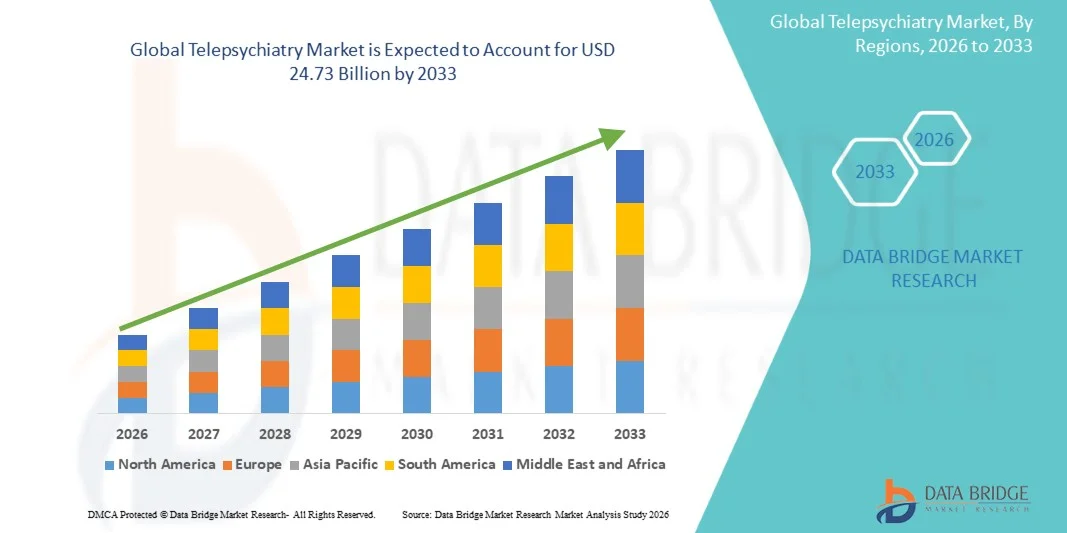
The Telepsychiatry Market was valued at USD 9.64 billion in 2025 and is projected to reach USD 24.73 billion by 2033, growing at a CAGR of 12.50% from 2026 to 2033. The market is experiencing consistent growth driven by rising prevalence of mental health disorders, increasing acceptance of virtual mental healthcare services, and rapid expansion of digital health infrastructure across developed and emerging economies. Growing integration of telemedicine platforms with psychiatric care delivery is further strengthening market adoption across hospitals, clinics, and independent practitioners.
The increasing incidence of depression, anxiety, and stress-related conditions globally, combined with a shortage of mental health professionals in many regions, is compelling healthcare systems and providers to adopt telepsychiatry solutions. Advancements in secure video consultation platforms, AI-enabled mental health screening tools, and remote patient monitoring systems are enabling more accessible, timely, and cost-effective psychiatric care. In addition, supportive government initiatives, improved reimbursement frameworks, and growing awareness about mental health are accelerating the shift from traditional in-person consultations to virtual psychiatric services.
Key Market Trends & Insights
- North America dominated the Telepsychiatry Market with the largest revenue share of 39.82% in 2025, supported by advanced healthcare infrastructure, favorable reimbursement policies, and widespread adoption of virtual mental health services.
- In-home Solutions segment led the market with a 44.28% share in 2025, driven by the increasing preference for receiving mental healthcare services from home environments.
- Asia-Pacific is expected to be the fastest-growing region at a CAGR of 13.4% from 2026 to 2033, fueled by increasing mental health awareness, expanding internet penetration, and government initiatives supporting telehealth adoption.
- Crisis Solutions are the fastest-growing product type, projected to register a CAGR of 13.8%, reflecting the surge in demand for immediate psychiatric intervention during mental health emergencies.
- The Adult segment dominated the age group category with a 62.45% revenue share in 2025, led by high prevalence of depression, anxiety disorders, stress-related conditions, and substance abuse among working-age populations.
- Depression accounted for 35.48% of the market, preferred by the substantial global burden of depressive disorders and increasing demand for accessible psychiatric care.
- The Anxiety Disorders segment is the fastest-growing application category, with a CAGR of 13.9%, driven by increasing stress levels, lifestyle pressures, and growing awareness of anxiety-related conditions.
Market Size & Forecast
- Global Market Value (2025): USD 9.64 Billion
- Expected Market Value (2033): USD 24.73 Billion
- Forecast CAGR (2026–2033): 12.50%
- Leading Region in 2025: North America
- Fastest Growing Region: Asia Pacific
Report Scope and Telepsychiatry Market Segmentation
|
Attributes |
Telepsychiatry Key Market Insights |
|
Segments Covered |
|
|
Countries Covered |
North America · U.S. · Canada · Mexico Europe · Germany · France · U.K. · Netherlands · Switzerland · Belgium · Russia · Italy · Spain · Turkey · Rest of Europe Asia-Pacific · China · Japan · India · South Korea · Singapore · Malaysia · Australia · Thailand · Indonesia · Philippines · Rest of Asia-Pacific Middle East and Africa · Saudi Arabia · U.A.E. · South Africa · Egypt · Israel · Rest of Middle East and Africa South America · Brazil · Argentina · Rest of South America |
|
Key Market Players |
· Teladoc Health, Inc. (U.S.) · Talkspace, Inc. (U.S.) · American Well Corporation (U.S.) · Array Behavioral Care, Inc. (U.S.) · Iris Telehealth Inc. (U.S.) · innovaTel Telepsychiatry (U.S.) · MDLIVE Inc. (U.S.) · Advanced Telemed Services, Inc. (U.S.) · Genoa Telepsychiatry, LLC (U.S.) · FasPsych, LLC (U.S.) · Encounter Telehealth, LLC (U.S.) · ePsychiatry Pty Ltd (Australia) · Access TeleCare, LLC (U.S.) · Telemynd, Inc. (U.S.) · Amwell Medical Group, P.A. (U.S.) · Included Health, Inc. (U.S.) · Brightside Health, Inc. (U.S.) · Quartet Health, Inc. (U.S.) · Lyra Health, Inc. (U.S.) · Talkiatry Management Services, LLC (U.S.) |
|
Market Opportunities |
· Expansion of telepsychiatry services in rural and underserved regions · Integration of AI-powered mental health screening and clinical decision-support tools · Growing adoption of telepsychiatry by employers, universities, and workplace wellness programs |
|
Value Added Data Infosets |
In addition to the insights on market scenarios such as market value, growth rate, segmentation, geographical coverage, and major players, the market reports curated by the Data Bridge Market Research also include in-depth expert analysis, patient epidemiology, pipeline analysis, pricing analysis, and regulatory framework. |
Telepsychiatry Market Trends
Trend: Expansion of AI-Enabled Virtual Mental Health Services
Healthcare providers are increasingly adopting AI-enhanced telepsychiatry platforms to improve patient screening, streamline clinical workflows, and deliver personalized mental health interventions without the limitations of geographic boundaries. The integration of real-time symptom tracking enables continuous assessment of patient progress and treatment outcomes. Hospitals and behavioral health networks are similarly leveraging telepsychiatry solutions to expand specialist access through standardized, technology-driven care models, while advanced analytics and digital engagement tools create seamless experiences that closely replicate traditional psychiatric consultations.
Telepsychiatry Market Dynamics
Key Market Driver: Rising Demand for Accessible Mental Health Care Services
The growing prevalence of mental health disorders and persistent shortages of psychiatric professionals have created substantial demand for telepsychiatry solutions that can deliver timely consultations, therapy sessions, and follow-up care across geographically dispersed populations. Healthcare systems, hospitals, and mental health providers are deploying virtual psychiatric services as a core component of their care delivery strategy, reducing access barriers, improving treatment continuity, and enhancing patient outcomes.
For instance, in January 2025, Teladoc Health expanded its virtual mental health offerings with enhanced digital behavioral health services, reflecting the increasing role of telepsychiatry in improving access to psychiatric care.
Key Restraint/Challenge: Concerns Regarding Data Privacy and Regulatory Compliance
A significant restraint in the Telepsychiatry Market is the complexity of maintaining patient privacy and complying with evolving healthcare regulations. Modern telepsychiatry platforms process sensitive mental health information, requiring substantial investment in cybersecurity infrastructure, secure communication systems, and regulatory compliance frameworks. The total cost of compliance extends to software updates, staff training, and ongoing risk management, making implementation challenging for smaller healthcare providers, community clinics, and resource-constrained organizations.
For instance, the continued strengthening of healthcare data protection requirements across major markets has increased operational and compliance obligations for telepsychiatry providers, highlighting the broader challenge of balancing accessibility with information security.
Key Market Opportunity: Integration of AI and Digital Behavioral Health Platforms
The integration of artificial intelligence in telepsychiatry presents a significant market opportunity. AI-enabled platforms can support early symptom detection, provide real-time clinical insights, and facilitate personalized mental health interventions at scale. The development of remote monitoring capabilities and cloud-based care delivery models is further democratizing access to psychiatric services, opening growth opportunities across underserved markets in Asia-Pacific, Latin America, and the Middle East.
For instance, in March 2025, Talkspace expanded the use of AI-driven tools to enhance patient engagement and care navigation, demonstrating the growing potential of intelligent digital mental health ecosystems.
Telepsychiatry Market Scope
The telepsychiatry market is segmented on the basis of product, age group, application, and end-use.
- By Product
On the basis of product, the Telepsychiatry Market is segmented into in-home solutions, forensic solutions, routine solutions, crisis solutions, and others. The In-home Solutions segment dominated the market with an estimated 44.28% share in 2025, owing to the increasing preference for receiving mental healthcare services from home environments. These solutions improve accessibility for patients residing in remote and underserved locations where psychiatric professionals are limited. They help reduce travel costs, waiting times, and barriers associated with stigma surrounding mental health treatment. The widespread availability of smartphones, tablets, and high-speed internet connectivity has further accelerated adoption. Healthcare providers increasingly utilize in-home telepsychiatry to improve treatment adherence and continuity of care. The convenience, flexibility, and cost-effectiveness offered by these solutions continue to support their leadership position in the market.
The Crisis Solutions segment is projected to register the fastest growth at a CAGR of 13.8% from 2026 to 2033, driven by rising demand for immediate psychiatric intervention during mental health emergencies. These solutions enable rapid assessment and treatment of patients experiencing acute psychiatric episodes, suicidal ideation, or severe emotional distress. Hospitals and emergency departments are increasingly implementing crisis telepsychiatry services to address shortages of on-site psychiatrists. Growing awareness regarding mental health emergencies is encouraging healthcare systems to strengthen remote crisis response capabilities. Advancements in secure video consultation technologies are improving the effectiveness of emergency psychiatric evaluations. Increasing government support for mental health crisis management programs is further contributing to segment growth.
- By Age Group
On the basis of age group, the Telepsychiatry Market is segmented into adult, pediatric and adolescent, and geriatric. The Adult segment led the market with an estimated 62.45% share in 2025, driven by the high prevalence of depression, anxiety disorders, stress-related conditions, and substance abuse among working-age populations. Adults represent the largest group seeking psychiatric consultations and ongoing therapy services through virtual platforms. The growing acceptance of telehealth services among professionals seeking flexible healthcare access is supporting market expansion. Employers and insurance providers are increasingly incorporating virtual mental health programs into employee wellness initiatives. Telepsychiatry also enables effective management of chronic psychiatric disorders requiring regular follow-up consultations. The segment continues to benefit from strong awareness and utilization of digital healthcare services.
The Pediatric and Adolescent segment is expected to witness the fastest growth at a CAGR of 14.2% from 2026 to 2033, driven by increasing recognition of mental health challenges among children and teenagers. Rising cases of anxiety, depression, behavioral disorders, and social stress are creating significant demand for accessible psychiatric support. Telepsychiatry provides convenient access to child psychiatrists and behavioral specialists who may not be available locally. Schools, parents, and healthcare providers are increasingly adopting virtual mental health services to ensure timely interventions. Growing integration of digital healthcare technologies into pediatric care models is supporting adoption. Early diagnosis and treatment initiatives are further accelerating growth within this segment.
- By Application
On the basis of application, the Telepsychiatry Market is segmented into depression, anxiety disorders, bipolar disorder, schizophrenia, post-traumatic stress disorder (PTSD), substance abuse disorders, and others. The Depression segment dominated the market with an estimated 35.48% share in 2025, owing to the substantial global burden of depressive disorders and increasing demand for accessible psychiatric care. Telepsychiatry offers patients convenient access to therapy sessions, psychiatric evaluations, and medication management services. The chronic and recurring nature of depression often requires continuous monitoring and follow-up consultations, making virtual care highly suitable. Healthcare providers increasingly use telepsychiatry platforms to improve treatment adherence and patient engagement. Growing awareness campaigns and mental health initiatives are also encouraging more individuals to seek professional support. The widespread prevalence of depression continues to sustain the segment’s market leadership.
The Anxiety Disorders segment is anticipated to register the fastest growth at a CAGR of 13.9% from 2026 to 2033, driven by increasing stress levels, lifestyle pressures, and growing awareness of anxiety-related conditions. Telepsychiatry provides a comfortable and accessible treatment environment that encourages patients to seek help without geographical or social barriers. Cognitive behavioral therapy and counseling services can be effectively delivered through virtual platforms. Expanding access to digital mental health applications is improving patient engagement and self-management. Healthcare providers are increasingly incorporating remote anxiety treatment into broader telehealth programs. The rising incidence of anxiety disorders globally is expected to support sustained segment growth.
- By End-Use
On the basis of end-use, the Telepsychiatry Market is segmented into community mental health centers, specialty care settings, skilled nursing facilities, homecare, and others. The Community Mental Health Centers segment accounted for the largest market share of 38.76% in 2025, driven by their critical role in delivering accessible psychiatric services to diverse patient populations. These centers increasingly rely on telepsychiatry to address psychiatrist shortages and expand service coverage. Virtual consultations help improve care access for rural, low-income, and underserved communities. Telepsychiatry also enhances operational efficiency by enabling providers to serve more patients remotely. Government-funded mental health programs frequently utilize community centers as primary care delivery points. Their broad reach and patient-focused approach continue to reinforce segment dominance.
The Homecare segment is projected to witness the fastest growth at a CAGR of 14.1% from 2026 to 2033, supported by rising demand for personalized and convenient mental healthcare services. Home-based telepsychiatry enables patients to receive psychiatric consultations and therapy sessions without visiting healthcare facilities. The model is particularly beneficial for elderly individuals, patients with mobility limitations, and those requiring long-term mental health management. Growing adoption of digital health technologies and remote monitoring tools is enhancing the effectiveness of homecare services. Healthcare systems are increasingly promoting home-based care to reduce hospital burden and improve patient satisfaction. Continued expansion of virtual healthcare infrastructure is expected to accelerate growth within this segment.
Telepsychiatry Market Regional Analysis
North America dominated the Telepsychiatry Market with the largest revenue share of 39.82% in 2025, supported by advanced healthcare infrastructure, favorable reimbursement policies, and widespread adoption of virtual mental health services. The region also benefits from high awareness of mental health conditions, widespread adoption of virtual care platforms, and increasing utilization of telepsychiatry across hospitals, community health centers, and private practices. Growing demand for accessible behavioral healthcare services and ongoing investments in digital health technologies continue to strengthen North America’s leadership position in the global market.
U.S. Telepsychiatry Market Insight
The U.S. telepsychiatry market is witnessing strong growth due to rising demand for accessible mental healthcare services, expanding telehealth reimbursement coverage, and increasing prevalence of mental health disorders. The country’s advanced healthcare infrastructure, along with growing adoption of AI-powered, cloud-based, and mobile telepsychiatry platforms, is driving demand across hospitals, community mental health centers, and private practices. In addition, growing emphasis on addressing psychiatrist shortages and improving behavioral healthcare access is accelerating telepsychiatry adoption across healthcare systems and provider networks.
Europe Telepsychiatry Market Insight
The Europe telepsychiatry market remains a major contributor to global revenue, driven by strong government support, digital healthcare initiatives, and high demand for remote mental health services. The widespread use of telepsychiatry solutions in hospitals, behavioral health centers, and community care programs is supporting market expansion across the region. Increasing investments in digital health technologies, coupled with growing awareness of mental health conditions and supportive regulatory frameworks, continue to enhance the adoption of telepsychiatry throughout Europe.
U.K. Telepsychiatry Market Insight
The U.K. telepsychiatry market is experiencing steady growth, supported by rising adoption of virtual mental healthcare services, increasing mental health awareness, and expanding digital health infrastructure. Increasing investments in telehealth platforms and growing demand for convenient, cost-effective psychiatric consultations are contributing to market growth. Furthermore, integration of AI, remote monitoring, and digital engagement technologies is improving care delivery and patient outcomes, positioning the U.K. as a key innovation hub in the telepsychiatry industry.
Germany Telepsychiatry Market Insight
The Germany telepsychiatry market is expanding steadily due to the country’s advanced healthcare system, strong digital transformation initiatives, and increasing adoption of telemedicine technologies. Healthcare providers, psychiatric clinics, and community health organizations are increasingly utilizing telepsychiatry for mental health assessment, therapy delivery, and long-term patient management. Continuous advancements in secure communication platforms, AI integration, and digital health solutions, along with strong government focus on healthcare accessibility and innovation, are further driving market growth in Germany.
Asia-Pacific Telepsychiatry Market Insight
The Asia-Pacific telepsychiatry market is expected to witness rapid growth, driven by increasing mental health awareness, expanding internet penetration, and rising investments in healthcare infrastructure across countries such as China, India, and Japan. Growing recognition of psychiatric disorders, rising adoption of digital healthcare technologies, and increasing demand for scalable and cost-effective mental health services are supporting regional market expansion. In addition, the growing presence of telehealth providers and government-led healthcare digitization initiatives is accelerating telepsychiatry adoption across clinical and community care settings.
Japan Telepsychiatry Market Insight
The Japan telepsychiatry market is witnessing consistent growth due to rising investments in digital healthcare technologies, mental health services, and aging population care programs. Healthcare providers, hospitals, and psychiatric specialists are increasingly adopting telepsychiatry platforms for patient consultations, treatment monitoring, and long-term behavioral health management. Moreover, increasing integration of AI-enabled healthcare tools and the country’s focus on accessible and efficient healthcare delivery are further contributing to market growth.
China Telepsychiatry Market Insight
The China telepsychiatry market is growing rapidly, driven by increasing urbanization, expanding digital health infrastructure, and rising government focus on mental healthcare accessibility. Growing adoption of AI-enabled and mobile-based telepsychiatry platforms across hospitals, healthcare networks, and community care settings is significantly boosting market demand. In addition, rising investments in healthcare digitization, increasing awareness regarding mental health treatment, and rapid technological advancements are positioning China as one of the fastest-growing markets for telepsychiatry globally.
Telepsychiatry Market Share
The telepsychiatry industry is primarily led by well-established companies, including:
- Teladoc Health, Inc. (U.S.)
- Talkspace, Inc. (U.S.)
- American Well Corporation (U.S.)
- Array Behavioral Care, Inc. (U.S.)
- Iris Telehealth Inc. (U.S.)
- innovaTel Telepsychiatry (U.S.)
- MDLIVE Inc. (U.S.)
- Advanced Telemed Services, Inc. (U.S.)
- Genoa Telepsychiatry, LLC (U.S.)
- FasPsych, LLC (U.S.)
- Encounter Telehealth, LLC (U.S.)
- ePsychiatry Pty Ltd (Australia)
- Access TeleCare, LLC (U.S.)
- Telemynd, Inc. (U.S.)
- Amwell Medical Group, P.A. (U.S.)
- Included Health, Inc. (U.S.)
- Brightside Health, Inc. (U.S.)
- Quartet Health, Inc. (U.S.)
- Lyra Health, Inc. (U.S.)
- Talkiatry Management Services, LLC (U.S.)
Latest Developments in Telepsychiatry Market
- In February 2025, LifeMD announced its entry into the behavioral health market, expanding its virtual care portfolio to include teletherapy, telepsychiatry, and medication management services. The initiative was designed to address growing demand for accessible mental healthcare and strengthen the company's presence in digital behavioral health. The expansion also included dedicated leadership to scale psychiatric services nationwide, reflecting increasing investment in virtual mental health delivery models
- In September 2024, BetterHelp partnered with Talkiatry to provide in-network telepsychiatry and medication management services to business clients. The collaboration expanded access to comprehensive mental healthcare by combining therapy and psychiatric treatment within employer-sponsored programs. The partnership highlights the growing integration of telepsychiatry into workplace mental health benefits and corporate wellness strategies
- In July 2024, Teladoc Health launched comprehensive pediatric, adolescent, and family mental healthcare services through a partnership with Brightline. The offering expanded access to specialized virtual mental health services for children and teenagers, enabling early intervention and treatment through telepsychiatry platforms. The development underscores the increasing focus on youth behavioral health within the telepsychiatry ecosystem
- In November 2023, Talkiatry partnered with Quest Behavioral Health to provide virtual psychiatric care services across its employer network. The collaboration expanded access to psychiatric consultations and treatment for members covered under self-funded employer health plans. This development reflects the growing adoption of telepsychiatry as a scalable solution for addressing workforce mental health challenges
- In March 2023, DialCare expanded its Mental Wellness program with the launch of DialCare Psychiatry, providing virtual access to board-certified psychiatrists for evaluations, medication management, and personalized treatment planning. The service was introduced to improve access to psychiatric care and reduce barriers associated with traditional in-person visits. The launch demonstrates the continued expansion of telepsychiatry services across the broader telehealth market

- Interactive Data Analysis Dashboard
- Company Analysis Dashboard for high growth potential opportunities
- Research Analyst Access for customization & queries
- Competitor Analysis with Interactive dashboard
- Latest News, Updates & Trend analysis
- Harness the Power of Benchmark Analysis for Comprehensive Competitor Tracking
Data collection and base year analysis are done using data collection modules with large sample sizes. The stage includes obtaining market information or related data through various sources and strategies. It includes examining and planning all the data acquired from the past in advance. It likewise envelops the examination of information inconsistencies seen across different information sources. The market data is analysed and estimated using market statistical and coherent models. Also, market share analysis and key trend analysis are the major success factors in the market report. To know more, please request an analyst call or drop down your inquiry.
The key research methodology used by DBMR research team is data triangulation which involves data mining, analysis of the impact of data variables on the market and primary (industry expert) validation. Data models include Vendor Positioning Grid, Market Time Line Analysis, Market Overview and Guide, Company Positioning Grid, Patent Analysis, Pricing Analysis, Company Market Share Analysis, Standards of Measurement, Global versus Regional and Vendor Share Analysis. To know more about the research methodology, drop in an inquiry to speak to our industry experts.
Data Bridge Market Research is a leader in advanced formative research. We take pride in servicing our existing and new customers with data and analysis that match and suits their goal. The report can be customized to include price trend analysis of target brands understanding the market for additional countries (ask for the list of countries), clinical trial results data, literature review, refurbished market and product base analysis. Market analysis of target competitors can be analyzed from technology-based analysis to market portfolio strategies. We can add as many competitors that you require data about in the format and data style you are looking for. Our team of analysts can also provide you data in crude raw excel files pivot tables (Fact book) or can assist you in creating presentations from the data sets available in the report.













