


Teleradiology Software Market Size
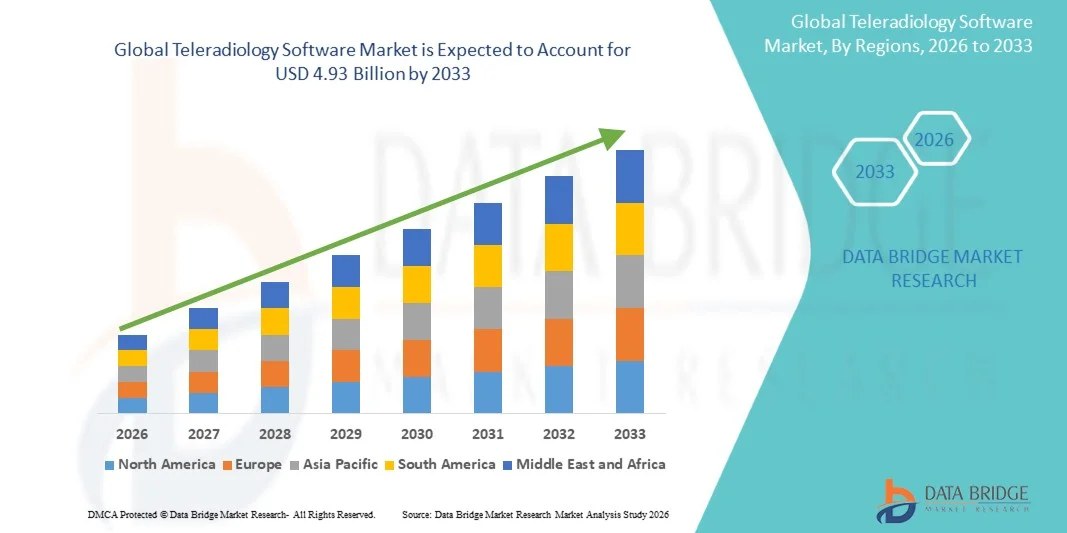
- The global Teleradiology Software market size was valued at USD 2.40 billion in 2025 and is expected to reach USD 4.93 billion by 2033, at a CAGR of 9.42% during the forecast period
- The market growth is largely fueled by the increasing adoption of digital healthcare solutions and advancements in medical imaging technologies, leading to enhanced remote diagnostics and improved workflow efficiency across hospitals and diagnostic centers
- Furthermore, rising demand for faster, accurate, and remote interpretation of radiological images, along with growing shortage of radiologists and increasing need for 24/7 diagnostic services, is establishing teleradiology software as a critical component of modern healthcare systems. These converging factors are accelerating the uptake of Teleradiology Software solutions, thereby significantly boosting the industry's growth
Teleradiology Software Market Analysis
- Teleradiology software, offering digital solutions for remote interpretation and transmission of radiological images, is increasingly becoming a vital component of modern healthcare systems in both hospitals and diagnostic centers due to its ability to enhance workflow efficiency, enable 24/7 reporting, and improve access to radiology expertise
- The escalating demand for teleradiology software is primarily fueled by the growing shortage of radiologists, increasing volume of diagnostic imaging procedures, widespread adoption of digital healthcare systems, and a rising preference for faster and more accurate remote diagnostics
- North America dominated the teleradiology software market with the largest revenue share of 42.0% in 2025, characterized by advanced healthcare IT infrastructure, high adoption of digital imaging technologies, strong presence of key industry players, and increasing demand for efficient radiology workflow solutions, with the U.S. experiencing substantial growth driven by rising imaging volumes and AI-integrated diagnostic tools
- Asia-Pacific is expected to be the fastest growing region in the teleradiology software market during the forecast period due to increasing healthcare digitization, rising investments in healthcare infrastructure, growing awareness, and expanding access to diagnostic services
- The PACS segment dominated the largest market revenue share of 58.6% in 2025, driven by its critical role in storing, retrieving, and sharing medical images across healthcare networks
Report Scope and Teleradiology Software Market Segmentation
|
Attributes |
Teleradiology Software Key Market Insights |
|
Segments Covered |
|
|
Countries Covered |
North America
Europe
Asia-Pacific
Middle East and Africa
South America
|
|
Key Market Players |
|
|
Market Opportunities |
|
|
Value Added Data Infosets |
In addition to the insights on market scenarios such as market value, growth rate, segmentation, geographical coverage, and major players, the market reports curated by the Data Bridge Market Research also include in-depth expert analysis, patient epidemiology, pipeline analysis, pricing analysis, and regulatory framework. |
Teleradiology Software Market Trends
“Advancements in AI-Driven Imaging Analysis and Cloud-Based Radiology Platforms”
- A significant and accelerating trend in the global Teleradiology Software market is the growing integration of artificial intelligence (AI) and cloud-based platforms to enhance diagnostic imaging interpretation and workflow efficiency
- AI-enabled solutions are increasingly being used to assist radiologists in detecting abnormalities with greater speed and accuracy, thereby improving clinical decision-making
- For instance, AI-powered teleradiology platforms can automatically prioritize critical cases such as suspected strokes or trauma scans, ensuring faster reporting and improved patient outcomes in emergency situations
- The adoption of cloud-based teleradiology systems is enabling seamless storage, sharing, and remote access to medical images, allowing radiologists to collaborate across geographies in real time. This is particularly beneficial for hospitals facing shortages of specialized radiologists
- Furthermore, machine learning algorithms are being trained on large imaging datasets to improve diagnostic accuracy over time, supporting early detection of diseases such as cancer, neurological disorders, and cardiovascular conditions
- The increasing use of mobile-enabled teleradiology solutions is also allowing healthcare professionals to review and interpret medical images remotely, improving flexibility and reducing diagnostic delays
- This trend toward more intelligent, automated, and connected imaging workflows is transforming radiology practices and significantly enhancing healthcare delivery efficiency worldwide
Teleradiology Software Market Dynamics
Driver
“Rising Demand for Remote Diagnostics and Growing Healthcare Infrastructure Gaps”
- The increasing need for remote diagnostic services, coupled with shortages of skilled radiologists in many regions, is a key driver for the Teleradiology Software market. Healthcare providers are increasingly relying on remote imaging interpretation to ensure timely diagnosis and treatment
- For instance, rural and underserved healthcare facilities often lack access to specialized radiology expertise, leading to delays in diagnosis; teleradiology platforms help bridge this gap by enabling remote reporting from centralized or global radiology networks
- The rising prevalence of chronic diseases such as cancer, cardiovascular disorders, and neurological conditions is further increasing the demand for imaging services, thereby boosting the adoption of teleradiology solutions
- Moreover, increasing healthcare digitization and government initiatives promoting telemedicine are supporting the expansion of digital radiology infrastructure across hospitals and diagnostic centers
- The ability to reduce turnaround time for imaging reports and improve operational efficiency is also encouraging healthcare providers to adopt teleradiology software solutions
Restraint/Challenge
“Data Security Concerns and High Implementation Costs”
- Concerns related to data privacy and cybersecurity remain a major challenge in the Teleradiology Software market, as these platforms involve the transmission and storage of sensitive patient medical imaging data over digital networks
- For instance, the risk of unauthorized access or data breaches in cloud-based systems raises concerns among healthcare providers regarding compliance with strict data protection regulations such as HIPAA and GDPR
- In addition, implementing advanced teleradiology systems requires significant investment in IT infrastructure, secure networks, and integration with existing hospital information systems, which can be a barrier for smaller healthcare facilities
- The need for continuous system maintenance, software upgrades, and cybersecurity protocols further adds to operational costs
- In developing regions, limited digital infrastructure and budget constraints can slow down adoption despite the growing need for remote diagnostic services
- Overcoming these challenges through stronger encryption technologies, regulatory compliance frameworks, and cost-effective deployment models will be essential for sustained market growth
Teleradiology Software Market Scope
The market is segmented on the basis of technology, imaging techniques, application, and end user.
• By Technology
On the basis of technology, the Teleradiology Software market is segmented into hardware, software, and telecom & networking. The software segment dominated the largest market revenue share of 46.9% in 2025, driven by the increasing adoption of advanced imaging platforms, cloud-based radiology solutions, and AI-integrated diagnostic systems. Software plays a critical role in enabling efficient image transfer, storage, and interpretation across healthcare facilities. Growing demand for real-time diagnostic reporting and remote access to imaging data further strengthens adoption. Rising integration of artificial intelligence and machine learning enhances diagnostic accuracy and workflow efficiency. Expanding hospital digitization and electronic health record (EHR) systems also support segment growth. Increasing investments in healthcare IT infrastructure accelerate software deployment. In addition, the need for seamless interoperability across healthcare networks boosts demand. The rising burden of chronic diseases requiring frequent imaging further drives utilization. Continuous technological advancements improve system performance and user experience. These factors collectively ensure the dominance of the software segment in the market.
The telecom and networking segment is expected to witness the fastest CAGR of 11.2% from 2026 to 2033, driven by the growing need for high-speed data transmission and secure connectivity in teleradiology systems. Increasing adoption of 5G networks and advanced cloud infrastructure enhances real-time image sharing capabilities. The rising demand for remote diagnostics and telemedicine services further fuels growth. Expanding healthcare access in rural and underserved regions strengthens adoption. The need for secure, low-latency communication channels supports technological upgrades. In addition, increasing investments in healthcare connectivity infrastructure drive expansion. Growing collaborations between telecom providers and healthcare organizations accelerate deployment. The rising volume of imaging data necessitates robust networking solutions. Furthermore, advancements in cybersecurity for medical data transmission enhance reliability. These factors position telecom and networking as the fastest-growing technology segment.
• By Imaging Techniques
On the basis of imaging techniques, the Teleradiology Software market is segmented into X-ray, computed tomography (CT), ultrasound, magnetic resonance imaging (MRI), nuclear imaging, fluoroscopy, mammography, and others. The computed tomography (CT) segment dominated the largest market revenue share of 28.4% in 2025, driven by its widespread use in emergency diagnostics, oncology, and trauma care. CT imaging provides high-resolution cross-sectional images, making it essential for accurate disease detection. Increasing prevalence of cancer and cardiovascular diseases significantly boosts demand. Rising hospital admissions for critical conditions further strengthen usage. Technological advancements such as low-dose CT scanning improve patient safety and adoption. Expanding healthcare infrastructure enhances access to CT imaging services. In addition, integration of AI-based interpretation tools improves diagnostic speed and accuracy. Growing use in pre-surgical planning and disease monitoring supports segment expansion. The availability of advanced CT scanners in both developed and emerging markets drives utilization. These factors collectively ensure the dominance of the CT imaging segment.
The MRI segment is expected to witness the fastest CAGR of 10.5% from 2026 to 2033, driven by increasing demand for high-precision, non-invasive diagnostic imaging. MRI is widely used for neurological, musculoskeletal, and soft tissue examinations. Rising prevalence of neurological disorders and spinal conditions supports growth. Technological advancements such as functional MRI (fMRI) and faster scanning techniques enhance efficiency. Increasing adoption in oncology for tumor detection further drives demand. Growing investments in advanced imaging infrastructure boost availability. In addition, the expansion of outpatient diagnostic centers supports accessibility. The rising need for early and accurate disease diagnosis strengthens adoption. Integration of AI in MRI interpretation improves workflow efficiency. These factors position MRI as the fastest-growing imaging technique segment.
• By Application
On the basis of application, the Teleradiology Software market is segmented into Picture Archiving and Communication System (PACS) and Radiology Information System (RIS). The PACS segment dominated the largest market revenue share of 58.6% in 2025, driven by its critical role in storing, retrieving, and sharing medical images across healthcare networks. PACS enables efficient digital management of radiological data, reducing dependency on physical film. Increasing adoption of digital healthcare systems significantly boosts demand. Growing need for remote access to imaging data in teleradiology further supports growth. Integration with hospital information systems enhances workflow efficiency. Rising volume of imaging procedures across healthcare facilities drives usage. In addition, advancements in cloud-based PACS solutions improve scalability and accessibility. Expanding healthcare digitization initiatives accelerate adoption globally. The need for faster diagnostic turnaround times strengthens its market position. These factors collectively ensure the dominance of the PACS segment.
The RIS segment is expected to witness the fastest CAGR of 9.8% from 2026 to 2033, driven by increasing demand for efficient management of radiology workflows and patient data. RIS helps streamline scheduling, reporting, and tracking of imaging services. Rising adoption of integrated healthcare IT systems supports growth. Increasing focus on improving operational efficiency in hospitals and diagnostic centers boosts demand. In addition, integration with PACS enhances overall system functionality. Growing emphasis on reducing diagnostic delays supports adoption. Expanding healthcare infrastructure in emerging economies further drives growth. The need for centralized data management systems strengthens demand. Technological advancements in cloud-based RIS platforms improve accessibility and performance. These factors position RIS as the fastest-growing application segment.
• By End User
On the basis of end user, the Teleradiology Software market is segmented into hospitals, ambulatory surgical centers, diagnostic centers, and others. The hospitals segment dominated the largest market revenue share of 52.1% in 2025, driven by high patient inflow and the availability of advanced imaging infrastructure. Hospitals are the primary centers for diagnostic imaging and emergency care, generating significant demand for teleradiology solutions. Increasing prevalence of chronic and acute diseases further supports imaging volume. Rising adoption of digital healthcare systems enhances workflow efficiency. Integration of AI-powered diagnostic tools improves accuracy and turnaround time. Expanding hospital networks globally contribute to market dominance. In addition, government investments in hospital digitization boost adoption. The need for centralized imaging data management strengthens usage. Growing collaborations with radiology service providers further enhance efficiency. These factors collectively ensure the dominance of the hospital segment.
The diagnostic centers segment is expected to witness the fastest CAGR of 11.0% from 2026 to 2033, driven by increasing demand for specialized and cost-effective imaging services. The rising number of standalone diagnostic facilities supports market expansion. Increasing preference for outpatient diagnostic services boosts adoption. Technological advancements in imaging equipment enhance service quality. Growing awareness regarding early disease detection drives patient visits. In addition, shorter turnaround times offered by diagnostic centers improve competitiveness. Expanding healthcare access in urban and semi-urban regions supports growth. Integration of cloud-based teleradiology platforms enhances efficiency. Increasing partnerships with hospitals further strengthen service networks. These factors position diagnostic centers as the fastest-growing end user segment.
Teleradiology Software Market Regional Analysis
- North America dominated the teleradiology software market with the largest revenue share of approximately 42.0% in 2025, characterized by advanced healthcare IT infrastructure, high adoption of digital imaging technologies, and a strong presence of key industry players
- The region is witnessing increasing demand for efficient radiology workflow solutions, driven by rising imaging volumes and the growing need for faster, more accurate diagnostic reporting across healthcare facilities
- The widespread implementation of teleradiology platforms across hospitals, diagnostic centers, and specialty clinics is further supported by continuous technological advancements, strong reimbursement frameworks, and the integration of AI-assisted imaging tools, enhancing overall diagnostic efficiency and clinical decision-making
U.S. Teleradiology Software Market Insight
The U.S. teleradiology software market captured the largest revenue share within North America in 2025, driven by rapid growth in diagnostic imaging volumes, strong digital healthcare infrastructure, and increasing adoption of AI-integrated radiology solutions. The rising demand for faster turnaround times in radiology reporting, coupled with the presence of leading healthcare IT companies, is further accelerating market expansion. Additionally, continuous innovation in cloud-based imaging platforms and advanced workflow automation tools is strengthening the country’s leadership in the global market.
Europe Teleradiology Software Market Insight
The Europe teleradiology software market is projected to expand at a substantial CAGR throughout the forecast period, primarily driven by increasing digitalization of healthcare systems, rising demand for remote diagnostic services, and growing prevalence of chronic diseases requiring imaging-based diagnosis. The region is also witnessing strong adoption of advanced radiology workflow solutions across hospitals and diagnostic networks.
U.K. Teleradiology Software Market Insight
The U.K. teleradiology software market is anticipated to grow at a noteworthy CAGR during the forecast period, supported by increasing investment in healthcare IT systems, rising demand for efficient diagnostic reporting, and expanding use of remote radiology services. Government initiatives aimed at improving healthcare accessibility and reducing diagnostic delays are further contributing to market growth.
Germany Teleradiology Software Market Insight
The Germany teleradiology software market is expected to expand at a considerable CAGR during the forecast period, fueled by strong healthcare infrastructure, increasing adoption of digital imaging technologies, and rising focus on precision diagnostics. The country’s emphasis on data security and high-quality healthcare services is driving the integration of advanced teleradiology platforms across clinical settings.
Asia-Pacific Teleradiology Software Market Insight
The Asia-Pacific teleradiology software market is expected to be the fastest growing region during the forecast period, driven by increasing healthcare digitization, rising investments in healthcare infrastructure, expanding diagnostic access, and growing awareness of advanced imaging technologies. The region is witnessing rapid adoption of teleradiology solutions to address the shortage of radiology specialists and improve diagnostic efficiency.
Japan Teleradiology Software Market Insight
The Japan teleradiology software market is gaining momentum due to the country’s advanced healthcare system, strong focus on technological innovation, and increasing demand for efficient diagnostic workflows. The growing aging population and rising need for timely medical imaging interpretation are further supporting market adoption across hospitals and diagnostic centers.
China Teleradiology Software Market Insight
The China teleradiology software market accounted for the largest market revenue share in Asia Pacific in 2025, attributed to rapid healthcare infrastructure development, increasing government investments in digital health, and growing adoption of advanced diagnostic technologies. The country’s large patient population, expanding hospital networks, and rising focus on improving diagnostic efficiency are key factors propelling market growth.
Teleradiology Software Market Share
The Teleradiology Software industry is primarily led by well-established companies, including:
- GE HealthCare (U.S.)
- Siemens Healthineers AG (Germany)
- Koninklijke Philips N.V. (Netherlands)
- Fujifilm Holdings Corporation (Japan)
- Agfa-Gevaert Group (Belgium)
- Carestream Health (U.S.)
- Sectra AB (Sweden)
- Merge Healthcare (U.S.)
- Novarad Corporation (U.S.)
- Intelerad Medical Systems (Canada)
- RamSoft Inc. (Canada)
- Mckesson Corporation (U.S.)
- IBM Watson Health (U.S.)
- Change Healthcare (U.S.)
- Ambra Health (U.S.)
- INFINITT Healthcare Co., Ltd. (South Korea)
- Teleradiology Solutions (India)
- Everlight Radiology (U.K.)
- Medica Reporting Ltd (U.K.)
- Radiology Partners (U.S.)
Latest Developments in Global Teleradiology Software Market
- In May 2025, Konica Minolta Healthcare Americas and NewVue introduced Exa Teleradiology, a new solution designed to support the complex needs of modern teleradiology practices and enhance remote imaging workflows
- In May 2025, Rad AI announced an additional USD 8 million in strategic investments from leading U.S. health systems to advance enterprise AI tools for radiology, supporting automated reporting and diagnostic workflows that integrate with teleradiology platforms. This funding highlights the growing role of AI in teleradiology software enhancements
- In November 2025, GE HealthCare announced an agreement to acquire medical imaging software provider Intelerad for USD 2.3 billion to expand its cloud-based imaging and software-as-a-service offerings, which are widely used in outpatient and remote diagnostic settings. This strategic move signals consolidation and expansion of teleradiology software capabilities globally

- Interactive Data Analysis Dashboard
- Company Analysis Dashboard for high growth potential opportunities
- Research Analyst Access for customization & queries
- Competitor Analysis with Interactive dashboard
- Latest News, Updates & Trend analysis
- Harness the Power of Benchmark Analysis for Comprehensive Competitor Tracking
Data collection and base year analysis are done using data collection modules with large sample sizes. The stage includes obtaining market information or related data through various sources and strategies. It includes examining and planning all the data acquired from the past in advance. It likewise envelops the examination of information inconsistencies seen across different information sources. The market data is analysed and estimated using market statistical and coherent models. Also, market share analysis and key trend analysis are the major success factors in the market report. To know more, please request an analyst call or drop down your inquiry.
The key research methodology used by DBMR research team is data triangulation which involves data mining, analysis of the impact of data variables on the market and primary (industry expert) validation. Data models include Vendor Positioning Grid, Market Time Line Analysis, Market Overview and Guide, Company Positioning Grid, Patent Analysis, Pricing Analysis, Company Market Share Analysis, Standards of Measurement, Global versus Regional and Vendor Share Analysis. To know more about the research methodology, drop in an inquiry to speak to our industry experts.
Data Bridge Market Research is a leader in advanced formative research. We take pride in servicing our existing and new customers with data and analysis that match and suits their goal. The report can be customized to include price trend analysis of target brands understanding the market for additional countries (ask for the list of countries), clinical trial results data, literature review, refurbished market and product base analysis. Market analysis of target competitors can be analyzed from technology-based analysis to market portfolio strategies. We can add as many competitors that you require data about in the format and data style you are looking for. Our team of analysts can also provide you data in crude raw excel files pivot tables (Fact book) or can assist you in creating presentations from the data sets available in the report.













