


What is the Tempeh Market Size and Growth Rate?
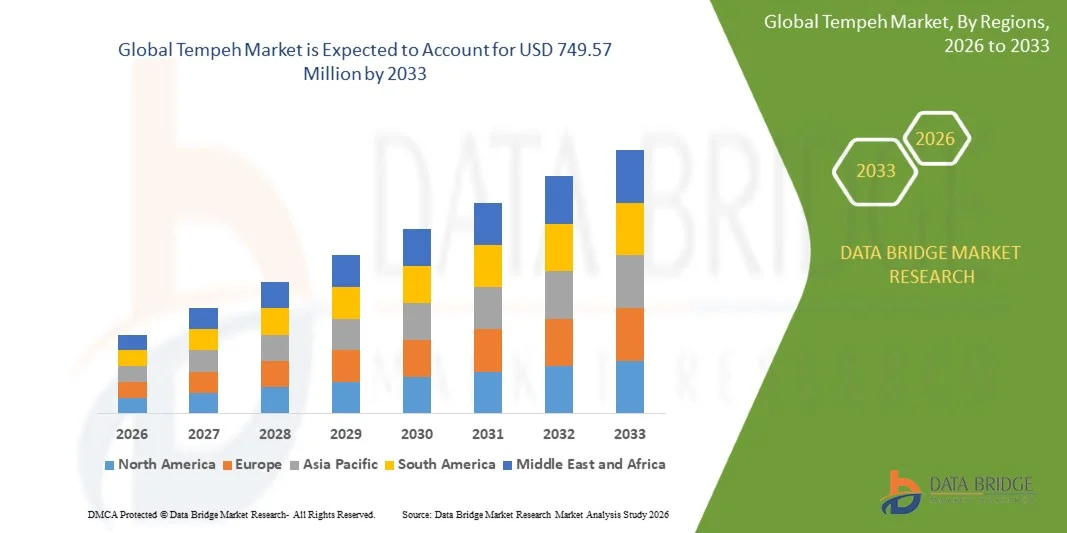
- As per Data Bridge Market Research analysis, the tempeh market was valued at USD 236.68 million in 2025 and is projected to reach USD 749.57 million by 2033, growing at a CAGR of 15.50% from 2026 to 2033.
- The market is experiencing consistent growth driven by rising demand for meat substitutes, increasing adoption of vegetarian and plant-based diets, growing health and nutritional awareness, and the expanding use of tempeh across household and foodservice applications. Tempeh's nutritional profile, including protein, fiber, minerals, and B vitamins, is strengthening its positioning as a functional and nutritious food alternative.
- The increasing focus on healthier eating, combined with a growing working population, busy lifestyles, and demand for convenient food products, is encouraging consumers to adopt convenient tempeh offerings such as frozen and ready-to-eat products. At the same time, broader distribution through direct and indirect channels is improving product accessibility and supporting market penetration across developed and emerging markets.
Market Size & Forecast
- Global Market Value (2025): USD 236.68 Million
- Expected Market Value (2033): USD 749.57 Million
- Forecast CAGR (2026–2033): 15.50%
- Leading Region in 2025: North America
- Fastest Growing Region: Asia Pacific
What are the Major Takeaways of the Tempeh Market?
- North America dominated the tempeh market with the largest revenue share of 39.75% in 2025, supported by strong consumer adoption of plant-based proteins, developed cold-chain infrastructure, and increasing availability of fresh and frozen tempeh products.
- Asia-Pacific is expected to be the fastest-growing region at a CAGR of 12.41% from 2026 to 2033, fueled by Indonesia's established tempeh consumption, expanding plant-based food demand, and increasing consumer interest in tempeh across China and India.
- The fresh tempeh segment led the market with a 46.7% share in 2025, driven by strong consumer preference for minimally processed and traditionally fermented tempeh
- Ready-to-eat tempeh are the fastest-growing product type, projected to register a CAGR of 6.4%, reflecting the surge in demand for convenient plant-based protein products among consumers with busy lifestyles.
- The soybean segment dominated the source type category with a 45.2% revenue share in 2025, led by the traditional use of soybeans as the primary substrate for tempeh fermentation.
- Conventional accounted for 55% of the market share in 2025, preferred by its broader availability, established production infrastructure, and comparatively lower price positioning.
- The herbs & spice segment is the fastest-growing flavour category, with a CAGR of 6%, driven by rising consumer demand for flavorful and convenient plant-based foods, increasing product innovation with differentiated seasoning profiles
Report Scope and Tempeh Market Segmentation
|
Attributes |
Tempeh Key Market Insights |
|
Segments Covered |
|
|
Countries Covered |
North America
Europe
Asia-Pacific
Middle East and Africa
South America
|
|
Key Market Players |
|
|
Market Opportunities |
|
|
Value Added Data Infosets |
In addition to the insights on market scenarios such as market value, growth rate, segmentation, geographical coverage, and major players, the market reports curated by the Data Bridge Market Research also include in-depth expert analysis, pricing analysis, brand share analysis, consumer survey, demography analysis, supply chain analysis, value chain analysis, raw material/consumables overview, vendor selection criteria, PESTLE Analysis, Porter Analysis, and regulatory framework. |
What is the Key Trend in the Tempeh Market?
- Product diversification beyond traditional soybean tempeh is becoming a key trend, as manufacturers and researchers introduce chickpea, pea, multigrain, and other formulations to broaden consumer appeal and address allergen, dietary, and nutritional preferences.
- In May 2025, The Tofoo Co. relaunched its tempeh in the U.K. with a new four-ingredient recipe made from organic, non-GMO soybeans, live culture, water, and apple cider vinegar. The reformulation was designed to deliver a nuttier taste and reduce the acidic flavor that can discourage new consumers, while the product was positioned for mainstream grocery retail
- Demand for high-protein and minimally processed plant-based foods is strengthening tempeh adoption, particularly among flexitarian, vegetarian, vegan, and health-conscious consumers seeking alternatives with recognizable ingredients and functional nutritional benefits.
- Ready-to-eat, flavored, and convenient tempeh formats are gaining attention, helping manufacturers reduce preparation barriers and position tempeh as an accessible protein option for mainstream consumers across retail and foodservice applications.
- Retail availability and product variety are expanding, with manufacturers offering tempeh through supermarkets, specialty stores, online channels, and foodservice outlets, improving accessibility beyond traditional markets and supporting broader consumer awareness.
- For instance, in December 2024, research article published in Food Bioscience demonstrated innovation in non-soy tempeh by fermenting jack beans with a combined Rhizopus oligosporus and Saccharomyces cerevisiae starter. The study reported improved sensory properties and a β-glucan content of 0.904%, illustrating the market trend toward alternative substrates and differentiated tempeh formulations.
- Fermentation innovation is increasingly focused on improving nutritional, sensory, and functional properties, as researchers investigate alternative substrates, microbial cultures, packaging systems, and controlled fermentation techniques for commercially scalable tempeh production.
What are the Key Drivers of the Tempeh Market?
- The rapid expansion of plant-based eating and flexitarian diets is increasing demand for protein-rich meat alternatives, with tempeh benefiting from its dense texture, fermentation characteristics, and suitability across multiple meal applications.
- For instance, in March 2024, Greenleaf Foods, the owner of Lightlife, launched Tempeh Protein Crumbles in the U.S. and Canada, citing growing consumer demand for healthy, clean, protein-rich foods. The pre-crumbled and pre-seasoned format was designed to make tempeh more convenient for consumers and broaden its use across everyday meals.
- Growing consumer awareness of protein, fiber, and healthier food choices is strengthening interest in minimally processed fermented foods, particularly as consumers seek nutritious alternatives that can be incorporated into everyday diets.
- The increasing penetration of supermarkets, specialty retailers, and online grocery platforms is improving tempeh accessibility, while wider distribution and cold-chain capabilities are helping manufacturers serve consumers beyond traditional geographic markets.
- For instance, in May 2024, Better Nature Tempeh expanded distribution to more than 700 Tesco stores and 300 Asda stores in the U.K., in addition to almost 1,000 Lidl stores, reporting 30% year-on-year growth for the U.K. tempeh category. The expanded retail presence demonstrates how increasing mainstream availability is supporting consumer adoption of tempeh as a whole-food protein.
- Rising interest in sustainable protein sources is encouraging food companies to explore fermented plant proteins that can diversify diets while supporting broader alternative-protein portfolios and responding to changing consumer preferences around animal-based foods.
Which Factors are Challenging the Growth of the Tempeh Market?
- Short shelf life and stringent temperature-control requirements remain major challenges, particularly for fresh tempeh, because continued fermentation and microbial activity can rapidly alter texture, aroma, moisture, and overall product quality after production.
- For instance, in June 2026, a study published in Food Research International examined long-term preservation techniques for tempeh and found that preservation methods can significantly influence its microbiota, volatile compounds, and proteolysis. The research highlighted the importance of appropriate preservation and starter-management strategies for maintaining product consistency, demonstrating a key technical challenge for scaling tempeh production and distribution
- Limited consumer familiarity with tempeh preparation, flavor, and fermentation characteristics in newer markets can restrict repeat purchases, requiring manufacturers and retailers to invest in education, recipes, sampling, and product innovation to build mainstream acceptance.
- Growing demand for fermented functional foods is creating opportunities for tempeh as consumers increasingly seek foods associated with digestive health, plant-based nutrition, and traditional fermentation processes.
- Expansion of foodservice applications and plant-based menus is increasing tempeh consumption, with restaurants, cafés, meal-delivery companies, and institutional food providers incorporating tempeh into burgers, bowls, sandwiches, and other prepared meals.
- For instance, in November 2021, a Danish consumer study involving 395 participants found that only 26% knew about tempeh and just 23% had a positive attitude toward it. The researchers identified limited product knowledge and unfamiliarity with preparation as important barriers to introducing tempeh in new markets, demonstrating the challenge of building consumer awareness outside established tempeh-consuming regions.
- Dependence on soybean-based production can create raw-material and formulation constraints, while introducing alternative substrates requires additional fermentation research to achieve consistent taste, texture, nutritional characteristics, and commercial-scale production performance.
How is the Tempeh Market Segmented?
The tempeh market is segmented on the basis of product type, source, nature, flavour, and retail channel.
- By Product Type
On the basis of product type, the tempeh market is segmented into fresh tempeh, frozen tempeh, and ready-to-eat tempeh. The fresh tempeh segment dominated the market with a 46.7% share in 2025, owing to strong consumer preference for minimally processed and traditionally fermented tempeh. Fresh tempeh provides the characteristic firm texture and nutty flavour associated with conventional tempeh. It is particularly popular in established tempeh-consuming markets where fresh production and local distribution networks are well developed. Consumers seeking natural foods with fewer preservatives also tend to prefer fresh formats. The segment is widely used in household cooking as well as restaurants and foodservice applications.
The ready-to-eat tempeh segment is projected to be the fastest-growing product type, registering a CAGR of 6.4% from 2026 to 2033. Growth is being supported by increasing demand for convenient plant-based protein products among consumers with busy lifestyles. Ready-to-eat formats eliminate much of the preparation traditionally required before consuming tempeh. Pre-cooked, pre-seasoned, sliced, cubed, and crumbled products are also making tempeh more accessible to consumers unfamiliar with traditional preparation methods. Manufacturers are increasingly developing convenient formats to expand tempeh consumption beyond specialist and traditional markets. These products are particularly suitable for quick meals, snacks, salads, sandwiches, bowls, and other contemporary food applications.
- By Source
On the basis of source, the tempeh market is segmented into soybean, multigrain, and others. The soybean segment dominated the market with a 45.2% share in 2025, supported by the traditional use of soybeans as the primary substrate for tempeh fermentation. Soybean-based tempeh is widely recognized as the conventional form of the product and benefits from strong consumer familiarity. Soybeans provide a high-protein base that supports tempeh's positioning as a plant-based meat alternative. The fermentation process also contributes to tempeh's distinctive texture, flavour, and nutritional profile. Established soybean supply chains and standardized fermentation practices enable manufacturers to produce tempeh consistently at commercial scale. Soybean tempeh is particularly well established in Indonesia and other Asian markets while also gaining popularity in Western plant-based food markets
The multigrain segment is projected to be the fastest-growing source category, with a CAGR of 6.4% from 2026 to 2033. Multigrain tempeh combines soybeans or other legumes with grains and provides opportunities for manufacturers to differentiate products through broader ingredient combinations. Consumers are increasingly interested in products offering diverse nutritional benefits, including protein, dietary fibre, vitamins, and minerals. Multigrain formulations can also provide distinctive textures and more complex flavour profiles than conventional soybean tempeh. These characteristics make the segment attractive for salads, bowls, stir-fries, sandwiches, and other modern food applications. Product innovation using alternative grains and legumes is also helping manufacturers appeal to consumers seeking variety in plant-based foods.
- By Nature
On the basis of nature, the tempeh market is segmented into organic and conventional tempeh. The conventional segment dominated the market with 55% share in 2025, supported by its broader availability, established production infrastructure, and comparatively lower price positioning. Conventional tempeh is widely offered through supermarkets, specialty retailers, traditional grocery outlets, and foodservice channels. Its relatively lower production cost makes it accessible to a larger consumer base and supports penetration into mass-market food categories. Conventional products also benefit from the long-established use of standard soybean fermentation processes. Consumers primarily seeking affordable plant-based protein are more likely to select conventional varieties.
The organic segment is projected to be the fastest-growing nature category, with a CAGR of 6.8% from 2026 to 2033. Demand is being driven by increasing consumer interest in organic sourcing, clean-label foods, and plant-based nutrition. Organic tempeh is particularly attractive to health-conscious consumers who prioritize minimally processed ingredients and organic agricultural practices. Growing awareness of sustainable food production is also supporting demand for organically sourced plant proteins. Premium grocery stores and specialty retailers provide important channels for organic tempeh brands to target higher-value consumers. Manufacturers can further differentiate organic offerings through non-GMO, clean-label, and environmentally focused positioning.
- By Flavour
On the basis of flavour, the tempeh market is segmented into plain and herbs & spice. The plain tempeh segment dominated the market with 65% share in 2025, driven by its versatility and broad culinary application. Plain tempeh can be marinated, seasoned, grilled, fried, baked, or incorporated into a wide range of recipes. Its relatively neutral flavour profile allows consumers to customize the product according to regional tastes and cooking preferences. Plain tempeh also remains closely associated with traditional fermented soybean products and therefore benefits from strong consumer familiarity. Foodservice operators can use it as a flexible ingredient across Asian, Western, and fusion dishes. Its compatibility with different sauces, marinades, herbs, and spices further strengthens its appeal.
The herbs & spice segment is projected to be the fastest-growing flavour category, with a CAGR of 6% during forecast period. Flavoured tempeh products can make the distinctive taste of fermented tempeh more approachable for consumers who are unfamiliar with the traditional product. Herbs and spices also provide manufacturers with opportunities to develop differentiated products suited to local and international taste preferences. Pre-seasoned products reduce preparation requirements and make tempeh more convenient for time-constrained consumers. The segment is also benefiting from product innovation in ready-to-cook and ready-to-eat plant-based foods. Manufacturers are increasingly using seasoning combinations to create smoky, spicy, savoury, and globally inspired tempeh varieties.
- By Retail Channel
On the basis of retail channel, the tempeh market is segmented into hypermarkets & supermarkets, convenience stores, specialty stores, traditional groceries, online retailers, and other retail channels. The hypermarkets & supermarkets segment dominated the retail market with 40% share in 2025, supported by broad consumer reach, high product visibility, and established refrigerated and frozen food infrastructure. These outlets allow consumers to compare multiple tempeh brands and formats within mainstream grocery environments. Supermarkets are also increasingly placing plant-based proteins alongside other meat alternatives, improving product visibility among mainstream shoppers. Large retail chains can provide manufacturers with extensive geographic coverage and higher distribution volumes.
The online retailers segment is projected to be the fastest-growing retail channel, with a CAGR of 8% during forecast period. E-commerce platforms improve access to tempeh products in areas where specialty or plant-based food retailers have limited physical presence. Online retailers can offer consumers a broader selection of organic, flavored, frozen, and ready-to-eat products than many conventional stores. Home delivery and subscription models also provide greater convenience for consumers who purchase tempeh regularly. Digital platforms enable manufacturers to explain product preparation, nutritional attributes, ingredients, and storage requirements through detailed product pages. The channel is particularly valuable for niche brands seeking direct access to health-conscious and plant-based consumers.
Which Region Holds the Largest Share of the Tempeh Market?
- North America dominated the tempeh market with the largest revenue share of 39.75% in 2025, supported by strong consumer adoption of plant-based proteins, developed cold-chain infrastructure, and increasing availability of fresh and frozen tempeh products.
- The region also benefits from growing demand for vegan, vegetarian, and flexitarian foods, established cold-chain infrastructure, and expanding distribution through supermarkets, specialty stores, and online platforms. Increasing investment in alternative-protein innovation is further strengthening North America's position, while rising consumer interest in nutritious and sustainable plant-based foods continues to support tempeh adoption across the region.
U.S. Tempeh Market Insight
The U.S. tempeh market is witnessing strong growth due to rising consumer interest in plant-based proteins, healthier food choices, and flexitarian diets. The country's established plant-based food industry, extensive supermarket network, and growing availability of tofu and tempeh are improving consumer access to fermented plant proteins. Retail demand is also being supported by consumers seeking minimally processed and protein-rich alternatives to conventional meat products. Increasing availability of fresh, frozen, flavored, and ready-to-use tempeh is further broadening its applications across household meals and foodservice. Regional purchasing data indicates particularly strong demand for tofu, tempeh, and seitan in the Western U.S., where more than two-thirds of households purchased plant-based foods in 2025 and the region recorded the highest spending on these traditional plant proteins.
Asia-Pacific Tempeh Market Insight
The Asia-Pacific tempeh market is expected to witness strong growth, driven by the region's longstanding cultural acceptance of fermented soybean foods and expanding interest in plant-based nutrition. Indonesia remains particularly important because tempeh is deeply integrated into traditional diets and is consumed across household and foodservice applications. Growing health awareness is also encouraging consumers in other Asian markets to consider tempeh as a protein-rich and versatile food ingredient. Increasing urbanization, modern retail development, and expansion of packaged food distribution are improving access to commercially produced tempeh. Rising interest in vegetarian and flexitarian diets in countries such as China, Japan, and India is creating additional opportunities for manufacturers. Product diversification into flavored, organic, multigrain, and ready-to-eat varieties is further supporting regional market development.
Japan Tempeh Market Insight
The Japan tempeh market is witnessing consistent growth due to increasing consumer awareness of plant-based protein, healthy eating, and sustainable food choices. Tempeh is gaining attention because of its high protein content, fermented characteristics, nutty flavor, and versatility across different dishes. Growing interest in vegetarian and vegan diets is creating additional demand for tempeh as a meat-alternative ingredient. The market is also benefiting from product innovation, including flavored, organic, non-GMO, and ready-to-eat tempeh offerings. Import activity is helping expand product availability, with Japan recording a significant increase in plant-based tofu and tempeh import shipments in 2024 compared with the previous year. Expansion through retailers, specialty stores, restaurants, and online channels is expected to improve consumer awareness and strengthen market penetration.
China Tempeh Market Insight
The China tempeh market is growing steadily, driven by increasing consumer awareness of plant-based protein sources and greater emphasis on healthier eating habits. Tempeh is gaining interest because it provides protein, dietary fiber, and fermentation-associated nutritional benefits while offering an alternative to conventional animal proteins. Rising adoption of plant-based diets among younger and urban consumers is creating opportunities for tempeh beyond its traditional regional consumer base. Expansion of supermarkets, specialty retailers, and online grocery platforms is also improving accessibility to packaged tempeh products. Manufacturers are increasingly introducing flavored and convenient formulations to make fermented plant proteins more suitable for contemporary consumption patterns. Growing interest in alternative proteins and product innovation is expected to support wider adoption of tempeh in China's retail and foodservice markets.
U.K. Tempeh Market Insight
The U.K. tempeh market is experiencing steady growth, supported by expanding consumer interest in plant-based foods, whole-food protein sources, and convenient meat alternatives. Retail availability has strengthened as tempeh products increasingly appear across supermarkets and other mainstream grocery channels. In 2025, combined U.K. supermarket sales of tofu, tempeh, and seitan increased by 14.6%, while sales volume rose by 16.8%, indicating strong momentum for these traditional plant-protein foods. Growing consumer preference for less processed plant proteins is supporting demand for tempeh compared with highly formulated meat substitutes. Investment in product development, marketing, and wider retail distribution is also increasing the visibility of specialist tempeh brands. The expansion of original, marinated, and plant-based mince formats is expected to further improve consumer adoption across the U.K.
Germany Tempeh Market Insight
The Germany tempeh market is expanding steadily due to strong consumer interest in plant-based proteins, sustainable diets, and healthier food alternatives. Tempeh is gaining traction alongside other traditional protein-rich foods such as tofu and seitan, particularly among consumers seeking less processed alternatives to conventional meat substitutes. Germany's developed supermarket infrastructure and extensive availability of specialist and organic food products provide favorable distribution conditions for tempeh. In 2025, the combined sales volume of tofu, tempeh, and seitan in Germany increased by 30% to approximately 14 million kilograms, demonstrating growing consumer demand for traditional plant-based protein foods. The relatively lower cost of traditional plant proteins compared with many formulated meat alternatives is also supporting consumer uptake. Continued expansion of organic, flavored, and convenient tempeh products is expected to strengthen the country's role as an important European market.
Which are the Top Companies in Tempeh Market?
The tempeh industry is primarily led by well-established companies, including:
- Better Nature (U.K.)
- Tiba Tempeh Ltd (U.K.)
- Tofoo (U.K.)
- Tempeh Meades Ltd (U.K.)
- Rhapsody Natural Foods (U.S.)
- SoyBoy (U.S.)
- Tootie’s Tempeh (U.S.)
- Henry's Tempeh Inc. (Canada)
- Tempeh Goodness Inc. (Canada)
- NOBLE BEAN (Canada)
- Tempea Natural Foods (Canada)
- Aliments Merjex inc. (Canada)
- Tempeh Deli (New Zealand)
- Nutrisoy (Australia)
- PrimaSoy (Australia)
- Murni (Australia)
- Tiram Food (Malaysia)
- Tempeh Today (India)
- Angie's Tempeh (Singapore)
- Schouten (Netherlands)
What are Latest Developments in Tempeh Market?
- In May 2025, The Tofoo Co. relaunched its tempeh in the U.K. with a new recipe produced at its Yorkshire facility, using only organic and non-GMO soybeans, live culture, water, and apple cider vinegar. The reformulated product was developed to provide a nuttier taste while reducing the acidic profile that can be less appealing to consumers unfamiliar with tempeh. The company positioned the product as a mainstream grocery offering and introduced refreshed packaging highlighting its U.K. production. The relaunch demonstrates continued innovation around taste, clean-label formulation, and consumer accessibility in the tempeh category.
- In April 2025, Better Nature expanded its tempeh distribution to 200 additional REWE stores across central Germany, following a listing in 400 REWE Südwest stores only weeks earlier. This expansion increased the company's presence to approximately 1,300 REWE stores across Germany. Better Nature's Organic and Smoky tempeh products were included in the rollout, demonstrating growing mainstream retail acceptance of tempeh in Europe. The development also reflects manufacturers' efforts to scale distribution beyond the U.K. into continental European markets.
- In April 2024, Tiba Tempeh introduced a new tempeh mince product in the U.K., initially launching through Ocado and subsequently expanding its retail presence. The product was formulated using natural and organic ingredients and positioned as a convenient alternative to conventional plant-based mince. At the same time, Tiba expanded its Original Tempeh Block and Sweet Chilli Marinated Tempeh Pieces into more than 400 Sainsbury's stores and refreshed its overall packaging. The development illustrates the industry's movement toward convenient formats and mainstream supermarket distribution.
- In March 2022, Lightlife launched Tempeh Cubes, a pre-cut and pre-seasoned ready-to-cook tempeh product in the U.S. The new range was introduced in Teriyaki, Southwest, and Tikka Masala varieties and was designed to simplify meal preparation while providing a convenient plant-based protein option. The launch was supported by expansion across online and retail channels, including Amazon and selected grocery chains. The development highlights the industry's shift from traditional tempeh blocks toward convenient, portioned, and flavored formats.
- In February 2021, Schouten Europe announced the launch of Tempeh Today in India, introducing a decentralized production system based on Small Fermentation Units (SFUs). The initiative was designed to enable local production of protein-rich tempeh through high-tech fermentation units, reducing dependence on centralized manufacturing and supporting local availability. Schouten stated that the system was intended to address the protein deficit in a rapidly growing Indian market and planned to implement at least 100 SFUs over the following five years. The development represents an important innovation in localized tempeh manufacturing and production infrastructure.

- Interactive Data Analysis Dashboard
- Company Analysis Dashboard for high growth potential opportunities
- Research Analyst Access for customization & queries
- Competitor Analysis with Interactive dashboard
- Latest News, Updates & Trend analysis
- Harness the Power of Benchmark Analysis for Comprehensive Competitor Tracking
Global Tempeh Market, Supply Chain Analysis and Ecosystem Framework
To support market growth and help clients navigate the impact of geopolitical shifts, DBMR has integrated in-depth supply chain analysis into its Global Tempeh Market research reports. This addition empowers clients to respond effectively to global changes affecting their industries. The supply chain analysis section includes detailed insights such as Global Tempeh Market consumption and production by country, price trend analysis, the impact of tariffs and geopolitical developments, and import and export trends by country and HSN code. It also highlights major suppliers with data on production capacity and company profiles, as well as key importers and exporters. In addition to research, DBMR offers specialized supply chain consulting services backed by over a decade of experience, providing solutions like supplier discovery, supplier risk assessment, price trend analysis, impact evaluation of inflation and trade route changes, and comprehensive market trend analysis.
Data collection and base year analysis are done using data collection modules with large sample sizes. The stage includes obtaining market information or related data through various sources and strategies. It includes examining and planning all the data acquired from the past in advance. It likewise envelops the examination of information inconsistencies seen across different information sources. The market data is analysed and estimated using market statistical and coherent models. Also, market share analysis and key trend analysis are the major success factors in the market report. To know more, please request an analyst call or drop down your inquiry.
The key research methodology used by DBMR research team is data triangulation which involves data mining, analysis of the impact of data variables on the market and primary (industry expert) validation. Data models include Vendor Positioning Grid, Market Time Line Analysis, Market Overview and Guide, Company Positioning Grid, Patent Analysis, Pricing Analysis, Company Market Share Analysis, Standards of Measurement, Global versus Regional and Vendor Share Analysis. To know more about the research methodology, drop in an inquiry to speak to our industry experts.
Data Bridge Market Research is a leader in advanced formative research. We take pride in servicing our existing and new customers with data and analysis that match and suits their goal. The report can be customized to include price trend analysis of target brands understanding the market for additional countries (ask for the list of countries), clinical trial results data, literature review, refurbished market and product base analysis. Market analysis of target competitors can be analyzed from technology-based analysis to market portfolio strategies. We can add as many competitors that you require data about in the format and data style you are looking for. Our team of analysts can also provide you data in crude raw excel files pivot tables (Fact book) or can assist you in creating presentations from the data sets available in the report.













