What is the Temperature-Controlled Pharmaceutical Shipping Packaging Market Size and Growth Rate?
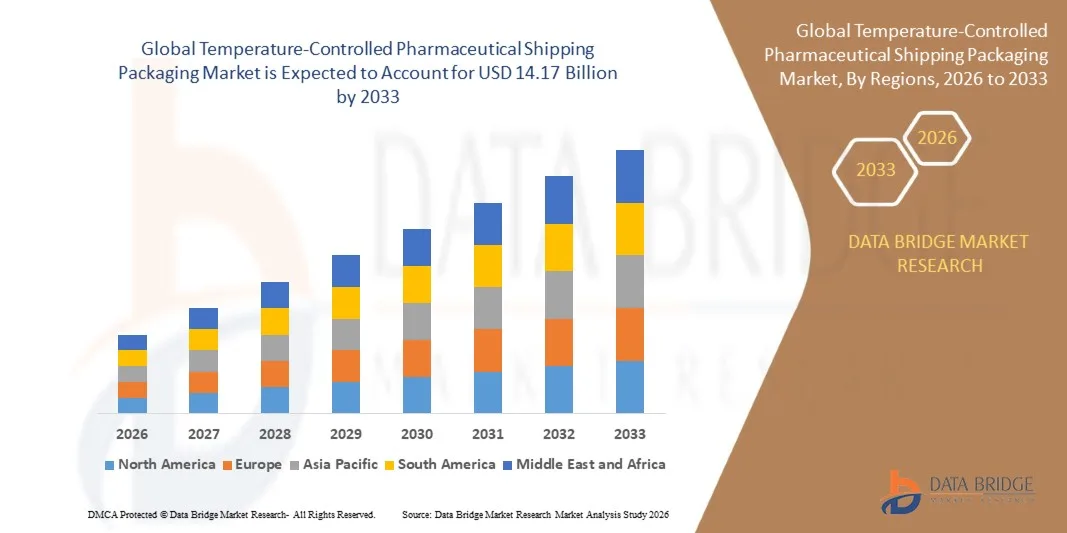
- As per Data Bridge Market Research analysis, the temperature-controlled pharmaceutical shipping packaging market was valued at USD 8.40 billion in 2025 and is projected to reach USD 14.17 billion by 2033, growing at a CAGR of 8.87% from 2026 to 2033.
- The market is experiencing consistent growth driven by rising demand for reliable pharmaceutical cold-chain solutions, increasing shipments of temperature-sensitive biologics and vaccines, and expanding applications across clinical trials, specialty medicines, and global pharmaceutical distribution.
- The growing demand for biologics and temperature-sensitive medicines globally, combined with stringent pharmaceutical storage and transportation requirements, is compelling pharmaceutical manufacturers, logistics providers, and healthcare organizations to adopt advanced temperature-controlled packaging solutions. Active and passive packaging systems with improved insulation and real-time temperature monitoring are supporting the safe transportation of sensitive medicines, reducing temperature excursions, and maintaining product integrity throughout the supply chain.
Market Size & Forecast
- Global Market Value (2025): USD 8.40 Billion
- Expected Market Value (2033): USD 14.17 Billion
- Forecast CAGR (2026–2033): 8.87%
- Leading Region in 2025: North America
- Fastest Growing Region: Asia Pacific
What are the Major Takeaways of the Temperature-Controlled Pharmaceutical Shipping Packaging Market?
- North America dominated the temperature-controlled pharmaceutical shipping packaging market with the largest revenue share of 41.89% in 2025, supported by advanced pharmaceutical logistics infrastructure, strong biologics manufacturing, and established cold-chain networks.
- Asia-Pacific is expected to be the fastest-growing region at a CAGR of 8.9% from 2026 to 2033, fueled by expanding pharmaceutical manufacturing, rising healthcare investments, and growing demand for temperature-sensitive medicines across China, India, and Japan.
- The passive temperature-controlled packaging segment led the market with a 62.4% share in 2025, driven by its cost-effectiveness, operational simplicity, and extensive use in pharmaceutical transportation
- Active temperature-controlled packaging are the fastest-growing packaging type, projected to register a CAGR of 10.8%, reflecting the surge in demand for precise temperature regulation.
- The insulated shippers segment dominated the product type category with a 43.7% revenue share in 2025, led by widespread use in pharmaceutical, biologics, vaccine, and clinical sample transportation.
- Expanded polystyrene (EPS) insulation accounted for 45% of the market share in 2025, preferred by its established use in insulated pharmaceutical shippers
- The biopharmaceuticals and biologics transportation segment is the fastest-growing application category, with a CAGR of 11.5%, driven by the expanding development of biologic therapies and advanced medicines.
Report Scope and Temperature-Controlled Pharmaceutical Shipping Packaging Market Segmentation
|
Attributes |
Temperature-Controlled Pharmaceutical Shipping Packaging Key Market Insights |
|
Segments Covered |
|
|
Countries Covered |
North America
Europe
Asia-Pacific
Middle East and Africa
South America
|
|
Key Market Players |
|
|
Market Opportunities |
|
|
Value Added Data Infosets |
In addition to the insights on market scenarios such as market value, growth rate, segmentation, geographical coverage, and major players, the market reports curated by the Data Bridge Market Research also include import export analysis, production capacity overview, production consumption analysis, price trend analysis, climate change scenario, supply chain analysis, value chain analysis, raw material/consumables overview, vendor selection criteria, PESTLE Analysis, Porter Analysis, and regulatory framework. |
What is the Key Trend in the Temperature-Controlled Pharmaceutical Shipping Packaging Market?
- Pharmaceutical manufacturers and logistics providers are increasingly adopting advanced temperature-controlled shipping packaging to maintain product stability, reduce temperature excursions, and protect sensitive medicines throughout global cold-chain transportation.
- For instance, in September 2024, CEVA Logistics highlighted the growing adoption of reusable temperature-controlled packaging and rental models for transporting vaccines, biologics, and other high-value medicines.
- Real-time temperature monitoring, phase-change materials, and high-performance insulation enable logistics teams to track shipment conditions and maintain required temperature ranges during transportation.
- Pharmaceutical companies are also increasingly using reusable and digitally monitored packaging systems to improve shipment visibility, reduce packaging waste, and support sustainable cold-chain operations.
- For instance, in February 2024, Sensitech launched its TempTale GEO X solution, providing validated, GxP-compliant monitoring for temperature-sensitive medicines and vaccines transported by air, sea, road, and rail.
- As biologics, vaccines, and advanced therapies expand across international markets, demand for reliable, traceable, and sustainable temperature-controlled pharmaceutical shipping packaging is expected to increase, reinforcing cold-chain packaging as a critical component of pharmaceutical distribution.
What are the Key Drivers of the Temperature-Controlled Pharmaceutical Shipping Packaging Market?
- The rapid expansion of biologics, vaccines, and specialty medicines has significantly increased demand for temperature-controlled shipping packaging capable of maintaining product stability across complex international distribution networks.
- For instance, in April 2025, DHL Group announced a €2 billion investment by 2030 in healthcare logistics, including expanded cold-chain capacity, temperature-controlled vehicles, and improved active and passive packaging solutions.
- Pharmaceutical manufacturers, biotechnology companies, and logistics providers are integrating validated insulated shippers, temperature-monitoring devices, and specialized cold-chain handling systems to reduce product degradation and maintain regulatory compliance.
- For instance, in January 2025, DS Smith launched TailorTemp, a recyclable, fibre-based temperature-controlled packaging solution designed to keep pharmaceutical products cool for up to 36 hours, addressing cold-chain transportation requirements and sustainability goals.
- As pharmaceutical pipelines increasingly include temperature-sensitive biologics and advanced therapies, the need for reliable thermal protection, shipment visibility, and validated packaging performance is expected to strengthen market growth.
What Factors are Challenging the Growth of the Temperature-Controlled Pharmaceutical Shipping Packaging Market?
- Temperature-controlled pharmaceutical shipping packaging requires significant upfront investment due to specialized insulation materials, phase-change coolants, validated shipping containers, and integrated temperature-monitoring systems.
- For instance, in December 2025, Packaging Dive reported that dry ice supply constraints were prompting cold-chain packaging companies to develop alternative cooling solutions amid concerns about potential shortages in 2026
- These high costs and qualification requirements can limit adoption among smaller pharmaceutical manufacturers, distributors, and logistics providers, particularly in emerging markets with limited cold-chain infrastructure.
- Pharmaceutical shippers must also validate packaging performance for specific temperature ranges, transportation durations, and environmental conditions, while maintaining appropriate monitoring records and handling procedures.
- For instance, in April 2024, Maersk highlighted infrastructure deficiencies in India's cold-chain logistics sector, including fragmented facilities, inadequate standardization, and shortages of refrigerated vehicle
- These validation requirements and recurring operational expenses can increase the total cost of pharmaceutical distribution, particularly for long-distance shipments and products requiring ultra-low temperatures. Consequently, cost-sensitive buyers may delay adopting advanced packaging systems, restricting market penetration despite growing demand for reliable cold-chain transportation.
How is the Temperature-Controlled Pharmaceutical Shipping Packaging Market Segmented?
The temperature-controlled pharmaceutical shipping packaging market is segmented on the basis of packaging type, product type, technology, and application.
- By Packaging Type
On the basis of packaging type, the temperature-controlled pharmaceutical shipping packaging market is segmented into active temperature-controlled packaging, passive temperature-controlled packaging, and hybrid temperature-controlled packaging. The passive temperature-controlled packaging segment dominated the market with an estimated 62.4% share in 2025, owing to its cost-effectiveness, operational simplicity, and extensive use in pharmaceutical transportation. These systems use insulating materials, refrigerants, and phase-change materials to maintain required temperatures without continuous external power. They are widely used for transporting vaccines, biologics, specialty medicines, and clinical trial materials. Their compatibility with air, road, and multimodal transportation supports broad adoption. Lower maintenance requirements and established packaging procedures further strengthen demand.
The active temperature-controlled packaging segment is projected to register the fastest growth at an estimated CAGR of 10.8% during the forecast period, driven by increasing demand for precise temperature regulation. These systems use powered refrigeration or heating components to maintain defined temperature conditions. They are particularly suitable for sensitive biologics, specialty pharmaceuticals, and shipments requiring tightly controlled environments. Integrated sensors and control systems enable continuous temperature management throughout transit. Growing international pharmaceutical trade and expanding advanced therapies are supporting demand for precise thermal protection. However, higher purchase costs, power requirements, and maintenance needs can limit adoption among smaller logistics providers.
- By Product Type
On the basis of product type, the temperature-controlled pharmaceutical shipping packaging market is segmented into insulated shippers, insulated containers, refrigerated shipping containers, thermal blankets, refrigerants and coolant packs, and temperature-controlled pallet shippers. The insulated shippers segment dominated the market with an estimated 43.7% share in 2025, supported by widespread use in pharmaceutical, biologics, vaccine, and clinical sample transportation. These shippers combine insulating materials with refrigerants to maintain specified temperatures during transit. Their lightweight construction makes them suitable for parcel shipments and air freight. They are available in multiple sizes and configurations to accommodate different pharmaceutical products and shipment durations. Compatibility with validated packaging procedures supports adoption among pharmaceutical manufacturers and logistics providers.
The refrigerants and coolant packs segment is projected to register the fastest growth at an estimated CAGR of 9.4% during the forecast period, driven by the growing need for reliable thermal control in pharmaceutical shipments. Gel packs, phase-change materials, and specialized coolants help maintain defined temperature ranges during transportation. They are used alongside insulated shippers and containers for vaccines, biologics, and specialty medicines. Increasing demand for refrigerated and frozen pharmaceutical distribution is supporting adoption. Innovations in phase-change formulations are improving temperature stability and thermal performance. However, coolant selection and conditioning must match the product's temperature requirements to prevent freezing or overheating.
- By Technology
On the basis of technology, the temperature-controlled pharmaceutical shipping packaging market is segmented into phase-change materials (PCMs), vacuum-insulated panels (VIPs), expanded polystyrene (EPS) insulation, polyurethane foam insulation, active refrigeration systems, and real-time temperature monitoring and data logging. The expanded polystyrene (EPS) insulation segment is estimated to account for 45% of the insulation-material category in 2025, supported by its established use in insulated pharmaceutical shippers. EPS provides lightweight thermal insulation, shock protection, and relatively low-cost packaging performance. Its compatibility with gel packs and other refrigerants makes it suitable for transporting temperature-sensitive medicines. Manufacturers benefit from established production processes and broad material availability. EPS-based packaging can be configured for different shipment sizes and temperature requirements.
The real-time temperature monitoring and data logging segment is projected to register the fastest growth at an estimated CAGR of 10% during the forecast period, as pharmaceutical supply chains increasingly prioritize shipment visibility and temperature compliance. These technologies record temperature conditions throughout transportation and help identify excursions that could compromise medicine quality. Connected sensors can provide alerts when shipments move outside specified temperature ranges. Digital records support investigations, quality assurance, and regulatory documentation. Integration with cloud-based logistics platforms enables pharmaceutical companies to monitor shipments across multiple transportation stages. Growing international distribution of biologics and clinical trial materials is strengthening demand for advanced monitoring solutions.
- By Application
On the basis of application, the temperature-controlled pharmaceutical shipping packaging market is segmented into vaccine transportation, biopharmaceuticals and biologics transportation, clinical trial materials transportation, specialty pharmaceuticals transportation, insulin and hormone transportation, and blood products and plasma-derived medicines transportation. The vaccine transportation segment is estimated to account for 41% of the application category in 2025, supported by widespread immunization programs and the need to maintain vaccine potency throughout distribution. Vaccines require carefully controlled storage and transportation conditions to preserve their effectiveness. Temperature-controlled packaging protects vaccines from excessive heat and accidental freezing during transit. Government immunization initiatives and international vaccination campaigns support demand for validated shipping solutions. Manufacturers and healthcare logistics providers rely on insulated shippers, refrigerants, and temperature-monitoring devices to maintain product integrity.
The biopharmaceuticals and biologics transportation segment is projected to register the fastest growth at an estimated CAGR of 11.5% during the forecast period, driven by the expanding development of biologic therapies and advanced medicines. Biologics often contain complex molecules that are sensitive to temperature fluctuations during storage and transportation. The growing development of monoclonal antibodies, cell therapies, gene therapies, and other advanced treatments is increasing demand for specialized packaging. These products may require refrigerated, frozen, or ultra-low-temperature shipping conditions. Validated insulation systems and continuous monitoring help maintain product quality across international distribution networks. Expanding biotechnology investment and the growth of specialty medicines are further supporting demand.
Which Region Holds the Largest Share of the Temperature-Controlled Pharmaceutical Shipping Packaging Market?
- North America dominated the temperature-controlled pharmaceutical shipping packaging market with the largest revenue share of 41.89% in 2025, supported by advanced pharmaceutical logistics infrastructure, strong biologics manufacturing, and established cold-chain networks.
- The region also benefits from substantial biotechnology investments, stringent pharmaceutical transportation requirements, and widespread adoption of validated insulated shippers, active cooling systems, and real-time temperature-monitoring technologies. Increasing shipments of vaccines, biologics, specialty medicines, and clinical trial materials, particularly across the U.S. and Canada, continue to strengthen North America's leadership in the global market.
U.S. Temperature-Controlled Pharmaceutical Shipping Packaging Market Insight
The U.S. temperature-controlled pharmaceutical shipping packaging market is witnessing strong growth due to rising demand for biologics, vaccines, specialty medicines, and advanced pharmaceutical cold-chain solutions. The country’s mature pharmaceutical industry, extensive healthcare logistics infrastructure, and increasing adoption of validated insulated shippers and real-time temperature-monitoring systems are driving demand across pharmaceutical manufacturing, biotechnology, and clinical trial applications. In addition, stringent product storage requirements and growing emphasis on maintaining medicine quality during transportation are accelerating the adoption of advanced packaging solutions.
Asia-Pacific Temperature-Controlled Pharmaceutical Shipping Packaging Market Insight
The Asia-Pacific temperature-controlled pharmaceutical shipping packaging market is expected to witness rapid growth, driven by expanding pharmaceutical manufacturing, increasing healthcare expenditure, and rising investments in cold-chain infrastructure across countries such as China, India, and Japan. Growing demand for vaccines, biologics, and temperature-sensitive specialty medicines is supporting regional market expansion. In addition, increasing clinical trial activities, improvements in pharmaceutical distribution networks, and rising adoption of insulated packaging and digital temperature-monitoring technologies are accelerating market growth.
Japan Temperature-Controlled Pharmaceutical Shipping Packaging Market Insight
The Japan temperature-controlled pharmaceutical shipping packaging market is witnessing consistent growth due to rising demand for biologics, vaccines, and specialty pharmaceutical products that require precise temperature management. Pharmaceutical manufacturers and healthcare logistics providers are increasingly adopting validated thermal packaging, advanced insulation materials, and temperature-monitoring systems to maintain product integrity during transportation. Moreover, Japan’s established pharmaceutical industry, advanced logistics capabilities, and focus on pharmaceutical quality and supply-chain reliability are further contributing to market growth.
China Temperature-Controlled Pharmaceutical Shipping Packaging Market Insight
The China temperature-controlled pharmaceutical shipping packaging market is growing rapidly, driven by expanding biopharmaceutical manufacturing, increasing vaccine distribution, and rising demand for temperature-sensitive medicines. Growing investments in pharmaceutical logistics infrastructure and the development of domestic biotechnology capabilities are boosting demand for reliable cold-chain packaging solutions. In addition, increasing clinical research activities, expanding healthcare access, and growing adoption of digital temperature-monitoring technologies are strengthening China’s position as a major growth market for temperature-controlled pharmaceutical shipping packaging.
U.K. Temperature-Controlled Pharmaceutical Shipping Packaging Market Insight
The U.K. temperature-controlled pharmaceutical shipping packaging market is experiencing steady growth, supported by strong biotechnology research, expanding clinical trial activities, and increasing demand for reliable pharmaceutical cold-chain logistics. Pharmaceutical manufacturers and specialist logistics providers are adopting validated insulated packaging, reusable shipping containers, and temperature-monitoring technologies to protect sensitive medicines during distribution. Furthermore, growing demand for biologics and advanced therapies, alongside increased emphasis on sustainable packaging and supply-chain traceability, is contributing to market growth across the U.K.
Germany Temperature-Controlled Pharmaceutical Shipping Packaging Market Insight
The Germany temperature-controlled pharmaceutical shipping packaging market is expanding steadily due to the country’s strong pharmaceutical manufacturing base, advanced healthcare infrastructure, and established logistics network. Pharmaceutical companies and cold-chain service providers are increasingly utilizing high-performance insulated shippers, phase-change materials, and active temperature-control systems to transport vaccines, biologics, and specialty medicines. Continuous improvements in packaging technology, increasing adoption of reusable solutions, and growing emphasis on pharmaceutical quality assurance and sustainable distribution practices are further driving market growth in Germany.
Which are the Top Companies in Temperature-Controlled Pharmaceutical Shipping Packaging Market?
The temperature-controlled pharmaceutical shipping packaging industry is primarily led by well-established companies, including:
- Cold Chain Technologies, LLC (U.S.)
- CSafe Global (U.S.)
- Cryopak (U.S.)
- Nordic Cold Chain Solutions (U.S.)
- Inmark Packaging (U.S.)
- Sofrigam (France)
- Envirotainer AB (Sweden)
- SkyCell AG (Switzerland)
- THERMOCON (Germany)
- Global Cold Chain Solutions (Australia)
- Puffin Packaging Ltd (U.K.)
- Thermopac Ltd (U.K.)
- Atherme (France)
- Cooled Solutions B.V. (Netherlands)
- Dryce S.r.l. (Italy)
- TempSecure GmbH (Germany)
- Bioship GmbH (Germany)
- DHL International GmbH (Germany)
- Marken (U.S.)
- World Courier (U.S.)
What are Latest Developments in Temperature-Controlled Pharmaceutical Shipping Packaging Market?
- In April 2025, ThermoSafe announced the launch of its ChillTherm™ Bio pallet shipper, a biodegradable EPS-based temperature-controlled packaging solution designed for pharmaceutical and biologic shipments. The system provides thermal performance for up to 120 hours at 2°C to 8°C under demanding air-freight conditions. The launch highlights the industry's growing focus on combining reliable cold-chain protection with more sustainable packaging materials.
- In January 2025, DS Smith launched TailorTemp, a fibre-based temperature-controlled pharmaceutical packaging solution made from recyclable corrugated cardboard. The packaging is designed to keep products cool for up to 36 hours, with its insulation and coolant configuration tailored to shipment requirements. The development supports pharmaceutical and biotechnology companies seeking to maintain temperature stability while reducing reliance on conventional packaging materials.
- In October 2024, Peli BioThermal announced the launch of Crēdo Vault, a temperature-controlled bulk shipper designed for pharmaceutical and life sciences transportation. The solution combines thermal protection with real-time monitoring to improve shipment visibility and help maintain product integrity. Its development addresses the need for dependable, high-capacity packaging systems for temperature-sensitive medicines moving through complex global cold chains.
- In January 2022, Catalent announced an expansion of its specialized packaging capabilities at its Philadelphia facility to support growing demand for biologics and cell and gene therapies. The expansion added approximately 20,000 square feet of packaging space and seven temperature-controlled processing suites capable of operating under refrigerated or frozen conditions. This development strengthened Catalent's ability to handle sensitive pharmaceutical products and support specialized cold-chain distribution requirements.
- In October 2021, Panasonic Connect Europe introduced VIXELL, a vacuum-insulated cooling box designed for pharmaceutical transportation, including vaccines and other temperature-sensitive medical supplies. The solution was engineered to maintain temperatures as low as −75°C ±15°C for up to 18 days when used with suitable refrigerants. Its vacuum-insulated construction was developed to reduce heat transfer and address the challenges of transporting pharmaceutical products requiring ultra-low-temperature conditions. The launch represented an advancement in specialized packaging for vaccines and temperature-sensitive medicines

- Interactive Data Analysis Dashboard
- Company Analysis Dashboard for high growth potential opportunities
- Research Analyst Access for customization & queries
- Competitor Analysis with Interactive dashboard
- Latest News, Updates & Trend analysis
- Harness the Power of Benchmark Analysis for Comprehensive Competitor Tracking
Global Temperature Controlled Pharmaceutical Shipping Packaging Market, Supply Chain Analysis and Ecosystem Framework
To support market growth and help clients navigate the impact of geopolitical shifts, DBMR has integrated in-depth supply chain analysis into its Global Temperature Controlled Pharmaceutical Shipping Packaging Market research reports. This addition empowers clients to respond effectively to global changes affecting their industries. The supply chain analysis section includes detailed insights such as Global Temperature Controlled Pharmaceutical Shipping Packaging Market consumption and production by country, price trend analysis, the impact of tariffs and geopolitical developments, and import and export trends by country and HSN code. It also highlights major suppliers with data on production capacity and company profiles, as well as key importers and exporters. In addition to research, DBMR offers specialized supply chain consulting services backed by over a decade of experience, providing solutions like supplier discovery, supplier risk assessment, price trend analysis, impact evaluation of inflation and trade route changes, and comprehensive market trend analysis.
Data collection and base year analysis are done using data collection modules with large sample sizes. The stage includes obtaining market information or related data through various sources and strategies. It includes examining and planning all the data acquired from the past in advance. It likewise envelops the examination of information inconsistencies seen across different information sources. The market data is analysed and estimated using market statistical and coherent models. Also, market share analysis and key trend analysis are the major success factors in the market report. To know more, please request an analyst call or drop down your inquiry.
The key research methodology used by DBMR research team is data triangulation which involves data mining, analysis of the impact of data variables on the market and primary (industry expert) validation. Data models include Vendor Positioning Grid, Market Time Line Analysis, Market Overview and Guide, Company Positioning Grid, Patent Analysis, Pricing Analysis, Company Market Share Analysis, Standards of Measurement, Global versus Regional and Vendor Share Analysis. To know more about the research methodology, drop in an inquiry to speak to our industry experts.
Data Bridge Market Research is a leader in advanced formative research. We take pride in servicing our existing and new customers with data and analysis that match and suits their goal. The report can be customized to include price trend analysis of target brands understanding the market for additional countries (ask for the list of countries), clinical trial results data, literature review, refurbished market and product base analysis. Market analysis of target competitors can be analyzed from technology-based analysis to market portfolio strategies. We can add as many competitors that you require data about in the format and data style you are looking for. Our team of analysts can also provide you data in crude raw excel files pivot tables (Fact book) or can assist you in creating presentations from the data sets available in the report.