


Temperature Modulation Devices Market Overview
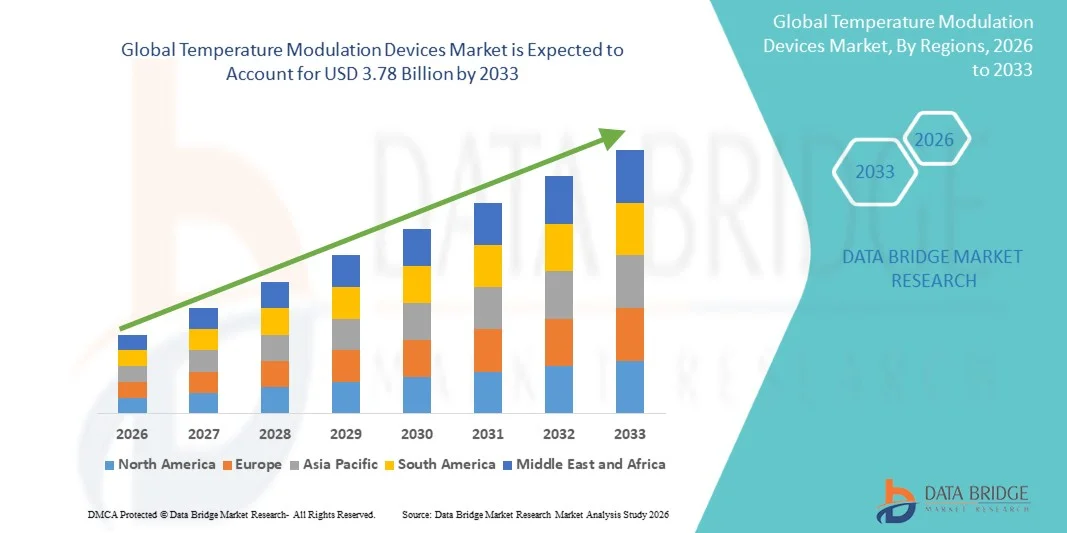
The Temperature Modulation Devices Market was valued at USD 2.32 billion in 2025 and is projected to reach USD 3.78 billion by 2033, growing at a CAGR of 2.70% from 2026 to 2033. The market is experiencing steady growth driven by the rising prevalence of cardiovascular, neurological, and critical care conditions requiring precise body temperature management, increasing adoption of therapeutic hypothermia technologies, and growing demand for advanced patient monitoring solutions across hospitals and emergency care settings.
The increasing incidence of cardiac arrest, stroke, traumatic brain injuries, and neonatal hypoxic ischemic encephalopathy is encouraging healthcare providers to adopt temperature modulation devices for targeted temperature management and improved patient outcomes. In addition, technological advancements in invasive and non-invasive cooling and warming systems, growing awareness regarding perioperative temperature management, and expanding investments in critical care infrastructure are accelerating market expansion globally. Hospitals and intensive care units are increasingly integrating automated temperature control systems to enhance clinical efficiency, reduce complications associated with temperature fluctuations, and support improved recovery rates in surgical and emergency care applications.
Key Market Trends & Insights
- North America dominated the Temperature Modulation Devices Market with the largest revenue share of 38.92% in 2025, supported by advanced healthcare infrastructure, high adoption of perioperative temperature management systems, and strong presence of leading medical device manufacturers.
- Convective Patient Warming Systems led the market with a 36.41% share in 2025, driven by their widespread use in surgical procedures, ease of integration in operating rooms, and strong clinical efficacy in preventing perioperative hypothermia.
- Asia-Pacific is expected to be the fastest-growing region at a CAGR of 7.3% from 2026 to 2033, fueled by expanding healthcare infrastructure, rising surgical volumes, increasing awareness of patient temperature management, and rapid hospital modernization in China, India, and Japan.
- Conductive Patient Cooling Systems are the fastest-growing product segment, projected to register a CAGR of 7.1%, driven by increasing demand in neurocritical care, cardiac arrest management, and targeted temperature management therapies.
- The Perioperative Care segment dominates the application category with a 42.18% revenue share in 2025, supported by the high volume of surgical procedures globally and the critical need to maintain normothermia during operations.
- Acute Care is emerging as a significant application area, accounting for a 25.36% market share in 2025, driven by rising ICU admissions, trauma cases, and emergency interventions requiring precise thermal regulation.
- The Portable Blood and IV Fluid Warmers segment holds a 17.84% share in 2025, owing to increasing usage in emergency medicine, ambulatory care, and battlefield or pre-hospital settings where rapid thermal stabilization is critical.
- The Newborn Care segment is witnessing steady expansion with a 12.67% share in 2025, driven by growing adoption in neonatal intensive care units (NICUs) for managing hypothermia in premature and low-birth-weight infants.
- The perioperative care segment dominated the market with a share of 43.12% in 2025, driven by the high global volume of surgical procedures and the critical need to maintain stable patient body temperature before, during, and after surgery.
Market Size & Forecast
- Global Market Value (2025): USD 2.32 Billion
- Expected Market Value (2033): USD 3.78 Billion
- Forecast CAGR (2026–2033): 2.70%
- Leading Region in 2025: North America
- Fastest Growing Region: Asia-Pacific
Report Scope and Temperature Modulation Devices Market Segmentation
|
Attributes |
Temperature Modulation Devices Key Market Insights |
|
Segments Covered |
|
|
Countries Covered |
North America · U.S. · Canada · Mexico Europe · Germany · France · U.K. · Netherlands · Switzerland · Belgium · Russia · Italy · Spain · Turkey · Rest of Europe Asia-Pacific · China · Japan · India · South Korea · Singapore · Malaysia · Australia · Thailand · Indonesia · Philippines · Rest of Asia-Pacific Middle East and Africa · Saudi Arabia · U.A.E. · South Africa · Egypt · Israel · Rest of Middle East and Africa South America · Brazil · Argentina · Rest of South America |
|
Key Market Players |
• 3M Company (U.S.) |
|
Market Opportunities |
· Expansion in Emerging Healthcare Infrastructure Markets · Growing Adoption of Targeted Temperature Management (TTM) in Critical Care · Integration of Smart, AI-Enabled Temperature Control Systems |
|
Value Added Data Infosets |
In addition to the insights on market scenarios such as market value, growth rate, segmentation, geographical coverage, and major players, the market reports curated by the Data Bridge Market Research also include in-depth expert analysis, geographically represented company-wise production and capacity, network layouts of distributors and partners, detailed and updated price trend analysis and deficit analysis of supply chain and demand. |
Temperature Modulation Devices Market Trends
Trend: Growth in Advanced Critical Care & Precision Temperature Management
Healthcare providers are increasingly adopting high-precision temperature modulation devices to improve patient outcomes in perioperative, acute, and neonatal care settings. The integration of real-time patient monitoring systems and closed-loop temperature control technologies is enabling more accurate and automated thermal regulation in ICUs and operating rooms. For instance, studies published in critical care journals indicate that targeted temperature management (TTM) can improve neurological recovery rates by up to 15–25% in post-cardiac arrest patients, driving strong clinical adoption. Hospitals across North America and Europe are also upgrading to smart convective warming systems that reduce perioperative hypothermia incidence by nearly 30–40% compared to conventional methods.
Temperature Modulation Devices Market Dynamics
Key Market Driver: Rising Adoption in Surgical, ICU, and Emergency Care Applications
The increasing prevalence of cardiovascular diseases, trauma cases, and complex surgical procedures is significantly driving demand for temperature modulation devices across healthcare facilities. According to global health estimates, over 310 million major surgical procedures are performed annually worldwide, many of which require perioperative temperature control to prevent complications such as surgical site infections and prolonged recovery.
Hospitals are increasingly integrating advanced systems such as convective warming blankets, intravascular cooling catheters, and fluid warmers into standard operating protocols. Leading medical centers in the U.S. and Europe report that automated warming systems can reduce intraoperative hypothermia rates from around 50–60% to below 20%, improving overall surgical safety and recovery outcomes.
Key Restraint/Challenge: High Capital and Operational Costs of Advanced Systems
Despite strong clinical benefits, the adoption of advanced temperature modulation systems remains constrained by high acquisition and maintenance costs. Fully integrated systems with automated feedback loops, central monitoring, and multi-patient connectivity can range from USD 8,000 to over USD 25,000 per unit, depending on configuration and hospital-grade specifications.
In addition, recurring expenses such as consumables (warming blankets, disposable probes), calibration, and servicing further increase total cost of ownership. Smaller hospitals and healthcare facilities in emerging economies often delay adoption due to budget constraints and limited reimbursement coverage for advanced thermal management procedures.
For instance, a 2024 procurement review across mid-sized hospitals in Asia-Pacific showed that nearly 35–45% of facilities still rely on basic manual warming techniques due to cost barriers and infrastructure limitations.
Key Market Opportunity: Integration of AI-Driven Smart Temperature Management Systems
The integration of artificial intelligence and IoT-enabled monitoring systems presents a major growth opportunity in the global market. AI-powered temperature modulation devices can continuously analyze patient vitals, predict thermal fluctuations, and automatically adjust heating or cooling parameters in real time.
Leading manufacturers are now developing smart ICU platforms that integrate with hospital EMR systems and central monitoring dashboards, enabling data-driven decision-making. Early deployments in advanced hospitals have demonstrated up to 20–30% improvement in temperature stability control during long surgical procedures when AI-assisted systems are used.
Furthermore, cloud-connected thermal management platforms are expanding adoption in multi-site hospital networks, enabling remote monitoring and predictive maintenance, particularly in North America, Western Europe, and rapidly modernizing healthcare systems in India and China.
Temperature Modulation Devices Market Scope
The Temperature Modulation Devices market is segmented on the basis of simulation type, vehicle type, training application, end user, hardware components, software components, training mode, integration & connectivity, deployment and support & services.
- By Product
On the basis of product, the Temperature Modulation Devices Market is segmented into portable blood and IV fluid warmers, conductive patient warming systems, convective patient warming systems, conductive patient cooling systems, and others. The convective patient warming systems segment dominated the market with a share of 37.86% in 2025, owing to their widespread adoption in operating rooms and intensive care units for preventing perioperative hypothermia. These systems are highly preferred due to their ease of use, non-invasive warming mechanism, and proven clinical effectiveness in maintaining normothermia during long surgical procedures. Hospitals across North America and Europe have increasingly integrated convective warming blankets and forced-air warming systems into standard surgical protocols, significantly reducing anesthesia-related hypothermia complications. In addition, rising surgical volumes—estimated at over 300 million procedures globally per year—are further reinforcing demand for these systems across tertiary care hospitals and ambulatory surgical centers. Strong adoption in trauma care, orthopedics, and cardiac surgeries is also contributing to segment leadership. Furthermore, continuous product innovation such as lightweight warming blankets, adjustable airflow control, and integrated temperature feedback systems is strengthening their clinical preference across developed healthcare markets.
The conductive patient cooling systems segment is expected to register the fastest CAGR of 7.4% from 2026 to 2033, driven by rising adoption in targeted temperature management (TTM) therapies across cardiac arrest, stroke, and neurocritical care applications. These systems are increasingly used in intensive care units to precisely lower and maintain patient body temperature within therapeutic ranges, improving neurological outcomes and survival rates. Clinical studies indicate that controlled therapeutic hypothermia can improve post-cardiac arrest recovery outcomes by up to 15–25%, significantly boosting demand. Hospitals in high-income regions are increasingly adopting advanced intravascular cooling catheters and surface cooling pads integrated with automated feedback systems. In addition, expanding awareness of neuroprotection protocols in emergency medicine and growing ICU admissions globally are accelerating adoption. Emerging economies in Asia-Pacific are also investing heavily in critical care modernization, further driving future demand for conductive cooling technologies.
- By Application
On the basis of application, the Temperature Modulation Devices Market is segmented into perioperative care, acute care, coronary care, newborn care, and others. The perioperative care segment dominated the market with a share of 43.12% in 2025, driven by the high global volume of surgical procedures and the critical need to maintain stable patient body temperature before, during, and after surgery. Perioperative hypothermia is associated with increased risks of infection, blood loss, and prolonged hospital stays, making temperature modulation devices essential in modern surgical protocols. Hospitals across developed regions have widely implemented automated warming systems in operating rooms, with studies showing that advanced temperature management can reduce hypothermia incidence from nearly 50–60% to below 20%. The strong presence of ambulatory surgical centers, rising adoption of minimally invasive surgeries, and increasing healthcare expenditure are further reinforcing segment dominance. In addition, integration of smart warming systems with real-time patient monitoring and anesthesia workstations is enhancing clinical efficiency and workflow optimization in surgical environments.
The newborn care segment is projected to register the fastest CAGR of 7.2% from 2026 to 2033, driven by increasing prevalence of preterm births and neonatal hypothermia cases worldwide. According to global health data, approximately 15 million babies are born preterm each year, many of whom require thermal regulation support in neonatal intensive care units (NICUs). Temperature modulation devices such as radiant warmers, incubators, and neonatal warming mattresses are widely used to stabilize body temperature in low-birth-weight and premature infants. Growing investments in maternal and child healthcare infrastructure in Asia-Pacific, Africa, and Latin America are significantly boosting adoption. In addition, rising awareness of neonatal mortality prevention programs and government-led initiatives to improve infant survival rates are further driving market expansion. Advanced NICU systems with integrated monitoring, humidity control, and automated warming features are also accelerating the adoption of next-generation temperature modulation technologies in pediatric care settings.
Temperature Modulation Devices Market Regional Analysis
North America dominated the Temperature Modulation Devices market and accounted for the largest revenue share of 38.92% in 2025, supported by advanced healthcare infrastructure, high adoption of perioperative temperature management systems, strong presence of leading medical device manufacturers, and widespread integration of convective and conductive patient warming technologies across hospitals and ICUs. The region also benefits from high surgical volumes, stringent patient safety regulations, and strong adoption of automated temperature control systems in critical care settings. Increasing integration of smart monitoring platforms, AI-enabled clinical decision support systems, and advanced ICU technologies continues to strengthen North America’s leadership position in the global market.
U.S. Temperature Modulation Devices Market Insight
The U.S. Temperature Modulation Devices market is witnessing strong growth due to rising surgical volumes, increasing prevalence of chronic and cardiovascular diseases, and expanding adoption of advanced perioperative and critical care temperature management solutions. The country’s highly developed healthcare infrastructure, along with strong penetration of innovative technologies such as intravascular warming and cooling systems, is driving demand across hospitals, ambulatory surgical centers, and emergency care units. In addition, growing emphasis on reducing surgical complications, improving patient recovery outcomes, and integrating AI-based patient monitoring systems is accelerating market expansion across healthcare facilities.
Europe Temperature Modulation Devices Market Insight
The Europe Temperature Modulation Devices market remains a major contributor to global revenue, driven by strong government healthcare spending, well-established hospital networks, and high adoption of advanced surgical care technologies. The widespread use of temperature modulation systems in perioperative care, intensive care units, and neonatal care is supporting steady market expansion across the region. Increasing focus on patient safety regulations, infection control standards, and modernization of healthcare infrastructure continues to enhance the adoption of advanced warming and cooling systems throughout Europe.
U.K. Temperature Modulation Devices Market Insight
The U.K. Temperature Modulation Devices market is experiencing steady growth, supported by increasing surgical procedures, rising demand for critical care infrastructure, and growing adoption of advanced perioperative temperature management systems. Hospitals and healthcare providers are increasingly investing in automated warming and cooling technologies to reduce complications such as perioperative hypothermia. Furthermore, integration of digital health systems, AI-enabled monitoring tools, and hospital automation solutions is improving treatment efficiency and strengthening market growth in the U.K.
Germany Temperature Modulation Devices Market Insight
The Germany Temperature Modulation Devices market is expanding steadily due to its strong hospital infrastructure, high healthcare expenditure, and increasing adoption of advanced medical technologies in surgical and critical care applications. German hospitals are increasingly utilizing convective warming systems, intravascular cooling devices, and automated temperature monitoring solutions to improve surgical outcomes. In addition, strong research capabilities, technological innovation in medical devices, and government focus on improving healthcare quality are further supporting market growth in the country.
Asia-Pacific Temperature Modulation Devices Market Insight
The Asia-Pacific Temperature Modulation Devices market is expected to witness rapid growth, driven by increasing healthcare investments, rising surgical volumes, and expanding hospital infrastructure across China, India, and Japan. Growing awareness of perioperative hypothermia management and neonatal care is driving adoption of advanced temperature control systems in both public and private healthcare facilities. In addition, government initiatives aimed at improving healthcare access, expanding ICU capacity, and modernizing hospitals are significantly boosting regional market growth.
Japan Temperature Modulation Devices Market Insight
The Japan Temperature Modulation Devices market is witnessing consistent growth due to its advanced healthcare system, aging population, and increasing demand for high-quality surgical and critical care services. Hospitals and medical institutions are increasingly adopting precision-based temperature management systems to improve patient safety and recovery outcomes. Moreover, integration of advanced monitoring technologies, automation in ICU systems, and strong focus on clinical efficiency are further contributing to market expansion in Japan.
China Temperature Modulation Devices Market Insight
The China Temperature Modulation Devices market is growing rapidly, driven by expanding healthcare infrastructure, rising surgical procedures, and increasing government investments in hospital modernization. Growing awareness regarding patient safety, perioperative care standards, and critical care management is boosting demand for advanced warming and cooling devices. In addition, rapid adoption of smart hospital systems, increasing penetration of high-end medical technologies, and strong domestic manufacturing capabilities are positioning China as one of the fastest-growing markets globally.
Temperature Modulation Devices Market Share
The Temperature Modulation Devices industry is primarily led by well-established companies, including:
- 3M Company (U.S.)
- Becton, Dickinson and Company (U.S.)
- Stryker Corporation (U.S.)
- Smiths Medical (U.K.)
- Baxter International Inc. (U.S.)
- GE HealthCare (U.S.)
- Medtronic plc (Ireland)
- ZOLL Medical Corporation (U.S.)
- Philips Healthcare (Netherlands)
- Drägerwerk AG & Co. KGaA (Germany)
- ICU Medical, Inc. (U.S.)
- ResMed Inc. (U.S.)
- Geratherm Medical AG (Germany)
- Asahi Kasei Corporation (Japan)
- Belmont Medical Technologies (U.S.)
- ThermoTek Inc. (U.S.)
- Gentherm Incorporated (U.S.)
- Emerson Electric Co. (U.S.)
- Sonoca GmbH (Germany)
- Cincinnati Sub-Zero Products LLC (U.S.)
- Sotera Health Company (U.S.)
- Atom Medical Corporation (Japan)
- Fisher & Paykel Healthcare (New Zealand)
- Mennen Medical Ltd. (Israel)
- Barkey GmbH & Co. KG (Germany)
- Arjo AB (Sweden)
- Zhengzhou Dison Instrument And Meter Co., Ltd. (China)
- Natus Medical Incorporated (U.S.)
- Hillrom (Baxter brand, U.S.)
- Vyaire Medical, Inc. (U.S.)
- Terumo Corporation (Japan)
- LivaNova PLC (U.K.)
- MicroPort Scientific Corporation (China)
Latest Developments in Temperature Modulation Devices Market
- In October 2021, ICU Medical completed the acquisition of Smiths Medical, expanding its global portfolio of infusion therapy and temperature management solutions. This acquisition strengthened ICU Medical’s position in critical care and perioperative temperature management, including fluid warming and patient temperature regulation systems widely used in hospitals and surgical settings. The deal significantly enhanced its global distribution network and product integration capabilities in temperature modulation technologies
- In June 2022, the U.S. Food and Drug Administration (FDA) cleared advanced next-generation heater-cooler system designs using glycol-based heat transfer technology. This regulatory update marked a major innovation shift in temperature modulation devices, reducing contamination risks associated with traditional water-based systems used in cardiothoracic surgeries. The clearance supported safer and more efficient patient warming and cooling during complex surgical procedures and intensive care treatments
- In April 2023, Baxter showcased its new conductive patient warming system at AORN 2023, designed to enhance perioperative normothermia management.The system was introduced to improve surgical patient safety by maintaining stable core body temperature and reducing post-operative complications such as infections and blood loss. Baxter’s launch highlighted increasing innovation in conductive warming technologies used across operating rooms globally
- In June 2023, ICU Medical launched the Level 1 H-1200 Fast Flow Fluid Warmer, designed for rapid infusion of warmed fluids in emergency and surgical care.The device includes integrated safety features such as air detection and automatic clamping, improving patient safety during high-risk transfusions and trauma care. This launch reinforced ICU Medical’s leadership in blood and fluid warming solutions used in acute care settings
- In December 2023, Medline received FDA 510(k) clearance for its ComfortTemp Patient Warming System for adult and pediatric use.The system uses forced-air warming technology to prevent and treat perioperative hypothermia and provide thermal comfort during surgical procedures. The clearance expanded its use across broader clinical applications, strengthening adoption in hospitals and ambulatory surgical centers
- In January 2024, SourceMark expanded its partnership with Gentherm to offer a full portfolio of patient warming modalities including resistive, convective, and conductive systems. This partnership strengthened distribution channels in the U.S. healthcare market and improved access to advanced perioperative temperature management solutions across hospitals and surgical centers

- Interactive Data Analysis Dashboard
- Company Analysis Dashboard for high growth potential opportunities
- Research Analyst Access for customization & queries
- Competitor Analysis with Interactive dashboard
- Latest News, Updates & Trend analysis
- Harness the Power of Benchmark Analysis for Comprehensive Competitor Tracking
Data collection and base year analysis are done using data collection modules with large sample sizes. The stage includes obtaining market information or related data through various sources and strategies. It includes examining and planning all the data acquired from the past in advance. It likewise envelops the examination of information inconsistencies seen across different information sources. The market data is analysed and estimated using market statistical and coherent models. Also, market share analysis and key trend analysis are the major success factors in the market report. To know more, please request an analyst call or drop down your inquiry.
The key research methodology used by DBMR research team is data triangulation which involves data mining, analysis of the impact of data variables on the market and primary (industry expert) validation. Data models include Vendor Positioning Grid, Market Time Line Analysis, Market Overview and Guide, Company Positioning Grid, Patent Analysis, Pricing Analysis, Company Market Share Analysis, Standards of Measurement, Global versus Regional and Vendor Share Analysis. To know more about the research methodology, drop in an inquiry to speak to our industry experts.
Data Bridge Market Research is a leader in advanced formative research. We take pride in servicing our existing and new customers with data and analysis that match and suits their goal. The report can be customized to include price trend analysis of target brands understanding the market for additional countries (ask for the list of countries), clinical trial results data, literature review, refurbished market and product base analysis. Market analysis of target competitors can be analyzed from technology-based analysis to market portfolio strategies. We can add as many competitors that you require data about in the format and data style you are looking for. Our team of analysts can also provide you data in crude raw excel files pivot tables (Fact book) or can assist you in creating presentations from the data sets available in the report.













