What is the Tennis Ball Machines Market Size and Overview?
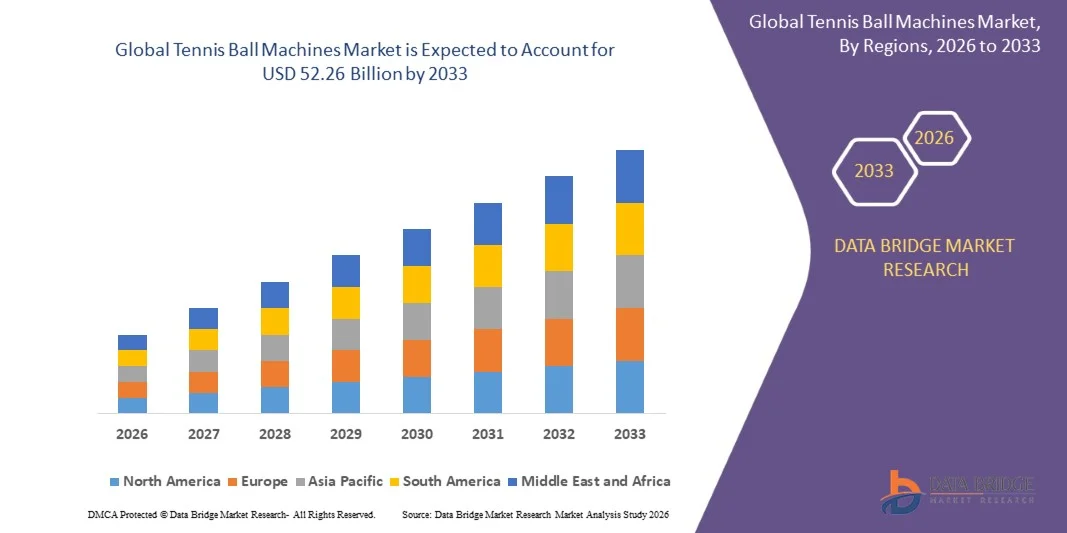
As per Data Bridge Market Research Analysis the Tennis Ball Machines Market was valued at USD 40.30 billion in 2025 and is projected to reach USD 52.26 billion by 2033, growing at a CAGR of 3.30% from 2026 to 2033. The market is witnessing steady growth driven by increasing participation in tennis across recreational and professional segments, growing demand for automated training equipment, and continuous advancements in machine portability, battery efficiency, and programmable shot delivery systems.
The rising emphasis on skill development, personalized coaching, and year-round practice opportunities is encouraging tennis academies, sports clubs, schools, and individual players to invest in advanced tennis ball machines. Modern machines equipped with smartphone connectivity, customizable training modes, oscillation features, and AI-enabled performance tracking are enhancing training effectiveness while reducing dependence on human practice partners. Furthermore, the expansion of tennis infrastructure, increasing popularity of home-based sports training, and growing adoption of smart sports equipment are supporting market growth across developed and emerging regions.
Key Market Trends & Insights
- North America dominated the tennis ball machines market with the largest revenue share of 38.74% in 2025, supported by high tennis participation rates, advanced sports infrastructure, widespread adoption of training technologies, and strong consumer spending on sports and fitness equipment.
- Asia-Pacific is expected to be the fastest-growing region, recording a CAGR of 4.80% from 2026 to 2033. Growth is driven by increasing urbanization, rising disposable incomes, expanding tennis infrastructure, growing sports participation, and increasing adoption of advanced training equipment across China, Japan, India, and South Korea.
- The Ball segment held the largest market revenue share of approximately 36.4% in 2025 driven by continuous replacement demand generated by training sessions, professional tournaments, recreational activities, and tennis academies worldwide. Tennis balls have a relatively short usable lifespan due to wear and pressure loss, creating recurring purchase cycles across all levels of play. The growth of organized tennis programs, youth development initiatives, and club memberships is further supporting segment expansion. Manufacturers are also introducing premium pressure-retaining and high-durability balls designed for machine-fed training sessions, increasing average product value. Rising participation rates across North America, Europe, and Asia-Pacific continue to sustain demand for tennis balls across both institutional and consumer markets.
- The Racquet segment is projected to register the fastest growth at a CAGR of 4.2% from 2026 to 2033, driven by technological advancements in racquet materials, increasing tennis participation, and growing demand for performance-enhancing equipment among competitive and recreational players. Manufacturers are increasingly utilizing carbon fiber composites and vibration-dampening technologies to improve player performance and comfort. Rising consumer interest in customized racquets and premium sports equipment is further contributing to segment growth. Professional player endorsements and growing exposure through international tournaments are also encouraging equipment upgrades among amateur players.
- The Lightweight segment accounted for the largest market revenue share of approximately 61.8% in 2025 owing to growing consumer preference for portable, easy-to-transport tennis training equipment suitable for personal and academy use. Lightweight machines are increasingly being adopted by coaches, recreational players, and training facilities seeking greater mobility between courts and training locations. Advances in battery technology and lightweight composite materials have enabled manufacturers to reduce overall machine weight without compromising functionality. The segment is also benefiting from growing demand for home-based sports training solutions. Compact designs and user-friendly operation continue to make lightweight machines attractive for a wide range of customers.
- The Heavyweight segment is expected to witness the fastest growth at a CAGR of 3.9% from 2026 to 2033 due to rising adoption among professional training facilities and tennis clubs requiring higher ball capacities, extended operational durations, and advanced programmable training features. These machines typically offer greater durability and support intensive training schedules. Professional academies increasingly prefer heavyweight systems capable of simulating competitive match conditions through sophisticated shot programming. Growing investments in elite player development programs are further supporting segment expansion.
- The Commercial segment dominated the market with a revenue share of approximately 68.7% in 2025 driven by extensive deployment across tennis academies, sports clubs, educational institutions, and professional training centers. Commercial facilities increasingly utilize tennis ball machines to improve coaching efficiency, reduce dependency on human feeders, and maximize court utilization. Rising investments in sports infrastructure and professional coaching programs are further supporting adoption. Many clubs are integrating advanced machines with customized training software to enhance player development. Growing demand for structured and technology-driven training solutions continues to strengthen the segment's market position.
- The Domestic segment is anticipated to grow at the fastest CAGR of 4.5% during the forecast period due to increasing interest in home-based sports training, growing availability of compact machines, and rising consumer spending on sports and fitness equipment. Recreational players are increasingly investing in personal training tools to improve consistency and practice flexibility. The availability of affordable entry-level models and online purchasing options is making these products accessible to a broader customer base. Growing awareness regarding skill development outside formal coaching environments is also supporting segment growth.
- The Sports Stores segment held the largest market revenue share of approximately 57.9% in 2025 supported by consumers’ preference for physical product demonstrations, expert recommendations, and after-sales service support before purchasing high-value sports equipment. Retail outlets allow customers to compare product features, evaluate machine quality, and receive professional guidance regarding training requirements. Established sporting goods chains continue to maintain strong relationships with leading manufacturers, ensuring broad product availability. In addition, in-store promotional activities and equipment demonstrations support purchasing decisions among first-time buyers.
- The E-Commerce segment is projected to register the fastest CAGR of 5.1% from 2026 to 2033 driven by expanding online retail infrastructure, competitive pricing, wider product availability, and growing adoption of digital purchasing channels among sports enthusiasts. Online platforms provide convenient access to product reviews, feature comparisons, and direct manufacturer offerings. The increasing popularity of direct-to-consumer sales strategies is further accelerating online market growth. Improved logistics networks and faster delivery services are also enhancing customer purchasing experiences globally.
Market Size & Forecast
- Global Market Value (2025): USD 40.30 Billion
- Expected Market Value (2033): USD 52.26 Billion
- Forecast CAGR (2026–2033): 3.30%
- Leading Region in 2025: North America
- Fastest Growing Region: Asia-Pacific
Report Scope and Tennis Ball Machines Market Segmentation
|
Attributes |
Tennis Ball Machines Key Market Insights |
|
Segments Covered |
|
|
Countries Covered |
North America
Europe
Asia-Pacific
Middle East and Africa
South America
|
|
Key Market Players |
• Ace Attack (U.S.) |
|
Market Opportunities |
• Growing Adoption Of AI-Enabled And Smart Connected Tennis Ball Machines • Expansion Of Tennis Academies, Sports Clubs, And Recreational Training Facilities |
|
Value Added Data Infosets |
In addition to the insights on market scenarios such as market value, growth rate, segmentation, geographical coverage, and major players, the market reports curated by the Data Bridge Market Research also include in-depth expert analysis, pricing analysis, brand share analysis, consumer survey, demography analysis, supply chain analysis, value chain analysis, raw material/consumables overview, vendor selection criteria, PESTLE Analysis, Porter Analysis, and regulatory framework. |
What is the Key Trend in the Tennis Ball Machines Market?
Trend: Rising Adoption Of Smart, App-Connected, And AI-Enabled Training Systems
The tennis ball machines market is witnessing increasing demand for intelligent training solutions that provide personalized practice experiences and professional-level performance analysis. As tennis participation grows across recreational, academy, and professional segments, players are seeking advanced equipment capable of replicating real-match conditions while offering flexibility, convenience, and data-driven training insights. Traditional training methods often require coaches or practice partners, creating demand for automated systems that can support independent skill development.
Modern tennis ball machines are increasingly incorporating smartphone connectivity, programmable drills, remote-control functionality, and AI-powered shot customization. For instance, leading manufacturers are introducing machines capable of delivering more than 100 different shot combinations, including topspin, backspin, lobs, and random oscillation patterns to simulate match scenarios. In 2025, several premium machine models integrated mobile applications that allowed users to store customized training programs and track session performance metrics. Growing adoption of smart sports technology among amateur and professional athletes is further accelerating market demand. Tennis participation continues to expand globally, with industry associations reporting more than 106 million tennis players worldwide, creating a larger customer base for advanced training equipment.
Tennis Ball Machines Market Dynamics
Key Market Driver: Growing Participation In Tennis And Demand For Individualized Training
The growing popularity of tennis across all age groups is significantly increasing demand for equipment that enhances player development and training efficiency. Rising investments in sports infrastructure, expansion of tennis academies, and increasing awareness regarding fitness and recreational activities are encouraging both professional and amateur players to adopt advanced training solutions. Tennis ball machines provide players with the ability to practice independently, improve consistency, and develop specific technical skills without requiring a training partner.
Tennis academies, schools, and sports clubs are increasingly investing in programmable ball machines to improve coaching efficiency and maximize court utilization. For instance, many professional training centers now deploy multiple machines capable of delivering balls at speeds exceeding 120 km/h while adjusting spin, trajectory, and feed frequency according to player requirements. The growing popularity of youth tennis programs and community sports initiatives is further supporting market expansion. According to international tennis participation statistics released during 2024–2025, several major markets including the U.S., U.K., and Australia reported sustained growth in recreational tennis participation, contributing to increased demand for automated training equipment across both institutional and consumer segments.
Key Restraint/Challenge: High Product Costs And Limited Adoption In Price-Sensitive Markets
Advanced tennis ball machines often involve significant upfront investment due to sophisticated hardware components, programmable control systems, rechargeable battery technologies, and smart connectivity features. Premium machines designed for professional training can be costly for individual consumers, limiting adoption particularly in developing economies where affordability remains a major purchasing consideration. Maintenance requirements and replacement costs for batteries, wheels, and electronic components further increase total ownership expenses.
In addition, many recreational players continue to rely on traditional coaching methods or shared club equipment instead of purchasing personal machines. Limited awareness regarding advanced training technologies in emerging markets also restricts adoption rates. Commercial market comparisons indicate that high-performance tennis ball machines equipped with smartphone integration and advanced oscillation systems can cost several times more than entry-level models, creating a significant barrier for casual players and smaller sports facilities. These pricing challenges continue to affect market penetration despite growing technological advancements and product innovation.
Key Market Opportunity: Expansion Of Home-Based Training And Portable Smart Tennis Equipment
Increasing demand for flexible and self-directed sports training is creating substantial opportunities for manufacturers of portable and technologically advanced tennis ball machines. Modern consumers increasingly prefer training solutions that can be used conveniently at private courts, residential communities, and local sports facilities without requiring extensive setup or coaching assistance. The growing popularity of home-based sports practice is encouraging demand for lightweight, battery-operated, and easy-to-transport machines.
Manufacturers are developing compact models featuring extended battery life, wireless controls, cloud-based training programs, and AI-assisted performance analytics to address evolving customer requirements. For instance, newer portable machines launched during 2025 offered battery runtimes exceeding 6–8 hours while supporting remote operation through mobile applications. In addition, integration with video analysis platforms is enabling players to combine machine-generated drills with performance assessment tools for more effective training. Rising investments in smart sports technologies and increasing participation in tennis across Asia-Pacific and North America are expected to create significant growth opportunities. Product testing programs conducted by leading manufacturers during 2025 demonstrated measurable improvements in shot consistency and reaction training after structured machine-assisted practice sessions, supporting broader adoption across recreational and competitive tennis segments.
How is the Tennis Ball Machines Market Segmented?
The market is segmented on the basis of product, type, application, distribution channel, material, end users, and sales channel.
- By Product
On the basis of product, the tennis ball machines market is segmented into Apparel, Racquet, Ball, Tennis Bag, and Others. The Ball segment held the largest market revenue share of approximately 36.4% in 2025 driven by continuous replacement demand generated by training sessions, professional tournaments, recreational activities, and tennis academies worldwide. Tennis balls have a relatively short usable lifespan due to wear and pressure loss, creating recurring purchase cycles across all levels of play. The growth of organized tennis programs, youth development initiatives, and club memberships is further supporting segment expansion. Manufacturers are also introducing premium pressure-retaining and high-durability balls designed for machine-fed training sessions, increasing average product value. Rising participation rates across North America, Europe, and Asia-Pacific continue to sustain demand for tennis balls across both institutional and consumer markets.
The Racquet segment is projected to register the fastest growth at a CAGR of 4.2% from 2026 to 2033, driven by technological advancements in racquet materials, increasing tennis participation, and growing demand for performance-enhancing equipment among competitive and recreational players. Manufacturers are increasingly utilizing carbon fiber composites and vibration-dampening technologies to improve player performance and comfort. Rising consumer interest in customized racquets and premium sports equipment is further contributing to segment growth. Professional player endorsements and growing exposure through international tournaments are also encouraging equipment upgrades among amateur players.
- By Type
On the basis of type, the market is segmented into Lightweight and Heavyweight. The Lightweight segment accounted for the largest market revenue share of approximately 61.8% in 2025 owing to growing consumer preference for portable, easy-to-transport tennis training equipment suitable for personal and academy use. Lightweight machines are increasingly being adopted by coaches, recreational players, and training facilities seeking greater mobility between courts and training locations. Advances in battery technology and lightweight composite materials have enabled manufacturers to reduce overall machine weight without compromising functionality. The segment is also benefiting from growing demand for home-based sports training solutions. Compact designs and user-friendly operation continue to make lightweight machines attractive for a wide range of customers.
The Heavyweight segment is expected to witness the fastest growth at a CAGR of 3.9% from 2026 to 2033 due to rising adoption among professional training facilities and tennis clubs requiring higher ball capacities, extended operational durations, and advanced programmable training features. These machines typically offer greater durability and support intensive training schedules. Professional academies increasingly prefer heavyweight systems capable of simulating competitive match conditions through sophisticated shot programming. Growing investments in elite player development programs are further supporting segment expansion.
- By Application
On the basis of application, the market is segmented into Domestic and Commercial. The Commercial segment dominated the market with a revenue share of approximately 68.7% in 2025 driven by extensive deployment across tennis academies, sports clubs, educational institutions, and professional training centers. Commercial facilities increasingly utilize tennis ball machines to improve coaching efficiency, reduce dependency on human feeders, and maximize court utilization. Rising investments in sports infrastructure and professional coaching programs are further supporting adoption. Many clubs are integrating advanced machines with customized training software to enhance player development. Growing demand for structured and technology-driven training solutions continues to strengthen the segment's market position.
The Domestic segment is anticipated to grow at the fastest CAGR of 4.5% during the forecast period due to increasing interest in home-based sports training, growing availability of compact machines, and rising consumer spending on sports and fitness equipment. Recreational players are increasingly investing in personal training tools to improve consistency and practice flexibility. The availability of affordable entry-level models and online purchasing options is making these products accessible to a broader customer base. Growing awareness regarding skill development outside formal coaching environments is also supporting segment growth.
- By Distribution Channel
On the basis of distribution channel, the market is segmented into Sports Stores and E-Commerce. The Sports Stores segment held the largest market revenue share of approximately 57.9% in 2025 supported by consumers’ preference for physical product demonstrations, expert recommendations, and after-sales service support before purchasing high-value sports equipment. Retail outlets allow customers to compare product features, evaluate machine quality, and receive professional guidance regarding training requirements. Established sporting goods chains continue to maintain strong relationships with leading manufacturers, ensuring broad product availability. In addition, in-store promotional activities and equipment demonstrations support purchasing decisions among first-time buyers.
The E-Commerce segment is projected to register the fastest CAGR of 5.1% from 2026 to 2033 driven by expanding online retail infrastructure, competitive pricing, wider product availability, and growing adoption of digital purchasing channels among sports enthusiasts. Online platforms provide convenient access to product reviews, feature comparisons, and direct manufacturer offerings. The increasing popularity of direct-to-consumer sales strategies is further accelerating online market growth. Improved logistics networks and faster delivery services are also enhancing customer purchasing experiences globally.
- By Material
On the basis of material, the market is segmented into Composites, Metallic, and Other Materials. The Composites segment accounted for the largest market revenue share of approximately 54.6% in 2025 owing to its lightweight characteristics, durability, corrosion resistance, and ability to enhance portability and machine performance. Composite materials help manufacturers reduce equipment weight while maintaining structural integrity and long-term reliability. The segment is benefiting from increasing adoption of carbon fiber-reinforced and advanced polymer materials in premium machine models. These materials also contribute to improved energy efficiency and ease of transportation. Continuous innovation in sports equipment manufacturing technologies is expected to support further segment growth.
The Other Materials segment is expected to grow at the fastest CAGR of 4.7% during the forecast period due to increasing innovation in engineered polymers and advanced lightweight materials designed to improve product durability and manufacturing efficiency. Manufacturers are exploring alternative materials that offer cost advantages while maintaining performance standards. Growing emphasis on sustainability and environmentally friendly manufacturing processes is also encouraging material innovation. These developments are expected to create new growth opportunities across both consumer and commercial product categories.
- By End Users
On the basis of end users, the market is segmented into Individual and Institutional. The Institutional segment dominated the market with a revenue share of approximately 63.5% in 2025 driven by strong demand from tennis academies, sports clubs, schools, universities, and professional training organizations that require multiple machines for structured coaching programs. Institutions continue to invest in advanced training technologies to improve player performance and operational efficiency. Growing participation in organized sports programs and competitive tennis events is increasing demand for professional-grade equipment. Many institutions are also integrating machine-assisted training into player development curriculums. Long-term equipment procurement contracts further support segment revenue growth.
The Individual segment is projected to witness the fastest growth at a CAGR of 4.8% from 2026 to 2033 owing to rising tennis participation rates, growing interest in personalized training, and increasing availability of affordable portable tennis ball machines. Consumers are increasingly seeking independent practice solutions that offer flexibility and convenience. Advancements in app-controlled functionality and user-friendly interfaces are making machines more attractive to recreational players. Growing disposable income levels and interest in sports technology are also supporting segment expansion.
- By Sales Channel
On the basis of sales channel, the market is segmented into Independent Sports Outlet, Sports Retail Chain, Franchised Sports Outlet, Direct to Customer Online Channel, Direct-to-Customer Institutional Channel, Modern Trade Channels, and Third Party Online Channel. The Sports Retail Chain segment held the largest market revenue share of approximately 28.9% in 2025 supported by extensive product portfolios, strong brand partnerships, and widespread retail presence across major sporting goods markets. These retailers offer customers access to multiple brands, product demonstrations, financing options, and professional consultation services. Large retail networks also benefit from strong inventory management systems and established customer trust. Their ability to provide both premium and entry-level products continues to support segment leadership.
The Direct to Customer Online Channel segment is anticipated to register the fastest CAGR of 5.6% during the forecast period driven by increasing manufacturer focus on direct sales strategies, higher profit margins, personalized customer engagement, and growing consumer preference for online purchasing platforms. Direct online channels enable manufacturers to offer exclusive products, customized configurations, and promotional pricing. Growing digital marketing investments and improved e-commerce capabilities are further accelerating sales growth. The expansion of online sports communities and increasing consumer confidence in digital transactions are expected to support long-term segment development.
Which Region Holds the Largest Share of the Tennis Ball Machines Market?
North America Tennis Ball Machines Market Insight
North America dominated the tennis ball machines market with the largest revenue share of 38.74% in 2025, supported by high tennis participation rates, strong sports infrastructure, and widespread adoption of advanced training technologies. The region is home to a large number of tennis academies, country clubs, and professional coaching centers that actively utilize automated training equipment to enhance player development. Consumers increasingly value personalized training solutions that allow flexible practice schedules and performance improvement. The growing popularity of smart, app-connected tennis ball machines and rising investments in youth sports programs continue to support market expansion. Furthermore, the presence of leading sports equipment manufacturers and strong consumer spending on sports technology reinforce North America's leadership position in the market.
U.S. Tennis Ball Machines Market Insight
The U.S. tennis ball machines market captured the largest revenue share in 2025 within North America, fueled by the country's large tennis-playing population and growing demand for independent training solutions. Tennis clubs, academies, and individual players are increasingly investing in advanced machines equipped with programmable drills, remote-control functionality, and smartphone integration. The rising popularity of recreational tennis and increasing participation in youth development programs continue to strengthen market demand. In addition, growing consumer interest in home-based sports training and performance analytics is encouraging adoption across amateur and professional player segments. Strong e-commerce penetration and widespread availability of premium sports equipment further contribute to market growth.
Europe Tennis Ball Machines Market Insight
The Europe tennis ball machines market is expected to witness significant growth from 2026 to 2033, primarily driven by increasing participation in tennis, growing investments in sports infrastructure, and rising demand for advanced coaching technologies. Tennis remains one of the most popular recreational and competitive sports across several European countries, creating favorable conditions for equipment adoption. Sports clubs and training academies are increasingly incorporating automated training systems to improve coaching efficiency and player performance. The growing popularity of smart sports technologies and data-driven training solutions is also supporting market expansion. Furthermore, increasing renovation and modernization of sports facilities across the region are creating new opportunities for manufacturers.
U.K. Tennis Ball Machines Market Insight
The U.K. tennis ball machines market is expected to witness robust growth from 2026 to 2033, driven by growing interest in tennis participation, expanding grassroots development programs, and increasing demand for flexible training solutions. Tennis clubs and educational institutions are increasingly utilizing automated training systems to support skill development and maximize court utilization. Rising awareness regarding the benefits of machine-assisted training is encouraging adoption among both amateur and professional players. In addition, the growing popularity of portable and app-controlled machines is attracting individual consumers seeking convenient practice solutions. The country's strong retail and e-commerce infrastructure is further facilitating market growth.
Germany Tennis Ball Machines Market Insight
The Germany tennis ball machines market is expected to witness strong growth from 2026 to 2033, fueled by increasing demand for technologically advanced sports training equipment and growing investments in athlete development programs. Germany's strong sporting culture and emphasis on performance optimization are encouraging the adoption of automated training solutions across clubs and professional academies. Consumers are increasingly seeking durable, energy-efficient, and high-performance training equipment capable of supporting structured practice sessions. The integration of smart technologies and remote-control capabilities is further enhancing product attractiveness. Growing investments in sports infrastructure and coaching facilities continue to support market expansion.
Asia-Pacific Tennis Ball Machines Market Insight
The Asia-Pacific tennis ball machines market is expected to witness the fastest growth rate from 2026 to 2033, supported by increasing urbanization, rising disposable incomes, and growing participation in tennis across major economies such as China, Japan, India, and South Korea. Governments and private organizations are investing significantly in sports infrastructure and athlete development initiatives, creating favorable conditions for market growth. The expanding middle-class population and rising awareness regarding fitness and recreational sports are increasing demand for advanced training equipment. Furthermore, the growing presence of regional manufacturers is improving product affordability and accessibility across emerging markets.
Japan Tennis Ball Machines Market Insight
The Japan tennis ball machines market is expected to witness substantial growth from 2026 to 2033 due to the country's strong sports culture, technological advancement, and growing demand for precision-based training solutions. Japanese consumers place significant emphasis on skill improvement and training efficiency, encouraging the adoption of automated tennis practice systems. The increasing integration of smart technologies, including mobile applications and programmable training features, is supporting market development. Tennis academies and sports clubs are increasingly utilizing advanced machines to enhance coaching effectiveness and player performance. In addition, rising participation among youth and recreational players continues to create growth opportunities.
China Tennis Ball Machines Market Insight
The China tennis ball machines market accounted for the largest market revenue share in Asia-Pacific in 2025, attributed to rapid urbanization, expanding tennis participation, and increasing consumer spending on sports equipment. The country has witnessed significant growth in tennis infrastructure development, including new courts, sports complexes, and training centers. Growing interest in professional sports and rising demand for structured coaching programs are encouraging adoption of automated training technologies. In addition, the presence of domestic manufacturing capabilities enables competitive pricing and broader product availability. Government initiatives promoting sports participation and healthy lifestyles are further supporting long-term market growth in China.
Which are the Top Companies in Tennis Ball Machines Market?
The Tennis Ball Machines industry is primarily led by well-established companies, including:
- Ace Attack (U.S.)
- SIBOASI (China)
- Lob-ster Inc. (U.S.)
- Spinfire Sport (U.S.)
- Spinshot Sports US (U.S.)
- Sports Attack, LLC (U.S.)
- Wilson Sporting Goods (U.S.)
- Yonex Co., Ltd (Japan)
- Dunlop Sports (U.K.)
- Babolat (France)
- HEAD (Austria)
- Tecnifibre (France)
- GAMMA Sports (U.S.)
- Prokennex (Taiwan)
- Solinco (U.S.)
- PowerAngle LLC (U.S.)
- Rishi Sports (India)
- Get Set Sports Company (India)
- M/s Mittal Rubber Industries (India)
- Metco Sports Private Limited (India)
- Sports Line (India)
- Thermo Blow Engineers (India)
- Kumaram Sports (India)
- Vinex Enterprises Private Limited (India)
- M. (India)
What are Latest Developments in Tennis Ball Machines Market?
- In October 2025, Slinger Bag (U.S.) announced the expansion of its distribution network across key European markets through strategic retail partnerships. This expansion is aimed at increasing product accessibility, strengthening brand presence, and addressing rising demand for portable tennis training solutions. The initiative is expected to enhance the company's market penetration while intensifying competition across the European tennis ball machines market.
- In August 2025, Lobster Sports (U.S.) launched an advanced AI-enabled tennis ball machine capable of analyzing player performance in real time and delivering personalized training feedback. The development is designed to improve training effectiveness, accelerate player skill development, and enhance user engagement. This innovation reinforces the growing trend toward intelligent and data-driven sports training technologies.
- In November 2024, PongBot (Hong Kong) introduced an artificial intelligence-powered tennis and table tennis ball machine that adjusts shot delivery based on player movement and positioning. The product aims to create a more adaptive and realistic training environment while improving player responsiveness and technique. The launch highlights the increasing integration of AI technologies into sports training equipment.
- In September 2024, Spinshot Sports (Australia) entered into a partnership with a sports analytics company to develop a mobile application integrated with its tennis ball machines. The platform is intended to provide detailed performance metrics, customized training programs, and enhanced player monitoring capabilities. This development is expected to strengthen customer engagement and support the evolution of connected training ecosystems within the market.
- In June 2023, Wilson Sporting Goods (U.S.) expanded its smart sports technology portfolio through increased investment in connected training solutions and digital coaching platforms. The initiative focuses on improving athlete performance analysis and delivering more personalized training experiences. The move reflects the industry's broader shift toward technology-enabled player development and smart sports equipment.
- In April 2022, SIBOASI (China) introduced a new generation of portable tennis ball machines featuring upgraded battery systems, programmable drill functions, and remote-control capabilities. The product launch was aimed at improving user convenience, training flexibility, and machine mobility for both recreational and professional players. The development contributed to the growing adoption of portable and intelligent tennis training equipment worldwide.

- Interactive Data Analysis Dashboard
- Company Analysis Dashboard for high growth potential opportunities
- Research Analyst Access for customization & queries
- Competitor Analysis with Interactive dashboard
- Latest News, Updates & Trend analysis
- Harness the Power of Benchmark Analysis for Comprehensive Competitor Tracking
Data collection and base year analysis are done using data collection modules with large sample sizes. The stage includes obtaining market information or related data through various sources and strategies. It includes examining and planning all the data acquired from the past in advance. It likewise envelops the examination of information inconsistencies seen across different information sources. The market data is analysed and estimated using market statistical and coherent models. Also, market share analysis and key trend analysis are the major success factors in the market report. To know more, please request an analyst call or drop down your inquiry.
The key research methodology used by DBMR research team is data triangulation which involves data mining, analysis of the impact of data variables on the market and primary (industry expert) validation. Data models include Vendor Positioning Grid, Market Time Line Analysis, Market Overview and Guide, Company Positioning Grid, Patent Analysis, Pricing Analysis, Company Market Share Analysis, Standards of Measurement, Global versus Regional and Vendor Share Analysis. To know more about the research methodology, drop in an inquiry to speak to our industry experts.
Data Bridge Market Research is a leader in advanced formative research. We take pride in servicing our existing and new customers with data and analysis that match and suits their goal. The report can be customized to include price trend analysis of target brands understanding the market for additional countries (ask for the list of countries), clinical trial results data, literature review, refurbished market and product base analysis. Market analysis of target competitors can be analyzed from technology-based analysis to market portfolio strategies. We can add as many competitors that you require data about in the format and data style you are looking for. Our team of analysts can also provide you data in crude raw excel files pivot tables (Fact book) or can assist you in creating presentations from the data sets available in the report.