


Terahertz and Infrared Spectroscopy Market Size
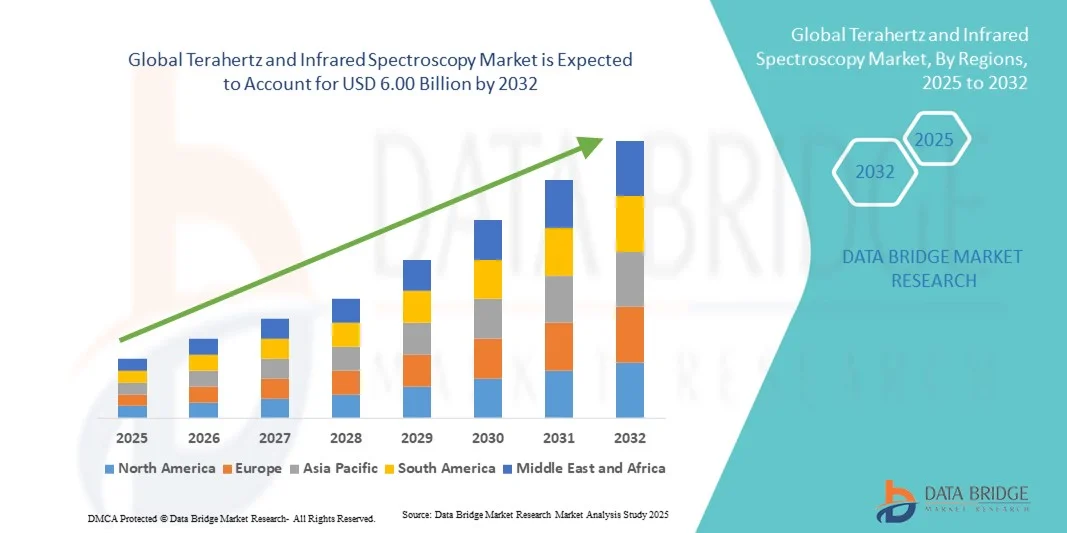
- The global terahertz and infrared spectroscopy market size was valued at USD 1.20 billion in 2024 and is expected to reach USD 6.00 billion by 2032, at a CAGR of 22.30% during the forecast period
- The market growth is largely driven by the increasing adoption and technological advancements in Terahertz and Infrared Spectroscopy solutions, which are being widely integrated across pharmaceuticals, material science, chemical analysis, and security applications
- Furthermore, rising demand for precise, non-destructive, and rapid analytical techniques is establishing Terahertz and Infrared Spectroscopy as essential tools for research, quality control, and industrial applications. These converging factors are accelerating the uptake of these spectroscopy solutions, thereby significantly boosting the industry’s growth
Terahertz and Infrared Spectroscopy Market Analysis
- Terahertz and Infrared Spectroscopy technologies are increasingly vital for applications in healthcare, defense, industrial quality control, and research, due to their ability to provide non-destructive, precise, and rapid analysis of materials and biological samples
- The growing demand for terahertz and infrared spectroscopy is primarily driven by rising research and development activities, expanding industrial applications, increased government funding, and the need for high-precision analytical tools
- North America dominated the terahertz and infrared spectroscopy market with the largest revenue share of 42% in 2024, characterized by early adoption of advanced spectroscopy technologies, strong R&D investments, and a high presence of key industry players, with the U.S. experiencing substantial growth across healthcare, security, and industrial applications
- Asia-Pacific is expected to be the fastest-growing region in the terahertz and infrared spectroscopy market during the forecast period due to rapid industrialization, urbanization, rising disposable incomes, and expanding government support for advanced spectroscopy technology adoption
- The Benchtop segment dominated the terahertz and infrared spectroscopy market in 2024 with a revenue share of 45.3%, attributed to its high precision, reproducibility, and suitability for large-scale research and laboratory workflows
Report Scope and Terahertz and Infrared Spectroscopy Market Segmentation
|
Attributes |
Terahertz and Infrared Spectroscopy Key Market Insights |
|
Segments Covered |
|
|
Countries Covered |
North America
Europe
Asia-Pacific
Middle East and Africa
South America
|
|
Key Market Players |
|
|
Market Opportunities |
|
|
Value Added Data Infosets |
In addition to the insights on market scenarios such as market value, growth rate, segmentation, geographical coverage, and major players, the market reports curated by the Data Bridge Market Research also include in-depth expert analysis, pricing analysis, brand share analysis, consumer survey, demography analysis, supply chain analysis, value chain analysis, raw material/consumables overview, vendor selection criteria, PESTLE Analysis, Porter Analysis, and regulatory framework. |
Terahertz and Infrared Spectroscopy Market Trends
Enhanced Precision and Integration with AI and Advanced Analytics
- A significant and accelerating trend in the global terahertz and infrared spectroscopy market is the growing integration with artificial intelligence (AI) and advanced data analytics platforms. This combination is enabling faster, more accurate material characterization, molecular analysis, and defect detection in industrial, pharmaceutical, and research applications
- For instance, modern spectroscopy systems are now capable of real-time spectral analysis and predictive modeling, allowing researchers to identify chemical compositions and material properties with higher confidence and speed
- AI integration in spectroscopy equipment enables features such as anomaly detection, pattern recognition, and predictive maintenance, enhancing operational efficiency and reducing experimental errors
- The seamless integration of spectroscopy systems with laboratory information management systems (LIMS) and industrial IoT platforms facilitates centralized monitoring, control, and automated reporting, streamlining laboratory and production workflows
- This trend towards more intelligent, automated, and interconnected spectroscopy systems is reshaping user expectations for precision analysis, prompting companies to develop platforms that offer predictive insights, AI-powered data interpretation, and real-time monitoring capabilities
Terahertz and Infrared Spectroscopy Market Dynamics
Driver
Growing Demand Due to Expanding Applications Across Industries
- The increasing adoption of Terahertz and Infrared Spectroscopy in healthcare, pharmaceuticals, security screening, industrial quality control, and material science is a significant driver of market growth
- For instance, in March 2025, several pharmaceutical companies implemented advanced terahertz spectroscopy systems for non-destructive analysis of tablet coatings and active pharmaceutical ingredients, improving quality control efficiency
- As industries seek high-precision, non-invasive analytical methods, Terahertz and Infrared Spectroscopy provides a compelling alternative to traditional destructive or time-consuming techniques
- Furthermore, regulatory requirements for precise material characterization in pharmaceuticals, aerospace, and defense sectors are increasing the adoption of spectroscopy systems
- The growing demand for automated and high-throughput spectroscopy solutions, combined with the expansion of research and industrial applications, continues to propel the global market growth during the forecast period
Restraint/Challenge
High Initial Costs and Technical Complexity
- The relatively high cost of advanced Terahertz and Infrared Spectroscopy systems poses a significant challenge for widespread adoption, particularly among small laboratories and emerging market companies
- For instance, high-end systems with integrated AI analytics and real-time monitoring capabilities can cost several times more than conventional analytical tools, limiting their accessibility to well-funded research institutions and large industrial enterprises
- Technical complexity and the need for specialized operators can also restrict adoption, as some organizations may lack trained personnel capable of fully utilizing the advanced features of modern spectroscopy platforms
- Addressing these challenges through simplified user interfaces, modular systems, and affordable mid-range options is crucial for expanding the market to broader segments
- Companies are increasingly focusing on offering training programs, service contracts, and user-friendly platforms to overcome these adoption barriers and drive sustained growth in the Terahertz and Infrared Spectroscopy market
Terahertz and Infrared Spectroscopy Market Scope
The market is segmented on the basis of spectrum, technology, application, and end use.
- By Spectrum
On the basis of spectrum, the terahertz and infrared spectroscopy market is segmented into near-infrared radiation (NIR), Mid-Infrared Radiation (MIR), and Far-Infrared Radiation (FIR). The Mid-Infrared Radiation (MIR) segment dominated the market in 2024 with a revenue share of 42.5%, driven by its broad applicability in chemical fingerprinting, material characterization, and molecular structure analysis. MIR spectroscopy offers high sensitivity, selectivity, and accuracy, which makes it ideal for pharmaceutical, chemical, and industrial research. Laboratories increasingly rely on MIR instruments for quality control, detection of impurities, and monitoring chemical reactions in real time. The segment benefits from ongoing technological advancements, including improved detectors, sources, and software for spectral analysis. Its dominance is further strengthened by compatibility with benchtop and hyphenated systems, enabling multi-purpose applications. Academic institutions and R&D laboratories also favor MIR due to its well-established protocols and widespread standardization. In addition, the growth in biomedical diagnostics and environmental monitoring drives MIR adoption, as researchers require precise molecular identification. Strategic collaborations between spectroscopy equipment manufacturers and end-users reinforce the MIR segment’s leadership position. Overall, MIR remains the preferred spectrum due to its robustness, versatility, and integration potential across various analytical workflows.
The Far-Infrared Radiation (FIR) segment is expected to witness the fastest CAGR of 9.8% from 2025 to 2032, fueled by emerging applications in homeland security, non-destructive testing, and advanced semiconductor inspection. FIR allows non-invasive, high-precision detection of structural defects, moisture content, and material heterogeneity, which is increasingly critical in industrial and research applications. The segment benefits from growing demand for portable and handheld FIR devices that facilitate on-site analysis, improving operational efficiency and reducing laboratory dependence. Technological advancements in FIR detectors and imaging systems have also expanded its applicability. Rising investments in industrial quality assurance, semiconductor fabrication, and aerospace material testing further accelerate growth. Moreover, FIR’s ability to complement other spectral techniques, such as NIR and MIR, increases its adoption in hybrid analytical workflows. The adoption of automated FIR systems in industrial R&D laboratories ensures consistent, high-throughput analysis. Increasing awareness among environmental and biomedical researchers regarding FIR capabilities adds to its market potential. Academic and private sector research collaborations are further promoting FIR adoption. FIR’s unique features in non-destructive testing and material characterization make it a promising area for sustained market expansion.
- By Technology
On the basis of technology, the terahertz and infrared spectroscopy market is segmented into Benchtop, Microscopy, Portable & Handheld, and Hyphenated. The Benchtop segment dominated the market in 2024 with a revenue share of 45.3%, attributed to its high precision, reproducibility, and suitability for large-scale research and laboratory workflows. Benchtop instruments provide stable measurement conditions, comprehensive software controls, and advanced detector capabilities, making them essential for pharmaceutical, industrial, and academic applications. They are widely adopted for molecular analysis, chemical fingerprinting, and process monitoring. The segment also benefits from strong installation bases in research institutions and R&D centers, where robust instrumentation is critical. Continuous innovations in benchtop spectroscopy, including improved automation and AI-assisted spectral analysis, enhance throughput and reliability. Additionally, benchtop systems are preferred for their compatibility with multiple spectral ranges, including NIR, MIR, and FIR, allowing versatile applications. The segment’s leadership is reinforced by ongoing demand in quality control, semiconductor testing, and biomedical research. Government and private funding initiatives also support adoption in advanced research environments. Overall, benchtop instruments remain a cornerstone of laboratory spectroscopy due to their accuracy, stability, and multi-purpose applicability.
The Portable & Handheld segment is expected to witness the fastest CAGR of 10.2% from 2025 to 2032, driven by increasing demand for on-site, real-time analysis across industrial, environmental, and security applications. Portable spectroscopy devices allow rapid inspection of materials, chemicals, and food products without the need for laboratory facilities, enhancing operational efficiency. The segment benefits from technological advancements in miniaturized detectors, compact light sources, and wireless connectivity, enabling flexible and user-friendly instruments. Rising applications in environmental monitoring, food safety testing, and semiconductor quality inspection are fueling adoption. The need for real-time, non-destructive, and in-field testing in pharmaceuticals and industrial chemistry also contributes to rapid growth. Portable and handheld devices reduce sample preparation time, offer cost-effective solutions, and support high-throughput workflows. Increasing adoption in emerging economies, where laboratory infrastructure may be limited, further boosts the segment. Integration with cloud-based data analytics and AI-driven interpretation enhances usability. Government safety regulations and industry standards promoting rapid testing accelerate demand. Overall, portable and handheld technology is expanding as industries seek flexible, efficient, and precise analytical tools.
- By Application
On the basis of application, the terahertz and infrared spectroscopy market is segmented into Semiconductors, Homeland Security, Non-Destructive Testing, Research & Development, and Biomedical. The Research & Development segment dominated the market in 2024 with a revenue share of 41.8%, owing to its extensive use in academic institutions, industrial laboratories, and pharmaceutical companies. R&D applications require high-precision spectroscopy to support molecular characterization, chemical analysis, material research, and process optimization. The segment benefits from increasing investment in biotechnology, pharmaceuticals, and advanced material research. The growing demand for accurate and reproducible data in experimental workflows reinforces the adoption of advanced spectroscopy systems. Automation, AI-assisted analysis, and integration with laboratory information management systems enhance productivity. Research laboratories favor instruments capable of multi-spectral analysis and hyphenated technology combinations. The segment also sees strong adoption due to government and private funding in genomics, chemistry, and material science research. R&D applications drive recurring revenue for consumables, maintenance, and system upgrades, ensuring long-term market stability. Strategic partnerships between universities and industry promote the acquisition of high-end spectroscopy systems. Overall, the Research & Development segment leads due to its critical role in scientific and industrial advancements.
The Homeland Security segment is expected to witness the fastest CAGR of 9.6% from 2025 to 2032, driven by the rising need for non-invasive, rapid, and highly accurate detection technologies to screen for explosives, hazardous chemicals, and illegal substances. Terahertz and infrared spectroscopy provide real-time, non-destructive inspection capabilities, enabling security agencies to monitor public spaces, airports, and sensitive infrastructure efficiently. The segment benefits from government investments in national safety programs, defense applications, and counter-terrorism initiatives. Technological advances in portable and handheld devices further increase adoption. Integration with AI-based threat detection systems allows automated alerts and enhanced operational efficiency. Growing public safety concerns and regulatory mandates accelerate deployment in both developed and emerging regions. Rising awareness of advanced screening techniques among private security agencies also contributes to growth. Homeland Security applications are increasingly combined with industrial inspection workflows, creating multi-functional solutions. Strategic collaborations between technology providers and government agencies further support segment expansion. The rapid adoption of non-contact screening solutions ensures continued high growth potential.
- By End Use
On the basis of end use, the terahertz and infrared spectroscopy market is segmented into Pharmaceuticals & Biotechnology, Industrial Chemistry, Food & Beverage Testing, Environmental Testing, and Other Application. The Pharmaceuticals & Biotechnology segment dominated the market in 2024 with a revenue share of 44.1%, driven by the need for precise material characterization, quality control, and drug development analysis. Pharmaceutical laboratories require high-resolution spectroscopy to ensure drug purity, detect impurities, and monitor manufacturing processes. The segment benefits from continuous innovation in instrumentation, including automation and multi-spectral analysis. High adoption is also fueled by regulatory compliance requirements from agencies such as the FDA and EMA. The segment is characterized by recurring consumable sales, software upgrades, and maintenance contracts, which contribute to sustained revenue growth. Advanced spectroscopy facilitates formulation development, stability testing, and in-process monitoring. Integration with laboratory information management systems improves workflow efficiency. The increasing focus on personalized medicine and biologics further supports segment growth. Strategic collaborations with research institutes reinforce market dominance. Overall, Pharmaceuticals & Biotechnology remain the largest end-use segment due to critical reliance on spectroscopy for analytical precision.
The Food & Beverage Testing segment is expected to witness the fastest CAGR of 9.9% from 2025 to 2032, fueled by rising demand for quality assurance, contamination detection, and nutritional analysis in the food industry. Terahertz and infrared spectroscopy allow non-destructive and rapid analysis of food products, ensuring safety and compliance with regulatory standards. Portable and benchtop instruments are increasingly used for on-site inspections and routine quality checks. Growth is driven by expanding food processing operations, global trade, and rising consumer awareness regarding food safety. Integration with AI-driven analytics enhances detection accuracy and operational efficiency. Increasing adoption in beverage quality control and monitoring of agricultural produce further accelerates market growth. The segment also benefits from government regulations and certifications promoting advanced testing methods. Continuous development of user-friendly and cost-effective instruments ensures accessibility for small and medium-sized food enterprises. Strategic partnerships between spectroscopy manufacturers and food testing labs support adoption. Overall, Food & Beverage Testing represents a high-growth opportunity due to increasing industry emphasis on safety, quality, and regulatory compliance.
Terahertz and Infrared Spectroscopy Market Regional Analysis
- North America dominated the terahertz and infrared spectroscopy market with the largest revenue share of 42% in 2024
- Characterized by early adoption of advanced spectroscopy technologies, strong R&D investments, and a high presence of key industry players
- With the substantial growth across healthcare, industrial quality control, security, and research applications
U.S. Terahertz and Infrared Spectroscopy Market Insight
The U.S. terahertz and infrared spectroscopy market captured the largest revenue share in 2024 within North America, fueled by increasing adoption of advanced analytical systems, automated high-throughput spectroscopy platforms, and AI-assisted data analytics. The country is witnessing strong demand from healthcare, pharmaceutical, industrial, and security applications, driving market expansion.
Europe Terahertz and Infrared Spectroscopy Market Insight
The Europe terahertz and infrared spectroscopy market is projected to expand at a substantial CAGR during the forecast period, driven by stringent regulatory requirements, growing industrial and research applications, and increasing investment in advanced spectroscopy technologies. The region is experiencing significant adoption across healthcare, pharmaceuticals, manufacturing, and defense sectors, with systems being deployed in both new facilities and modernization projects.
U.K. Terahertz and Infrared Spectroscopy Market Insight
The U.K. terahertz and infrared spectroscopy market is anticipated to grow steadily during the forecast period, driven by the increasing adoption of advanced analytical systems in research institutions, industrial quality control laboratories, and academic facilities. Rising demand for high-precision measurement, process optimization, and material characterization is fueling market growth, alongside technological modernization and integration of automated spectroscopy platforms in both R&D and production environments
Germany Terahertz and Infrared Spectroscopy Market Insight
The Germany terahertz and infrared spectroscopy market is expected to expand at a notable CAGR, supported by its well-developed industrial infrastructure, focus on innovation in manufacturing and research, and growing adoption of sustainable, high-precision spectroscopy solutions across industrial and laboratory settings. German companies and research labs are increasingly implementing spectroscopy technologies for material analysis, quality assurance, and process monitoring, driving strong market growth.
Asia-Pacific Terahertz and Infrared Spectroscopy Market Insight
The Asia-Pacific terahertz and infrared spectroscopy market is poised to grow at the fastest CAGR during 2025–2032, driven by rapid industrialization, urbanization, rising disposable incomes, and government initiatives supporting advanced spectroscopy technology adoption. China accounted for the largest revenue share in APAC in 2024, driven by industrial growth, technological adoption, and research infrastructure expansion. Japan’s market is growing due to high-tech culture, strong automation in laboratories and industrial processes, and increasing demand for precision and efficiency in spectroscopy applications.
China Terahertz and Infrared Spectroscopy Market Insight
The China terahertz and infrared spectroscopy market accounted for the largest market revenue share in the Asia-Pacific region in 2024, driven by rapid adoption of advanced analytical technologies, expanding industrial and research applications, and significant investments in modern research infrastructure. The growing demand for high-precision material characterization, quality control, and process monitoring in both manufacturing and academic research is fueling market growth. Chinese research institutions and industrial laboratories are increasingly integrating AI-assisted spectroscopy platforms to enhance efficiency, accuracy, and throughput.
Japan Terahertz and Infrared Spectroscopy Market Insight
The Japan terahertz and infrared spectroscopy market is gaining momentum, supported by the country’s high-tech culture, increasing automation in laboratories and industrial processes, and a strong focus on precision and operational efficiency. Japanese industries and research facilities are adopting advanced spectroscopy solutions for applications such as material analysis, pharmaceutical research, and quality assurance. Continuous innovation in analytical instruments and the integration of smart and AI-enabled platforms are further accelerating market expansion
Terahertz and Infrared Spectroscopy Market Share
The Terahertz and Infrared Spectroscopy industry is primarily led by well-established companies, including:
- Advantest Corporation (Japan)
- HÜBNER GmbH & Co. KG (Germany)
- TOPTICA Photonics AG (Germany)
- Thorlabs, Inc. (U.S.)
- Luna Innovations (U.S.)
- Shimadzu Corporation (Japan)
- PerkinElmer (U.S.)
- Microtech Instruments (U.S.)
- BaySpec, Inc. (U.S.)
- Teledyne Vision Solutions (U.S.)
- Spectra Analysis Instruments, Inc. (U.S.)
- EKSPLA (Lithuania)
- HÜBNER GmbH (Germany)
- Thermo Fisher Scientific, Inc. (U.S.)
- Agilent Technologies, Inc. (U.S.)
- Bruker Corporation (Germany)
- Menlo Systems (Germany)
- BATOP GmbH (Germany)
- Microtech Instruments (U.S.)
Latest Developments in Global Terahertz and Infrared Spectroscopy Market
- In July 2025, TeraView, a pioneer in terahertz technology, announced a collaboration with Doolim-Yaskawa to advance multi-layer paint applications for the Korean automotive manufacturing industry. This partnership aims to enhance the efficiency and precision of coating processes using terahertz technology
- In June 2025, TeraView expanded its Asian operations by partnering with Axbis to explore opportunities in the Korean electric vehicle (EV) battery manufacturing market. This strategic alliance focuses on integrating terahertz technology for quality control and performance evaluation in EV battery production
- In April 2025, TeraView was awarded two new patents in Korea and Taiwan, further enhancing the protection of its unique intellectual property employed to test and inspect semiconductor chips. These patents solidify TeraView's position as a leader in terahertz technology for semiconductor applications
- In August 2024, TeraView launched a new sensor specifically designed to measure the thickness, density, and loading of coatings that are key components of anodes in lithium-ion batteries for electric vehicles. This innovation aims to improve the manufacturing process and performance of EV batteries

- Interactive Data Analysis Dashboard
- Company Analysis Dashboard for high growth potential opportunities
- Research Analyst Access for customization & queries
- Competitor Analysis with Interactive dashboard
- Latest News, Updates & Trend analysis
- Harness the Power of Benchmark Analysis for Comprehensive Competitor Tracking
Data collection and base year analysis are done using data collection modules with large sample sizes. The stage includes obtaining market information or related data through various sources and strategies. It includes examining and planning all the data acquired from the past in advance. It likewise envelops the examination of information inconsistencies seen across different information sources. The market data is analysed and estimated using market statistical and coherent models. Also, market share analysis and key trend analysis are the major success factors in the market report. To know more, please request an analyst call or drop down your inquiry.
The key research methodology used by DBMR research team is data triangulation which involves data mining, analysis of the impact of data variables on the market and primary (industry expert) validation. Data models include Vendor Positioning Grid, Market Time Line Analysis, Market Overview and Guide, Company Positioning Grid, Patent Analysis, Pricing Analysis, Company Market Share Analysis, Standards of Measurement, Global versus Regional and Vendor Share Analysis. To know more about the research methodology, drop in an inquiry to speak to our industry experts.
Data Bridge Market Research is a leader in advanced formative research. We take pride in servicing our existing and new customers with data and analysis that match and suits their goal. The report can be customized to include price trend analysis of target brands understanding the market for additional countries (ask for the list of countries), clinical trial results data, literature review, refurbished market and product base analysis. Market analysis of target competitors can be analyzed from technology-based analysis to market portfolio strategies. We can add as many competitors that you require data about in the format and data style you are looking for. Our team of analysts can also provide you data in crude raw excel files pivot tables (Fact book) or can assist you in creating presentations from the data sets available in the report.













