What is the Tetrakis (Hydroxymethyl) Phosphonium Sulfate Market Size and Growth Rate?
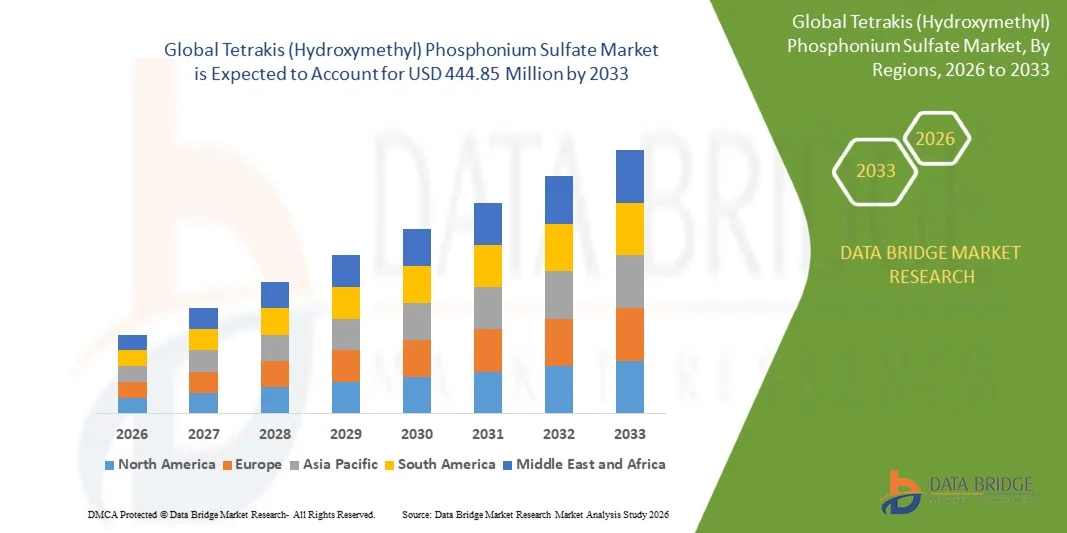
- As per Data Bridge Market Research analysis, the tetrakis (hydroxymethyl) phosphonium sulfate market was valued at USD 272.87 million in 2025 and is projected to reach USD 444.85 million by 2033, growing at a CAGR of 6.3% from 2026 to 2033.
- The market is experiencing consistent growth driven by increasing demand for effective biocides in industrial applications, particularly in the oil and gas sector, where THPS is used for controlling microbial contamination, while its use as an iron sulfide scavenger supports applications in water treatment. Emerging applications in the textile and leather industries, together with its use as a flame retardant, are further contributing to market expansion.
- The expanding use of THPS across oil and gas, water treatment, textile, and leather industries, combined with increasing environmental regulations and demand for safer, biodegradable, and environmentally friendly chemical alternatives, is supporting market growth. THPS is used as a biocide, flame retardant, tanning agent, and iron sulfide scavenger, with research highlighting its effectiveness in controlling microbial growth in industrial water and petroleum systems.
Market Size & Forecast
- Global Market Value (2025): USD 272.87 Million
- Expected Market Value (2033): USD 444.85 Million
- Forecast CAGR (2026–2033): 6.3%
- Leading Region in 2025: North America
- Fastest Growing Region: Asia Pacific
What are the Major Takeaways of the Tetrakis (Hydroxymethyl) Phosphonium Sulfate Market?
- North America dominated the tetrakis (hydroxymethyl) phosphonium sulfate market with the largest revenue share of 33.84% in 2025, supported by rising oil and gas activity and increasing demand from water treatment, leather, textile, and oil & gas applications.
- Asia-Pacific is expected to be the fastest-growing region at a CAGR of 5.8% from 2026 to 2033, fueled by increasing consumption of THPS as a flame retardant and microbiocide and growing industrial activity in China, India, Australia, and Japan.
- The biocide segment led the market with a 43.2% share in 2025, driven by its strong antibacterial efficacy, rapid microbial control, and suitability for industrial water treatment, oilfield operations, and paper manufacturing.
- Tanning agent are the fastest-growing function type, projected to register a CAGR of 7.2%, reflecting the surge in demand for chrome-free and environmentally preferable leather-tanning processes.
- The liquid segment dominated the form type category with a 70% revenue share in 2025, led by its widespread commercial availability, ease of handling and dosing, and extensive use in oil & gas and water-treatment applications.
- Oil & gas accounted for 43.6% of the market share in 2025, preferred by its effective microbial control, sulfate-reducing bacteria management, and iron sulfide removal in oilfield operations.
- The water treatment segment is the fastest-growing application category, with a CAGR of 5.8%, driven by increasing industrial process water recycling rates, expanding desalination infrastructure, and growing demand for microbial control in industrial water systems.
Report Scope and Tetrakis (Hydroxymethyl) Phosphonium Sulfate Market Segmentation
|
Attributes |
Tetrakis (Hydroxymethyl) Phosphonium Sulfate Key Market Insights |
|
Segments Covered |
|
|
Countries Covered |
North America
Europe
Asia-Pacific
Middle East and Africa
South America
|
|
Key Market Players |
|
|
Market Opportunities |
|
|
Value Added Data Infosets |
In addition to the insights on market scenarios such as market value, growth rate, segmentation, geographical coverage, and major players, the market reports curated by the Data Bridge Market Research also include import export analysis, production capacity overview, production consumption analysis, price trend analysis, climate change scenario, supply chain analysis, value chain analysis, raw material/consumables overview, vendor selection criteria, PESTLE Analysis, Porter Analysis, and regulatory framework. |
What is the Key Trend in the Tetrakis (Hydroxymethyl) Phosphonium Sulfate Market?
- THPS is increasingly being used in chrome-free and eco-benign leather tanning systems, as manufacturers seek alternatives to conventional chromium tanning and technologies that can reduce the environmental impact of tanning wastewater.
- For instance, in January 2024, a Heliyon research study developed a chrome-free chestnut–THPS combination tanning system, using 20% chestnut followed by 2% THPS, which achieved a 95°C maximum shrinkage temperature and significantly reduced TS, TDS, TSS, and BOD in wastewater, supporting THPS's emerging role in cleaner leather-tanning technologies.
- THPS is also gaining attention as a multi-functional industrial chemical, with research identifying applications as a biocide in water systems, a scale-removing agent in the oil industry, a flame retardant in textiles, and a tanning agent in leather processing.
- Oilfield and industrial water-treatment applications continue to represent important uses, particularly because THPS can control microorganisms and is also used to dissolve iron sulfide formed in oil wells.
- For instance, in January 2025, a research article published in Polymer Degradation and Stability developed a high-molecular-weight flame retardant derived from bis[tetrakis(hydroxymethyl)phosphonium] sulfate for cotton fabrics; cotton treated with 30 wt% of the formulation achieved a 46.8% limiting oxygen index, which remained 39.8% after 50 laundering cycles, demonstrating THPS's expanding use in durable flame-retardant textile applications.
- As industries increasingly seek chrome-free tanning technologies, industrial microbial-control solutions, and multifunctional phosphorus-based chemicals, THPS is being investigated across diverse applications, although its environmental and toxicological characteristics remain important considerations for future adoption.
What are the Key Drivers of the Tetrakis (Hydroxymethyl) Phosphonium Sulfate Market?
- The increasing need for effective microbial control in oil & gas operations and industrial water systems is supporting demand for THPS, which is widely used as a biocide and for iron sulfide control.
- For instance, in May 2024, a study published in Geoenergy Science and Engineering evaluated 250 mg/L of THPS in a simulated crude-oil storage tank and found that THPS initially reduced planktonic microbial populations and corrosion rates, supporting its application for microbiologically influenced corrosion control in oil & gas infrastructure.
- Expanding industrial water-treatment requirements are increasing the need for non-oxidizing biocides capable of controlling microbial growth in water systems and helping maintain operational efficiency.
- For instance, In June 2025, a study published in Bioelectrochemistry demonstrated that combining THPS with peptide enhancers improved its biocidal performance against Desulfovibrio ferrophilus; 40 ppm THPS + 100 nM peptide Tcs reduced EH36 steel weight loss by 90%, while the peptide combinations reduced the THPS dosage required for comparable bactericidal activity by approximately 60%.
- Growing demand for alternatives to conventional chromium tanning is creating additional opportunities for THPS, particularly as research demonstrates its potential in chrome-free combination tanning systems.
Which Factors are Challenging the Growth of the Tetrakis (Hydroxymethyl) Phosphonium Sulfate Market?
- Environmental and toxicological concerns associated with THPS can challenge wider adoption because research has identified acute aquatic toxicity and potential hazards associated with THPS and its degradation products.
- For instance, in November 2024, a study published in Scientific Reports found that sub-minimum inhibitory concentrations of THPS stimulated biofilm formation by Pseudomonas aeruginosa and consequently intensified carbon-steel corrosion, highlighting the risk of ineffective dosing and the technical challenge of maintaining adequate biocide concentrations in industrial water systems.
- These concerns can increase the need for careful handling, wastewater management, environmental monitoring, and controlled application, particularly where THPS is used in industrial water-treatment and oilfield operations.
- The environmental and safety considerations associated with THPS continue to require attention, particularly because its aqueous chemistry can produce formaldehyde, phosphine, and other potentially hazardous compounds under certain conditions.
- For instance, in May 2024, a study published in Geoenergy Science and Engineering found that a single 250 mg/L THPS treatment initially reduced microbial populations in a simulated crude-oil storage tank, but after 60 days, sulfate-reducing microorganisms and methanogens increased, indicating that treatment interruption and microbial adaptation can limit long-term THPS effectiveness in oilfield applications.
- These concerns can increase compliance and handling requirements and may encourage users to evaluate alternative biocides where technically and economically feasible.
How is the Tetrakis (Hydroxymethyl) Phosphonium Sulfate Market Segmented?
The tetrakis (hydroxymethyl) phosphonium sulfate market is segmented on the basis of function, form, and application.
- By Function
On the basis of function, the tetrakis (hydroxymethyl) phosphonium sulfate market is segmented into iron sulfide scavenger, biocide, flame retardant, and tanning agent. The biocide segment dominated the market with 43.2% share in 2025, The segment's dominance is supported by the strong antibacterial efficacy of THPS and its applications in industrial water treatment, oilfield operations, and paper manufacturing. THPS biocides are increasingly used for controlling microbial growth and sulfate-reducing bacteria in industrial systems. Its environmental degradation characteristics also support adoption as industries seek antimicrobial solutions with lower persistence. The broad use of THPS as a biocide continues to make this the largest function segment globally.
The tanning agent segment is expected to witness significant growth at a CAGR of 7.2% from 2026 to 2033, driven by increasing demand for chrome-free and environmentally preferable leather-tanning processes. THPS is used with vegetable tannins and other tanning materials to improve the hydrothermal stability and physical properties of leather. THPS-based tanning processes can achieve a maximum shrinkage temperature of approximately 95°C, supporting the production of leather with suitable thermal stability. These applications also help reduce the environmental burden associated with conventional chromium-based tanning processes. Increasing environmental concerns and the demand for cleaner leather-processing technologies are creating additional opportunities for THPS-based tanning agents. The growing focus on sustainable leather manufacturing is therefore expected to support the expansion of the tanning agent function.
- By Form
On the basis of form, the tetrakis (hydroxymethyl) phosphonium sulfate market is segmented into liquid and other forms. The liquid segment dominated the market with 70% share in 2025, as THPS is widely supplied and used as an aqueous liquid formulation in industrial applications. Liquid THPS provides convenient handling, mixing, transportation, and controlled dosing in water-treatment and oilfield systems. Its high-water solubility makes it suitable for direct application in industrial water and petroleum-processing environments. Commercial THPS is commonly supplied as concentrated aqueous solutions for industrial use. The liquid formulation is particularly advantageous where continuous or metered chemical dosing is required. A reliable public market-report percentage share for the liquid segment was not disclosed, so a numerical share should not be inserted without access to the underlying report table.
The other forms segment is expected to witness significant growth at a CAGR of 5.0% from 2026 to 2033, particularly through specialized formulations designed for different transportation, storage, handling, and application requirements. Market research identifies alternative physical forms such as powder and granules in addition to liquid formulations. These forms can potentially provide different handling and dosing characteristics for specialized industrial applications. However, publicly available market-report summaries do not provide a verified CAGR for the “other forms” category. Therefore, assigning a numerical CAGR to this segment would require estimation rather than report-supported data. The liquid form remains the principal commercial form of THPS in industrial applications. Product diversification could nevertheless support development of alternative formulations for specific end-use requirements.
- By Application
On the basis of application, the tetrakis (hydroxymethyl) phosphonium sulfate market is segmented into water treatment, oil & gas, leather, and textile. The oil & gas segment dominated the market with 43.6% share in 2025. THPS is widely used in oilfield operations for microbial control in drilling fluids, injection waters, and produced-water systems. It is particularly important for controlling sulfate-reducing bacteria associated with corrosion and hydrogen sulfide generation. THPS is also used as an iron sulfide scavenger in oilfield applications. Increasing focus on corrosion prevention, produced-water management, and operational efficiency continues to support demand from the oil and gas industry.
The water treatment segment is expected to witness significant growth at a CAGR of 5.8% from 2026 to 2033, driven by increasing demand for microbial-control chemicals in industrial water systems and cooling-water applications. THPS is used as a non-oxidizing biocide to control microbial growth and biofouling in water-treatment systems. Research has also examined THPS in industrial water systems because of its relationship with microbial biofilms and carbon-steel corrosion. Increasing industrialization and the expansion of water-treatment infrastructure are supporting demand for effective industrial biocides.
Which Region Holds the Largest Share of the Tetrakis (Hydroxymethyl) Phosphonium Sulfate Market?
- North America dominated the tetrakis (hydroxymethyl) phosphonium sulfate market with the largest revenue share of 33.84% in 2025, supported by rising oil and gas activity and increasing demand from water treatment, leather, textile, and oil & gas applications.
- The region also benefits from extensive oil and gas infrastructure, industrial wastewater-treatment facilities, and demand for effective biocides, while strict wastewater-treatment requirements further support the use of THPS in industrial applications. Increasing consumption of leather and leather products in the U.S. and Canada, together with continued oilfield activity, strengthens North America's position in the global THPS market.
U.S. Tetrakis (Hydroxymethyl) Phosphonium Sulfate Market Insight
The U.S. tetrakis (hydroxymethyl) phosphonium sulfate market is witnessing strong growth due to high demand from oil & gas operations, industrial water treatment, and manufacturing applications. The country’s extensive oilfield infrastructure provides an important end-use base for THPS as a biocide and iron sulfide scavenger. In 2025, U.S. crude oil production reached a record 13.6 million barrels per day, supporting continued demand for oilfield chemicals used in production and water-management operations. In addition, THPS demand is supported by industrial water-treatment requirements and established chemical distribution infrastructure. The U.S. accounted for the overwhelming majority of North American THPS consumption, according to available market research.
Asia-Pacific Tetrakis (Hydroxymethyl) Phosphonium Sulfate Market Insight
The Asia-Pacific tetrakis (hydroxymethyl) phosphonium sulfate market is expected to witness rapid growth, driven by industrialization, expanding water-treatment requirements, and increasing oil & gas and manufacturing activities across China and India. The growth is supported by increasing demand for THPS across industrial applications. China’s national 14th Five-Year Plan for Water Security emphasizes water-resource conservation, major water infrastructure, wastewater governance, and modernization of water management. India is also expanding access to treated water through the Jal Jeevan Mission, supporting long-term demand for water-treatment infrastructure. These developments are creating additional opportunities for THPS applications in water treatment, oil & gas, textiles, and other industrial sectors.
Japan Tetrakis (Hydroxymethyl) Phosphonium Sulfate Market Insight
The Japan tetrakis (hydroxymethyl) phosphonium sulfate market is witnessing consistent growth due to the country’s advanced industrial water-treatment infrastructure, manufacturing base, and emphasis on environmental management. Demand for THPS is supported particularly by industrial applications requiring microbial control and effective water-system management. Japan’s highly developed industrial sector creates opportunities for specialty chemicals used in water treatment, textiles, leather processing, and other manufacturing activities. Increasing requirements for efficient water management and environmental protection are further supporting demand for industrial treatment chemicals. The country’s established manufacturing capabilities and focus on resource efficiency provide a stable environment for THPS applications.
China Tetrakis (Hydroxymethyl) Phosphonium Sulfate Market Insight
The China tetrakis (hydroxymethyl) phosphonium sulfate market is growing rapidly, driven by expanding water-security infrastructure, industrialization, and increasing demand for industrial water treatment. China’s 14th Five-Year Plan for Water Security established national priorities covering water conservation, major water-resource projects, river and lake remediation, rural water infrastructure, and digital water management. These investments support demand for chemicals used in industrial and water-treatment applications. China’s large manufacturing and textile industries also provide additional end-use opportunities for THPS as a flame retardant and processing chemical. Increasing environmental governance and water-quality requirements are further supporting the use of specialized treatment chemicals.
U.K. Tetrakis (Hydroxymethyl) Phosphonium Sulfate Market Insight
The U.K. tetrakis (hydroxymethyl) phosphonium sulfate market is experiencing steady growth, supported by substantial investment in wastewater infrastructure and increasingly stringent environmental requirements. In 2025, the U.K. Government announced a record USD 129.2 billion investment programme for water-sector upgrades between 2025 and 2030, including improvements to wastewater treatment infrastructure. The government also requires water companies to upgrade 440 wastewater treatment works by 2030 to meet stricter phosphorus limits. These investments are increasing the need for effective water-treatment and microbial-control solutions. Continued regulatory emphasis on water quality and wastewater management is therefore supporting opportunities for THPS in industrial and water-treatment applications.
Germany Tetrakis (Hydroxymethyl) Phosphonium Sulfate Market Insight
The Germany tetrakis (hydroxymethyl) phosphonium sulfate market is expanding steadily due to the country’s large wastewater-treatment infrastructure, stringent environmental requirements, and strong industrial manufacturing base. Approximately 97% of Germany’s population is connected to the public sewage system, with wastewater treated in around 9,000 treatment plants, creating a substantial infrastructure base for water-treatment chemicals. Germany is also required to implement additional treatment technologies under the revised EU Urban Wastewater Treatment Directive, including fourth-stage treatment for certain plants by 2045. Industrial water treatment represents a major THPS demand area in Germany, while textile, leather, and other manufacturing applications provide additional opportunities.
Which are the Top Companies in Tetrakis (Hydroxymethyl) Phosphonium Sulfate Market?
The tetrakis (hydroxymethyl) phosphonium sulfate industry is primarily led by well-established companies, including:
- SMC GLOBAL (U.S.)
- Hubei Xingfa Chemicals Group Co.,Ltd (China)
- Hefei TNJ Chemical Industry Co.,Ltd (China)
- Shandong Minglang Chemical Co., Ltd. (China)
- Hangzhou Bayee Chemical Co., Ltd. (China)
- GetChem Co., Ltd. (China)
- Hyma Synthesis Private Limited (India)
- LANXESS (Germany)
- Arkema (France)
- Clariant (Switzerland)
- DuPont (U.S.)
- Merck KGaA (Germany)
- Italmatch Chemicals S.p.A (Italy)
- Finoric LLC (U.S.)
- IRO GROUP INC. (China)
- Zhejiang Xinhua Chemical Co.,Ltd. (China)
- Changshu New-Tech Chemicals Co., Ltd. (China)
- Acuro Organics Limited (India)
- The Chemical Company (U.S.)
- Univar Solutions LLC. (U.S.)
What are Latest Developments in Tetrakis (Hydroxymethyl) Phosphonium Sulfate Market?
- In April 2025, the Society of Petroleum Engineers published “A Development and Field Deployment of Novel Iron Sulfide Prevention Package,” describing the development and successful field trial of a high-performance iron sulfide control formulation. The formulation was reported to have a 25% lower minimum effective concentration than conventional THPS and was deployed at a 7,500-barrel-per-day Permian Basin gathering facility.
- In February 2024, LANXESS expanded a distribution partnership with a specialized chemical distributor in North America, incorporating the microbial-control portfolio it had acquired from International Flavors & Fragrances (IFF), which included tetrakis (hydroxymethyl) phosphonium sulfate (THPS). The agreement was intended to broaden distribution of microbial-control products used in industrial fluids and strengthen LANXESS’s market reach.
- In July 2023, Bioelectrochemistry published research on using an antimicrobial peptide as a THPS biocide enhancer for mitigating biocorrosion of EH36 ship steel. The combination of 100 nM E6 and 80 ppm THPS produced an additional 1.6-log reduction in sessile bacterial cells and reduced steel weight loss and pit depth by 78% and 83%, respectively.
- In May 2022, Sustainability published research on optimized O₃/Fe(II) treatment of THPS wastewater, addressing the difficulty of biodegrading this industrial wastewater. The optimized model predicted an 86.04% organic-phosphorus removal rate, demonstrating a potential treatment route for THPS-containing wastewater.
- In March 2021, Chemical Engineering and Processing – Process Intensification published research on combining THPS with xanthan biopolymer for controlling microbiologically influenced corrosion in SAE 1010 carbon steel. The combination reduced the corrosion rate, biomass, and extracellular polymeric substances in the biofilm compared with THPS alone, while xanthan formed a more adherent film on the steel surface.

- Interactive Data Analysis Dashboard
- Company Analysis Dashboard for high growth potential opportunities
- Research Analyst Access for customization & queries
- Competitor Analysis with Interactive dashboard
- Latest News, Updates & Trend analysis
- Harness the Power of Benchmark Analysis for Comprehensive Competitor Tracking
Data collection and base year analysis are done using data collection modules with large sample sizes. The stage includes obtaining market information or related data through various sources and strategies. It includes examining and planning all the data acquired from the past in advance. It likewise envelops the examination of information inconsistencies seen across different information sources. The market data is analysed and estimated using market statistical and coherent models. Also, market share analysis and key trend analysis are the major success factors in the market report. To know more, please request an analyst call or drop down your inquiry.
The key research methodology used by DBMR research team is data triangulation which involves data mining, analysis of the impact of data variables on the market and primary (industry expert) validation. Data models include Vendor Positioning Grid, Market Time Line Analysis, Market Overview and Guide, Company Positioning Grid, Patent Analysis, Pricing Analysis, Company Market Share Analysis, Standards of Measurement, Global versus Regional and Vendor Share Analysis. To know more about the research methodology, drop in an inquiry to speak to our industry experts.
Data Bridge Market Research is a leader in advanced formative research. We take pride in servicing our existing and new customers with data and analysis that match and suits their goal. The report can be customized to include price trend analysis of target brands understanding the market for additional countries (ask for the list of countries), clinical trial results data, literature review, refurbished market and product base analysis. Market analysis of target competitors can be analyzed from technology-based analysis to market portfolio strategies. We can add as many competitors that you require data about in the format and data style you are looking for. Our team of analysts can also provide you data in crude raw excel files pivot tables (Fact book) or can assist you in creating presentations from the data sets available in the report.