


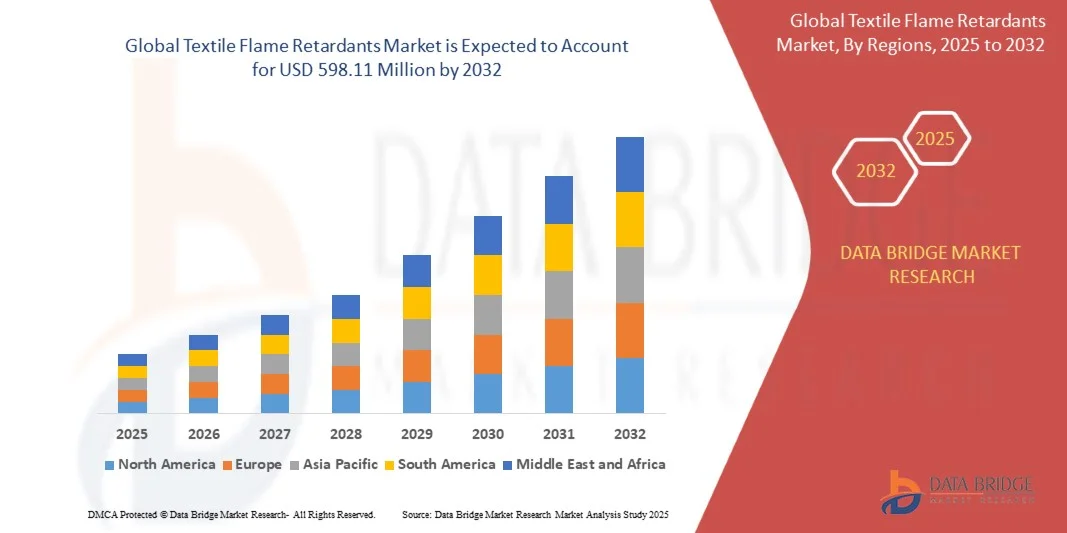
Textile Flame Retardants Market Size
- The global textile flame retardants market size was valued at USD 437.04 million in 2024 and is expected to reach USD 598.11 million by 2032, at a CAGR of 4.00% during the forecast period
- The market growth is largely fueled by the increasing awareness of fire safety regulations across residential, commercial, and industrial sectors, driving the adoption of flame-retardant-treated textiles. Rising demand for fire-safe fabrics in apparel, upholstery, transportation, and protective clothing is creating significant opportunities for manufacturers and suppliers
- Furthermore, growing environmental and health concerns are promoting the development and adoption of sustainable, halogen-free, and non-toxic flame-retardant solutions. For instance, companies are innovating polymeric and eco-friendly additives that maintain high performance while complying with global safety and environmental standards, accelerating the market expansion
Textile Flame Retardants Market Analysis
- Textile flame retardants, applied through treatments such as dyeing, spraying, and coating, are becoming essential in high-performance textiles across industrial, defense, household, and transportation applications due to their ability to reduce flammability and enhance safety without compromising fabric quality
- The escalating demand for flame-retardant textiles is primarily driven by stringent fire safety regulations, increasing consumer awareness, and rising industrial and commercial applications requiring compliance with global safety standards. Innovations in sustainable and high-performance additives are further enhancing market adoption and growth
- Asia-Pacific dominated the textile flame retardants market with a share of 55.8% in 2024, due to growing industrial textile production, rising demand for fire-safe home and commercial textiles, and the presence of major textile manufacturing hubs
- North America is expected to be the fastest growing region in the textile flame retardants market during the forecast period due to rising demand for fire-safe textiles in industrial, defense, transportation, and household applications
- Halogenated segment dominated the market with a market share of 61.5% in 2024, due to its high efficiency in reducing flammability and meeting stringent fire safety regulations across industrial and defense applications. Halogenated flame retardants are widely preferred for their reliable performance on synthetic fibers and compatibility with various textile processing methods, making them a go-to choice for manufacturers aiming to meet compliance standards without compromising fabric integrity. Their established market presence and proven effectiveness in emergency safety applications further strengthen their adoption
Report Scope and Textile Flame Retardants Market Segmentation
|
Attributes |
Textile Flame Retardants Key Market Insights |
|
Segments Covered |
|
|
Countries Covered |
North America
Europe
Asia-Pacific
Middle East and Africa
South America
|
|
Key Market Players |
|
|
Market Opportunities |
|
|
Value Added Data Infosets |
In addition to the insights on market scenarios such as market value, growth rate, segmentation, geographical coverage, and major players, the market reports curated by the Data Bridge Market Research also include import export analysis, production capacity overview, production consumption analysis, price trend analysis, climate change scenario, supply chain analysis, value chain analysis, raw material/consumables overview, vendor selection criteria, PESTLE Analysis, Porter Analysis, and regulatory framework. |
Textile Flame Retardants Market Trends
“Growing Use of Sustainable, Halogen-Free Flame-Retardant Textiles”
- The textile flame retardants market is witnessing a pronounced move toward sustainable and halogen-free solutions, underpinned by rising environmental consciousness and evolving regulatory mandates. Manufacturers are prioritizing phosphorus-, nitrogen-, and mineral-based flame retardants which offer enhanced safety, lower toxicity, and compliance with green standards while preserving textile performance
- For instance, Avient has introduced halogen-free, bio-based flame-retardant thermoplastic elastomer grades designed for sustainable textile applications. These innovations incorporate recycled and bio-based resins to address the need for fire safety in consumer and industrial fabrics without compromising on processability or durability
- Adoption of eco-friendly flame retardant formulations is gaining momentum as end-users such as the construction, automotive, and protective clothing industries demand textiles that comply with strict emission and toxicity limits. These industries benefit from the versatility of new flame-retardant chemistries compatible with synthetic and natural fibers, broadening application scope and supporting product differentiation
- Continuous R&D in flame retardant chemistry is enabling novel pathways to achieve effective fire protection while minimizing environmental and health impacts. The development of nanotechnology-enabled and bio-based flame retardants is expanding the range of high-performance, non-halogen alternatives that further reduce environmental footprints
- Market participants are accelerating innovation in response to expanding end-use applications and growing awareness of hazardous emissions from traditional halogen-based retardants. This shift is stimulating partnerships and investments targeting both material science advancements and compliance with emerging global safety standards
- This trend toward sustainable, halogen-free flame-retardant textiles marks a strategic inflection for the sector, driving future growth and competitiveness as stakeholders align with stricter environmental, health, and workplace safety expectations worldwide
Textile Flame Retardants Market Dynamics
Driver
“Rising Demand for Fire-Safe Textiles Across Industrial and Household Application”
- Global demand for fire-safe textiles is steadily rising as regulatory standards tighten and awareness of fire hazards in industrial and household environments grows. Flame retardant textiles are increasingly specified for use in applications spanning furnishings, bedding, uniforms, transportation interiors, and public infrastructure to meet safety codes and reduce fire risks
- For instance, major textile brands and suppliers for airlines, hotels, and hospitals are working with materials companies to integrate advanced flame-retardant solutions that ensure compliance with insurance requirements and local fire regulations. These partnerships deliver value by improving end-user safety and minimizing liability exposure for public and private sector clients
- Safety-conscious consumers and organizations are driving the adoption of textiles designed to limit flame spread and withstand high temperatures. The growing frequency of fire incidents and property losses is reinforcing the need for fire-resistant fabrics in both professional environments and residential settings
- Innovation in flame-retardant chemistry and processing enables textile producers to balance safety performance with comfort, durability, and aesthetics. Newer formulations support the manufacturing of lighter and more breathable fabrics that retain fire retardancy, expanding their appeal for sportswear, children’s products, and protective apparel
- The critical role of fire-safe textiles in public health and safety is expected to sustain long-term demand. This aligns with the broader regulatory push and rising societal expectations for accountable, low-risk environments in multiple sectors
Restraint/Challenge
“High Costs and Complex Production of Advanced Flame-Retardants”
- High costs and complex production processes for advanced flame-retardant chemicals remain significant challenges for textile manufacturers seeking to meet emerging safety and environmental standards. Developing new halogen-free and bio-based flame retardants involves expensive R&D, rigorous efficacy testing, and adherence to evolving certification norms, all of which elevate product development costs
- For instance, major companies such as Clariant and Albemarle have invested heavily in next-generation flame retardant platforms but face price sensitivity issues in cost-competitive textile markets. These challenges are often compounded by limited scalability of specialty chemistries in high-volume production environments and the need for specialized processing equipment
- Complex integration of innovative flame-retardant additives within diverse fiber types can increase manufacturing inefficiencies and limit compatibility with standard dyeing and finishing processes. This may result in product defects and inconsistent performance, further increasing rejection rates and operational expenses
- Increasing regulatory oversight on chemical composition and manufacturing sustainability is adding to the administrative and technical burden for industry players. Compliance and documentation requirements intensify as regional safety standards frequently change and as supply chains extend across jurisdictions
- Overcoming these barriers hinges on advanced process technologies, supply chain optimization, and collaborative approaches to innovation. As the industry moves toward scalable, cost-effective, and high-performance solutions, the transition to sustainable flame-retardant textiles will accelerate in line with market and regulatory expectations
Textile Flame Retardants Market Scope
The market is segmented on the basis of product, type, technology, application, and end-users.
• By Product
On the basis of product, the textile flame retardants market is segmented into halogenated and non-halogenated. The halogenated segment dominated the market in 2024, capturing the largest revenue share of 61.5% due to its high efficiency in reducing flammability and meeting stringent fire safety regulations across industrial and defense applications. Halogenated flame retardants are widely preferred for their reliable performance on synthetic fibers and compatibility with various textile processing methods, making them a go-to choice for manufacturers aiming to meet compliance standards without compromising fabric integrity. Their established market presence and proven effectiveness in emergency safety applications further strengthen their adoption.
The non-halogenated segment is expected to witness the fastest growth from 2025 to 2032, driven by increasing environmental concerns and regulatory pressure to reduce toxic chemical usage. Non-halogenated flame retardants are gaining traction as eco-friendly alternatives, offering low smoke and reduced toxicity during combustion. Rising consumer demand for sustainable textiles and growing use in home textiles and apparel applications fuel the adoption of non-halogenated solutions, especially in regions with strict environmental norms.
• By Type
On the basis of type, the market is segmented into durable, semi-durable, and non-durable flame retardants. The durable segment dominated the market in 2024, owing to its long-lasting performance even after repeated washes or exposure to sunlight. Durable flame retardants are highly favored in industrial, defense, and transportation textiles where safety standards are critical and reliability over the product’s lifecycle is required. Manufacturers prefer durable types due to their ability to maintain flame resistance without frequent reapplication, ensuring cost efficiency and compliance with fire safety regulations.
The semi-durable segment is anticipated to record the fastest growth from 2025 to 2032, fueled by its balance between performance and cost-effectiveness. Semi-durable flame retardants are increasingly used in consumer textiles such as upholstery and workwear, where moderate wash durability meets regulatory compliance. Rising adoption in emerging markets and expanding applications in public safety textiles further drive the segment’s growth.
• By Technology
On the basis of technology, the market is segmented into dyeing, spraying, printing, foam coating, and others. The dyeing segment dominated the market in 2024, as it allows uniform incorporation of flame retardants into fibers during the manufacturing process, enhancing durability and ensuring consistent fire protection. Dyeing-based flame retardant application is particularly preferred in industrial and defense textiles for high-performance requirements. Its integration with automated textile production techniques also supports large-scale manufacturing while maintaining fabric quality and compliance with safety standards.
The spraying segment is expected to witness the fastest growth from 2025 to 2032, driven by its flexibility and ease of application on finished textiles. Spraying enables targeted flame retardant application and is ideal for specialty fabrics and customized solutions. Increasing adoption in household textiles, apparel, and niche industrial applications supports the growth, particularly where post-production treatment is required without affecting textile aesthetics.
• By Application
On the basis of application, the market is segmented into polyester, cotton, viscose, nylon, nylon 6,6, PU, PVC, polypropylene, aramid, and others. The polyester segment dominated the market in 2024, due to its widespread use in apparel, home textiles, and industrial fabrics, coupled with polyester’s inherent flammability risk that requires effective flame retardant treatment. Polyester textiles with flame retardants are extensively used in transportation, industrial, and commercial sectors, ensuring safety and compliance with fire regulations. Manufacturers favor polyester treatments for their consistency, ease of processing, and compatibility with various textile finishing techniques.
The cotton segment is anticipated to witness the fastest growth from 2025 to 2032, driven by rising demand for treated cotton in household textiles, workwear, and protective clothing. Eco-conscious consumers prefer cotton-based flame retardant textiles for their comfort, breathability, and sustainability. Growing adoption in emerging economies and increasing regulatory emphasis on fire safety in home and public spaces further boost the segment’s expansion.
• By End Users
On the basis of end users, the market is segmented into industrial, defense, public safety services, transportation, household, and others. The industrial segment dominated the market in 2024, accounting for the largest revenue share due to extensive use in manufacturing uniforms, safety apparel, and facility textiles that require high flame resistance. Industrial end users prioritize durable and effective flame retardants to comply with occupational safety regulations and minimize workplace fire hazards. Consistent demand from large-scale industrial operations ensures steady market growth for this segment.
The household segment is expected to witness the fastest growth from 2025 to 2032, fueled by increasing awareness of fire safety in home textiles such as curtains, upholstery, and bedding. Rising disposable incomes, urbanization, and stringent fire safety regulations in residential spaces drive the adoption of flame retardant-treated fabrics. The segment benefits from innovative, easy-to-use solutions that enhance consumer confidence while ensuring home safety.
Textile Flame Retardants Market Regional Analysis
- Asia-Pacific dominated the textile flame retardants market with the largest revenue share of 55.8% in 2024, driven by growing industrial textile production, rising demand for fire-safe home and commercial textiles, and the presence of major textile manufacturing hubs
- The region’s cost-effective production infrastructure, favorable labor availability, and increasing government initiatives for fire safety standards are accelerating market expansion
- Rapid urbanization, growing awareness of fire safety regulations, and adoption of advanced textile processing technologies across developing economies are contributing to increased consumption of flame retardants in both industrial and household applications
China Textile Flame Retardants Market Insight
China held the largest share in the Asia-Pacific textile flame retardants market in 2024, owing to its position as a global leader in textile manufacturing and export-oriented production. Strong government support for fire safety compliance, coupled with large-scale industrial textile operations, is driving demand. Ongoing investments in specialty textiles and growing awareness of workplace and household safety regulations further strengthen market growth.
India Textile Flame Retardants Market Insight
India is witnessing the fastest growth in the Asia-Pacific region, fueled by expanding textile and apparel production, rising export demand for treated fabrics, and increasing government initiatives promoting fire-safe textiles. The "Make in India" program, along with growing adoption of international fire safety standards, is strengthening market expansion. Rising household and commercial consumption, coupled with investment in modern textile finishing facilities, is boosting demand for flame retardants.
Europe Textile Flame Retardants Market Insight
The Europe market is expanding steadily, supported by stringent fire safety regulations, growing demand for treated textiles in public and industrial sectors, and increasing investments in eco-friendly and specialty flame retardants. The region emphasizes sustainability, high-quality textile standards, and compliance with environmental norms, particularly for industrial, household, and public safety textiles. Adoption of innovative and non-halogenated solutions is further driving growth.
Germany Textile Flame Retardants Market Insight
Germany’s market is driven by its leadership in high-performance textile production, strong regulatory frameworks, and export-focused industrial operations. The country has advanced R&D networks and industry-academia collaborations that foster innovation in flame retardant treatments. Demand is particularly strong for industrial textiles, defense fabrics, and public safety applications, where high durability and compliance are required.
U.K. Textile Flame Retardants Market Insight
The U.K. market is supported by a mature textile sector, increased focus on safety standards in public and household fabrics, and investments in research for eco-friendly flame retardants. With rising collaboration between textile manufacturers and research institutions, the U.K. is emphasizing high-value, specialty-treated fabrics. Government and industry initiatives promoting fire-safe textiles in construction, transportation, and household sectors further enhance market adoption.
North America Textile Flame Retardants Market Insight
North America is projected to grow at the fastest CAGR from 2025 to 2032, driven by rising demand for fire-safe textiles in industrial, defense, transportation, and household applications. Stringent fire safety standards, technological advancements in textile treatment, and increasing reshoring of textile production are boosting market growth. Rising awareness among consumers and manufacturers for non-halogenated and sustainable flame retardants is further supporting expansion.
U.S. Textile Flame Retardants Market Insight
The U.S. accounted for the largest share in the North America market in 2024, underpinned by a strong industrial textile sector, advanced R&D infrastructure, and rising adoption of high-performance flame retardant solutions. Government regulations on fire safety and sustainability, coupled with increasing investments in treated textiles for defense, transportation, and household applications, are fueling demand. Presence of leading manufacturers and a mature distribution network solidify the U.S.'s leading position in the region.
Textile Flame Retardants Market Share
The textile flame retardants industry is primarily led by well-established companies, including:
- Huntsman International LLC (U.S.)
- Archroma (Switzerland)
- Omya (Switzerland)
- Biotex (U.S.)
- Fibro Chem, LLC (U.S.)
- Evonik (Germany)
- Kemira (Finland)
- The Lubrizol Corporation (U.S.)
- DyStar Singapore Pte Ltd (Singapore)
- CHT (Germany)
- Solvay (Belgium)
- JINTEX Corporation Ltd (China)
- Ethox Chemicals, LLC (U.S.)
- Sarex (Italy)
- Kemin Industries, Inc. (U.S.)
- Tanatex Chemicals B.V. (Netherlands)
- Wacker Chemie AG (Germany)
- Rudolf GmbH (Germany)
- NICCA CHEMICAL CO., LTD (Japan)
- Albemarle Corporation (U.S.)
- LANXESS (Germany)
- Dow (U.S.)
Latest Developments in Global Textile Flame Retardants Market
- In September 2025, LANXESS AG announced the development of Emerald Innovation 5000, a next-generation sustainable flame-retardant product designed for long-life compound applications. This development reflects the growing market focus on replacing traditional halogenated flame retardants with eco-friendly alternatives, particularly in high-performance textiles and engineered fabrics. The innovation is expected to drive adoption among formulators seeking durable, safe, and environmentally compliant flame-retardant solutions, while also supporting regulatory compliance in markets with strict environmental standards
- In October 2025, Clariant AG completed a significant expansion at its Daya Bay facility to enhance capacity for its Exolit™ OP portfolio of sustainable flame-retardant solutions. This strategic investment strengthens supply for halogen-free and renewable-based flame retardants, enabling manufacturers to meet rising demand for environmentally conscious textile applications. The expansion also positions Clariant to capture growth in industrial, defense, and household textile segments, where demand for safer and sustainable flame-retardant treatments is accelerating
- In September 2024, Asahi Kasei Corp. launched a high-performance grade of its LASTAN flame-retardant non-woven fabric capable of withstanding extreme heat and particle impacts. Targeted at specialty applications such as EV-battery protection and high-performance textiles, this innovation boosts the adoption of advanced flame-retardant textiles. The launch encourages manufacturers to upgrade existing textile treatments, adopt higher performance standards, and address growing safety requirements in industrial, automotive, and emerging technology applications
- In August 2023, LANXESS, a leading German specialty chemicals company, signed a memorandum of understanding with FRX Innovations to explore collaboration on environmentally friendly polymeric flame-retardant additives. This partnership is expected to accelerate research and commercialization of sustainable flame-retardant solutions for textiles and other industries. The collaboration also signals a strategic market shift toward green chemistries, enabling wider adoption of non-toxic, halogen-free flame retardants in both consumer and industrial textile segments
- In October 2022, a specialty chemical company initiated the construction of its second flame-retardant production facility in China to meet growing regional demand and expand its global footprint. This development highlights the increasing consumption of flame-retardant-treated textiles in the Asia-Pacific region and strengthens the company’s ability to supply high-quality solutions to industrial, household, and defense textile markets. The new facility is expected to enhance production efficiency, shorten lead times, and support sustainable market growth across key applications

- Interactive Data Analysis Dashboard
- Company Analysis Dashboard for high growth potential opportunities
- Research Analyst Access for customization & queries
- Competitor Analysis with Interactive dashboard
- Latest News, Updates & Trend analysis
- Harness the Power of Benchmark Analysis for Comprehensive Competitor Tracking
Global Textile Flame Retardants Market, Supply Chain Analysis and Ecosystem Framework
To support market growth and help clients navigate the impact of geopolitical shifts, DBMR has integrated in-depth supply chain analysis into its Global Textile Flame Retardants Market research reports. This addition empowers clients to respond effectively to global changes affecting their industries. The supply chain analysis section includes detailed insights such as Global Textile Flame Retardants Market consumption and production by country, price trend analysis, the impact of tariffs and geopolitical developments, and import and export trends by country and HSN code. It also highlights major suppliers with data on production capacity and company profiles, as well as key importers and exporters. In addition to research, DBMR offers specialized supply chain consulting services backed by over a decade of experience, providing solutions like supplier discovery, supplier risk assessment, price trend analysis, impact evaluation of inflation and trade route changes, and comprehensive market trend analysis.
Data collection and base year analysis are done using data collection modules with large sample sizes. The stage includes obtaining market information or related data through various sources and strategies. It includes examining and planning all the data acquired from the past in advance. It likewise envelops the examination of information inconsistencies seen across different information sources. The market data is analysed and estimated using market statistical and coherent models. Also, market share analysis and key trend analysis are the major success factors in the market report. To know more, please request an analyst call or drop down your inquiry.
The key research methodology used by DBMR research team is data triangulation which involves data mining, analysis of the impact of data variables on the market and primary (industry expert) validation. Data models include Vendor Positioning Grid, Market Time Line Analysis, Market Overview and Guide, Company Positioning Grid, Patent Analysis, Pricing Analysis, Company Market Share Analysis, Standards of Measurement, Global versus Regional and Vendor Share Analysis. To know more about the research methodology, drop in an inquiry to speak to our industry experts.
Data Bridge Market Research is a leader in advanced formative research. We take pride in servicing our existing and new customers with data and analysis that match and suits their goal. The report can be customized to include price trend analysis of target brands understanding the market for additional countries (ask for the list of countries), clinical trial results data, literature review, refurbished market and product base analysis. Market analysis of target competitors can be analyzed from technology-based analysis to market portfolio strategies. We can add as many competitors that you require data about in the format and data style you are looking for. Our team of analysts can also provide you data in crude raw excel files pivot tables (Fact book) or can assist you in creating presentations from the data sets available in the report.













