


Thermal Ceramics Market Size
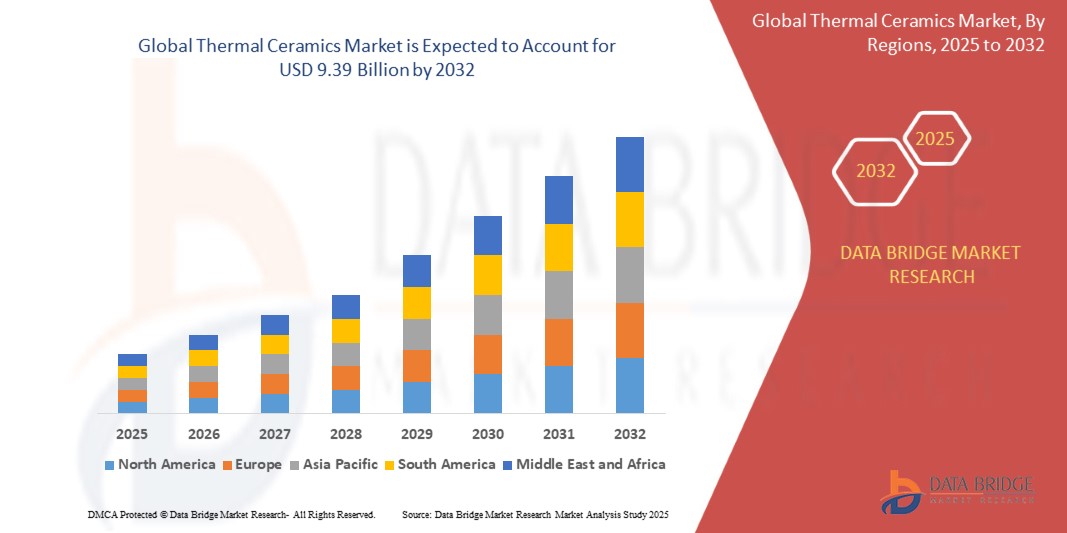
- The global thermal ceramics market size was valued at USD 5.57 billion in 2024 and is expected to reach USD 9.39 billion by 2032, at a CAGR of 6.8% during the forecast period
- The market growth is largely fueled by the rising demand for energy-efficient and advanced heat-resistant insulation materials, driven by expansion in industrial sectors including mining, metal processing, petrochemicals, power generation, aerospace, and construction.
- Furthermore, increasing focus on sustainability and stricter global environmental regulations are major drivers contributing to the adoption of innovative thermal ceramics for safer, more efficient, and low-emission industrial operations.
Thermal Ceramics Market Analysis
- Thermal ceramics, which include products like ceramic fibers and insulation bricks, are critical across industrial, energy, and construction applications due to their exceptional heat resistance, low thermal conductivity, and mechanical strength. These materials play a vital role in reducing energy loss, improving operational safety, and supporting efficient processes in high-temperature environments such as furnaces, kilns, reactors, and power systems.
- The growing demand for thermal ceramics is primarily driven by rising emphasis on energy conservation, strict emission regulations, and the need for advanced insulation solutions in sectors such as mining, metal processing, petrochemicals, power generation, aerospace, and next-generation electric vehicles.
- Asia-Pacific dominated the global thermal ceramics market with the largest revenue share in 2024, supported by robust industrialization, infrastructure expansion, and well-established manufacturing hubs in China, India, Japan, and South Korea. Significant investments in sustainable technologies and rising adoption of energy-efficient materials further boost regional growth.
- Ceramic fibers represent the dominant product segment, accounting for a major portion of global market revenue in 2024. Their lightweight, high-temperature stability, and adaptability for various insulation and fire protection applications make them the preferred choice in modern industrial settings.
- The mining & metal processing application segment continues to hold significant market traction, driven by the increasing need for safe, durable, and energy-saving insulation in smelting, refining, and metal production operations. Power generation, chemicals, aerospace, and construction sectors are also experiencing accelerated growth, fueled by the integration of advanced thermal ceramics for improved efficiency and safety.
Report Scope and Thermal Ceramics Market Segmentation
|
Attributes |
Thermal Ceramics Key Market Insights |
|
Segments Covered |
|
|
Countries Covered |
North America
Europe
Asia-Pacific
Middle East and Africa
South America
|
|
Key Market Players |
|
|
Market Opportunities |
|
|
Value Added Data Infosets |
In addition to the insights on market scenarios such as market value, growth rate, segmentation, geographical coverage, and major players, the market reports curated by the Data Bridge Market Research also include in-depth expert analysis, pricing analysis, brand share analysis, consumer survey, demography analysis, supply chain analysis, value chain analysis, raw material/consumables overview, vendor selection criteria, PESTLE Analysis, Porter Analysis, and regulatory framework. |
Thermal Ceramics Market Trends
Emphasis on Energy Efficiency and Sustainable Insulation Materials
- A key emerging trend in the global thermal ceramics market is the drive toward energy-efficient and environmentally sustainable insulation solutions, spurred by stricter emissions regulations and global carbon reduction initiatives. Manufacturers are innovating with low-emission ceramic fibers and eco-friendly insulation bricks that improve thermal management while minimizing environmental impact in heavy industry, power generation, and transportation sectors.
- For instance, leading companies are introducing bio-persistent ceramic fiber products certified for eco-safety, meeting evolving emissions standards for high-temperature industrial furnaces and automotive thermal protection systems. The shift to advanced ceramic composites in electric vehicles and next-generation aerospace applications is further fueling demand for light, durable, and high-performance thermal ceramics.
- Growing attention to recyclable and hybrid insulation materials is shaping product development, especially in sectors looking to extend asset life, enhance energy savings, and minimize maintenance cost. Sustainable materials and production methods are increasingly being adopted to address both operational efficiency and environmental stewardship goals.
- ·Industrial users across Asia-Pacific, Europe, and North America are aggressively integrating newly engineered thermal ceramics in infrastructure upgrades, renewable energy installations, and smart manufacturing processes. The region’s industrial scale and policy support are making Asia-Pacific the focal point for deployment and growth.
- As companies prioritize sustainable operations, products that combine high thermal efficiency with green manufacturing and circular material design are gaining competitive advantage.
Thermal Ceramics Market Dynamics
Driver
Rising Demand from High-Temperature Industrial and Clean Energy Applications
- The increasing need for reliable thermal insulation in heavy industry, clean energy plants, EV batteries, and high-tech aerospace is a primary driver for the growth of the thermal ceramics market. Post-pandemic recovery and decarbonization initiatives are accelerating investments in new infrastructure, driving upgrades in energy performance and operational safety.
- For example, industrial expansions in steel, chemicals, and advanced ceramics production are boosting demand for durable furnace linings and fire-protection materials worldwide. Strategic investments by leading manufacturers are propelling adoption across diverse sectors.
- Modern power and energy systems, from renewable installations to grid-scale battery storage, rely on high-efficiency ceramic fibers and bricks for cost-effective, long-lasting thermal management.
- Additionally, urbanization and higher living standards in emerging economies are expanding adoption of advanced insulation in smart buildings and transport, supporting further market growth.
- Sustainability is also driving the introduction of hybrid ceramic insulation solutions, blending mineral fibers and advanced composites for improved reliability and reduced lifecycle costs
Restraint/Challenge
Stringent Regulation, Price Volatility, and Adoption Barriers
- A significant challenge in the thermal ceramics market is regulatory scrutiny over fiber biopersistence, occupational safety, and emissions performance. Evolving standards in the EU, U.S., and APAC require explicit safety certifications and environmental documentation, potentially increasing R&D and compliance costs for manufacturers.
- Price fluctuations in key raw materials as well as high production costs present further hurdles, especially in price-sensitive and emerging markets. Robust competition from alternative materials (such as mineral wool, polymer-based insulations) also poses adoption risks in sectors with tight margins.
- Capital intensity of manufacturing and the need to educate industrial buyers on the long-term benefits of advanced ceramics over traditional options may slow adoption rates.
- To mitigate these challenges, major industry players are investing in clean manufacturing, transparent safety testing, and collaborative innovation with regulatory bodies. Ongoing consumer and business education on performance, durability, and return on investment will be pivotal for broader market uptake.
Thermal Ceramics Market Scope
The market is segmented on the basis of type and end user industry.
- By Type
On the basis of type, the thermal ceramics market is segmented into ceramic fibers and insulation bricks. Ceramic fibers dominate the largest market revenue share in 2024, primarily due to their lightweight nature, superior thermal insulation capabilities, and high resistance to extreme temperatures. They are widely used in industrial furnaces, kilns, and fire protection applications. Insulation bricks are valued for their structural strength and are extensively applied where durable thermal barriers and support are required. The ceramic fiber segment is projected to witness the fastest growth rate from 2025 to 2032, driven by advancements in energy-efficient manufacturing processes and the increasing adoption in automotive, aerospace, and power generation sectors.
- By End User Industry
On the basis of end user industry, the thermal ceramics market is segmented into mining & metal processing, chemicals & petrochemicals, power generation, manufacturing, aerospace, construction, and others. Mining & metal processing dominated the market in 2024, driven by the need for efficient and durable insulating solutions in high-temperature metal refining and smelting operations. Power generation and chemicals sectors are expected to register the fastest CAGR from 2025 to 2032, fueled by global investments in energy infrastructure, increased adoption of renewable energy facilities, and modernization of process plants requiring advanced thermal management.
Thermal Ceramics Market Regional Analysis
- Asia-Pacific dominated the thermal ceramics market with the largest revenue share of in 2024, driven by rapid industrialization, increasing investments in infrastructure, and robust growth in manufacturing and energy sectors across countries like China, India, Japan, and South Korea.
- Industrial users and manufacturers in the region are increasingly incorporating thermal ceramics in high-temperature processes such as metal refining, power generation, chemical production, and automotive components, fueled by the need for energy efficiency, operational safety, and regulatory compliance.
- The region’s market strength is further supported by government emphasis on sustainable industrial practices, strong demand from construction and process industries, and access to affordable raw materials and skilled labor. Asia-Pacific’s leading position in global exports of advanced ceramic insulation and rising adoption of innovative, eco-friendly thermal solutions reinforce its market leadership.
U.S. Thermal Ceramics Market Insight
The U.S. dominates the North American thermal ceramics market in 2024, supported by strong manufacturing capabilities, advanced energy infrastructure, and a technology-driven approach to industrial insulation. Demand is high across power generation, metallurgy, petrochemicals, and aerospace, as facilities actively invest in modern, energy-efficient thermal ceramic solutions. Increasing regulatory focus on emissions and workplace safety further drives market penetration, while major players are innovating with high-performance and sustainable ceramic insulation products.
Europe Thermal Ceramics Market Insight
The Europe thermal ceramics market is poised for consistent growth, led by stringent energy efficiency regulations, expanding applications in automotive, metallurgy, and chemical industries, and growing investments in sustainable insulation technologies. Adoption is increasing across power stations, industrial furnaces, construction, and transport sectors. Countries such as Germany, France, and the U.K. are at the forefront, with local companies emphasizing advanced, eco-friendly ceramic fiber and brick production for both domestic and export markets.
U.K. Thermal Ceramics Market Insight
The U.K. thermal ceramics market is expected to witness steady growth, driven by the demand for superior insulation in advanced manufacturing, aerospace, power generation, and construction sectors. Facilities are increasingly selecting high-performance ceramic fibers and blocks for enhanced energy savings, safety, and compliance with strict environmental standards. Rising interest in green building and infrastructure projects continues to boost adoption in both industrial and commercial applications.
Germany Thermal Ceramics Market Insight
Germany’s thermal ceramics market is projected to grow steadily, supported by leadership in engineering, process industries, and sustainable manufacturing. The country’s strong focus on advanced ceramics for metal processing, chemicals, and automotive is fostering market expansion. Emphasis on emissions reduction and thermal efficiency, coupled with innovation in eco-friendly ceramic solutions, is promoting the use of durable insulation in diverse industrial operations.
Asia-Pacific Thermal Ceramics Market Insight
The Asia-Pacific thermal ceramics market accounted for the largest revenue share in 2024, driven by rapid industrialization and robust infrastructure development in China, India, and Japan. The region’s strong manufacturing and export base, coupled with growing applications in metallurgy, power generation, construction, and automotive, significantly accelerates market growth. Government programs supporting energy conservation and sustainable industrial practices have further increased demand for advanced ceramic insulation. Affordable manufacturing, abundant raw material supply, and expanding export activities reinforce Asia-Pacific’s leadership position.
India Thermal Ceramics Market Insight
The India thermal ceramics market is projected a substantial CAGR over the forecast period, fueled by infrastructure investments, rising demand for energy-efficient materials in power, process industries, and construction, and government initiatives such as “Make in India.” With industrial modernization, local manufacturing of ceramic insulation products is expanding rapidly, creating growth opportunities in cost-sensitive and high-performance applications.
China Thermal Ceramics Market Insight
China leads the Asia-Pacific thermal ceramics market in terms of revenue share, supported by its dominant position in manufacturing, metals, chemicals, and construction. The market is growing in critical segments including industrial furnaces, power generation, and energy storage, boosted by domestic modernization and strong export potential. China’s advancements in production technology and expansion of eco-friendly ceramic fiber manufacturing are attracting both local and international buyers. Rising energy demand and urbanization fuel increased consumption of high-quality thermal ceramics for new infrastructure and industrial projects.
Thermal Ceramics Market Share
The Thermal Ceramics industry is primarily led by well-established companies, including:
- Morgan Advanced Materials (U.K)
- Luyang Energy-Saving Materials Co. Ltd. (China)
- 3M Company (U.S.)
- Ibiden Co. Ltd. (Japan)
- Mitsubishi Chemical Holdings Corporation (Japan)
- Unifrax (U.S.)
- Rath Group (Austria)
- RHI Magnesita GmbH (Austria)
- CeramTec GmbH (Germany)
- Isolite Insulating Products Co., Ltd. (Japan)
- Nutec Group (Mexico)
- Yeso Insulating Products Co., Ltd. (China)
- Skamol A/S (Denmark)
- Thermal Products Company, Inc. (U.S.)
- BNZ Materials, Inc. (U.S.)
Latest Developments in Global Thermal Ceramics Market
- In 2021, Luyang Energy-Saving Materials supplied ceramic fiber blankets to Vietnam for high-temperature industrial insulation projects.
- Morgan Thermal Ceramics expanded its EV battery thermal management product offerings in 2020.
- Unifrax launched the Isofrax 1400 bio-persistent and eco-friendly ceramic fiber blanket in 2020, advancing sustainable thermal insulation technologies.

- Interactive Data Analysis Dashboard
- Company Analysis Dashboard for high growth potential opportunities
- Research Analyst Access for customization & queries
- Competitor Analysis with Interactive dashboard
- Latest News, Updates & Trend analysis
- Harness the Power of Benchmark Analysis for Comprehensive Competitor Tracking
Global Thermal Ceramics Market, Supply Chain Analysis and Ecosystem Framework
To support market growth and help clients navigate the impact of geopolitical shifts, DBMR has integrated in-depth supply chain analysis into its Global Thermal Ceramics Market research reports. This addition empowers clients to respond effectively to global changes affecting their industries. The supply chain analysis section includes detailed insights such as Global Thermal Ceramics Market consumption and production by country, price trend analysis, the impact of tariffs and geopolitical developments, and import and export trends by country and HSN code. It also highlights major suppliers with data on production capacity and company profiles, as well as key importers and exporters. In addition to research, DBMR offers specialized supply chain consulting services backed by over a decade of experience, providing solutions like supplier discovery, supplier risk assessment, price trend analysis, impact evaluation of inflation and trade route changes, and comprehensive market trend analysis.
Data collection and base year analysis are done using data collection modules with large sample sizes. The stage includes obtaining market information or related data through various sources and strategies. It includes examining and planning all the data acquired from the past in advance. It likewise envelops the examination of information inconsistencies seen across different information sources. The market data is analysed and estimated using market statistical and coherent models. Also, market share analysis and key trend analysis are the major success factors in the market report. To know more, please request an analyst call or drop down your inquiry.
The key research methodology used by DBMR research team is data triangulation which involves data mining, analysis of the impact of data variables on the market and primary (industry expert) validation. Data models include Vendor Positioning Grid, Market Time Line Analysis, Market Overview and Guide, Company Positioning Grid, Patent Analysis, Pricing Analysis, Company Market Share Analysis, Standards of Measurement, Global versus Regional and Vendor Share Analysis. To know more about the research methodology, drop in an inquiry to speak to our industry experts.
Data Bridge Market Research is a leader in advanced formative research. We take pride in servicing our existing and new customers with data and analysis that match and suits their goal. The report can be customized to include price trend analysis of target brands understanding the market for additional countries (ask for the list of countries), clinical trial results data, literature review, refurbished market and product base analysis. Market analysis of target competitors can be analyzed from technology-based analysis to market portfolio strategies. We can add as many competitors that you require data about in the format and data style you are looking for. Our team of analysts can also provide you data in crude raw excel files pivot tables (Fact book) or can assist you in creating presentations from the data sets available in the report.













