What is the Thermal Insulation Packaging for Pharmaceutical Cold Chain Market Size and Growth Rate?
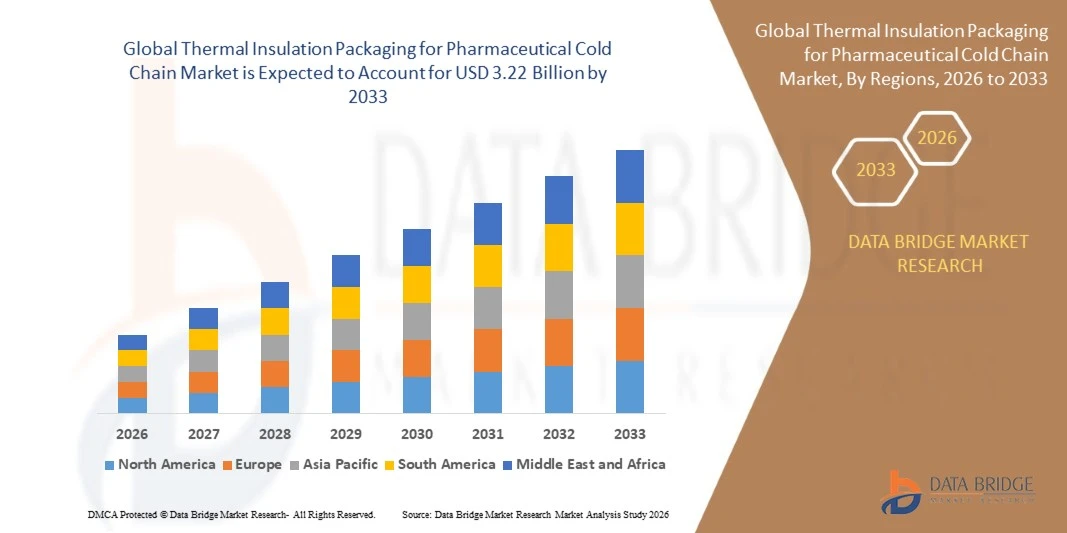
- As per Data Bridge Market Research analysis, the thermal insulation packaging for pharmaceutical cold chain market was valued at USD 1.65 billion in 2025 and is projected to reach USD 3.22 billion by 2033, growing at a CAGR of 8.70% from 2026 to 2033.
- The market is experiencing consistent growth driven by rising demand for temperature-controlled pharmaceutical transportation, advancements in thermal insulation materials, and expanding applications across vaccines, biologics, specialty medicines, and clinical trial logistics.
- The increasing distribution of temperature-sensitive pharmaceuticals globally, combined with stringent requirements for maintaining product stability and safety, is compelling pharmaceutical manufacturers, healthcare providers, and logistics companies to adopt advanced thermal insulation packaging solutions. Insulated shippers, high-performance packaging materials, and phase change cooling systems are supporting reliable temperature control during transportation, reducing product spoilage, and maintaining the efficacy of critical medicines throughout the pharmaceutical cold chain.
Market Size & Forecast
- Global Market Value (2025): USD 1.65 Billion
- Expected Market Value (2033): USD 3.22 Billion
- Forecast CAGR (2026–2033): 8.70%
- Leading Region in 2025: North America
- Fastest Growing Region: Asia Pacific
What are the Major Takeaways of the Thermal Insulation Packaging for Pharmaceutical Cold Chain Market?
- North America dominated the thermal insulation packaging for pharmaceutical cold chain market with the largest revenue share of 35.9% in 2025, supported by advanced pharmaceutical manufacturing infrastructure and established cold chain logistics networks.
- Asia-Pacific is expected to be the fastest-growing region at a CAGR of 6.3% from 2026 to 2033, fueled by expanding pharmaceutical manufacturing, rising demand for biologics and vaccines, and increasing investments in temperature-controlled logistics across China, India, and Japan.
- The insulated shippers segment led the market with a 43.7% share in 2025, driven by widespread adoption for transporting temperature-sensitive pharmaceutical products.
- Refrigerant packs and phase change materials (PCMs) are the fastest-growing product type, projected to register a CAGR of 12.0%, reflecting the surge in need for precise temperature management across pharmaceutical shipping routes
- The passive packaging segment dominated the packaging type category with a 62.4% revenue share in 2025, led by its cost-effectiveness and widespread use in pharmaceutical transportation.
- Expanded polystyrene (EPS) accounted for 45.0% of the market share in 2025, preferred by its established use in insulated pharmaceutical shippers and temperature-controlled packaging.
- The biologics and biosimilars segment is the fastest-growing application category, with a CAGR of 11.5%, driven by the expanding development and commercialization of temperature-sensitive biological medicines.
Report Scope and Thermal Insulation Packaging for Pharmaceutical Cold Chain Market Segmentation
|
Attributes |
Thermal Insulation Packaging for Pharmaceutical Cold Chain Key Market Insights |
|
Segments Covered |
|
|
Countries Covered |
North America
Europe
Asia-Pacific
Middle East and Africa
South America
|
|
Key Market Players |
|
|
Market Opportunities |
|
|
Value Added Data Infosets |
In addition to the insights on market scenarios such as market value, growth rate, segmentation, geographical coverage, and major players, the market reports curated by the Data Bridge Market Research also include import export analysis, production capacity overview, production consumption analysis, price trend analysis, climate change scenario, supply chain analysis, value chain analysis, raw material/consumables overview, vendor selection criteria, PESTLE Analysis, Porter Analysis, and regulatory framework. |
What is the Key Trend in the Thermal Insulation Packaging for Pharmaceutical Cold Chain Market?
- Pharmaceutical companies are increasingly adopting sustainable thermal insulation packaging to protect temperature-sensitive medicines, reduce packaging waste, and improve the efficiency of cold chain transportation.
- For instance, in January 2025, DS Smith launched TailorTemp, a fibre-based pharmaceutical temperature-controlled packaging solution designed to keep products cool for up to 36 hours while providing a recyclable alternative to expanded polystyrene packaging
- Advanced insulation materials and optimized coolant configurations enable manufacturers to maintain required temperatures during transportation while reducing packaging weight and material consumption.
- Pharmaceutical logistics providers are increasingly exploring reusable shippers, recyclable insulation materials, and phase change materials to improve temperature stability and support sustainability targets.
- For instance, in October 2025, CSafe launched Silverskin RE, a reusable thermal cover designed for pharmaceutical shipments requiring temperature ranges of +2°C to +8°C and +15°C to +25°C, with rental and return logistics supporting repeated use.
- As pharmaceutical manufacturers prioritize sustainability, reliable temperature protection, and efficient distribution, the adoption of recyclable and reusable thermal insulation packaging is expected to accelerate, reinforcing packaging innovation as a core component of pharmaceutical cold chain management.
What are the Key Drivers of the Thermal Insulation Packaging for Pharmaceutical Cold Chain Market?
- The rapid expansion of biologics, vaccines, and temperature-sensitive specialty medicines has significantly increased demand for thermal insulation packaging capable of maintaining product stability throughout transportation.
- For instance, in July 2025, the World Health Organization published the seventh edition of its international vaccine packaging and shipping guidelines, incorporating guidance on ultra-low-temperature vaccine shipments and emphasizing temperature control during international distribution.
- Pharmaceutical manufacturers, biotechnology companies, and logistics providers are investing in advanced insulation materials, validated shipping systems, and reusable packaging to reduce temperature excursions and protect product quality.
- For instance, in August 2025, Marken announced InfiniDI, a reusable dry ice packaging solution developed with Peli BioThermal that can reduce dry ice use by 50% and environmental waste by up to 90%, according to the companies.
- With pharmaceutical distribution becoming increasingly global and therapies requiring more precise temperature control, thermal insulation packaging will remain essential for preserving medicine quality and supporting reliable cold chain delivery.
What Factors are Challenging the Growth of the Thermal Insulation Packaging for Pharmaceutical Cold Chain Market?
- Advanced thermal insulation packaging requires significant upfront investment due to specialized insulation materials, phase change coolants, temperature monitoring systems, and packaging qualification procedures.
- For instance, in November 2021, Pharma Manufacturing reported that reusable temperature-controlled shippers involve return-shipping expenses, inventory management, storage requirements, and the risk of unreturned packaging, increasing the total cost and complexity of reuse.
- These high costs can limit adoption among smaller pharmaceutical manufacturers, healthcare distributors, and logistics providers, particularly in price-sensitive markets with limited cold chain infrastructure.
- The need for validated thermal performance, reliable reverse logistics for reusable packaging, and compliance with varying international requirements increases operational complexity for pharmaceutical supply chains.
- For instance, in October 2026, an article published in AAPS Open highlighted that temperature excursions during pharmaceutical storage, transportation, and handling can compromise product quality and require additional stability assessments before affected medicines can be released for use. These risks increase quality-control costs and complicate cold chain distribution
- High initial costs, validation requirements, and the logistical challenges of collecting and reconditioning reusable packaging continue to restrict adoption, particularly among smaller organizations and emerging markets, despite rising demand for reliable temperature-controlled pharmaceutical transportation.
How is the Thermal Insulation Packaging for Pharmaceutical Cold Chain Market Segmented?
The thermal insulation packaging for pharmaceutical cold chain market is segmented on the basis of product type, packaging type, insulation material, and application
- By Product Type
On the basis of product type, the thermal insulation packaging for pharmaceutical cold chain market is segmented into insulated shippers, insulated containers, insulated boxes, insulated pallet shippers, thermal insulation liners and inserts, and refrigerant packs and phase change materials (PCMs). The insulated shippers segment dominated the market with 43.7% share in 2025, supported by widespread adoption for transporting temperature-sensitive pharmaceutical products. These shippers combine thermal insulation with suitable coolant configurations to maintain required temperature conditions during distribution. They are commonly used for vaccines, biologics, specialty medicines, and clinical trial materials. Their availability in different sizes and temperature-performance configurations supports diverse shipment requirements. Pharmaceutical manufacturers and logistics providers value their ability to protect product integrity during domestic and international transportation.
The refrigerant packs and phase change materials (PCMs) segment is expected to witness strong growth, with CAGR of 12.0% from 2026 to 2033, driven by the need for precise temperature management across pharmaceutical shipping routes. These materials absorb or release thermal energy to help maintain products within specified temperature ranges. Unlike conventional water-based coolants, appropriately selected PCMs can be designed around specific phase-change temperatures. Their integration into validated packaging systems supports the transportation of vaccines, biologics, and advanced therapies. Improvements in reusable coolant technologies are helping reduce waste and improve shipment consistency.
- By Packaging Type
On the basis of packaging type, the thermal insulation packaging for pharmaceutical cold chain market is segmented into passive packaging, active packaging, and hybrid packaging. The passive packaging segment dominated the market with 62.4% share in 2025, supported by its cost-effectiveness and widespread use in pharmaceutical transportation. Passive systems rely on insulation materials and coolants to maintain specified temperature ranges without continuous external power. They are widely used for vaccines, biologics, specialty medicines, and clinical trial materials. Their relatively simple operating requirements make them suitable for domestic distribution and international shipments. Compatibility with insulated shippers, gel packs, and phase change materials further strengthens adoption.
The active packaging segment is expected to witness the fastest growth, with CAGR of 10.8% from 2026 to 2033, driven by increasing demand for precise temperature regulation during long-distance pharmaceutical transportation. Active systems use powered refrigeration or heating mechanisms to maintain specified conditions. They are particularly suitable for high-value biologics, sensitive specialty medicines, and shipments requiring extended temperature control. Advanced monitoring and control technologies help minimize temperature deviations during transit. Their ability to regulate internal conditions despite changing external temperatures makes them useful for complex logistics routes.
- By Insulation Material
On the basis of insulation material, the thermal insulation packaging for pharmaceutical cold chain market is segmented into expanded polystyrene (EPS), polyurethane (PU) foam, vacuum insulated panels (VIPs), expanded polypropylene (EPP), molded fiber and paper-based insulation, reflective foils and composite materials, and bio-based and biodegradable insulation materials. The expanded polystyrene (EPS) segment dominated the market with 45.0% share in 2025, supported by its established use in insulated pharmaceutical shippers and temperature-controlled packaging. Its lightweight structure and insulating properties make it suitable for protecting temperature-sensitive medicines during transportation. EPS packaging can accommodate gel packs and other cooling elements to maintain required conditions. Its affordability and ease of manufacturing support adoption among pharmaceutical manufacturers and logistics providers.
The vacuum insulated panels (VIPs) segment is expected to register the fastest growth, with CAGR of 14.2% from 2026 to 2033, driven by demand for high-performance thermal protection in pharmaceutical cold chain logistics. VIPs provide high thermal resistance within relatively thin packaging walls. This enables compact packaging designs while preserving valuable internal space for pharmaceutical products. They are particularly useful for high-value biologics and shipments requiring extended temperature stability. Their reduced thermal conductivity can help maintain temperature conditions over longer transportation periods when combined with an appropriately validated packaging system. Growing interest in lightweight shipping configurations and premium cold chain solutions is supporting adoption.
- By Application
On the basis of application, the thermal insulation packaging for pharmaceutical cold chain market is segmented into vaccines, biologics and biosimilars, cell and gene therapies, specialty pharmaceuticals, clinical trial materials, blood products and biological samples, and other pharmaceutical products. The vaccines segment is expected to account for a significant share of the application category, with 30.0% share in 2025, supported by the continued need to maintain strict temperature conditions throughout vaccine distribution. Many vaccines require refrigerated storage, while certain products need frozen or ultra-low-temperature conditions. Thermal insulation packaging helps protect vaccine stability during transportation between manufacturers, distribution centers, healthcare facilities, and vaccination sites. Validated shippers and suitable coolant configurations help reduce the risk of temperature excursions. Government immunization programs and international vaccine distribution further support demand for reliable packaging.
The biologics and biosimilars segment is expected to witness the fastest growth, with CAGR of 11.5% from 2026 to 2033, driven by the expanding development and commercialization of temperature-sensitive biological medicines. These products can be sensitive to temperature fluctuations, making validated thermal packaging essential throughout distribution. Growing demand for monoclonal antibodies, therapeutic proteins, and other advanced biological treatments is increasing requirements for specialized shipping systems. Insulated containers, high-performance panels, and phase change materials help maintain suitable conditions during transit. Increasing cross-border distribution and the expansion of specialty pharmaceutical supply chains are further supporting demand.
Which Region Holds the Largest Share of the Thermal Insulation Packaging for Pharmaceutical Cold Chain Market?
- North America dominated the thermal insulation packaging for pharmaceutical cold chain market with the largest revenue share of 35.9% in 2025, supported by advanced pharmaceutical manufacturing infrastructure and established cold chain logistics networks.
- The region also benefits from stringent pharmaceutical quality regulations, high demand for temperature-sensitive biologics and vaccines, and widespread adoption of validated insulated shipping solutions. Strong investments in pharmaceutical research, specialty medicines, and temperature-controlled transportation continue to strengthen North America's leadership position in the global market.
U.S. Thermal Insulation Packaging for Pharmaceutical Cold Chain Market Insight
The U.S. thermal insulation packaging for pharmaceutical cold chain market is witnessing strong growth due to rising demand for temperature-sensitive biologics, vaccines, and specialty medicines. The country’s advanced pharmaceutical manufacturing ecosystem, along with increasing adoption of high-performance insulated shippers, phase change materials, and temperature-monitoring solutions, is driving demand across pharmaceutical and biotechnology applications. In addition, growing emphasis on maintaining product integrity, complying with pharmaceutical handling standards, and reducing temperature excursions is accelerating the adoption of advanced thermal packaging solutions.
Asia-Pacific Thermal Insulation Packaging for Pharmaceutical Cold Chain Market Insight
The Asia-Pacific thermal insulation packaging for pharmaceutical cold chain market is expected to witness rapid growth, driven by expanding pharmaceutical manufacturing, rising healthcare expenditure, and increasing investments in cold chain logistics across countries such as China, India, and Japan. Growing demand for vaccines, biologics, and temperature-sensitive specialty medicines is supporting regional market expansion. In addition, improvements in pharmaceutical distribution infrastructure, increasing clinical trial activity, and rising adoption of advanced insulation materials are accelerating demand for reliable thermal packaging solutions across the region.
Japan Thermal Insulation Packaging for Pharmaceutical Cold Chain Market Insight
The Japan thermal insulation packaging for pharmaceutical cold chain market is witnessing consistent growth due to rising demand for biologics, vaccines, and advanced pharmaceutical therapies requiring precise temperature control. Pharmaceutical manufacturers, biotechnology companies, and logistics providers are increasingly adopting insulated containers, high-performance thermal materials, and validated shipping systems to protect product quality during transportation. Moreover, Japan’s advanced healthcare infrastructure, emphasis on pharmaceutical quality standards, and growing focus on efficient cold chain logistics are further contributing to market growth.
China Thermal Insulation Packaging for Pharmaceutical Cold Chain Market Insight
The China thermal insulation packaging for pharmaceutical cold chain market is growing rapidly, driven by expanding pharmaceutical production, increasing vaccine distribution, and rising demand for biologics and temperature-sensitive medicines. Growing investments in pharmaceutical logistics infrastructure and the adoption of advanced insulated packaging solutions are significantly boosting market demand. In addition, increasing biotechnology research, expanding clinical trial activities, and rising emphasis on pharmaceutical product safety are positioning China as an important growth market for thermal insulation packaging in the pharmaceutical cold chain industry.
U.K. Thermal Insulation Packaging for Pharmaceutical Cold Chain Market Insight
The U.K. thermal insulation packaging for pharmaceutical cold chain market is experiencing steady growth, supported by rising demand for temperature-controlled pharmaceutical distribution, biologics transportation, and clinical trial logistics. Increasing investments in advanced insulated shippers, reusable packaging systems, and sustainable insulation materials are contributing to market growth. Furthermore, growing emphasis on pharmaceutical quality assurance, reduced packaging waste, and reliable temperature management during transportation is encouraging the adoption of innovative thermal packaging solutions across the U.K. pharmaceutical supply chain.
Germany Thermal Insulation Packaging for Pharmaceutical Cold Chain Market Insight
The Germany thermal insulation packaging for pharmaceutical cold chain market is expanding steadily due to the country’s strong pharmaceutical manufacturing base, established biotechnology sector, and advanced logistics infrastructure. Pharmaceutical companies and cold chain service providers are increasingly utilizing insulated containers, phase change materials, and high-performance insulation systems to protect temperature-sensitive products during transportation. Continuous advancements in sustainable packaging materials, reusable shipping systems, and temperature-control technologies, along with growing demand for biologics and specialty medicines, are further driving market growth in Germany.
Which are the Top Companies in Thermal Insulation Packaging for Pharmaceutical Cold Chain Market?
The thermal insulation packaging for pharmaceutical cold chain industry is primarily led by well-established companies, including:
- ThermoSafe (U.S.)
- CSafe (U.S.)
- Cryopak (U.S.)
- Insulated Products Corporation (U.S.)
- Veritiv (U.S.)
- Schaumaplast (Germany)
- Thermopac (U.K.)
- Global Cold Chain Solutions (Australia)
- Puffin Europe (Netherlands)
- INNOPLUS (Italy)
- Thermal Packaging Solutions (U.K.)
- Thermal Covers Company (India)
- Mettcover (India)
- Wilpak Group International (Australia)
- Envirotainer (Sweden)
- Peli BioThermal (U.S.)
- Emball’Iso (France)
- SkyCell (Switzerland)
- Intelsius (U.K.)
- Tempk (Spain)
What are Latest Developments in Thermal Insulation Packaging for Pharmaceutical Cold Chain Market?
- In October 2025, CSafe launched Silverskin RE, a reusable thermal cover designed to support pharmaceutical shipments requiring controlled temperatures of +2°C to +8°C and +15°C to +25°C. The solution features a durable, cleanable exterior, integrated tracking capabilities, and a rental model with return logistics. This launch highlights the industry's focus on reducing single-use packaging waste while maintaining reliable thermal protection for temperature-sensitive medicines
- In April 2025, ThermoSafe launched the ChillTherm Bio pallet shipper, a biodegradable expanded polystyrene (EPS) thermal packaging solution designed for pharmaceutical and biologic shipments. The shipper provides up to 120 hours of thermal performance at 2°C to 8°C under specified shipping conditions and is designed for high-volume distribution. The development demonstrates efforts to combine pharmaceutical cold chain reliability with more sustainable packaging materials.
- In October 2024, Peli BioThermal introduced Crēdo Vault, a bulk temperature-controlled shipper designed for pharmaceutical and life sciences shipments. The system combines thermal protection with built-in Internet of Things (IoT) monitoring to provide real-time shipment visibility. It supports multiple temperature ranges and offers qualified thermal protection for extended shipping durations, helping pharmaceutical companies protect product integrity and improve logistics efficiency.
- In October 2024, CSafe launched the CGT Ultra D dewar, a reusable dry ice shipping container developed for cell and gene therapies and other advanced therapy medicinal products. The system maintains temperatures below −70°C for more than 37 days and incorporates data loggers for shipment tracking and condition monitoring. This development addresses the specialized thermal protection requirements of advanced biological therapies during transportation
- In October 2022, CSafe launched the CSafeAPS reusable pallet shipper, designed to provide thermal protection for pharmaceutical shipments at ambient, refrigerated, and frozen temperatures. The system offers more than 120 hours of qualified thermal protection and includes real-time tracking of shipment location, temperature, humidity, pressure, shock, and tilt. The launch strengthened the availability of reusable passive packaging solutions for pharmaceutical companies seeking reliable temperature control and improved shipment visibility.
- Interactive Data Analysis Dashboard
- Company Analysis Dashboard for high growth potential opportunities
- Research Analyst Access for customization & queries
- Competitor Analysis with Interactive dashboard
- Latest News, Updates & Trend analysis
- Harness the Power of Benchmark Analysis for Comprehensive Competitor Tracking
Global Thermal Insulation Packaging For Pharmaceutical Cold Chain Market, Supply Chain Analysis and Ecosystem Framework
To support market growth and help clients navigate the impact of geopolitical shifts, DBMR has integrated in-depth supply chain analysis into its Global Thermal Insulation Packaging For Pharmaceutical Cold Chain Market research reports. This addition empowers clients to respond effectively to global changes affecting their industries. The supply chain analysis section includes detailed insights such as Global Thermal Insulation Packaging For Pharmaceutical Cold Chain Market consumption and production by country, price trend analysis, the impact of tariffs and geopolitical developments, and import and export trends by country and HSN code. It also highlights major suppliers with data on production capacity and company profiles, as well as key importers and exporters. In addition to research, DBMR offers specialized supply chain consulting services backed by over a decade of experience, providing solutions like supplier discovery, supplier risk assessment, price trend analysis, impact evaluation of inflation and trade route changes, and comprehensive market trend analysis.
Data collection and base year analysis are done using data collection modules with large sample sizes. The stage includes obtaining market information or related data through various sources and strategies. It includes examining and planning all the data acquired from the past in advance. It likewise envelops the examination of information inconsistencies seen across different information sources. The market data is analysed and estimated using market statistical and coherent models. Also, market share analysis and key trend analysis are the major success factors in the market report. To know more, please request an analyst call or drop down your inquiry.
The key research methodology used by DBMR research team is data triangulation which involves data mining, analysis of the impact of data variables on the market and primary (industry expert) validation. Data models include Vendor Positioning Grid, Market Time Line Analysis, Market Overview and Guide, Company Positioning Grid, Patent Analysis, Pricing Analysis, Company Market Share Analysis, Standards of Measurement, Global versus Regional and Vendor Share Analysis. To know more about the research methodology, drop in an inquiry to speak to our industry experts.
Data Bridge Market Research is a leader in advanced formative research. We take pride in servicing our existing and new customers with data and analysis that match and suits their goal. The report can be customized to include price trend analysis of target brands understanding the market for additional countries (ask for the list of countries), clinical trial results data, literature review, refurbished market and product base analysis. Market analysis of target competitors can be analyzed from technology-based analysis to market portfolio strategies. We can add as many competitors that you require data about in the format and data style you are looking for. Our team of analysts can also provide you data in crude raw excel files pivot tables (Fact book) or can assist you in creating presentations from the data sets available in the report.