


Thermal Printer Market Overview
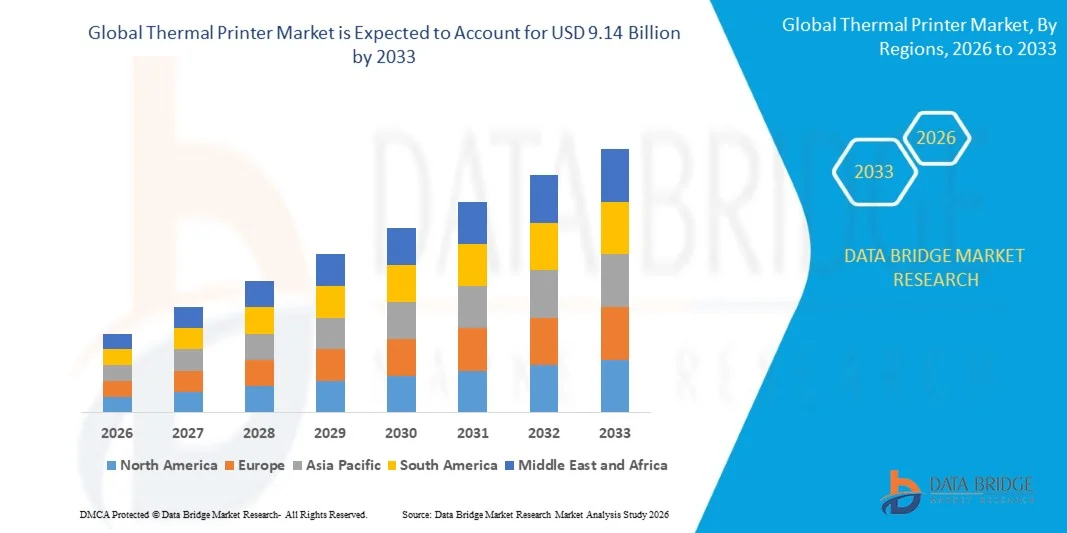
The Thermal Printer Market was valued at USD 5.65 billion in 2025 and is projected to reach USD 9.14 billion by 2033, growing at a CAGR of 6.20% from 2026 to 2033. in 2025 and is projected to reach USD 9.14 billion by 2033, growing at a CAGR of 6.20% from 2026 to 2033. The market is witnessing steady growth driven by increasing demand for fast, cost-efficient, and low-maintenance printing solutions across retail, logistics, healthcare, and manufacturing sectors.
The rising expansion of e-commerce, digital payment systems, and point-of-sale (POS) infrastructure is significantly accelerating the adoption of thermal printers for receipt printing, labeling, and barcode applications. In addition, growing automation in supply chain and inventory management systems is further strengthening market demand, as businesses increasingly prioritize operational efficiency and real-time tracking capabilities across global distribution networks.
Key Market Trends & Insights
- North America dominated the thermal printer market with the largest revenue share of approximately 37.8% in 2025, supported by strong retail infrastructure, advanced logistics networks, high adoption of barcode and POS systems, and widespread integration of automated inventory and enterprise management solutions.
- Asia-Pacific is expected to be the fastest-growing region in the Thermal Printer Market, recording a strong CAGR from 2026 to 2033. Growth is driven by rapid e-commerce expansion, increasing industrial automation, rising logistics activities, and growing adoption of cost-effective printing solutions across emerging economies such as China, India, and Southeast Asia.
- The Direct Thermal (DT) segment held the largest market revenue share of approximately 52.6% in 2025 driven by its widespread use in retail receipts, logistics labeling, and shipping documentation applications. DT printers are preferred due to their low operating cost, high printing speed, and minimal maintenance requirements as they do not require ink or ribbons.
- The Thermal Transfer (TT) segment is projected to register the fastest growth at a CAGR of 7.4% from 2026 to 2033, driven by increasing demand for durable and long-lasting labels in industrial, healthcare, and manufacturing applications. TT printing is widely adopted for barcode labeling, asset tracking, and product identification where resistance to heat, chemicals, and abrasion is required. Growing automation in supply chain operations is further accelerating segment expansion.
- The Desktop segment held the largest market revenue share of approximately 41.3% in 2025 driven by strong adoption in retail point-of-sale systems, healthcare laboratories, and office-based printing environments. Desktop printers are widely preferred due to their compact design, cost efficiency, and ease of integration with existing business systems.
- The Mobile segment is projected to register the fastest growth at a CAGR of 9.1% from 2026 to 2033, driven by increasing demand for on-the-go printing solutions in logistics, field services, transportation, and last-mile delivery operations. Mobile thermal printers enable real-time receipt and label printing, improving operational efficiency and reducing turnaround time in dynamic business environments.
- The Retail segment held the largest market share of approximately 28.4% in 2025 driven by widespread use of thermal printers in billing systems, receipt generation, and point-of-sale automation across supermarkets and retail chains.
- The Logistics & Warehousing segment accounted for approximately 24.7% share supported by rapid expansion of e-commerce, increasing shipment volumes, and strong demand for automated barcode labeling and tracking systems.
Market Size & Forecast
- Global Market Value (2025): USD 5.65 Billion
- Expected Market Value (2033): USD 9.14 Billion
- Forecast CAGR (2026–2033): 6.20%
- Leading Region in 2025: North America
- Fastest Growing Region: Asia-Pacific
Report Scope and Thermal Printer Market Segmentation
|
Attributes |
Thermal Printer Key Market Insights |
|
Segments Covered |
|
|
Countries Covered |
North America
Europe
Asia-Pacific
Middle East and Africa
South America
|
|
Key Market Players |
• Amazon Web Services, Inc. (U.S.) |
|
Market Opportunities |
|
|
Value Added Data Infosets |
In addition to the insights on market scenarios such as market value, growth rate, segmentation, geographical coverage, and major players, the market reports curated by the Data Bridge Market Research also include in-depth expert analysis, geographically represented company-wise production and capacity, network layouts of distributors and partners, detailed and updated price trend analysis and deficit analysis of supply chain and demand. |
Thermal Printer Market Trends
Trend: Growth In High-Speed Digital Printing And Automated Labeling Solutions
Increasing demand for fast, reliable, and cost-efficient printing solutions across retail, logistics, healthcare, and manufacturing sectors is accelerating the adoption of thermal printing technologies. Conventional ink-based printing systems require higher maintenance, frequent consumable replacement, and longer processing time, encouraging industries to shift toward thermal printers that offer low operational complexity and high-speed output.
In modern retail environments, companies are increasingly deploying thermal printers for point-of-sale receipt generation and billing automation, For instance large retail chains and supermarkets are integrating POS-linked thermal printing systems to improve transaction speed and reduce checkout time by nearly 20–30% during peak hours. In logistics and e-commerce operations, thermal printers are widely used for barcode labeling and shipping documentation, enabling real-time tracking and reducing manual errors in supply chain workflows.
The rapid expansion of online retail platforms and last-mile delivery networks is also increasing demand for compact, durable, and high-volume printing systems capable of operating continuously in warehouse environments. In addition, the healthcare sector continues to rely on thermal printing for patient wristbands, prescription labels, and diagnostic sample tracking, ensuring accuracy and compliance in critical workflows. Growing adoption in 2025 across Asia-Pacific logistics hubs, particularly in China and India, has shown significant efficiency improvements in warehouse operations, with automated labeling systems reducing processing errors by up to 25% in high-volume distribution centers.
Thermal Printer Market Dynamics
Key Market Driver: Rising Demand For Automation In Retail And Logistics Operations
Industries worldwide are increasingly focusing on automation, operational efficiency, and cost reduction, driving strong adoption of thermal printing technologies across retail billing systems, logistics labeling, and industrial packaging applications. Thermal printers eliminate the need for ink or toner, reducing recurring operational costs while enabling faster and cleaner printing processes suitable for high-volume environments.
Retailers and logistics companies are increasingly deploying thermal printing systems, For instance in e-commerce fulfillment centers for automated shipping labels, barcode generation, and inventory tracking to support growing order volumes and same-day delivery models. The expansion of organized retail and digital payment systems is further accelerating adoption of POS-integrated thermal printers across urban and semi-urban markets.
Similarly, healthcare institutions and diagnostic laboratories are adopting thermal printing for specimen labeling and patient record management, improving traceability and reducing identification errors. Real-world deployments across major logistics hubs in Singapore and India during 2024 have demonstrated processing efficiency improvements of around 15–25% after integrating automated thermal printing systems into warehouse management operations.
Key Restraint/Challenge: Limited Print Durability And Media Sensitivity Issues
Despite strong adoption, thermal printing technology faces challenges related to print durability, environmental sensitivity, and media limitations. Thermal prints are prone to fading when exposed to heat, sunlight, or long-term storage conditions, restricting their use in applications requiring permanent documentation.
In addition, the dependence on specialized thermal paper increases operational costs and limits flexibility compared to conventional printing technologies. Businesses operating in harsh environments such as outdoor logistics or industrial manufacturing may face reduced print quality due to temperature and humidity variations affecting label readability.
Industry evaluations indicate that thermal printed labels can begin to degrade within 6–12 months under high-temperature exposure conditions, compared to ink-based or laser-printed outputs that offer significantly longer archival stability, creating concerns for long-term documentation and regulatory compliance in certain sectors
Key Market Opportunity: Expansion In Smart Packaging And Healthcare Labeling Applications
The increasing demand for intelligent packaging solutions, real-time tracking, and compliance-driven labeling is creating significant growth opportunities for thermal printers across global industries. Modern supply chains require high-speed, accurate, and machine-readable labeling systems to support automation and digital traceability across product lifecycles.
Companies are increasingly integrating thermal printing systems, For instance in pharmaceutical packaging and vaccine distribution networks to ensure accurate batch tracking, expiration labeling, and regulatory compliance across global healthcare supply chains. In retail and logistics, the expansion of RFID-enabled and barcode-based tracking systems is further increasing the need for high-resolution thermal printing solutions.
In addition, advancements in mobile and wireless thermal printers are enabling field-based operations in transportation, delivery services, and emergency healthcare systems. Pilot deployments in 2025 across Southeast Asia logistics providers have demonstrated improved delivery accuracy and operational efficiency gains of around 18–22% through integration of mobile thermal printing devices in last-mile delivery networks.
Thermal Printer Market Scope
The market is segmented on the basis of model, type, functionality, offering, and end-use application
• By Printing Technology
On the basis of printing technology, the Thermal Printer Market is segmented into Direct Thermal (DT), Thermal Transfer (TT), and Dye-Diffusion Thermal Transfer (D2T2). The Direct Thermal (DT) segment held the largest market revenue share of approximately 52.6% in 2025 driven by its widespread use in retail receipts, logistics labeling, and shipping documentation applications. DT printers are preferred due to their low operating cost, high printing speed, and minimal maintenance requirements as they do not require ink or ribbons.
The Thermal Transfer (TT) segment is projected to register the fastest growth at a CAGR of 7.4% from 2026 to 2033, driven by increasing demand for durable and long-lasting labels in industrial, healthcare, and manufacturing applications. TT printing is widely adopted for barcode labeling, asset tracking, and product identification where resistance to heat, chemicals, and abrasion is required. Growing automation in supply chain operations is further accelerating segment expansion.
• By Format Type
On the basis of format type, the market is segmented into Industrial, Desktop, and Mobile. The Desktop segment held the largest market revenue share of approximately 41.3% in 2025 driven by strong adoption in retail point-of-sale systems, healthcare laboratories, and office-based printing environments. Desktop printers are widely preferred due to their compact design, cost efficiency, and ease of integration with existing business systems.
The Mobile segment is projected to register the fastest growth at a CAGR of 9.1% from 2026 to 2033, driven by increasing demand for on-the-go printing solutions in logistics, field services, transportation, and last-mile delivery operations. Mobile thermal printers enable real-time receipt and label printing, improving operational efficiency and reducing turnaround time in dynamic business environments.
• By Application
On the basis of application, the market is segmented into Retail, Logistics & Warehousing, Healthcare, Manufacturing & Industrial, Hospitality & Ticketing, Government & Public Services, and Others. The Retail segment held the largest market share of approximately 28.4% in 2025 driven by widespread use of thermal printers in billing systems, receipt generation, and point-of-sale automation across supermarkets and retail chains.
The Logistics & Warehousing segment accounted for approximately 24.7% share supported by rapid expansion of e-commerce, increasing shipment volumes, and strong demand for automated barcode labeling and tracking systems.
Thermal Printer Market Regional Analysis
North America Thermal Printer Market Insight
North America dominated the thermal printer market with the largest revenue share of 37.8% in 2025, supported by strong demand from retail, logistics, healthcare, and industrial automation sectors. The region benefits from advanced POS infrastructure, high adoption of barcode and labeling systems, and widespread deployment of automated supply chain management solutions. Growing e-commerce penetration and the expansion of organized retail chains are further strengthening demand for high-speed and reliable printing technologies. In addition, the presence of leading technology providers and strong integration of thermal printers with enterprise management systems are reinforcing regional market leadership.
U.S. Thermal Printer Market Insight
The U.S. thermal printer market captured the largest revenue share in 2025 within North America, driven by rapid adoption of automation technologies and strong growth in e-commerce and logistics operations. Businesses are increasingly prioritizing real-time labeling, inventory tracking, and POS efficiency through advanced thermal printing systems. The rising expansion of fulfillment centers by major retailers such as Amazon and Walmart is further boosting demand for high-volume printing solutions. In addition, increasing integration of thermal printers with cloud-based inventory and retail management systems is significantly contributing to market expansion.
Europe Thermal Printer Market Insight
The Europe thermal printer market is expected to witness the fastest growth rate from 2026 to 2033, driven by increasing adoption of automated retail systems, stringent labeling regulations, and growing demand for efficient logistics operations. The region is experiencing strong growth in pharmaceutical and healthcare labeling applications, where accuracy and compliance are critical. Expansion of e-commerce platforms and smart warehousing systems is further accelerating demand for thermal printing solutions. In addition, Europe’s focus on sustainable and low-maintenance printing technologies is supporting widespread adoption across multiple industries.
U.K. Thermal Printer Market Insight
The U.K. thermal printer market is expected to witness steady growth from 2026 to 2033, supported by rapid digital transformation in retail, hospitality, and logistics sectors. Increasing adoption of contactless retail systems and automated billing solutions is driving demand for compact and efficient thermal printers. Growth in online food delivery and last-mile logistics services is further supporting market expansion. In addition, strong penetration of cloud-based retail management systems is enhancing integration of thermal printers in small and medium-sized enterprises across the country.
Germany Thermal Printer Market Insight
The Germany thermal printer market is expected to witness significant growth from 2026 to 2033, driven by strong industrial automation, advanced manufacturing infrastructure, and rising demand for high-precision labeling systems. Germany’s focus on Industry 4.0 and smart factory initiatives is accelerating adoption of thermal printers for asset tracking and production monitoring. The pharmaceutical and automotive sectors are key contributors, where durable and compliant labeling is essential. In addition, increasing investments in logistics modernization are further strengthening market growth.
Asia-Pacific Thermal Printer Market Insight
The Asia-Pacific thermal printer market is expected to witness the fastest growth rate from 2026 to 2033, supported by rapid industrialization, booming e-commerce, and expanding logistics networks across countries such as China, India, and Japan. The region’s strong manufacturing base and growing adoption of automated warehousing systems are significantly increasing demand for thermal printing solutions. Government initiatives promoting digitalization and smart infrastructure development are further accelerating market expansion. In addition, increasing affordability of thermal printers and rising small business adoption are broadening market penetration across emerging economies.
Japan Thermal Printer Market Insight
The Japan thermal printer market is expected to witness strong growth from 2026 to 2033 due to the country’s advanced technological ecosystem, high automation levels, and strong demand for precision-based printing systems. Japanese industries place high emphasis on efficiency and accuracy, driving adoption of thermal printers in retail, healthcare, and manufacturing sectors. The integration of thermal printing with robotics and IoT-based inventory systems is further supporting market growth. In addition, Japan’s aging workforce is increasing demand for simple, low-maintenance, and automated printing solutions across business environments.
China Thermal Printer Market Insight
The China thermal printer market accounted for the largest revenue share in Asia-Pacific in 2025, driven by massive e-commerce expansion, strong logistics infrastructure, and rapid industrial automation. China’s leadership in manufacturing and retail digitization is significantly boosting demand for barcode labeling, POS printing, and shipping documentation systems. The expansion of express delivery services and warehouse automation is further strengthening market growth. In addition, strong domestic manufacturing capabilities and cost-effective product availability are making thermal printers widely accessible across commercial and industrial applications.
Thermal Printer Market Share
The Thermal Printer industry is primarily led by well-established companies, including:
• Amazon Web Services, Inc. (U.S.)
• Microsoft Corporation (U.S.)
• Google LLC (U.S.)
• IBM (U.S.)
• Oracle (U.S.)
• Zebra Technologies Corporation (U.S.)
• Honeywell International Inc. (U.S.)
• SATO Holdings Corporation (Japan)
• Toshiba Tec Corporation (Japan)
• Seiko Epson Corporation (Japan)
• Bixolon Co., Ltd. (South Korea)
• Star Micronics Co., Ltd. (Japan)
• Citizen Systems Japan Co., Ltd. (Japan)
• HP Development Company, L.P. (U.S.)
• Brother Industries, Ltd. (Japan)

- Interactive Data Analysis Dashboard
- Company Analysis Dashboard for high growth potential opportunities
- Research Analyst Access for customization & queries
- Competitor Analysis with Interactive dashboard
- Latest News, Updates & Trend analysis
- Harness the Power of Benchmark Analysis for Comprehensive Competitor Tracking
Global Thermal Printer Market, Supply Chain Analysis and Ecosystem Framework
To support market growth and help clients navigate the impact of geopolitical shifts, DBMR has integrated in-depth supply chain analysis into its Global Thermal Printer Market research reports. This addition empowers clients to respond effectively to global changes affecting their industries. The supply chain analysis section includes detailed insights such as Global Thermal Printer Market consumption and production by country, price trend analysis, the impact of tariffs and geopolitical developments, and import and export trends by country and HSN code. It also highlights major suppliers with data on production capacity and company profiles, as well as key importers and exporters. In addition to research, DBMR offers specialized supply chain consulting services backed by over a decade of experience, providing solutions like supplier discovery, supplier risk assessment, price trend analysis, impact evaluation of inflation and trade route changes, and comprehensive market trend analysis.
Data collection and base year analysis are done using data collection modules with large sample sizes. The stage includes obtaining market information or related data through various sources and strategies. It includes examining and planning all the data acquired from the past in advance. It likewise envelops the examination of information inconsistencies seen across different information sources. The market data is analysed and estimated using market statistical and coherent models. Also, market share analysis and key trend analysis are the major success factors in the market report. To know more, please request an analyst call or drop down your inquiry.
The key research methodology used by DBMR research team is data triangulation which involves data mining, analysis of the impact of data variables on the market and primary (industry expert) validation. Data models include Vendor Positioning Grid, Market Time Line Analysis, Market Overview and Guide, Company Positioning Grid, Patent Analysis, Pricing Analysis, Company Market Share Analysis, Standards of Measurement, Global versus Regional and Vendor Share Analysis. To know more about the research methodology, drop in an inquiry to speak to our industry experts.
Data Bridge Market Research is a leader in advanced formative research. We take pride in servicing our existing and new customers with data and analysis that match and suits their goal. The report can be customized to include price trend analysis of target brands understanding the market for additional countries (ask for the list of countries), clinical trial results data, literature review, refurbished market and product base analysis. Market analysis of target competitors can be analyzed from technology-based analysis to market portfolio strategies. We can add as many competitors that you require data about in the format and data style you are looking for. Our team of analysts can also provide you data in crude raw excel files pivot tables (Fact book) or can assist you in creating presentations from the data sets available in the report.













