


Thermal Printing Market Size
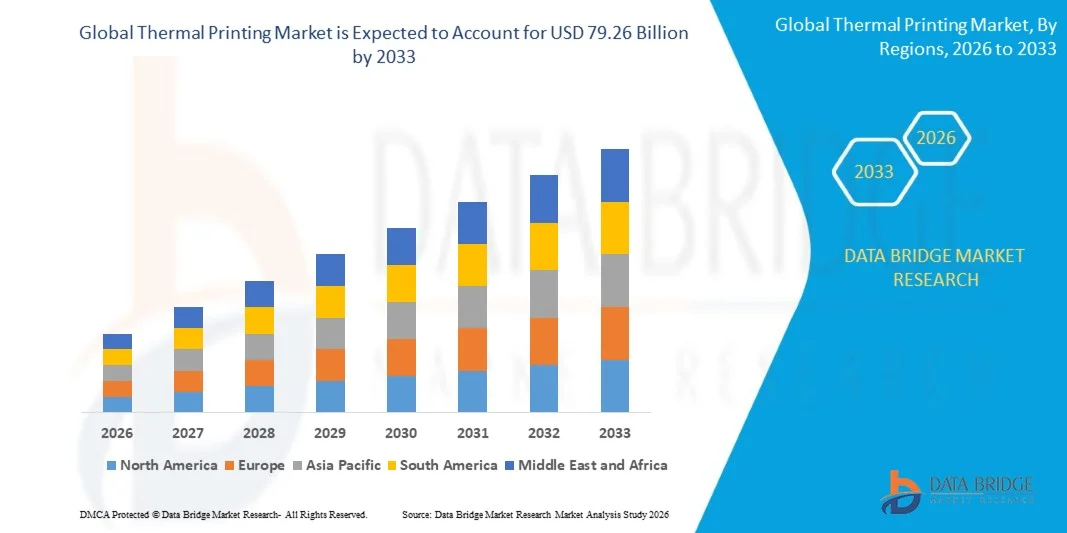
- The global thermal printing market size was valued at USD 52.12 billion in 2025 and is expected to reach USD 79.26 billion by 2033, at a CAGR of 5.38% during the forecast period
- The market growth is largely fueled by the increasing adoption of automated labeling, barcode, and receipt printing across retail, logistics, healthcare, and manufacturing sectors, driving demand for efficient and reliable thermal printing solutions
- Furthermore, rising business needs for high-speed, durable, and cost-effective printing solutions are establishing thermal printers as essential tools for inventory management, shipping, and point-of-sale operations. These converging factors are accelerating the deployment of thermal printing systems, thereby significantly boosting the industry’s growth
Thermal Printing Market Analysis
- Thermal printers are devices that use heat-sensitive technology to produce high-quality labels, barcodes, receipts, and tags on various media types. They are available in multiple configurations, including desktop, mobile, industrial, and POS models, catering to different operational scales and industry requirements
- The escalating demand for thermal printers is primarily driven by the need for accurate inventory tracking, faster transaction processing, compliance with labeling regulations, and integration with modern POS and logistics management systems. Growing e-commerce, retail expansion, and warehouse automation further propel the adoption of thermal printing technologies
- North America dominated the thermal printing market with a share of 36.3% in 2025, due to strong adoption in retail, logistics, and healthcare sectors
- Asia-Pacific is expected to be the fastest growing region in the thermal printing market during the forecast period due to rapid urbanization, rising industrialization, and increasing e-commerce penetration in countries such as China, Japan, and India
- Direct thermal printing segment dominated the market with a market share of 52.8% in 2025, due to its simplified printing process and lower maintenance requirements. Direct thermal printers do not require ink, toner, or ribbons, making them highly cost-effective for high-volume label and receipt printing operations. The segment also benefits from widespread adoption in retail and logistics, where quick, on-demand printing is critical for efficiency. Its compact design and compatibility with portable setups make it suitable for small and medium enterprises
Report Scope and Thermal Printing Market Segmentation
|
Attributes |
Thermal Printing Key Market Insights |
|
Segments Covered |
|
|
Countries Covered |
North America
Europe
Asia-Pacific
Middle East and Africa
South America
|
|
Key Market Players |
|
|
Market Opportunities |
|
|
Value Added Data Infosets |
In addition to the insights on market scenarios such as market value, growth rate, segmentation, geographical coverage, and major players, the market reports curated by the Data Bridge Market Research also include in-depth expert analysis, geographically represented company-wise production and capacity, network layouts of distributors and partners, detailed and updated price trend analysis and deficit analysis of supply chain and demand. |
Thermal Printing Market Trends
“Growing Adoption of Automated Labeling and Barcode Printing Solutions”
- A significant trend in the thermal printing market is the increasing deployment of automated labeling and barcode printing systems across retail, logistics, and manufacturing industries, driven by the need for operational efficiency, accuracy, and traceability. This trend is promoting faster workflow management and reducing manual errors in inventory tracking and product identification
- For instance, Zebra Technologies and Honeywell supply advanced thermal printers and automated labeling solutions that are widely implemented in warehouses and retail chains for real-time barcode printing. Such solutions enhance speed, accuracy, and scalability in high-volume operations
- The demand for mobile and on-demand printing is rising as businesses require portable thermal printers for field operations, delivery services, and point-of-sale environments. This is positioning thermal printing as a flexible solution for applications requiring immediate labeling and ticketing
- Retail and e-commerce sectors are increasingly integrating thermal printing for price tags, shipping labels, and inventory management, where applications such as self-checkout systems and automated packaging require consistent and durable prints. This adoption is driving innovation in high-resolution and fast-printing technologies
- Healthcare and pharmaceutical industries are employing thermal printing for patient wristbands, prescription labels, and laboratory sample tracking, where precision and compliance with safety standards are critical. This trend is accelerating the development of printers capable of handling variable media types with high reliability
- Logistics and supply chain companies are leveraging thermal printing to improve parcel tracking, shipment labeling, and RFID tagging, where integration with warehouse management software is crucial for operational efficiency. The growing use of thermal solutions is reinforcing automation and visibility across global supply chains
Thermal Printing Market Dynamics
Driver
“Rising Demand for High-Speed, Durable, and Cost-Effective Printing Systems”
- The rising need for fast, reliable, and cost-efficient printing systems across retail, logistics, and manufacturing is driving thermal printer adoption. These printers reduce operational delays and improve labeling accuracy in high-volume environments
- For instance, Epson and TSC Auto ID supply high-speed industrial and desktop thermal printers that cater to large-scale retail and warehousing operations. These systems enhance print durability, lower maintenance requirements, and reduce total cost of ownership
- Growing demand for thermal printers capable of handling various media formats, including labels, tags, and receipts, is fueling market growth. Versatile printers that operate under continuous production cycles are increasingly preferred in logistics and manufacturing
- The healthcare sector requires printers that deliver high-quality, smudge-free prints for compliance labeling and patient safety, which drives investment in durable and precise thermal printing systems
- Integration with automated software solutions and ERP systems is increasing printer adoption, as businesses aim to streamline workflows, minimize errors, and reduce manual intervention. This driver reinforces thermal printing as an essential technology for operational efficiency
Restraint/Challenge
“Fluctuating Raw Material Costs and Printer Component Supply Constraints”
- The thermal printing market faces challenges due to variability in the cost and availability of essential materials such as thermal paper, ribbons, and printhead components. These fluctuations can increase operational expenses for printer manufacturers and end-users
- For instance, SATO and Honeywell have experienced supply chain delays for critical printhead components, impacting production schedules and delivery timelines. Such constraints limit the ability of manufacturers to scale production efficiently and maintain cost predictability
- Dependence on specialized components, including precision motors, sensors, and electronics, increases manufacturing complexity and vulnerability to global supply disruptions
- High demand during peak seasons, such as e-commerce sales or logistics surges, places pressure on manufacturers to maintain adequate inventory while managing component shortages
- The market continues to grapple with balancing production capacity, component availability, and pricing stability, which collectively constrains growth and necessitates strategic supply chain management
Thermal Printing Market Scope
The market is segmented on the basis of technology, product type, application, and end-use industry.
• By Technology
On the basis of technology, the thermal printing market is segmented into direct thermal printing and thermal transfer printing. The direct thermal printing segment dominated the largest market revenue share of 52.8% in 2025, driven by its simplified printing process and lower maintenance requirements. Direct thermal printers do not require ink, toner, or ribbons, making them highly cost-effective for high-volume label and receipt printing operations. The segment also benefits from widespread adoption in retail and logistics, where quick, on-demand printing is critical for efficiency. Its compact design and compatibility with portable setups make it suitable for small and medium enterprises.
The thermal transfer printing segment is anticipated to witness the fastest growth rate from 2026 to 2033, fueled by increasing demand for durable and high-quality printed outputs. For instance, companies such as Zebra Technologies utilize thermal transfer printers for industrial-grade labeling that withstands harsh environmental conditions. Thermal transfer printers are preferred in manufacturing, healthcare, and transportation sectors where longevity and resistance to smudging or fading are essential. Their versatility in handling various media types further contributes to their rising adoption across professional applications.
• By Product Type
On the basis of product type, the thermal printing market is segmented into desktop printers, mobile printers, industrial printers, and POS printers. The desktop printers segment held the largest revenue share in 2025, driven by its affordability, compact footprint, and suitability for small office and retail environments. Desktop printers are commonly used for barcode and label printing in moderate volumes, offering ease of installation and integration into existing workflows. The segment’s popularity is enhanced by the availability of models supporting both direct thermal and thermal transfer technologies, meeting diverse user requirements.
The mobile printers segment is expected to witness the fastest CAGR from 2026 to 2033, fueled by growing demand for on-the-go printing solutions in logistics, field services, and retail operations. For instance, Epson’s mobile printer solutions are widely adopted for printing receipts and shipping labels directly at the point of service. Mobile printers provide convenience, portability, and battery-operated functionality, enabling businesses to reduce dependency on fixed printing stations while enhancing operational efficiency.
• By Application
On the basis of application, the thermal printing market is segmented into barcode and label printing, receipt printing, RFID tag printing & encoding, wristband printing, ticket printing, asset & inventory tagging, and shipping label printing. The barcode and label printing segment dominated the largest revenue share in 2025, driven by the need for efficient product tracking and inventory management across retail, logistics, and manufacturing sectors. Barcode labels enhance operational accuracy, reduce manual errors, and facilitate real-time data capture for supply chain optimization. The widespread adoption of retail POS systems and warehouse automation further strengthens the demand for barcode and label printing solutions.
The RFID tag printing & encoding segment is anticipated to witness the fastest growth rate from 2026 to 2033, driven by increasing adoption in smart retail, asset tracking, and contactless payment systems. For instance, Honeywell provides thermal RFID printers that enable encoding and printing in a single step, streamlining inventory and asset management processes. RFID-enabled thermal printing offers enhanced data security, faster scanning, and improved operational visibility, fueling its rapid uptake across multiple industries.
• By End-Use Industry
On the basis of end-use industry, the thermal printing market is segmented into retail, healthcare & hospitality, transportation & logistics, manufacturing, and government. The retail segment dominated the largest revenue share in 2025, driven by the extensive need for receipt printing, barcode labeling, and price tagging across stores and supermarkets. Retailers rely on thermal printing for fast, reliable, and cost-effective operations, supporting high customer throughput and seamless inventory management. The integration of POS systems and automated checkout processes also contributes to the segment’s leadership in the market.
The transportation & logistics segment is expected to witness the fastest CAGR from 2026 to 2033, fueled by growing demand for shipping labels, asset tracking, and warehouse automation solutions. For instance, FedEx and DHL utilize thermal printing technology to streamline label printing for parcels and packages. Thermal printers in this sector enhance operational efficiency, minimize labeling errors, and provide durable outputs that withstand shipping and handling conditions, making them critical for logistics operations.
Thermal Printing Market Regional Analysis
- North America dominated the thermal printing market with the largest revenue share of 36.3% in 2025, driven by strong adoption in retail, logistics, and healthcare sectors
- Businesses in the region prioritize efficiency, accuracy, and high-speed printing for barcodes, labels, and receipts, which supports widespread deployment of thermal printers
- This growth is further fueled by technologically advanced infrastructure, high disposable incomes, and the increasing preference for automated and connected printing solutions across enterprises
U.S. Thermal Printing Market Insight
The U.S. thermal printing market captured the largest revenue share within North America in 2025, driven by the adoption of modern POS systems, e-commerce fulfillment centers, and retail automation. Enterprises are increasingly leveraging mobile and industrial thermal printers to enhance operational efficiency, reduce labeling errors, and support real-time inventory tracking. The integration of thermal printing with cloud-based software solutions and IoT-enabled devices further accelerates market growth, catering to both small and large-scale businesses.
Europe Thermal Printing Market Insight
The Europe thermal printing market is projected to expand at a substantial CAGR during the forecast period, supported by rising demand in retail, manufacturing, and transportation sectors. Stringent labeling regulations, supply chain automation, and the need for durable printing outputs are encouraging adoption of both direct thermal and thermal transfer printers. European businesses also prioritize energy-efficient and eco-friendly printing solutions, contributing to steady market growth across industrial and commercial applications.
U.K. Thermal Printing Market Insight
The U.K. thermal printing market is expected to grow at a noteworthy CAGR during the forecast period, driven by the increasing use of thermal printers in retail outlets, logistics centers, and healthcare facilities. The country’s growing e-commerce sector and adoption of smart warehouse solutions are fueling demand for efficient labeling and receipt printing systems. Thermal printing solutions that integrate seamlessly with mobile and web-based platforms are particularly popular among enterprises seeking real-time operational visibility.
Germany Thermal Printing Market Insight
The Germany thermal printing market is anticipated to expand at a considerable CAGR, fueled by increasing demand for industrial-grade printing and high-quality labeling in manufacturing, healthcare, and logistics. German companies focus on automation and precision, making thermal printers a key tool for operational efficiency. Sustainability initiatives and the preference for reliable, long-lasting printing solutions further reinforce the adoption of thermal printing technologies in the region.
Asia-Pacific Thermal Printing Market Insight
The Asia-Pacific thermal printing market is poised to grow at the fastest CAGR during the forecast period, driven by rapid urbanization, rising industrialization, and increasing e-commerce penetration in countries such as China, Japan, and India. The region’s expanding retail and logistics sectors, coupled with demand for efficient inventory management and labeling solutions, are key growth drivers. Thermal printers are becoming increasingly accessible due to local manufacturing, competitive pricing, and government initiatives promoting digitalization across industries.
Japan Thermal Printing Market Insight
The Japan thermal printing market is gaining traction due to advanced technological adoption, high standards for operational efficiency, and growing use in retail, healthcare, and transportation sectors. Japanese enterprises emphasize precision and durability, boosting demand for both direct thermal and thermal transfer printers. Integration with IoT-enabled devices and automated systems enhances productivity and reduces errors, while aging population trends drive demand for easy-to-use printing solutions in commercial and healthcare applications.
China Thermal Printing Market Insight
The China thermal printing market accounted for the largest revenue share in Asia-Pacific in 2025, supported by rapid urbanization, expanding retail chains, and growth in e-commerce logistics. Thermal printers are widely adopted for barcode, label, and shipping applications due to their reliability, low maintenance, and cost-effectiveness. Domestic manufacturing of thermal printing systems, government digitalization initiatives, and increasing consumer awareness of automated solutions are key factors propelling the market in China.
Thermal Printing Market Share
The thermal printing industry is primarily led by well-established companies, including:
- Zebra Technologies Corporation (U.S.)
- Honeywell International Inc. (U.S.)
- Seiko Epson Corporation (Japan)
- TSC Auto ID Technology Co., Ltd. (Taiwan)
- Bixolon Co., Ltd. (South Korea)
- Sato Holdings Corporation (Japan)
- Brother Industries, Ltd. (Japan)
- GoDEX International Co., Ltd. (Taiwan)
- Citizen Systems Japan Co., Ltd. (Japan)
- Toshiba TEC Corporation (Japan)
- Fujitsu Limited (Japan)
- TransAct Technologies Incorporated (U.S.)
- Printronix Auto ID Inc. (U.S.)
- Posiflex Technology Inc. (Taiwan)
- Avery Dennison Corporation (U.S.)
Latest Developments in Global Thermal Printing Market
- In April 2025, Source Technologies announced the acquisition of AMT Datasouth’s printer assets, significantly strengthening its position in the thermal printing industry. This strategic acquisition allows Source Technologies to expand its portfolio across label, barcode, and receipt printing solutions, catering to a wide range of commercial and industrial applications. By integrating AMT Datasouth’s technologies, Source Technologies can offer enhanced performance, reliability, and a broader product range to meet evolving market demands. The move also positions the company to better serve retail, logistics, and manufacturing clients seeking efficient and durable thermal printing solutions
- In March 2025, Distribution Management (DM) expanded its product offerings by incorporating Brother’s thermal desktop and industrial printers into its portfolio. This partnership strengthens DM’s capabilities in thermal printing, mobile, and labeling solutions while aligning with Brother’s growth strategy. By leveraging DM’s extensive reseller network, Brother can extend its reach across multiple sectors, including state and local government, healthcare, and retail. The collaboration ensures broader accessibility of high-performance thermal printers and enhances the companies’ ability to provide integrated solutions for businesses requiring reliable printing, tracking, and labeling systems
- In October 2024, Munbyn introduced two new label printers specifically designed for small and medium-sized businesses. The Realwriter RW402 addresses operational challenges such as paper waste and downtime, incorporating advanced mechanisms that reduce paper jams to under 0.01%. Meanwhile, the Munbyn FM226 offers portable, battery-powered printing, making it ideal for entrepreneurs and mobile applications that require on-the-go custom labeling. These launches reflect Munbyn’s focus on enhancing efficiency, print quality, and convenience for businesses seeking reliable, high-performance thermal printing solutions for everyday operations
- In April 2024, Kite Packaging launched an expanded range of thermal labels and printers, including both direct thermal and thermal transfer options. The new portfolio features desktop and mobile printers from well-known brands alongside Kite’s own entry-level models, catering to different business sizes and operational needs. This initiative enables companies to access a variety of cost-effective and efficient thermal printing solutions for labeling, shipping, and inventory management. By offering flexible options, Kite Packaging aims to support businesses in streamlining their printing processes while improving productivity and operational efficiency
- In January 2024, Munbyn launched the RW401AP wireless label printer, targeting small and medium-sized businesses that require high-quality, reliable printing. The printer features 300dpi resolution, ensuring sharper images and clearer logistics labels for inventory, shipping, and product identification. Its wireless capabilities allow for flexible placement and seamless integration with existing business systems, improving workflow efficiency. This launch reinforces Munbyn’s commitment to providing accessible, high-performance printing solutions tailored to the needs of growing businesses, enhancing productivity and operational accuracy

- Interactive Data Analysis Dashboard
- Company Analysis Dashboard for high growth potential opportunities
- Research Analyst Access for customization & queries
- Competitor Analysis with Interactive dashboard
- Latest News, Updates & Trend analysis
- Harness the Power of Benchmark Analysis for Comprehensive Competitor Tracking
Global Thermal Printing Market, Supply Chain Analysis and Ecosystem Framework
To support market growth and help clients navigate the impact of geopolitical shifts, DBMR has integrated in-depth supply chain analysis into its Global Thermal Printing Market research reports. This addition empowers clients to respond effectively to global changes affecting their industries. The supply chain analysis section includes detailed insights such as Global Thermal Printing Market consumption and production by country, price trend analysis, the impact of tariffs and geopolitical developments, and import and export trends by country and HSN code. It also highlights major suppliers with data on production capacity and company profiles, as well as key importers and exporters. In addition to research, DBMR offers specialized supply chain consulting services backed by over a decade of experience, providing solutions like supplier discovery, supplier risk assessment, price trend analysis, impact evaluation of inflation and trade route changes, and comprehensive market trend analysis.
Data collection and base year analysis are done using data collection modules with large sample sizes. The stage includes obtaining market information or related data through various sources and strategies. It includes examining and planning all the data acquired from the past in advance. It likewise envelops the examination of information inconsistencies seen across different information sources. The market data is analysed and estimated using market statistical and coherent models. Also, market share analysis and key trend analysis are the major success factors in the market report. To know more, please request an analyst call or drop down your inquiry.
The key research methodology used by DBMR research team is data triangulation which involves data mining, analysis of the impact of data variables on the market and primary (industry expert) validation. Data models include Vendor Positioning Grid, Market Time Line Analysis, Market Overview and Guide, Company Positioning Grid, Patent Analysis, Pricing Analysis, Company Market Share Analysis, Standards of Measurement, Global versus Regional and Vendor Share Analysis. To know more about the research methodology, drop in an inquiry to speak to our industry experts.
Data Bridge Market Research is a leader in advanced formative research. We take pride in servicing our existing and new customers with data and analysis that match and suits their goal. The report can be customized to include price trend analysis of target brands understanding the market for additional countries (ask for the list of countries), clinical trial results data, literature review, refurbished market and product base analysis. Market analysis of target competitors can be analyzed from technology-based analysis to market portfolio strategies. We can add as many competitors that you require data about in the format and data style you are looking for. Our team of analysts can also provide you data in crude raw excel files pivot tables (Fact book) or can assist you in creating presentations from the data sets available in the report.













