


Thermistor Market Overview
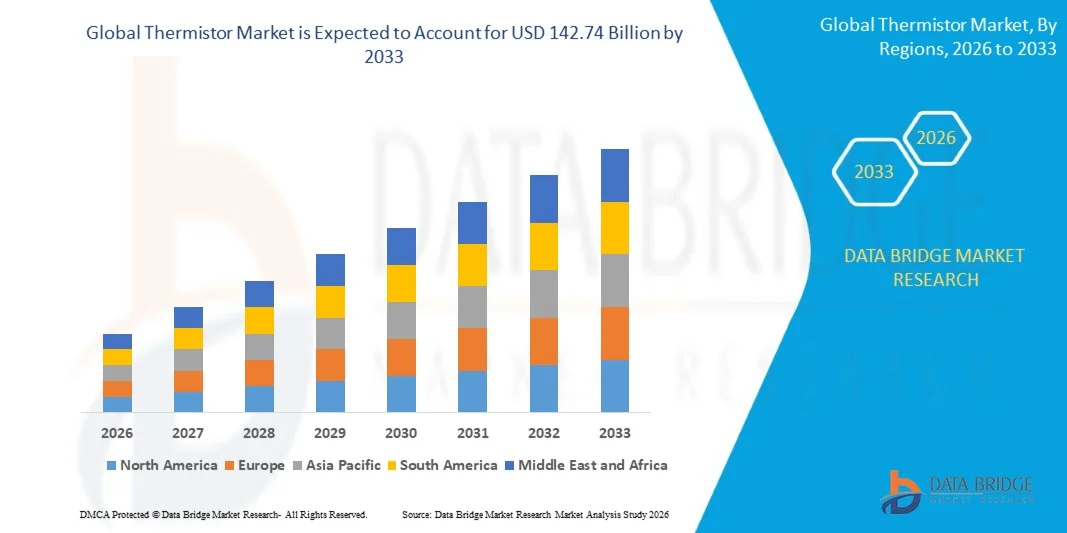
As per Data Bridge Market Research Analysis the thermistor market was valued at USD 100.83 billion in 2025 and is projected to reach USD 142.74 billion by 2033, growing at a CAGR of 4.44% from 2026 to 2033. The market is experiencing consistent growth driven by rising demand for precise and reliable temperature sensing solutions, rapid advancements in thermistor miniaturization and material technologies, and expanding applications across automotive electronics, healthcare diagnostics, industrial process control, energy and power management, and chemical and petrochemical processing verticals.
The increasing complexity of modern electronic systems globally, combined with stricter government and industry regulations on thermal management, energy efficiency, and equipment safety monitoring, is compelling automotive OEMs, industrial operators, healthcare device manufacturers, and power electronics companies to adopt advanced thermistor-based temperature sensing and control technologies. Negative Temperature Coefficient (NTC) thermistors are progressively replacing traditional temperature sensing instruments in many markets, offering cost-effective, highly sensitive, and compact solutions for temperature monitoring, temperature control, motor drives, power supplies, and heat-sink thermal management applications across both industrial and non-industrial verticals.
Market Size & Forecast
- Global Market Value (2025): USD 100.83 Billion
- Expected Market Value (2033): USD 142.74 Billion
- Forecast CAGR (2026–2033): 4.44%
- Leading Region in 2025: Asia-Pacific
- Fastest Growing Region: Middle East
Key Market Trends & Insights
- Asia-Pacific dominated the Global Thermistor Market with the largest revenue share of 46.08% in 2025, supported by the region's massive electronics manufacturing base, strong automotive production ecosystem, rapid industrialization, and the presence of leading thermistor manufacturers across China, Japan, South Korea, and India driving high-volume NTC and PTC thermistor production and adoption across temperature monitoring and industrial electronics applications.
- Middle East is also expected to be the fastest-growing region, projected to register the highest CAGR of 6.98% during the forecast period of 2026 to 2033, fueled by rapid expansion of electric vehicle production, growing investments in smart manufacturing and industrial IoT infrastructure, increasing healthcare device adoption, and rising deployment of thermistors in energy and power management systems .
- The negative temperature coefficient (NTC) segment dominated the Type category with the largest revenue share in 2025, driven by its superior sensitivity, wide operating temperature range, compact form factor, and cost-effectiveness, making it the most widely deployed thermistor type across temperature monitoring, temperature control, automotive electronics, healthcare diagnostics, and power supply thermal management applications globally.
- The positive temperature coefficient (PTC) segment is the fastest-growing type, projected to register a strong CAGR through the forecast period, driven by surging demand for PTC thermistors in motor drives, overcurrent protection circuits, self-regulating heating elements, and automotive battery thermal management systems — particularly in the rapidly expanding electric vehicle market.
- The temperature monitoring application segment dominated the Application category with the largest revenue share in 2025, supported by widespread deployment of NTC thermistors across industrial process monitoring, healthcare patient temperature surveillance, automotive powertrain thermal management, and food and beverage cold chain monitoring applications requiring continuous, accurate, and real-time temperature sensing.
- The automotive industry vertical dominated the Industry Vertical category in 2025, driven by the accelerating adoption of thermistors across electric vehicle battery management systems, powertrain thermal control, HVAC systems, and motor drive temperature protection circuits. The NTC thermistors market is forecasted to reach USD 913.41 million in 2026 and achieve USD 1,323.56 million by 2035 at a CAGR of 13.16%, with automotive electrification serving as the primary growth catalyst.
- The healthcare industry vertical is the fastest-growing end-use segment, projected to register the highest CAGR through the forecast period, driven by increasing integration of NTC thermistors into medical-grade temperature monitoring devices, patient wearable health sensors, diagnostic equipment, and pharmaceutical cold chain management systems requiring high-accuracy, miniaturized, and biocompatible temperature sensing solutions.
- The temperature control application segment is the fastest-growing application category, projected to register the highest CAGR from 2026 to 2033, driven by accelerating adoption of thermistor-based closed-loop thermal control systems across power supplies, converters, heat-sink thermal management platforms, and electric vehicle battery management systems requiring precise, real-time temperature regulation to ensure operational safety and energy efficiency.
Report Scope and Thermistor Market Segmentation
|
Attributes |
Thermistor Key Market Insights |
|
Segments Covered |
|
|
Countries Covered |
North America · U.S. · Canada · Mexico Europe · Germany · France · U.K. · Netherlands · Switzerland · Belgium · Russia · Italy · Spain · Turkey · Rest of Europe Asia-Pacific · China · Japan · India · South Korea · Singapore · Malaysia · Australia · Thailand · Indonesia · Philippines · Rest of Asia-Pacific Middle East and Africa · Saudi Arabia · U.A.E. · South Africa · Egypt · Israel · Rest of Middle East and Africa South America · Brazil · Argentina · Rest of South America |
|
Key Market Players |
· Murata Manufacturing Co., Ltd. (Japan) · TDK Corporation (Japan) · Vishay Intertechnology, Inc. (U.S.) · TE Connectivity plc (Ireland) · Honeywell International Inc. (U.S.) · Panasonic Holdings Corporation (Japan) · Amphenol Corporation (U.S.) · Mitsubishi Materials Corporation (Japan) Semitec Corporation (Japan) · Littelfuse, Inc. (U.S.) · TDK Electronics AG (Germany) (Formerly EPCOS AG) · Thinking Electronic Industrial Co., Ltd. (Taiwan) · Shibaura Electronics Co., Ltd. (Japan) · Bourns, Inc. (U.S.) · Omega Engineering, Inc. (U.S.) · Exsense Electronics Technology Co., Ltd. (China) · Cantherm (Canada) · BetaTHERM, Inc. (Ireland) · Focusens Technology Co., Ltd. (China) Thermosen Technology Co., Ltd. (China) CTS Corporation (USA) |
|
Market Opportunities |
· Expansion into EV Battery Thermal Management Systems · Integration into Industrial IoT and Smart Manufacturing Platforms · Growth in Healthcare Wearables and Medical-Grade Temperature Sensing. |
|
Value Added Data Infosets |
In addition to the insights on market scenarios such as market value, growth rate, segmentation, geographical coverage, and major players, the market reports curated by the Data Bridge Market Research also include in-depth expert analysis, geographically represented company-wise production and capacity, network layouts of distributors and partners, detailed and updated price trend analysis and deficit analysis of supply chain and demand. |
Thermistor Market Trends
Trend: Growth in IoT-Enabled Smart Temperature Sensing and Miniaturization
Prof Industrial operators, automotive OEMs, healthcare device manufacturers, and energy management companies are increasingly adopting advanced thermistor-based temperature sensing platforms to transition from conventional bulky sensing instruments to miniaturized, highly sensitive, and IoT-integrated NTC and PTC thermistor solutions. The integration of chip NTC thermistors into smart connected devices, wearable health monitors, EV battery management systems, and industrial IoT networks is enabling precise, real-time temperature monitoring and control across distributed asset ecosystems. The chip NTC thermistor market alone was valued at USD 1.82 billion in 2025 and is projected to reach USD 3.41 billion by 2034 at a CAGR of 7.2%, reflecting the accelerating pace of miniaturization and IoT-driven thermistor adoption across temperature control, industrial electronics, and motor drive applications. Automotive-grade SMD NTC thermistors are similarly scaling rapidly, with the segment valued at USD 1,023 million in 2025 and projected to reach USD 2,500 million by 2035 at a CAGR of 9.3%, driven by the surge in EV production, stricter automotive safety standards, and expanding electronic content per vehicle.
Thermistor Market Dynamics
Key Market Driver: Rising Demand for Precision Temperature Management in Automotive and EV Battery Systems
The rapid electrification of the global automotive industry and the accelerating development of Electric Vehicles (EVs) and Advanced Driver Assistance Systems (ADAS) has created substantial demand for high-precision NTC and PTC thermistors capable of continuous, accurate thermal monitoring across battery packs, motor drives, power supplies, and converters. Automotive OEMs, Tier-1 suppliers, and EV battery manufacturers are deploying thermistors as a core component of their Battery Management Systems (BMS), thermal runaway prevention circuits, and powertrain thermal control architectures. The global automotive NTC thermistor market was estimated at USD 130.76 million in 2025 and is expected to reach USD 161.52 million by 2034 at a CAGR of 2.4% for standard automotive NTC variants, while the broader automotive-grade SMD NTC thermistor segment is growing at a significantly higher CAGR of 9.3% through 2035, reflecting the deepening integration of thermistors into next-generation EV and hybrid vehicle platforms. The Asia-Pacific automotive NTC thermistor market is projected to grow at a CAGR of 7–9% through 2030, driven by EV adoption, stricter safety standards, and increasing electronic content per vehicle across China, Japan, South Korea, and India.
Key Restraint/Challenge: Sensitivity to Environmental Conditions and Self-Heating Errors
A significant restraint in the global thermistor market is the inherent susceptibility of thermistors — particularly NTC variants — to self-heating errors, non-linear resistance-temperature characteristics, and performance degradation under extreme environmental conditions including high humidity, chemical exposure, and mechanical vibration. The non-linear output of NTC thermistors necessitates complex signal conditioning and linearization circuitry, increasing system design complexity and cost for precision industrial, chemical and petrochemical, and oil and gas applications. Additionally, the limited operating temperature range of standard thermistors compared to competing technologies such as RTDs and thermocouples constrains their adoption in high-temperature industrial process environments within the chemical and petrochemical and oil and gas verticals. The global temperature sensor market, valued at USD 7.43 billion in 2025 and projected to reach USD 8.94 billion by 2030 at a CAGR of 3.8%, reflects the competitive multi-technology landscape in which thermistors must continuously demonstrate performance and cost advantages to maintain and expand their market position.
Key Market Opportunity: Integration of Thermistors in Healthcare Diagnostics and Wearable Medical Devices
The convergence of miniaturized NTC thermistor technology with wearable health monitoring platforms, implantable medical devices, and point-of-care diagnostic instruments presents a significant market opportunity. AI-enabled health monitoring platforms can leverage the high sensitivity of NTC thermistors — capable of detecting temperature changes as small as 0.001°C — to provide continuous, real-time patient temperature surveillance, early fever detection, and pharmaceutical cold chain integrity monitoring. The development of biocompatible, ultra-miniaturized thermistor packages and cloud-connected temperature logging platforms is further democratizing access to advanced medical-grade temperature sensing, opening growth opportunities across cost-sensitive healthcare markets in Asia-Pacific, Latin America, and the Middle East. The global temperature sensor market is projected to reach USD 12.23 billion by 2034 at a CAGR of 5.11%, with healthcare and medical device applications representing one of the fastest-growing end-use verticals driving thermistor demand.
Thermistor Market Scope
The thermistor market is segmented on the basis of type, application, and industry vertical.
- By Type
On the basis of type, the global thermistor market is segmented into positive temperature coefficient (PTC), negative temperature coefficient (NTC), and thin film RTD. The negative temperature coefficient (NTC) segment dominated the market with the largest revenue share in 2025, owing to its superior temperature sensitivity, wide operating range, compact form factor, and cost-effectiveness, making it the most widely deployed thermistor type across temperature monitoring, temperature control, automotive electronics, healthcare diagnostics, heat-sink thermal management, and power supply applications globally. NTC thermistors exhibit high resistance at low temperatures that decreases predictably with rising temperature, enabling precise closed-loop thermal control in motor drives, converters, and battery management systems. The NTC thermistors market is forecasted to be worth USD 913.41 million in 2026 and is expected to achieve USD 1,323.56 million by 2035 at a CAGR of 13.16%, reflecting the dominant and accelerating adoption of NTC thermistors across both industrial and consumer end-use verticals.
The positive temperature coefficient (PTC) segment is projected to register the fastest growth at a strong CAGR through the forecast period, driven by surging demand for PTC thermistors in self-regulating heating elements, overcurrent and overtemperature protection circuits, motor drive thermal protection, and automotive battery thermal management systems. The inherent self-resetting overcurrent protection capability of PTC thermistors is making them indispensable across power supplies, converters, and industrial electronics applications, particularly as EV production scales globally and the need for reliable, maintenance-free thermal protection components intensifies across automotive and energy and power verticals.
- By Application
On the basis of application, the global thermistor market is segmented into temperature control, temperature monitoring, industrial electronics, motor drives, power supplies, converters, heat-sink, and others. The temperature monitoring segment dominated the market with the largest revenue share in 2025, supported by widespread deployment of NTC thermistors across industrial process monitoring, healthcare patient temperature surveillance, automotive powertrain thermal management, food and beverage cold chain monitoring, and oil and gas pipeline temperature tracking applications requiring continuous, accurate, and real-time temperature sensing. The broad applicability of thermistor-based temperature monitoring across virtually every industry vertical — from chemical and petrochemical processing to pharmaceutical cold chain management — reinforces the segment's leading position in the global thermistor market.
The temperature control segment is projected to register the fastest growth at the highest CAGR from 2026 to 2033, driven by accelerating adoption of thermistor-based closed-loop thermal control systems across power supplies, converters, heat-sink thermal management platforms, and electric vehicle battery management systems. The growing complexity of power electronics in EV drivetrains, industrial motor drives, and renewable energy converters is compelling engineers to deploy high-sensitivity NTC thermistors for precise, real-time temperature regulation to ensure operational safety, energy efficiency, and component longevity. The global temperature sensor market's projected growth to USD 8.94 billion by 2030 at a CAGR of 3.8% underscores the expanding demand for precision temperature control solutions across industrial and automotive applications.
- By Industry Vertical
On the basis of industry vertical, the global thermistor market is segmented into chemical and petrochemical, oil and gas, energy and power, automotive, food and beverages, healthcare, and others. The automotive segment dominated the market with the largest revenue share in 2025, driven by the accelerating adoption of NTC and PTC thermistors across electric vehicle battery management systems, powertrain thermal control, HVAC systems, motor drive temperature protection circuits, and power supply thermal management platforms. The automotive-grade SMD NTC thermistor segment, valued at USD 1,023 million in 2025 and projected to reach USD 2,500 million by 2035 at a CAGR of 9.3%, exemplifies the scale and pace of thermistor adoption within the automotive vertical, underpinned by global EV production ramp-ups, stricter automotive safety and thermal management regulations, and the increasing electronic content per vehicle across passenger and commercial vehicle platforms.
The healthcare segment is expected to witness the fastest growth at the highest CAGR from 2026 to 2033, driven by increasing integration of miniaturized NTC thermistors into medical-grade wearable health monitors, patient temperature surveillance systems, diagnostic equipment, infusion pump thermal management, and pharmaceutical cold chain monitoring platforms. The high sensitivity of NTC thermistors — capable of detecting temperature variations as small as 0.001°C — makes them uniquely suited for precision medical diagnostics and patient safety applications. The global temperature sensor market, projected to reach USD 12.23 billion by 2034 at a CAGR of 5.11%, reflects the broad-based growth in healthcare and medical device temperature sensing demand that is directly benefiting thermistor manufacturers and solution providers.
Thermistor Market Regional Analysis
Asia-Pacific dominated the thermistor market and accounted for the largest revenue share of 46.08% in 2025, supported by the region's massive electronics manufacturing base, strong automotive production ecosystem, rapid industrialization, and the presence of leading thermistor manufacturers across China, Japan, South Korea, and India driving high-volume NTC and PTC thermistor production. The region also benefits from accelerating EV adoption, rising government investments in smart manufacturing and industrial IoT infrastructure, stringent industrial safety and process monitoring regulations, and growing deployment of thermistors across automotive battery management systems, healthcare diagnostics, food and beverage cold chain monitoring, and energy and power management applications. Increasing focus on precision temperature control in EV drivetrains, industrial motor drives, and renewable energy converters continues to strengthen Asia-Pacific's leadership position in the global thermistor market.
U.K. Thermistor Market Insight
The U.K. thermistor market is experiencing steady growth, supported by rising adoption of thermistor-based temperature sensing technologies across industrial electronics, healthcare diagnostics, energy and power management, and food and beverage processing applications. Increasing investments in EV manufacturing infrastructure — including Jaguar Land Rover's electrification programs and the UK government's commitment to banning new petrol and diesel vehicle sales — are driving demand for automotive-grade NTC and PTC thermistors in battery management and powertrain thermal control systems. Furthermore, integration of thermistors into IIoT-connected smart factory platforms, pharmaceutical cold chain monitoring systems, and wearable health monitoring devices is improving temperature sensing accuracy and operational efficiency, positioning the U.K. as a key innovation hub in the European thermistor industry. The global temperature sensor market, valued at USD 7.93 billion in 2025 and projected to exceed USD 12.43 billion by the forecast period at a CAGR of 4.6%, reflects the expanding addressable market for thermistor-based sensing solutions across U.K. industrial and commercial verticals.
Germany Thermistor Market Insight
The Germany thermistor market is expanding steadily due to the country's strong automotive manufacturing base — home to BMW, Mercedes-Benz, Volkswagen, Bosch, and Continental — advanced industrial automation capabilities, and increasing adoption of NTC and PTC thermistors across EV battery management systems, industrial motor drives, power supplies, and chemical and petrochemical process monitoring applications. Automotive companies, industrial electronics manufacturers, and energy and power operators are increasingly utilizing thermistors for precise thermal management, overcurrent protection, and process safety monitoring. Continuous advancements in thin film RTD and chip NTC thermistor technologies, combined with Germany's strong focus on Industry 4.0, energy transition (Energiewende), and automotive electrification, are further driving thermistor market growth.
U.S. Thermistor Market Insight
The U.S. thermistor market is witnessing strong growth due to rising investments in EV production, industrial automation, healthcare device manufacturing, and energy and power infrastructure modernization. The country's mature automotive and electronics ecosystem, along with increasing adoption of NTC thermistors in EV battery management systems, medical-grade wearable health monitors, oil and gas pipeline temperature monitoring, and IIoT-connected smart manufacturing platforms, is driving demand across commercial, industrial, and healthcare applications. In addition, growing emphasis on industrial process safety, energy efficiency compliance, and predictive maintenance in chemical and petrochemical and oil and gas verticals is accelerating thermistor adoption across manufacturing and process industries. The NTC thermistors market is forecasted to reach USD 913.41 million in 2026 and achieve USD 1,323.56 million by 2035 at a CAGR of 13.16%, with North America — led by the U.S. — representing a key high-value regional market driven by advanced industrial and healthcare end-use demand.
Europe Thermistor Market Insight
The Europe thermistor market is expected to witness rapid growth, driven by the region's accelerating automotive electrification programs, expanding renewable energy infrastructure, stringent industrial safety and environmental regulations, and rising adoption of thermistors across chemical and petrochemical, oil and gas, energy and power, and food and beverage processing verticals. Growing awareness regarding precision temperature management, rising deployment of NTC and PTC thermistors in EV battery systems and industrial motor drives, and increasing demand for scalable and cost-effective temperature sensing solutions are supporting regional market expansion. Additionally, the growing presence of automotive R&D centres, pharmaceutical manufacturing facilities, and smart grid energy management infrastructure across Germany, France, Italy, and the Netherlands is accelerating thermistor adoption across industrial and commercial sectors. The Middle East region records the highest forecast growth at a CAGR of 6.98% through 2031, while Europe maintains a strong revenue position driven by its advanced industrial and automotive manufacturing base.
Japan Thermistor Market Insight
The Japan thermistor market is witnessing consistent growth due to the country's position as a global leader in precision electronics manufacturing, advanced automotive technology, and high-reliability component production. Japan-headquartered thermistor manufacturers — including Murata Manufacturing, TDK Corporation, Panasonic Corporation, Semitec Corporation, and Shibaura Electronics — collectively account for a dominant share of global NTC and PTC thermistor production capacity, reinforcing Japan's strategic importance in the global thermistor supply chain. The Japan Thin Film NTC Thermistor Market alone was valued at USD 0.9 billion in 2024 and is projected to grow from USD 0.95 billion in 2025 to USD 1.4 billion through the forecast period, reflecting the country's deep-rooted expertise in thermistor miniaturization, material science, and precision manufacturing. Automotive manufacturers, industrial electronics companies, and healthcare device producers are increasingly adopting high-precision NTC and PTC thermistors for EV battery thermal management, motor drive overcurrent protection, power supply thermal control, and medical-grade wearable temperature monitoring applications. Moreover, Japan's national focus on carbon neutrality by 2050, accelerating EV adoption, and advanced robotics and industrial automation ecosystems are further driving thermistor demand across automotive, energy and power, and industrial electronics verticals, positioning Japan as one of the most technologically advanced and high-value national markets within the global thermistor industry.
China Thermistor Market Insight
The China thermistor market is growing rapidly, driven by the country's position as the world's largest electric vehicle producer, the largest consumer electronics manufacturing hub, and a rapidly expanding industrial automation and smart manufacturing ecosystem. China's EV sales surpassed 9.5 million units in 2024 and are projected to exceed 15 million units annually by 2027, creating an enormous and sustained demand for automotive-grade NTC and PTC thermistors across battery management systems, powertrain thermal control, motor drives, and power supply thermal protection circuits. The chip NTC thermistor market — of which China is the dominant production and consumption center — was valued at USD 1.82 billion in 2025 and is projected to reach USD 3.41 billion by 2034 at a CAGR of 7.2%, reflecting the scale and pace of China-driven thermistor demand growth. Rising government investments in industrial IoT infrastructure, smart factory modernization under the "Made in China 2025" initiative, and expanding chemical and petrochemical and energy and power sector deployments are further accelerating thermistor adoption across industrial process monitoring, temperature control, and heat-sink thermal management applications. In addition, the rapid growth of China's healthcare sector, increasing deployment of thermistors in food and beverage cold chain monitoring, and the presence of major domestic thermistor manufacturers including Exsense Electronics, Focusens Technology, and Thermosen Technology are positioning China as the single largest and fastest-growing national market for thermistors globally, with the broader global thermistor market projected to grow from USD 672 million in 2024 to USD 919.67 million by 2032 at a CAGR of 4.0%.
Thermistor Market Share
The thermistor industry is primarily led by well-established companies, including:
- Murata Manufacturing Co., Ltd. (Japan)
- TDK Corporation (Japan)
- CTS Corporation(US)
- Vishay Intertechnology, Inc. (U.S.)
- TE Connectivity Ltd. (Switzerland)
- Honeywell International Inc. (U.S.)
- Panasonic Corporation (Japan)
- Amphenol Corporation (U.S.)
- Mitsubishi Materials Corporation (Japan)
- Semitec Corporation (Japan)
- Littelfuse, Inc. (U.S.)
- EPCOS AG (TDK Group) (Germany)
- Thinking Electronic Industrial Co., Ltd. (Taiwan)
- Shibaura Electronics Co., Ltd. (Japan)
- Bourns, Inc. (U.S.)
- Omega Engineering, Inc. (Spectris plc) (U.S.)
- Exsense Electronics Technology Co., Ltd. (China)
- Cantherm (Thermometrics) (Canada)
- BETA THERM Corporation (Ireland)
- Focusens Technology Co., Ltd. (China)
- Thermosen Technology Co., Ltd. (China)
Latest Developments in Market
- In July 2026, Vishay Intertechnology, Inc. launched six new surface-mount polymer positive temperature coefficient (PPTC) thermistor series (ranging from PPTC0603E3 to PPTC2920E3). Engineered for resettable overcurrent protection in low-voltage circuits, these components feature ultra-fast trip times down to 50 milliseconds and ultra-low resistance to reduce voltage drops. This launch directly targets the growing need for space-saving, highly efficient thermal management in industrial automation systems, Power over Ethernet (PoE) equipment, and battery-powered tools.
- In June 2026, CTS Corporation unveiled the TSX Crystal with Integrated Thermistor, marking the company's first crystal product to embed a thermistor directly within the package. This integration provides real-time temperature feedback directly at the crystal element, improving frequency compensation and reducing overall board-level complexity. The development is specifically designed to address severe thermal management and cooling challenges in high-density data center infrastructure and network synchronization systems.
- In May 2026, Murata Manufacturing Co., Ltd. commenced construction of a new, dedicated thermistor production facility at its Yokaichi Plant in Shiga, Japan. Representing a major capital investment of approximately 16.9 billion yen, this five-story facility is a strategic capacity expansion. It is designed to secure Murata's supply chain against the surging medium-to-long-term global demand for temperature sensing components driven by the rapid growth of the electric vehicle (EV), renewable energy, and power-dense industrial equipment sectors.
- In February 2026, TDK Corporation expanded its NTCSP series of NTC thermistors, raising the maximum operating temperature rating from +150°C to +175°C. The AEC-Q200 compliant (automotive grade) components utilize silver-palladium (AgPd) terminals designed specifically for conductive-glue mounting rather than traditional soldering. This development is critical for modern automotive architectures, allowing for highly reliable temperature monitoring of next-generation, high-heat power semiconductors used in anti-lock braking systems (ABS), transmissions, and EV engines.
- In January 2025, Vishay Intertechnology, Inc. introduced the PTCES series of insulated, surface-mount inrush current limiting PTC thermistors. Delivering up to 260% higher energy handling capabilities (up to 340 Joules) and 20% higher maximum voltages (up to 1200 VDC) than competing devices, the series allows hardware engineers to use fewer components per circuit. The AEC-Q200 qualified thermistors are engineered to improve board-level efficiency and lower production costs for high-load applications like EV on-board chargers (OBC), DC/DC converters, and motor drives.

- Interactive Data Analysis Dashboard
- Company Analysis Dashboard for high growth potential opportunities
- Research Analyst Access for customization & queries
- Competitor Analysis with Interactive dashboard
- Latest News, Updates & Trend analysis
- Harness the Power of Benchmark Analysis for Comprehensive Competitor Tracking
Global Thermistor Market, Supply Chain Analysis and Ecosystem Framework
To support market growth and help clients navigate the impact of geopolitical shifts, DBMR has integrated in-depth supply chain analysis into its Global Thermistor Market research reports. This addition empowers clients to respond effectively to global changes affecting their industries. The supply chain analysis section includes detailed insights such as Global Thermistor Market consumption and production by country, price trend analysis, the impact of tariffs and geopolitical developments, and import and export trends by country and HSN code. It also highlights major suppliers with data on production capacity and company profiles, as well as key importers and exporters. In addition to research, DBMR offers specialized supply chain consulting services backed by over a decade of experience, providing solutions like supplier discovery, supplier risk assessment, price trend analysis, impact evaluation of inflation and trade route changes, and comprehensive market trend analysis.
Data collection and base year analysis are done using data collection modules with large sample sizes. The stage includes obtaining market information or related data through various sources and strategies. It includes examining and planning all the data acquired from the past in advance. It likewise envelops the examination of information inconsistencies seen across different information sources. The market data is analysed and estimated using market statistical and coherent models. Also, market share analysis and key trend analysis are the major success factors in the market report. To know more, please request an analyst call or drop down your inquiry.
The key research methodology used by DBMR research team is data triangulation which involves data mining, analysis of the impact of data variables on the market and primary (industry expert) validation. Data models include Vendor Positioning Grid, Market Time Line Analysis, Market Overview and Guide, Company Positioning Grid, Patent Analysis, Pricing Analysis, Company Market Share Analysis, Standards of Measurement, Global versus Regional and Vendor Share Analysis. To know more about the research methodology, drop in an inquiry to speak to our industry experts.
Data Bridge Market Research is a leader in advanced formative research. We take pride in servicing our existing and new customers with data and analysis that match and suits their goal. The report can be customized to include price trend analysis of target brands understanding the market for additional countries (ask for the list of countries), clinical trial results data, literature review, refurbished market and product base analysis. Market analysis of target competitors can be analyzed from technology-based analysis to market portfolio strategies. We can add as many competitors that you require data about in the format and data style you are looking for. Our team of analysts can also provide you data in crude raw excel files pivot tables (Fact book) or can assist you in creating presentations from the data sets available in the report.













