Thermochromic Materials Market Size
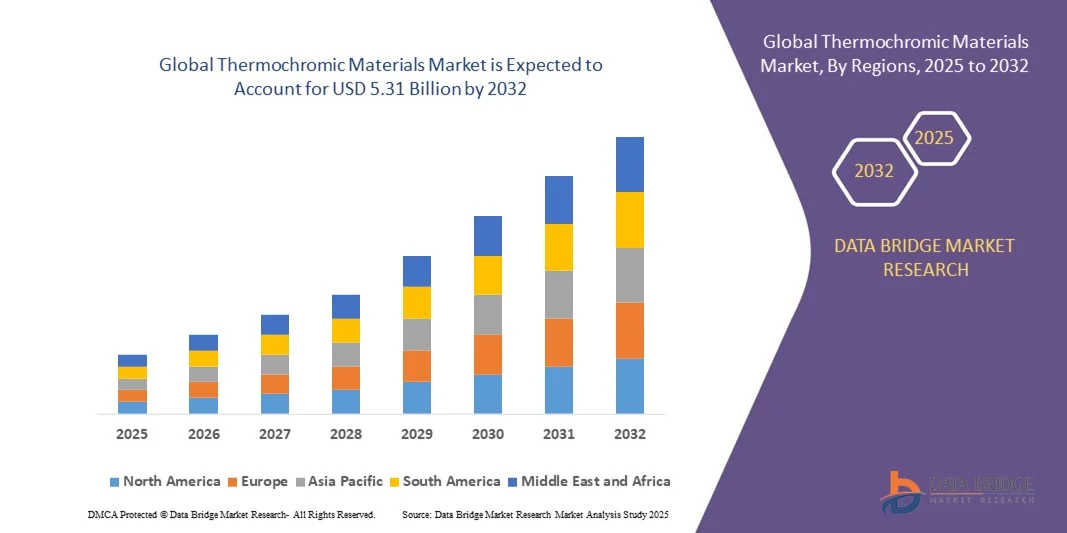
- The global thermochromic materials market size was valued at USD 2.6 billion in 2024 and is expected to reach USD 5.31 billion by 2032, at a CAGR of 9.35% during the forecast period
- The market growth is largely fuelled by increasing demand for temperature-sensitive materials across packaging, automotive, textiles, and electronics applications, along with rising consumer preference for smart and interactive products
- Growing R&D initiatives and technological advancements in thermochromic formulations are enabling enhanced performance, durability, and customization, further boosting market adoption
Thermochromic Materials Market Analysis
- The market is witnessing rapid innovation, with new materials offering faster response times, improved stability, and broader application potential in consumer goods, automotive, and industrial uses
- Increasing adoption of thermochromic materials in smart packaging, safety indicators, and temperature monitoring solutions is enhancing product functionality and market demand
- North America dominated the thermochromic materials market with the largest revenue share in 2024, driven by rising demand for smart packaging, temperature-sensitive indicators, and industrial applications. The region benefits from a well-established manufacturing base, strong regulatory compliance, and high adoption of innovative materials across multiple industries
- Asia-Pacific region is expected to witness the highest growth rate in the global thermochromic materials market, driven by expanding manufacturing capabilities, rising disposable incomes, and growing demand for smart and temperature-sensitive applications
- The Reversible segment held the largest market revenue share in 2024, driven by its ability to repeatedly change color in response to temperature variations, making it ideal for applications such as smart packaging, textiles, and temperature indicators. Reversible thermochromic materials are particularly popular due to their durability, consistency, and versatility across multiple industries
Report Scope and Thermochromic Materials Market Segmentation
|
Attributes |
Thermochromic Materials Key Market Insights |
|
Segments Covered |
|
|
Countries Covered |
North America
Europe
Asia-Pacific
Middle East and Africa
South America
|
|
Key Market Players |
|
|
Market Opportunities |
|
|
Value Added Data Infosets |
In addition to the insights on market scenarios such as market value, growth rate, segmentation, geographical coverage, and major players, the market reports curated by the Data Bridge Market Research also include in-depth expert analysis, pricing analysis, brand share analysis, consumer survey, demography analysis, supply chain analysis, value chain analysis, raw material/consumables overview, vendor selection criteria, PESTLE Analysis, Porter Analysis, and regulatory framework. |
Thermochromic Materials Market Trends
Increasing Adoption of Thermochromic Materials Across Smart Packaging and Industrial Applications
- The growing use of thermochromic materials is transforming industries by enabling real-time, temperature-sensitive visual indicators. These materials allow for immediate detection of temperature changes, improving product quality monitoring in food, pharmaceuticals, and chemical industries. Their versatility across multiple sectors is encouraging manufacturers to integrate them in novel ways, enhancing product differentiation and brand value
- High demand for thermochromic solutions in packaging, medical devices, and textiles is accelerating adoption of reversible and irreversible materials. These materials are particularly effective where visual temperature feedback enhances safety, usability, and consumer engagement. The ability to customize color-change thresholds and response times is also fueling product innovation across applications
- The affordability and ease of integration of modern thermochromic materials are making them attractive for manufacturers across various sectors. Companies can implement color-changing indicators without significant cost or process modification, supporting broader adoption. This also enables small and medium enterprises to incorporate advanced safety and monitoring features in their products
- For instance, in 2023, several food packaging companies in Europe and North America reported improved product freshness monitoring after incorporating thermochromic labels, enhancing consumer trust and reducing spoilage. Similarly, textile and medical device manufacturers observed better compliance with quality standards and improved user experience
- While thermochromic materials are driving enhanced product interaction and safety, their impact depends on continued innovation, regulatory compliance, and cost-efficiency. Manufacturers must focus on developing durable, eco-friendly, and application-specific solutions to fully capitalize on market growth, while maintaining consistency and reliability across batches
Thermochromic Materials Market Dynamics
Driver
Rising Demand for Smart and Temperature-Sensitive Applications
- Growing awareness about product safety and quality is pushing companies to adopt thermochromic materials as a visual temperature-monitoring solution. Industries such as food, pharmaceuticals, and electronics increasingly rely on these materials to prevent damage and ensure compliance. This trend is also driving investments in research and development of advanced thermochromic formulations
- Manufacturers are seeking innovative, low-cost, and visually interactive solutions to enhance product functionality, leading to increased use of thermochromic dyes, pigments, and liquid crystals across sectors. The flexibility to tailor color change properties for specific temperature ranges is enhancing product usability and expanding application areas
- Government regulations and standards related to temperature-sensitive products are further driving adoption. Compliance with safety, labeling, and quality requirements encourages industries to integrate thermochromic materials into packaging and devices. Subsidies, incentives, and industry certifications are further motivating adoption in both mature and emerging markets
- For instance, in 2022, medical device companies in Asia implemented thermochromic indicators in temperature-sensitive diagnostic kits, improving usability and compliance with regulatory standards. Similarly, food safety regulators encouraged packaging innovations incorporating reversible thermochromic materials for freshness monitoring
- While demand is rising, ensuring consistent material performance, durability, and affordability remains critical for sustained market growth. Manufacturers are also investing in sustainable production techniques and eco-friendly raw materials to align with regulatory and consumer expectations
Restraint/Challenge
High Cost and Limited Standardization Across Applications
- The cost of advanced thermochromic materials, particularly high-performance dyes and liquid crystals, limits accessibility for small and medium-sized manufacturers. Specialty materials are often used only in high-value applications, constraining market penetration. This high cost also discourages adoption in low-margin industries or price-sensitive markets
- Lack of standardization and variability in performance across suppliers restricts large-scale adoption. Inconsistent color change, durability, or response times can reduce effectiveness in critical applications such as medical devices or food safety indicators. Manufacturers must invest in quality control and supplier audits to ensure reliability
- Supply chain and raw material constraints further affect production and availability. Manufacturers may face delays or higher costs due to limited access to high-quality thermochromic compounds. Regional disruptions or limited raw material sources can also slow the pace of market growth
- For instance, in 2023, several packaging companies in Africa and Southeast Asia reported delays in implementing smart labels due to high material costs and inconsistent supplier quality. Similar issues were observed in electronics and textile applications, affecting product rollout schedules
- While thermochromic technologies continue to evolve, addressing cost, standardization, and supply chain challenges is essential. Market stakeholders must focus on scalable, reliable, and cost-effective solutions to unlock long-term growth potential, while investing in sustainable manufacturing and consistent product quality
Thermochromic Materials Market Scope
The thermochromic materials market is segmented on the basis of type, material, application, and end-use industry.
- By Type
On the basis of type, the thermochromic materials market is segmented into Reversible and Irreversible. The Reversible segment held the largest market revenue share in 2024, driven by its ability to repeatedly change color in response to temperature variations, making it ideal for applications such as smart packaging, textiles, and temperature indicators. Reversible thermochromic materials are particularly popular due to their durability, consistency, and versatility across multiple industries.
The Irreversible segment is expected to witness the fastest growth rate from 2025 to 2032, driven by its one-time color change feature, which is ideal for security labels, tamper-evident packaging, and safety indicators. Irreversible thermochromic materials are gaining traction for their simplicity, cost-effectiveness, and effectiveness in applications requiring permanent temperature-triggered changes.
- By Material
On the basis of material, the thermochromic materials market is segmented into Leuco Dyes, Liquid Crystals, Pigments, and Others. The Leuco Dyes segment held the largest market revenue share in 2024, attributed to its reliable color-changing properties, ease of integration, and wide adoption in packaging, paints, and printing applications. Leuco dye-based materials are highly favored for their consistency, versatility, and compatibility with various substrates.
The Liquid Crystals segment is expected to witness the fastest growth rate from 2025 to 2032, driven by its high precision in temperature-sensitive color changes, making it suitable for medical devices, thermometers, and advanced display technologies. Liquid crystal thermochromic materials are preferred for applications requiring accurate and reversible temperature indication.
- By Application
On the basis of application, the thermochromic materials market is segmented into Food Quality Indicators, Paper, Paints & Pigments, Thermometers, Medical Devices, and Others. The Food Quality Indicators segment held the largest market revenue share in 2024, driven by the increasing demand for smart packaging solutions that ensure freshness, safety, and quality of perishable products. These indicators enhance consumer trust and provide real-time visual feedback on product condition.
The Thermometers segment is expected to witness the fastest growth rate from 2025 to 2032, fueled by rising adoption in healthcare, laboratories, and industrial settings for accurate temperature monitoring. Thermometer applications benefit from rapid response, precise color changes, and ease of use, driving demand for thermochromic materials in these sectors.
- By End-Use Industry
On the basis of end-use industry, the thermochromic materials market is segmented into Packaging, Printing & Coating, Medical, Textile, Industrial, and Others. The Packaging segment held the largest market revenue share in 2024, owing to the growing need for smart, interactive, and safety-compliant packaging solutions in food, pharmaceutical, and consumer goods industries. Packaging applications benefit from visual temperature indicators and enhanced product differentiation.
The Medical segment is expected to witness the fastest growth rate from 2025 to 2032, driven by the rising use of thermochromic materials in temperature-sensitive medical devices, diagnostic tools, and healthcare monitoring systems. Medical applications leverage precise color changes to ensure safety, accuracy, and regulatory compliance, boosting market adoption.
Thermochromic Materials Market Regional Analysis
- North America dominated the thermochromic materials market with the largest revenue share in 2024, driven by rising demand for smart packaging, temperature-sensitive indicators, and industrial applications. The region benefits from a well-established manufacturing base, strong regulatory compliance, and high adoption of innovative materials across multiple industries
- Consumers and manufacturers in the region highly value the convenience, enhanced safety, and real-time monitoring offered by thermochromic materials in food packaging, medical devices, and industrial processes. Their integration improves product quality, compliance, and end-user trust, boosting market adoption
- This widespread uptake is further supported by high disposable incomes, technologically advanced industries, and growing focus on sustainability and regulatory standards, establishing thermochromic materials as a preferred solution across both commercial and industrial applications
U.S. Thermochromic Materials Market Insight
The U.S. thermochromic materials market captured the largest revenue share in 2024 within North America, fueled by strong adoption in smart packaging, industrial coatings, and healthcare devices. Companies are increasingly integrating color-changing indicators to monitor temperature-sensitive products, enhance safety, and improve consumer engagement. Growing demand for interactive, low-cost, and regulatory-compliant solutions is further propelling market expansion, with continuous innovation in dyes, pigments, and liquid crystal-based systems.
Europe Thermochromic Materials Market Insight
The Europe thermochromic materials market is expected to witness the fastest growth rate from 2025 to 2032, driven by stringent safety regulations and rising adoption in packaging, medical, and industrial applications. Increasing urbanization and a focus on sustainable and high-performance materials are fostering demand. European manufacturers are leveraging advanced thermochromic solutions to improve compliance, durability, and product usability across sectors.
U.K. Thermochromic Materials Market Insight
The U.K. thermochromic materials market is expected to witness rapid growth from 2025 to 2032, driven by increasing awareness of product safety, consumer interaction, and packaging innovation. Businesses are adopting reversible and irreversible thermochromic materials for freshness indicators, tamper-evident labels, and medical devices. The U.K.’s well-established manufacturing infrastructure and robust e-commerce sector are supporting market expansion.
Germany Thermochromic Materials Market Insight
The Germany thermochromic materials market is projected to grow strongly from 2025 to 2032, fueled by a focus on industrial automation, digitalization, and eco-friendly solutions. German manufacturers are integrating thermochromic materials into industrial coatings, packaging, and medical devices to enhance safety, compliance, and product quality. The region’s emphasis on technological innovation and sustainability promotes broader adoption across multiple industries.
Asia-Pacific Thermochromic Materials Market Insight
The Asia-Pacific thermochromic materials market is expected to witness the highest growth rate from 2025 to 2032, driven by rapid industrialization, urbanization, and rising disposable incomes in countries such as China, Japan, and India. Growing adoption in smart packaging, textiles, and medical devices, coupled with supportive government initiatives, is driving demand. APAC is also emerging as a key manufacturing hub for high-quality thermochromic compounds, improving affordability and accessibility.
Japan Thermochromic Materials Market Insight
The Japan thermochromic materials market is expected to witness strong growth from 2025 to 2032, owing to the country’s high-tech culture, demand for precision monitoring, and adoption of smart packaging solutions. Manufacturers are integrating thermochromic indicators into temperature-sensitive medical devices, electronics, and consumer products. The aging population and emphasis on safety and convenience are further boosting market adoption.
China Thermochromic Materials Market Insight
The China thermochromic materials market accounted for the largest market revenue share in Asia-Pacific in 2024, driven by rapid urbanization, a growing middle class, and increasing industrial and packaging applications. Thermochromic materials are being widely used in food packaging, medical devices, and industrial coatings. Government initiatives for smart packaging, coupled with strong domestic manufacturing capabilities, are supporting market expansion and improving accessibility.
Thermochromic Materials Market Share
The Thermochromic Materials industry is primarily led by well-established companies, including:
- OliKrom (France)
- LCR Hallcrest LLC (U.S.)
- Indestructible Paint Limited (U.K.)
- Chromatic Technologies Inc. (U.S.)
- MICI (Canada)
- New Prismatic Enterprise Co. (Taiwan)
- Gem'innov (France)
- SMAROL INDUSTRY CO., LTD. (South Korea)
- Kolortek Co., Ltd (China)
- Hali Pigment Co., Ltd. (India)
- FX Pigments Pvt. Ltd. (India)
- Good Life Innovations LTD (U.K.)
- Vipul Chemicals India Pvt Ltd. (India)
- QCR Solutions Corp (U.S.)
- SFXC (China)
Latest Developments in Global Thermochromic Materials Market
- In 2022, OliKrom developed a thermochromic coat in collaboration with GRTgaz Group, designed to detect early corrosion on overhead pipelines. This innovation aimed to enhance industrial safety and maintenance monitoring, providing real-time visual alerts and improving the reliability of critical infrastructure management
- In November, 2023, Matsui International Company launched a new series of thermochromic microcapsules for industrial applications. These microcapsules enable objects to change color in response to temperature fluctuations, enhancing both functionality and aesthetic appeal across multiple sectors and supporting quality monitoring processes
- In 2023, Good Life Innovations Ltd. introduced a new range of thermochromic microcapsules for food and beverage packaging. Engineered for direct food contact, these materials meet regulatory standards while offering smart, visual indicators of product condition, increasing consumer confidence and advancing the adoption of intelligent packaging solutions

- Interactive Data Analysis Dashboard
- Company Analysis Dashboard for high growth potential opportunities
- Research Analyst Access for customization & queries
- Competitor Analysis with Interactive dashboard
- Latest News, Updates & Trend analysis
- Harness the Power of Benchmark Analysis for Comprehensive Competitor Tracking
Data collection and base year analysis are done using data collection modules with large sample sizes. The stage includes obtaining market information or related data through various sources and strategies. It includes examining and planning all the data acquired from the past in advance. It likewise envelops the examination of information inconsistencies seen across different information sources. The market data is analysed and estimated using market statistical and coherent models. Also, market share analysis and key trend analysis are the major success factors in the market report. To know more, please request an analyst call or drop down your inquiry.
The key research methodology used by DBMR research team is data triangulation which involves data mining, analysis of the impact of data variables on the market and primary (industry expert) validation. Data models include Vendor Positioning Grid, Market Time Line Analysis, Market Overview and Guide, Company Positioning Grid, Patent Analysis, Pricing Analysis, Company Market Share Analysis, Standards of Measurement, Global versus Regional and Vendor Share Analysis. To know more about the research methodology, drop in an inquiry to speak to our industry experts.
Data Bridge Market Research is a leader in advanced formative research. We take pride in servicing our existing and new customers with data and analysis that match and suits their goal. The report can be customized to include price trend analysis of target brands understanding the market for additional countries (ask for the list of countries), clinical trial results data, literature review, refurbished market and product base analysis. Market analysis of target competitors can be analyzed from technology-based analysis to market portfolio strategies. We can add as many competitors that you require data about in the format and data style you are looking for. Our team of analysts can also provide you data in crude raw excel files pivot tables (Fact book) or can assist you in creating presentations from the data sets available in the report.