


Thermocouple Market Overview
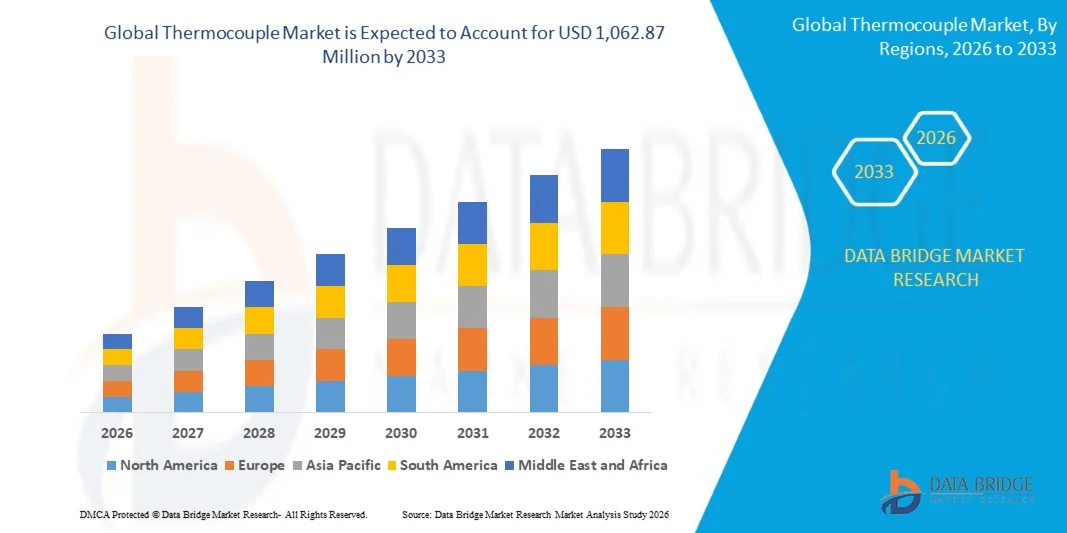
As per Data Bridge Market Research analysis, the thermocouple market was valued at USD 807.16 million in 2025 and is projected to reach USD 1,062.87 million by 2033, growing at a CAGR of 3.50% from 2026 to 2033. The market is experiencing consistent growth driven by rising adoption of automation and process control systems, and expanding utilization in sectors such as automotive, power generation, oil & gas, chemical processing, aerospace, and manufacturing. The market growth is driven by the need for reliable temperature monitoring devices that provide high durability, fast response time, and operational efficiency in extreme temperature environments.
The increasing focus on industrial automation, energy efficiency, and advanced manufacturing processes is accelerating the adoption of thermocouples across various industries. Growing investments in power generation infrastructure, semiconductor manufacturing, automotive production, and process industries are further supporting market expansion. Thermocouples are increasingly being integrated with digital monitoring systems and Industry 4.0 technologies, enabling real-time temperature tracking, predictive maintenance, and improved operational safety in industrial environments.
Market Size & Forecast
- Global Market Value (2025): USD 807.16 Million
- Expected Market Value (2033): USD 1,062.87 Million
- Forecast CAGR (2026–2033): 3.50%
- Leading Region in 2025: North America
- Fastest Growing Region: Asia Pacific
Key Market Trends & Insights
- North America dominated the thermocouple market with the largest revenue share of 35.9% in 2025, supported by advanced industrial infrastructure, strong presence of key temperature sensor manufacturers, and increasing adoption across aerospace, automotive, power generation, oil & gas, and manufacturing industries
- The contact type temperature sensor segment led the market with a 70.5% share in 2025, driven by the widespread adoption of thermocouples for direct temperature measurement across industrial processing, manufacturing, automotive, and energy applications
- Asia-Pacific is expected to be the fastest-growing region at a CAGR of 6.8% during the forecast period, with strong growth supported by increasing industrial automation, expanding manufacturing activities, infrastructure investments, and rising adoption of temperature sensing solutions across China, India, Japan, and South Korea
- Non-contact type temperature sensor is the fastest-growing sensor type, projected to register a CAGR of 7.9%, reflecting the surge in demand for remote temperature measurement solutions in applications where direct contact is difficult or unsafe.
- The nickel segment dominated the metals category with a 50% revenue share in 2025, led by extensive usage in nickel-alloy thermocouples such as Type K and Type N for industrial temperature sensing applications.
- Nickel-alloy thermocouples accounted for 60.5% of the market, preferred by their extensive adoption in industrial temperature monitoring applications due to reliability, affordability, and wide operating temperature capability.
- The type N thermocouple segment is the fastest-growing product type category, with a CAGR of 6.8%, driven by increasing demand for improved stability and high-temperature performance
Report Scope and Thermocouple Market Segmentation
|
Attributes |
Thermocouple Key Market Insights |
|
Segments Covered |
|
|
Countries Covered |
North America
Europe
Asia-Pacific
Middle East and Africa
South America
|
|
Key Market Players |
|
|
Market Opportunities |
|
|
Value Added Data Infosets |
In addition to the insights on market scenarios such as market value, growth rate, segmentation, geographical coverage, and major players, the market reports curated by the Data Bridge Market Research also include in-depth expert analysis, geographically represented company-wise production and capacity, network layouts of distributors and partners, detailed and updated price trend analysis and deficit analysis of supply chain and demand. |
Thermocouple Market Trends
Trend: Increasing Adoption of Smart Thermocouples in Industrial Automation
Industries are increasingly adopting smart thermocouple systems integrated with digital transmitters, wireless communication, and industrial Internet of Things (IIoT) platforms to enable real-time temperature monitoring, predictive maintenance, and improved process efficiency. Advanced thermocouples with enhanced connectivity are being deployed across manufacturing, power generation, oil & gas, and chemical processing industries to support automated process control and data-driven operations. The integration of intelligent temperature sensing solutions allows industries to reduce equipment downtime, improve operational safety, and optimize energy consumption in complex industrial environments. For instance, in March 2024, Emerson highlighted advancements in its Rosemount Temperature Measurement solutions, focusing on accurate temperature measurement, improved process safety, operational efficiency, and advanced diagnostics for process industries such as oil & gas, chemical, food & beverage, and pharmaceuticals
The transition toward smart manufacturing and Industry 4.0 is creating new growth opportunities for thermocouple manufacturers by increasing demand for connected, intelligent, and automated temperature monitoring solutions.
Thermocouple Market Dynamics
Key Market Driver: Growing Demand for Temperature Monitoring in Industrial Process Automation
The increasing adoption of automation across manufacturing, chemical processing, power generation, and oil & gas industries is driving demand for thermocouples as reliable temperature measurement devices. Thermocouples provide accurate temperature sensing across wide temperature ranges and are widely used in furnaces, boilers, turbines, reactors, and industrial machinery where precise thermal monitoring is critical. The expansion of industrial automation systems and increasing focus on operational efficiency are encouraging industries to integrate advanced temperature sensors for process optimization, safety improvement, and equipment performance monitoring. For instance, in October 2023, Yokogawa Electric Corporation introduced the YTA710 Wireless Temperature Transmitter, designed for industrial process applications requiring reliable temperature monitoring and digital connectivity. The transmitter supports thermocouple and RTD inputs and enables wireless transmission of temperature data, helping industries improve process visibility, reduce installation complexity, and enhance operational efficiency in applications such as chemical processing, energy, and manufacturing.
Increasing adoption of industrial automation, process control systems, and advanced measurement technologies is supporting demand for thermocouple-based temperature monitoring solutions across manufacturing and energy-intensive industries.
Key Restraint/Challenge: Competition from Alternative Temperature Sensor Technologies
A A significant challenge for the thermocouple market is increasing competition from alternative temperature sensing technologies, including resistance temperature detectors (RTDs), infrared sensors, and semiconductor-based temperature sensors. While thermocouples offer advantages such as wide temperature range, durability, and cost-effectiveness, alternative sensors can provide higher accuracy, improved stability, and suitability for specific applications requiring precise temperature measurement. The availability of multiple sensing technologies may limit thermocouple adoption in applications where advanced accuracy and long-term stability are prioritized. For instance, in June 2024, Endress+Hauser announced the launch of the iTHERM ModuLine TM131 temperature assembly, designed for reliable temperature measurement in industrial process applications using RTD and thermocouple sensor technologies. The development reflects continued innovation in temperature measurement solutions and highlights competition among advanced sensing technologies for high-accuracy industrial applications.
The growing preference for RTDs in precision measurement applications creates competitive pressure for thermocouple manufacturers, encouraging innovation toward improved accuracy, digital integration, and application-specific temperature sensing solutions
Key Market Opportunity: Expansion of Thermocouple Applications in Electric Vehicles and Battery Thermal Management
The increasing adoption of electric vehicles and advancements in battery technologies are creating new opportunities for thermocouple manufacturers in automotive thermal management applications. Thermocouples are increasingly used for battery temperature monitoring, charging system management, and thermal safety systems due to their ability to provide accurate temperature measurements in demanding operating conditions. The growing focus on battery safety, performance optimization, and thermal control in electric vehicles is expected to expand the application scope of thermocouple-based temperature sensing solutions. For instance, in June 2024, LG Energy Solution and Analog Devices, Inc. announced a partnership to develop advanced battery management technologies capable of precisely measuring the internal temperature of EV battery cells. The technology aims to improve battery safety, optimize charging performance, and enhance battery longevity by enabling more accurate thermal condition monitoring within battery systems. This development highlights the growing importance of advanced temperature sensing and monitoring solutions in electric vehicle battery management applications.
The growing integration of temperature monitoring technologies in electric vehicle battery management systems is creating new opportunities for thermocouple and temperature sensor manufacturers by expanding their applications in battery thermal management, safety systems, and next-generation mobility solutions.
Thermocouple Market Scope
The thermocouple market is segmented on the basis of sensor type, metals, thermocouple type, product type, and end user.
- By Sensor Type
On the basis of sensor type, the thermocouple market is segmented into contact type temperature sensors and non-contact type temperature sensors. The contact type temperature sensor segment dominated the market with the largest revenue share of 70.5% in 2025, owing to the widespread adoption of thermocouples for direct temperature measurement across industrial processing, manufacturing, automotive, and energy applications. Contact sensors provide high accuracy, reliability, and fast response in applications requiring continuous temperature monitoring. Thermocouples are extensively preferred due to their ability to operate across wide temperature ranges and withstand harsh industrial environments. Their cost-effectiveness and simple installation process further support their adoption across process industries. Increasing demand for real-time temperature monitoring in furnaces, boilers, engines, and production equipment is strengthening segment growth. The extensive use of contact temperature sensors in industrial automation and process control systems continues to maintain their market dominance globally.
The non-contact type temperature sensor segment is projected to register the fastest growth at a CAGR of 7.9% during the forecast period, driven by increasing demand for remote temperature measurement solutions in applications where direct contact is difficult or unsafe. Infrared and radiation-based temperature sensing technologies are gaining adoption in high-temperature industrial environments, semiconductor manufacturing, and healthcare applications. These sensors enable faster measurement without affecting the target object or process. Growing focus on automation, safety, and remote monitoring is supporting adoption of non-contact technologies. Advancements in infrared sensing accuracy and integration with digital monitoring systems are further enhancing their application scope.
- By Metals
On the basis of metals, the thermocouple market is segmented into gold, copper, nickel, palladium, and platinum. The nickel segment dominated the market with 50% share in 2025, supported by extensive usage in nickel-alloy thermocouples such as Type K and Type N for industrial temperature sensing applications. Nickel alloys provide excellent thermal stability, oxidation resistance, and suitability for high-temperature environments. These materials are widely used in manufacturing, power generation, automotive, and chemical processing industries. The availability and cost advantage of nickel compared with precious metals contribute to their widespread adoption. Increasing demand for reliable temperature measurement in industrial automation is supporting segment growth. Their ability to perform efficiently under challenging operating conditions continues to make nickel one of the most widely used materials in thermocouple manufacturing.
The platinum segment is expected to witness the fastest growth at a CAGR of 6.8% during the forecast period, driven by increasing demand for high-precision temperature measurement in extreme temperature applications. Platinum-based thermocouples, including Type R, Type S, and Type B, are widely used in aerospace, glass manufacturing, semiconductor processing, and laboratory applications. These materials provide excellent stability, corrosion resistance, and accuracy at very high temperatures. Growing adoption of advanced manufacturing processes requiring precise thermal control is supporting demand for platinum thermocouples. Increasing investments in aerospace and semiconductor industries are creating additional growth opportunities.
- By Thermocouple Type
On the basis of thermocouple type, the market is segmented into nickel-alloy thermocouples, tungsten/rhenium-alloy thermocouples, chromel–gold/iron-alloy thermocouples, and others. The nickel-alloy thermocouples segment dominated the market with 60.5% share in 2025, driven by their extensive adoption in industrial temperature monitoring applications due to reliability, affordability, and wide operating temperature capability. Nickel-alloy thermocouples such as Type K and Type N are commonly used in manufacturing plants, furnaces, engines, and process industries. These thermocouples provide good resistance to oxidation and corrosion, making them suitable for demanding industrial environments. Their compatibility with standard industrial control systems further supports adoption. Growing industrial automation and increasing demand for process efficiency continue to drive demand for nickel-alloy thermocouples. Their cost-effectiveness compared with noble metal alternatives maintains their leading position in the market.
The tungsten/rhenium-alloy thermocouples segment is projected to register the fastest growth at a CAGR of 7.9% during the forecast period, supported by increasing demand for ultra-high-temperature measurement applications. Tungsten/rhenium thermocouples are capable of operating at extremely high temperatures and are widely used in aerospace, defense, furnace monitoring, and advanced research applications. Their ability to withstand extreme thermal environments makes them suitable for specialized applications where conventional thermocouples cannot perform effectively. Increasing investments in aerospace testing, defense technologies, and high-temperature manufacturing are supporting market expansion. Advancements in material science are improving durability and reliability of these thermocouples.
- By Product Type
On the basis of product type, the thermocouple market is segmented into type J thermocouple, type K thermocouple, type T thermocouple, type N thermocouple, type E thermocouple, type B thermocouple, type R thermocouple, and type S thermocouple. The type K thermocouple segment dominated the market with 35.0% revenue share in 2025, owing to its wide application across industrial processing, power generation, automotive, and manufacturing industries. Type K thermocouples offer a broad temperature measurement range of approximately -200°C to 1,260°C, making them suitable for diverse applications. Their affordability, durability, and availability contribute to widespread adoption globally. They are commonly used in furnaces, engines, boilers, and industrial machinery temperature monitoring systems. Increasing industrial automation and demand for reliable temperature measurement are supporting segment growth. The combination of performance, cost efficiency, and versatility makes Type K the most widely adopted thermocouple type.
The type N thermocouple segment is expected to witness the fastest growth at a CAGR of 6.8% during the forecast period, driven by increasing demand for improved stability and high-temperature performance compared with conventional Type K thermocouples. Type N thermocouples offer better resistance to oxidation and long-term drift, making them suitable for demanding industrial applications. They are increasingly used in power generation, aerospace, and advanced manufacturing processes. Growing requirements for accurate temperature measurement over extended operating periods are supporting adoption. Technological advancements in industrial equipment are creating new opportunities for Type N thermocouples.
- By End User
On the basis of end user, the thermocouple market is segmented into industrial applications, automotive, optical, metal manufacturing, aerospace, and defense applications. The industrial applications segment dominated the market with 40% revenue share in 2025, driven by extensive use of thermocouples in manufacturing plants, chemical processing facilities, oil & gas operations, and power generation units. Industrial users rely on thermocouples for accurate temperature monitoring, process optimization, and equipment safety. Increasing adoption of automation and process control systems is significantly supporting demand. Thermocouples are widely integrated into furnaces, turbines, reactors, and industrial machinery due to their durability and cost-effectiveness. Growing investments in industrial infrastructure and smart manufacturing technologies are further strengthening market growth.
The aerospace and defense segment is projected to register the fastest growth at a CAGR of 7.9% during the forecast period, supported by increasing demand for high-performance temperature sensing solutions in aircraft engines, propulsion systems, and defense equipment. Thermocouples are used in aerospace applications due to their ability to operate under extreme temperatures, vibration, and harsh environmental conditions. Growing investments in aircraft development, space exploration, and defense modernization programs are driving adoption. Advanced aerospace testing requires accurate thermal monitoring to improve safety and performance. Increasing development of next-generation aircraft and propulsion technologies is creating additional opportunities
Thermocouple Market Regional Analysis
North America dominated the thermocouple market with the largest revenue share of 35.9% in 2025, supported by advanced industrial infrastructure, strong presence of key temperature sensor manufacturers, and increasing adoption across aerospace, automotive, power generation, oil & gas, and manufacturing industries. The region benefits from increasing implementation of Industry 4.0 solutions, smart manufacturing systems, and advanced process control technologies requiring accurate temperature monitoring. Growing investments in semiconductor production, renewable energy projects, and industrial digitalization are further accelerating market development. Increasing focus on operational efficiency, predictive maintenance, process safety, and real-time industrial monitoring continues to strengthen North America's leadership position in the global thermocouple market.
U.S. Thermocouple Market Insight
The U.S. thermocouple market is witnessing strong growth due to rising demand for advanced temperature measurement solutions across industrial automation, aerospace, automotive, power generation, and semiconductor manufacturing sectors. The country’s mature manufacturing ecosystem, strong presence of process industries, and increasing adoption of Industry 4.0 technologies are driving demand for reliable temperature monitoring systems. In addition, growing investments in semiconductor fabrication and energy infrastructure are accelerating the adoption of thermocouples for process control and equipment safety applications. The U.S. Department of Energy’s focus on expanding domestic semiconductor manufacturing through the CHIPS and Science Act is supporting the growth of advanced manufacturing facilities, increasing demand for precise temperature monitoring technologies used in semiconductor processing.
Europe Thermocouple Market Insight
The Europe thermocouple market remains a major contributor to global revenue, driven by strong industrial automation adoption, advanced manufacturing capabilities, and increasing demand for accurate temperature measurement in process industries. The region benefits from a well-established automotive, chemical, aerospace, and energy sector that extensively uses thermocouples for production monitoring and safety applications. Increasing investments in smart factories, renewable energy systems, and industrial digitalization are supporting market expansion across European countries. Germany’s Industry 4.0 initiatives are accelerating the adoption of connected manufacturing systems, increasing demand for industrial sensors, including temperature measurement devices, for real-time process monitoring.
U.K. Thermocouple Market Insight
The U.K. thermocouple market is experiencing steady growth, supported by increasing adoption of industrial automation, aerospace manufacturing, energy transition projects, and advanced research applications. The country’s strong aerospace, pharmaceutical, and process manufacturing industries are generating demand for reliable temperature sensing technologies. Increasing investments in renewable energy infrastructure and precision manufacturing are further contributing to market growth. U.K. Government’s Advanced Manufacturing Plan supports investment in advanced manufacturing capabilities, digital technologies, and industrial innovation, creating a favorable environment for the adoption of advanced measurement and process monitoring solutions.
Germany Thermocouple Market Insight
The Germany thermocouple market is expanding steadily due to the country’s strong automotive manufacturing base, industrial automation leadership, and advanced engineering capabilities. Automotive manufacturers, chemical companies, metal processing industries, and machinery producers extensively use thermocouples for temperature monitoring, quality control, and production optimization. Continuous advancements in smart manufacturing and digital factory solutions are further driving adoption. Germany’s continued investment in Industry 4.0 manufacturing technologies is increasing the deployment of industrial sensors and automation systems across production facilities, supporting demand for temperature measurement solutions.
Asia-Pacific Thermocouple Market Insight
The Asia-Pacific thermocouple market is expected to witness rapid growth, driven by expanding manufacturing activities, increasing industrial automation, and rising investments in semiconductor, automotive, and energy industries across countries such as China, India, Japan, and South Korea. Growing adoption of smart manufacturing technologies and increasing demand for efficient process monitoring systems are supporting regional market expansion. In addition, rapid industrial development and infrastructure investments are accelerating the use of thermocouples in high-temperature industrial applications. India’s Production Linked Incentive (PLI) Scheme for the automotive and advanced technology sectors encouraged new investments in manufacturing capabilities, including advanced automotive technologies and electric vehicle components, increasing the requirement for industrial automation, process monitoring, and temperature measurement solutions used in production environments
Japan Thermocouple Market Insight
The Japan thermocouple market is witnessing consistent growth due to strong automotive production, semiconductor manufacturing, precision engineering, and advanced industrial automation capabilities. Japanese manufacturers are increasingly adopting high-performance temperature measurement solutions for production efficiency, quality control, and equipment monitoring. The country’s focus on robotics, smart factories, and advanced manufacturing technologies is further supporting demand for thermocouples. Japan’s Ministry of Economy, Trade and Industry (METI) promotes Connected Industries and Society 5.0 initiatives focused on IoT, automation, and smart manufacturing, supporting the adoption of advanced industrial sensors and real-time monitoring technologies across manufacturing sectors.
China Thermocouple Market Insight
The China thermocouple market is growing rapidly, driven by expanding industrial manufacturing, increasing automation adoption, and rising investments in electronics, automotive, and energy sectors. The country’s large-scale manufacturing base creates significant demand for temperature measurement systems across factories, power plants, chemical facilities, and semiconductor production units. Growing focus on smart manufacturing and industrial upgrading is further accelerating thermocouple adoption. China’s rapid expansion of smart factories, industrial automation, and advanced manufacturing infrastructure is increasing demand for industrial sensing technologies, including temperature measurement solutions such as thermocouples used for process monitoring and equipment control.
Thermocouple Market Share
The thermocouple industry is primarily led by well-established companies, including:
- Honeywell International Inc. (U.S.)
- Emerson Electric Co. (U.S.)
- OMEGA Engineering, Inc. (U.S.)
- Watlow Electric Manufacturing Company (U.S.)
- Yokogawa Electric Corporation (Japan)
- Endress+Hauser Group Services AG (Switzerland)
- ABB (Switzerland)
- Siemens (Germany)
- Schneider Electric SE (France)
- WIKA Alexander Wiegand SE & Co. KG (Germany)
- Fluke Corporation (U.S.)
- TE Connectivity (Switzerland)
- Analog Devices, Inc. (U.S.)
- Microchip Technology Incorporated (U.S.)
- National Instruments Corporation (U.S.)
- KROHNE Messtechnik GmbH (Germany)
- Konica Minolta, Inc. (Japan)
- RKC Instrument Inc. (Japan)
- Pyromation, Inc. (U.S.)
Latest Developments in Thermocouple Market
- In September 2025, Accelovant launched its Fiber Optical-Thermocouple sensing solution designed for critical power applications, including semiconductor, industrial, and data center markets. The fiber-optic thermocouple technology provides direct temperature monitoring capabilities with enhanced reliability for high-voltage and demanding environments. This development reflects the growing adoption of advanced thermocouple-based sensing technologies for asset health monitoring and industrial safety applications
- In September 2025, Microchip Technology introduced the MCP9604 thermocouple conditioning integrated circuit (IC), designed to simplify high-accuracy thermocouple temperature measurement applications. The new four-channel thermocouple conditioning solution provides up to ±1.5°C system accuracy and reduces design complexity compared with traditional discrete thermocouple conditioning solutions
- In August 2025, Emerson announced the release of the Rosemount 3144S Temperature Transmitter, designed to deliver improved accuracy, stability, diagnostics, and usability for demanding industrial temperature measurement applications. The transmitter provides 0.05°C accuracy, advanced diagnostics, and wireless connectivity features, supporting reliable temperature monitoring in process industries
- In October 2024, Endress+Hauser launched the iTEMP TMT86 temperature head transmitter with PROFINET over Ethernet-APL technology, designed for accurate and reliable temperature measurement in process automation applications. The transmitter supports thermocouples and RTDs, provides advanced diagnostics, and enables digital communication for improved process control. This development supports the increasing adoption of connected temperature measurement solutions in hazardous and industrial environments
- In April 2023, Advanced Energy launched new high-accuracy handheld temperature calibrators under its TEGAM product portfolio, supporting precise temperature measurement and calibration requirements across industrial applications. The calibrators support multiple thermocouple types and are designed for manufacturing, aerospace, automotive, chemical, pharmaceutical, and food safety environments. This development supports the increasing requirement for accurate calibration and reliable temperature measurement systems in industrial operations

- Interactive Data Analysis Dashboard
- Company Analysis Dashboard for high growth potential opportunities
- Research Analyst Access for customization & queries
- Competitor Analysis with Interactive dashboard
- Latest News, Updates & Trend analysis
- Harness the Power of Benchmark Analysis for Comprehensive Competitor Tracking
Global Thermocouple Market, Supply Chain Analysis and Ecosystem Framework
To support market growth and help clients navigate the impact of geopolitical shifts, DBMR has integrated in-depth supply chain analysis into its Global Thermocouple Market research reports. This addition empowers clients to respond effectively to global changes affecting their industries. The supply chain analysis section includes detailed insights such as Global Thermocouple Market consumption and production by country, price trend analysis, the impact of tariffs and geopolitical developments, and import and export trends by country and HSN code. It also highlights major suppliers with data on production capacity and company profiles, as well as key importers and exporters. In addition to research, DBMR offers specialized supply chain consulting services backed by over a decade of experience, providing solutions like supplier discovery, supplier risk assessment, price trend analysis, impact evaluation of inflation and trade route changes, and comprehensive market trend analysis.
Data collection and base year analysis are done using data collection modules with large sample sizes. The stage includes obtaining market information or related data through various sources and strategies. It includes examining and planning all the data acquired from the past in advance. It likewise envelops the examination of information inconsistencies seen across different information sources. The market data is analysed and estimated using market statistical and coherent models. Also, market share analysis and key trend analysis are the major success factors in the market report. To know more, please request an analyst call or drop down your inquiry.
The key research methodology used by DBMR research team is data triangulation which involves data mining, analysis of the impact of data variables on the market and primary (industry expert) validation. Data models include Vendor Positioning Grid, Market Time Line Analysis, Market Overview and Guide, Company Positioning Grid, Patent Analysis, Pricing Analysis, Company Market Share Analysis, Standards of Measurement, Global versus Regional and Vendor Share Analysis. To know more about the research methodology, drop in an inquiry to speak to our industry experts.
Data Bridge Market Research is a leader in advanced formative research. We take pride in servicing our existing and new customers with data and analysis that match and suits their goal. The report can be customized to include price trend analysis of target brands understanding the market for additional countries (ask for the list of countries), clinical trial results data, literature review, refurbished market and product base analysis. Market analysis of target competitors can be analyzed from technology-based analysis to market portfolio strategies. We can add as many competitors that you require data about in the format and data style you are looking for. Our team of analysts can also provide you data in crude raw excel files pivot tables (Fact book) or can assist you in creating presentations from the data sets available in the report.













