


Thermosetting Aerospace Composites Market Size
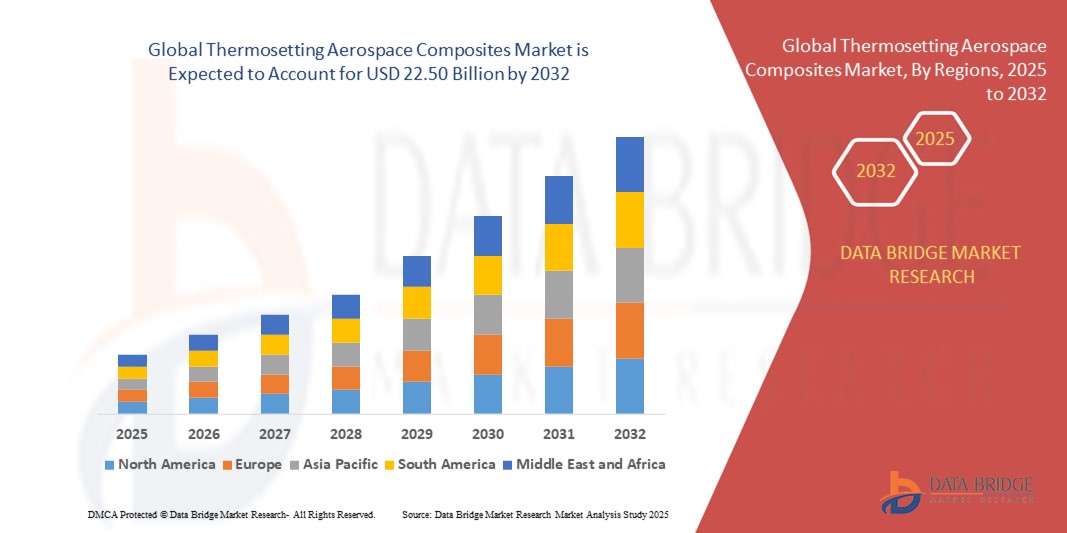
- The global thermosetting aerospace composites market size was valued at USD 8.83 billion in 2024 and is expected to reach USD 22.50 billion by 2032, at a CAGR of 12.4% during the forecast period
- The market growth is largely fuelled by the increasing use of lightweight, high-strength composite materials to enhance fuel efficiency, reduce emissions, and improve aircraft performance, as well as rising demand for next-generation aircraft in commercial, military, and space applications
- The expanding use of thermosetting composites in structural components to extend aircraft lifespan and reduce maintenance costs is also contributing to market growth.
Thermosetting Aerospace Composites Market Analysis
- The global thermosetting aerospace composites market is witnessing robust growth due to their superior mechanical properties, high thermal stability, and resistance to fatigue and corrosion, making them ideal for critical aerospace applications
- Their ability to reduce overall aircraft weight, thereby enhancing fuel efficiency and lowering operational costs, is further driving adoption
- North America dominated the thermosetting aerospace composites market with the largest revenue share in 2024, driven by strong demand for lightweight, high-performance materials in both commercial and defense aerospace sectors
- Asia-Pacific region is expected to witness the highest growth rate in the global thermosetting aerospace composites market, driven by increasing air passenger traffic, rising aircraft procurement, and expanding manufacturing capabilities in countries such as China, India, and Japan
- The epoxy segment dominated the market with the largest market revenue share in 2024, driven by its exceptional mechanical strength, chemical resistance, and suitability for high-performance aerospace applications. Epoxy-based composites are widely used in primary and secondary aircraft structures such as wings, fuselage panels, and tail sections, owing to their lightweight properties and durability. Continuous advancements in epoxy formulations are further enhancing performance under extreme operating conditions
Report Scope and Thermosetting Aerospace Composites Market Segmentation
|
Attributes |
Thermosetting Aerospace Composites Key Market Insights |
|
Segments Covered |
|
|
Countries Covered |
North America
Europe
Asia-Pacific
Middle East and Africa
South America
|
|
Key Market Players |
|
|
Market Opportunities |
|
|
Value Added Data Infosets |
In addition to the insights on market scenarios such as market value, growth rate, segmentation, geographical coverage, and major players, the market reports curated by the Data Bridge Market Research also include import export analysis, production capacity overview, production consumption analysis, price trend analysis, climate change scenario, supply chain analysis, value chain analysis, raw material/consumables overview, vendor selection criteria, PESTLE Analysis, Porter Analysis, and regulatory framework. |
Thermosetting Aerospace Composites Market Trends
Rising Adoption Of Lightweight And High-Performance Materials In Aerospace Manufacturing
- The growing preference for lightweight yet high-strength materials is reshaping aerospace manufacturing, with thermosetting composites becoming a material of choice for critical structural and interior components. Their ability to reduce aircraft weight directly contributes to improved fuel efficiency and lower emissions, aligning with global sustainability goals
- Increasing demand for materials with superior thermal stability and fatigue resistance is driving adoption in applications such as fuselage sections, wings, tail assemblies, and engine components. This trend is especially evident in new-generation aircraft programs where performance and efficiency are top priorities
- The development of innovative resin systems and reinforcement fibers is enabling thermosetting composites to deliver better impact resistance and longer service life, making them ideal for both commercial and defense aviation sectors
- For instance, in 2024, Airbus reported a significant reduction in overall aircraft weight by incorporating advanced epoxy-based carbon fiber composites in its A350 program, improving range and fuel economy while meeting stringent safety and performance standards
- While adoption is accelerating, the full potential of thermosetting aerospace composites depends on continuous advancements in manufacturing processes, cost reduction strategies, and recycling solutions to meet both performance and sustainability requirements
Thermosetting Aerospace Composites Market Dynamics
Driver
Growing Demand For Fuel-Efficient Aircraft And Enhanced Performance Materials
- Rising global air traffic and the push for greener aviation are prompting aircraft manufacturers to seek materials that can reduce fuel consumption without compromising safety. Thermosetting composites deliver significant weight savings while maintaining high strength-to-weight ratios, directly addressing these requirements
- Airlines are increasingly prioritizing aircraft with lower operating costs, further driving the use of advanced composites in structural and non-structural components. Reduced maintenance requirements and improved corrosion resistance also enhance operational efficiency
- Aerospace OEMs and tier suppliers are investing heavily in automated composite manufacturing technologies, such as resin transfer molding and automated fiber placement, to increase production efficiency and scalability
- For instance, in 2023, Boeing announced expanded use of thermosetting composites in its 777X program, integrating carbon fiber-reinforced epoxy systems into wing structures to improve aerodynamic performance and reduce fuel burn
- While strong demand and technology adoption are driving the market forward, overcoming raw material cost fluctuations and ensuring stable supply chains remain critical for sustained growth
Restraint/Challenge
High Production Costs And Limited Recycling Infrastructure
- The production of thermosetting aerospace composites involves complex processes and expensive raw materials, making them cost-prohibitive for some aerospace programs, particularly in developing markets or cost-sensitive segments
- Recycling thermosetting composites remains a major challenge due to their irreversible curing process, leading to end-of-life disposal concerns and increasing pressure from environmental regulations
- The aerospace industry faces limitations in scaling up production capacity due to the high capital investment required for specialized equipment and skilled labor, further restricting widespread adoption
- For instance, in 2024, several aerospace suppliers in Europe cited high energy costs and resin price volatility as key barriers to expanding thermosetting composite production for next-generation aircraft
- While technological innovations and new resin chemistries show promise, solving cost and recycling challenges will be essential for the market to reach its full potential, especially as sustainability pressures intensify
Thermosetting Aerospace Composites Market Scope
The market is segmented on the basis of resin type, aircraft type, and application.
- By Resin Type
On the basis of resin type, the thermosetting aerospace composites market is segmented into epoxy, phenolics, polyester, and polyimides. The epoxy segment dominated the market with the largest market revenue share in 2024, driven by its exceptional mechanical strength, chemical resistance, and suitability for high-performance aerospace applications. Epoxy-based composites are widely used in primary and secondary aircraft structures such as wings, fuselage panels, and tail sections, owing to their lightweight properties and durability. Continuous advancements in epoxy formulations are further enhancing performance under extreme operating conditions.
The polyimides segment is expected to witness the fastest growth rate from 2025 to 2032, fueled by their outstanding thermal stability and ability to maintain mechanical integrity at elevated temperatures. These properties make polyimide-based composites highly suitable for aerospace engine components and high-heat applications. Increasing research into high-temperature resin systems for next-generation aircraft propulsion is expected to accelerate demand in this segment.
- By Aircraft Type
On the basis of aircraft type, the thermosetting aerospace composites market is segmented into commercial aircraft, business & general aviation, civil helicopter, military aircraft, and others. The commercial aircraft segment held the largest market revenue share in 2024, driven by the rising production of fuel-efficient passenger jets and the use of composites to reduce weight and operational costs. The increasing adoption of thermosetting composites in fuselage structures, wing assemblies, and interior fittings is further propelling growth in this segment
The military aircraft segment is expected to witness the fastest growth rate from 2025 to 2032, supported by growing investments in next-generation defense programs and the demand for high-performance materials that can withstand extreme conditions. The ability of thermosetting composites to offer enhanced durability, radar-absorbing properties, and resistance to harsh environments makes them an essential material for modern combat and surveillance aircraft.
- By Application
On the basis of application, the thermosetting aerospace composites market is segmented into interior and exterior. The exterior segment accounted for the largest market revenue share in 2024, attributed to the extensive use of thermosetting composites in aircraft skin panels, wing structures, and tail assemblies. Their superior resistance to environmental stressors, combined with excellent load-bearing capabilities, makes them highly suitable for exterior aerospace applications.
The interior segment is expected to witness the fastest growth rate from 2025 to 2032, driven by the need for lightweight materials in cabin structures, seating components, and interior paneling to enhance fuel efficiency and passenger comfort. The ability of thermosetting composites to be molded into complex shapes and finished with high aesthetic quality further boosts their appeal for aircraft interiors.
Thermosetting Aerospace Composites Market Regional Analysis
- North America dominated the thermosetting aerospace composites market with the largest revenue share in 2024, driven by strong demand for lightweight, high-performance materials in both commercial and defense aerospace sectors
- The region benefits from the presence of leading aerospace manufacturers, robust R&D investments, and advanced production capabilities, fostering widespread adoption of thermosetting composites in aircraft manufacturing
- Growth is further supported by the emphasis on fuel efficiency, emission reduction, and the modernization of existing fleets, positioning thermosetting composites as a critical material choice for the aerospace industry
U.S. Thermosetting Aerospace Composites Market Insight
The U.S. thermosetting aerospace composites market captured the largest revenue share within North America in 2024, propelled by extensive usage in both military and commercial aircraft programs. The country’s strong focus on aerospace innovation, backed by government defense spending and private sector R&D, continues to drive demand. Increasing adoption of epoxy- and polyimide-based composites in structural and interior components enhances aircraft performance, durability, and weight savings. Moreover, the expansion of next-generation aircraft production lines is expected to sustain market growth in the coming years.
Europe Thermosetting Aerospace Composites Market Insight
The Europe thermosetting aerospace composites market is expected to witness the fastest growth rate from 2025 to 2032, supported by stringent environmental regulations and the need for fuel-efficient aircraft. The region’s leading aerospace manufacturers, including Airbus and multiple Tier 1 suppliers, are increasingly integrating advanced thermosetting composites into both new and retrofitted aircraft. Rising passenger traffic and the demand for lightweight materials to meet CO₂ reduction goals are fueling adoption across commercial and defense applications.
U.K. Thermosetting Aerospace Composites Market Insight
The U.K. thermosetting aerospace composites market is expected to witness the fastest growth rate from 2025 to 2032, driven by its strong aerospace manufacturing base and investments in composite innovation. The country’s involvement in global aerospace supply chains, coupled with its push towards sustainable aviation technologies, is encouraging greater usage of thermosetting composites in fuselage, wing, and interior applications.
Germany Thermosetting Aerospace Composites Market Insight
The Germany thermosetting aerospace composites market is expected to witness the fastest growth rate from 2025 to 2032, supported by the nation’s engineering expertise, aerospace R&D capabilities, and focus on sustainable manufacturing processes. Germany’s aerospace sector is increasingly deploying phenolic and epoxy composites in interior panels, flooring, and structural components to meet both performance and fire-resistance requirements.
Asia-Pacific Thermosetting Aerospace Composites Market Insight
The Asia-Pacific thermosetting aerospace composites market is expected to witness the fastest growth rate from 2025 to 2032, fueled by rapid expansion in commercial aviation, rising defense budgets, and increasing aircraft production in China, India, and Japan. Government initiatives to strengthen domestic aerospace manufacturing, coupled with growing adoption of advanced composite technologies, are accelerating market growth. The rising demand for fuel-efficient, high-performance aircraft further boosts the adoption of thermosetting composites in the region.
Japan Thermosetting Aerospace Composites Market Insight
The Japan thermosetting aerospace composites market is expected to witness the fastest growth rate from 2025 to 2032 due to the country’s emphasis on high-precision aerospace manufacturing and the integration of advanced composite materials into next-generation aircraft. With a strong domestic aerospace supply chain and technological expertise, Japan is adopting polyimide and epoxy composites to enhance performance, reduce weight, and improve fuel efficiency in both commercial and defense aviation.
China Thermosetting Aerospace Composites Market Insight
The China thermosetting aerospace composites market accounted for the largest share in Asia-Pacific in 2024, supported by the nation’s rapidly growing aerospace manufacturing capabilities and strong government investment in aviation. China’s commercial aircraft programs, coupled with expansion in military aviation, are driving large-scale adoption of thermosetting composites. The availability of domestic composite manufacturers and cost-effective production is further strengthening China’s position in the global market.
Thermosetting Aerospace Composites Market Share
The Thermosetting Aerospace Composites industry is primarily led by well-established companies, including:
- Toray Industries Ltd. (Japan)
- Solvay Group (Belgium)
- Teijin Limited (Japan)
- Owen Corning (U.S.)
- Royal Ten Cate (Netherlands)
- SGL Group (Germany)
- Kaman (U.S.)
- Hexcel Corporation (U.S.)
- General Electric (U.S.)
- Koninklijke Ten Cate BV (Netherlands)
- Mitsubishi Rayon Co., Ltd. (Japan)
- Jushi Group (China)
Latest Developments in Global Thermosetting Aerospace Composites Market
- In March 2020, Merck entered into a distribution agreement with Azelis, appointing the company as its official distributor in Vietnam for a range of products, including personal care, CASE (coatings, adhesives, sealants, and elastomers), food & health, and industrial chemicals. This strategic collaboration aims to strengthen Merck’s market presence in Vietnam by leveraging Azelis’s extensive distribution network and local expertise. The partnership is expected to enhance product accessibility, improve customer service, and expand market reach across diverse industries. In addition, it supports the growing demand for high-quality specialty chemicals in the region, thereby contributing to the overall market growth

- Interactive Data Analysis Dashboard
- Company Analysis Dashboard for high growth potential opportunities
- Research Analyst Access for customization & queries
- Competitor Analysis with Interactive dashboard
- Latest News, Updates & Trend analysis
- Harness the Power of Benchmark Analysis for Comprehensive Competitor Tracking
Global Thermosetting Aerospace Composites Market, Supply Chain Analysis and Ecosystem Framework
To support market growth and help clients navigate the impact of geopolitical shifts, DBMR has integrated in-depth supply chain analysis into its Global Thermosetting Aerospace Composites Market research reports. This addition empowers clients to respond effectively to global changes affecting their industries. The supply chain analysis section includes detailed insights such as Global Thermosetting Aerospace Composites Market consumption and production by country, price trend analysis, the impact of tariffs and geopolitical developments, and import and export trends by country and HSN code. It also highlights major suppliers with data on production capacity and company profiles, as well as key importers and exporters. In addition to research, DBMR offers specialized supply chain consulting services backed by over a decade of experience, providing solutions like supplier discovery, supplier risk assessment, price trend analysis, impact evaluation of inflation and trade route changes, and comprehensive market trend analysis.
Data collection and base year analysis are done using data collection modules with large sample sizes. The stage includes obtaining market information or related data through various sources and strategies. It includes examining and planning all the data acquired from the past in advance. It likewise envelops the examination of information inconsistencies seen across different information sources. The market data is analysed and estimated using market statistical and coherent models. Also, market share analysis and key trend analysis are the major success factors in the market report. To know more, please request an analyst call or drop down your inquiry.
The key research methodology used by DBMR research team is data triangulation which involves data mining, analysis of the impact of data variables on the market and primary (industry expert) validation. Data models include Vendor Positioning Grid, Market Time Line Analysis, Market Overview and Guide, Company Positioning Grid, Patent Analysis, Pricing Analysis, Company Market Share Analysis, Standards of Measurement, Global versus Regional and Vendor Share Analysis. To know more about the research methodology, drop in an inquiry to speak to our industry experts.
Data Bridge Market Research is a leader in advanced formative research. We take pride in servicing our existing and new customers with data and analysis that match and suits their goal. The report can be customized to include price trend analysis of target brands understanding the market for additional countries (ask for the list of countries), clinical trial results data, literature review, refurbished market and product base analysis. Market analysis of target competitors can be analyzed from technology-based analysis to market portfolio strategies. We can add as many competitors that you require data about in the format and data style you are looking for. Our team of analysts can also provide you data in crude raw excel files pivot tables (Fact book) or can assist you in creating presentations from the data sets available in the report.













