


Thin Film Solar Cell (tfsc) Market Overview
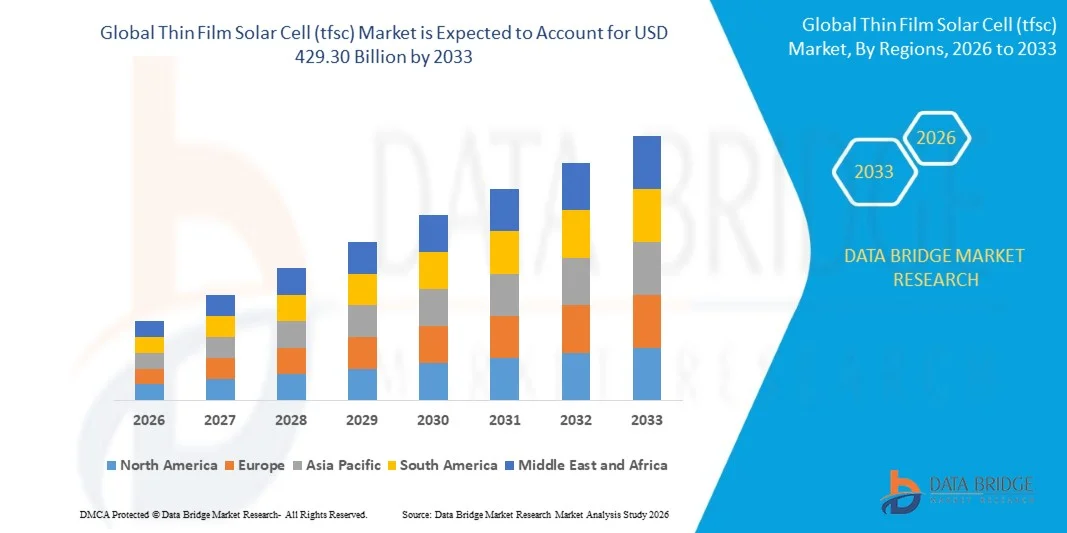
The Thin Film Solar Cell (tfsc) Market was valued at USD 248.00 billion in 2025 and is projected to reach USD 429.30 billion by 2033, growing at a CAGR of 7.10% from 2026 to 2033. The market is experiencing consistent growth driven by increasing global demand for renewable energy, rising investments in solar power generation, and continuous advancements in thin-film photovoltaic technologies.
The growing emphasis on decarbonization, coupled with supportive government policies promoting clean energy adoption and declining manufacturing costs, is encouraging utilities, commercial enterprises, and residential consumers to deploy advanced thin film solar cells. Cadmium telluride (CdTe), copper indium gallium selenide (CIGS), and amorphous silicon (a-Si) technologies are increasingly complementing conventional crystalline silicon solar panels in many applications, offering lightweight designs, flexibility, improved performance under low-light conditions, and cost-effective electricity generation for utility-scale, building-integrated, and off-grid solar installations.
Market Size & Forecast
- Global Market Value (2025): USD 248.00 Billion
- Expected Market Value (2033): USD 429.30 Billion
- Forecast CAGR (2026–2033): 7.10%
- Leading Region in 2025: North America
- Fastest Growing Region: Asia-Pacific
Key Market Trends & Insights
- North America dominated the Thin Film Solar Cell (tfsc) Market with the largest revenue share of 36.42% in 2025, supported by strong investments in renewable energy projects, favorable government incentives, increasing utility-scale solar installations, and the presence of leading thin-film solar manufacturers, particularly in the United States.
- The on-grid segment dominated the market with an estimated revenue share of 76.64% in 2025 due to rapid expansion of grid-connected solar power plants across developed and emerging economies.
- Asia-Pacific is expected to be the fastest-growing region at a CAGR of 9.3% from 2026 to 2033, fueled by rapid expansion of solar energy capacity, supportive government policies, increasing electricity demand, and large-scale renewable energy investments across China, India, Japan, and Southeast Asia.
- The copper indium gallium diselenide (CIGS) segment is the fastest-growing type, projected to register a CAGR of 10.1% from 2026 to 2033, reflecting increasing demand for lightweight, flexible, and high-efficiency thin-film solar modules in building-integrated photovoltaics (BIPV), portable electronics, and commercial applications.
- The on-grid installation segment dominated the market with a 74.81% revenue share in 2025, supported by expanding utility-scale solar farms, favorable net-metering policies, robust transmission infrastructure, and growing integration of renewable energy into national electricity grids.
Report Scope and Thin Film Solar Cell (tfsc) Market Segmentation
|
Attributes |
Thin Film Solar Cell (tfsc) Key Market Insights |
|
Segments Covered |
|
|
Countries Covered |
North America · U.S. · Canada · Mexico Europe · Germany · France · U.K. · Netherlands · Switzerland · Belgium · Russia · Italy · Spain · Turkey · Rest of Europe Asia-Pacific · China · Japan · India · South Korea · Singapore · Malaysia · Australia · Thailand · Indonesia · Philippines · Rest of Asia-Pacific Middle East and Africa · Saudi Arabia · U.A.E. · South Africa · Egypt · Israel · Rest of Middle East and Africa South America · Brazil · Argentina · Rest of South America |
|
Key Market Players |
|
|
Market Opportunities |
· Growing Adoption of Building-Integrated Photovoltaics (BIPV) · Expansion of Utility-Scale Solar Projects in Emerging Economies · Rising Demand for Flexible and Portable Solar Applications |
|
Value Added Data Infosets |
In addition to the insights on market scenarios such as market value, growth rate, segmentation, geographical coverage, and major players, the market reports curated by the Data Bridge Market Research also include in-depth expert analysis, geographically represented company-wise production and capacity, network layouts of distributors and partners, detailed and updated price trend analysis and deficit analysis of supply chain and demand. |
Thin Film Solar Cell (tfsc) Market Trends
Trend: Rising Adoption of Flexible and Building-Integrated Thin Film Solar Technologies
The Thin Film Solar Cell (tfsc) Market is witnessing a significant trend toward the adoption of flexible photovoltaic modules and Building-Integrated Photovoltaics (BIPV). Unlike conventional crystalline silicon panels, thin film solar cells offer lightweight construction, flexibility, and superior performance under low-light and high-temperature conditions, making them increasingly suitable for commercial buildings, industrial rooftops, transportation infrastructure, and portable power applications. Cadmium Telluride (CdTe) technology continues to dominate utility-scale installations due to its cost efficiency, while Copper Indium Gallium Diselenide (CIGS) is gaining momentum in flexible electronics and architectural applications. According to the International Energy Agency (IEA), global solar PV additions exceeded 590 GW in 2024, creating strong demand for advanced thin-film technologies that improve energy yield and reduce installation costs. Furthermore, manufacturers are investing in next-generation tandem thin-film cells and lightweight solar modules to support the growing demand for sustainable energy solutions across developed and emerging economies.
Thin Film Solar Cell (tfsc) Market Dynamics
Key Market Driver: Growing Investments in Renewable Energy and Utility-Scale Solar Projects
The increasing global transition toward renewable energy is a major driver of the Thin Film Solar Cell (tfsc) Market. Governments worldwide are implementing ambitious decarbonization strategies, renewable portfolio standards, and financial incentives to accelerate solar energy deployment. Thin-film solar technologies, particularly Cadmium Telluride (CdTe), are increasingly preferred for utility-scale photovoltaic projects due to their lower manufacturing costs, reduced material consumption, and strong performance in hot climates. According to the International Energy Agency (IEA), renewable electricity capacity additions reached record levels in recent years, with solar PV accounting for the largest share of new power generation capacity globally. In addition, the U.S. Inflation Reduction Act and similar clean energy initiatives across Europe and Asia-Pacific are encouraging domestic solar manufacturing and accelerating investments in thin-film photovoltaic technologies. Major manufacturers such as First Solar continue expanding production capacity to meet rapidly growing global demand for utility-scale solar installations.
Key Restraint/Challenge: Competition from Crystalline Silicon Solar Modules
A significant challenge for the Thin Film Solar Cell (tfsc) Market is the intense competition from conventional crystalline silicon photovoltaic modules, which continue to dominate global solar installations due to higher conversion efficiencies and large-scale manufacturing economies. Continuous reductions in crystalline silicon module prices have narrowed the cost advantage historically associated with thin-film technologies. In addition, thin-film solar cells generally require larger installation areas to generate equivalent power output, limiting their adoption where space availability is constrained. Supply chain challenges related to critical raw materials such as tellurium and indium, along with fluctuations in commodity prices, further affect manufacturing economics. Although technological advancements continue improving thin-film efficiency, manufacturers must compete with rapidly evolving silicon-based technologies that benefit from well-established global production infrastructure.
Key Market Opportunity: Expansion of Building-Integrated Photovoltaics (BIPV) and Flexible Solar Applications
The growing adoption of Building-Integrated Photovoltaics (BIPV), lightweight solar modules, and portable renewable energy systems presents a significant opportunity for the Thin Film Solar Cell (tfsc) Market. Thin-film technologies offer superior flexibility, low weight, and attractive aesthetics, making them ideal for integration into building facades, rooftops, skylights, transportation vehicles, and wearable electronic devices. Increasing investments in net-zero buildings, smart cities, and sustainable infrastructure are creating new commercial opportunities for flexible photovoltaic products. In addition, advancements in Copper Indium Gallium Diselenide (CIGS) and next-generation tandem thin-film technologies are improving conversion efficiency while maintaining manufacturing flexibility. Growing demand for distributed renewable energy generation across Asia-Pacific, North America, and Europe, coupled with supportive government incentives for green building construction, is expected to accelerate the adoption of thin-film solar solutions across diverse end-use applications.
Thin Film Solar Cell (tfsc) Market Scope
The Thin Film Solar Cell (tfsc) market is segmented on the basis of simulation type, vehicle type, training application, end user, hardware components, software components, training mode, integration & connectivity, deployment and support & services.
- By Type
On the basis of type, the Thin Film Solar Cell (tfsc) Market is segmented into Cadmium Telluride (CdTe), Copper Indium Gallium Diselenide (CIGS), and Amorphous Thin-Film Silicon (a-Si). The Cadmium Telluride (CdTe) segment dominated the market with an estimated share of 47.82% in 2025 due to its superior commercial maturity, competitive manufacturing cost, and high energy yield under high-temperature conditions. CdTe technology is extensively deployed in utility-scale solar projects because it delivers stable performance with lower material consumption compared to conventional crystalline silicon modules. Continuous manufacturing improvements have enhanced module efficiency while reducing production costs, making CdTe the preferred technology for large photovoltaic installations. Major manufacturers continue expanding production capacities to meet growing renewable energy demand across North America, Europe, and Asia-Pacific. Increasing investments in utility-scale solar farms, favorable government incentives, and rising corporate renewable energy procurement further strengthen demand. The technology also offers lower carbon emissions during manufacturing, supporting sustainability objectives. Ongoing innovations in thin-film deposition techniques and module durability continue improving competitiveness. As utility developers prioritize cost-effective and high-output solutions, the Thin Film Solar Cell (tfsc) Market continues to witness strong adoption of CdTe technology, reinforcing its leading market position.
The Copper Indium Gallium Diselenide (CIGS) segment is projected to register the fastest CAGR of 9.1% from 2026 to 2033 owing to its high conversion efficiency, lightweight structure, and exceptional flexibility. CIGS modules can be integrated into curved surfaces, lightweight rooftops, electric vehicles, aerospace applications, and portable power systems where conventional panels are unsuitable. Continuous research has significantly improved manufacturing yields while reducing fabrication costs, making commercial deployment increasingly viable. Governments and private investors are supporting advanced thin-film technologies through renewable energy funding initiatives. Building-integrated photovoltaics (BIPV) and smart infrastructure projects are also creating new growth opportunities for CIGS technology. Its excellent low-light performance enhances electricity generation under cloudy conditions, increasing commercial attractiveness. Growing adoption across industrial, transportation, and architectural applications is expected to accelerate demand. These technological advancements position CIGS as the fastest-growing technology segment within the Thin Film Solar Cell (tfsc) Market.
- By Installation
On the basis of installation, the Thin Film Solar Cell (tfsc) Market is segmented into On-Grid and Off-Grid. The on-grid segment dominated the market with an estimated revenue share of 76.64% in 2025 due to rapid expansion of grid-connected solar power plants across developed and emerging economies. Utility-scale solar installations continue benefiting from government incentives, renewable energy mandates, net-metering policies, and declining installation costs. Large commercial buildings and industrial facilities increasingly prefer on-grid systems to reduce electricity expenses while maintaining uninterrupted power supply through the utility network. Public and private investments in transmission infrastructure have further supported widespread deployment. Increasing corporate commitments toward carbon neutrality are driving installation of on-grid photovoltaic systems across manufacturing facilities, logistics centers, and commercial complexes. Financial institutions also offer favorable financing models for grid-connected renewable projects, improving project feasibility. Continuous improvements in inverter technologies and smart grid integration further enhance operational efficiency. Consequently, the Thin Film Solar Cell (tfsc) Market continues to witness strong dominance of the on-grid installation segment.
The Off-Grid segment is expected to witness the fastest CAGR of 8.7% during 2026–2033 owing to increasing electrification initiatives in remote and underserved regions. Governments, NGOs, and international development organizations are investing in decentralized renewable energy systems to improve electricity access. Off-grid thin-film solar modules are increasingly deployed in rural communities, mining operations, telecommunications towers, military bases, agricultural facilities, and disaster-relief applications. Their lightweight design, portability, and superior performance under varying weather conditions make them highly suitable for remote installations. Growing demand for hybrid renewable energy systems integrated with battery storage is also supporting market expansion. Declining battery costs and improved energy management technologies are further accelerating adoption. Rising emphasis on energy independence and resilient power infrastructure is expected to sustain long-term growth. These factors position off-grid installations as one of the fastest-growing opportunities in the Thin Film Solar Cell (tfsc) Market.
- By End User
On the basis of end user, the Thin Film Solar Cell (tfsc) Market is segmented into Residential, Commercial, and Utility. The utility segment dominated the market with an estimated share of 61.38% in 2025 owing to large-scale deployment of thin-film photovoltaic systems for electricity generation by independent power producers and public utilities. Utility developers increasingly favor thin-film technology because of its competitive cost structure, superior performance under high temperatures, and suitability for large land-based solar farms. Governments worldwide continue awarding renewable energy contracts to utility-scale projects as part of decarbonization strategies and clean energy transition programs. Increasing electricity demand, grid modernization initiatives, and supportive regulatory frameworks further strengthen investment in utility-scale installations. Technological improvements in module efficiency and manufacturing capacity expansion are reducing the levelized cost of electricity (LCOE), improving project economics. Long-term power purchase agreements (PPAs) signed with industrial and commercial customers also contribute to sustained demand. Continuous investment in renewable infrastructure ensures that the utility segment remains the largest contributor to the Thin Film Solar Cell (tfsc) Market.
The Commercial segment is projected to register the fastest CAGR of 8.9% from 2026 to 2033 driven by increasing adoption of rooftop solar systems across offices, shopping centers, warehouses, educational institutions, healthcare facilities, and manufacturing plants. Businesses are increasingly investing in renewable energy solutions to lower operating costs, achieve ESG targets, and reduce dependence on conventional electricity sources. Thin-film solar modules offer lightweight construction and architectural flexibility, making them ideal for commercial rooftops with structural limitations. Building-integrated photovoltaic (BIPV) installations are also gaining popularity in modern commercial infrastructure. Favorable tax incentives, renewable financing programs, and corporate sustainability commitments continue encouraging investments. Technological advancements improving module efficiency and lifespan further strengthen commercial adoption. Rising electricity prices across numerous countries are expected to accelerate demand throughout the forecast period. Consequently, the commercial segment is anticipated to emerge as the fastest-growing end-user category in the Thin Film Solar Cell (tfsc) Market.
Thin Film Solar Cell (tfsc) Market Regional Analysis
North America dominated the Thin Film Solar Cell (tfsc) Market and accounted for the largest revenue share of 36.42% in 2025, supported by strong investments in renewable energy projects, favorable government incentives, increasing utility-scale solar installations, and the presence of leading thin-film solar manufacturers, particularly in the United States. The region also benefits from ambitious decarbonization targets, growing adoption of building-integrated photovoltaics (BIPV), and continuous technological advancements in thin-film photovoltaic technologies. Increasing investments in clean energy infrastructure continue to strengthen North America's leadership in the Thin Film Solar Cell (tfsc) Market.
U.S. Thin Film Solar Cell (tfsc) Market Insight
The U.S. thin film solar cell (TFSC) market is witnessing strong growth due to increasing investments in renewable energy generation, supportive federal incentives, and expanding deployment of utility-scale solar projects. Growing adoption of cadmium telluride (CdTe) technology, rising demand for domestic solar manufacturing, and continuous investments in advanced photovoltaic technologies are driving market expansion. In addition, government initiatives promoting energy independence and clean electricity generation are accelerating market growth.
Europe Thin Film Solar Cell (tfsc) Market Insight
The Europe thin film solar cell (TFSC) market remains a major contributor to global revenue, driven by ambitious carbon neutrality targets, supportive renewable energy policies, and increasing deployment of solar energy systems. Rising investments in building-integrated photovoltaics, commercial rooftop installations, and sustainable infrastructure projects are supporting market expansion across the region. Continuous innovation in lightweight and flexible solar technologies further enhances adoption throughout Europe.
U.K. Thin Film Solar Cell (tfsc) Market Insight
The U.K. thin film solar cell (TFSC) market is experiencing steady growth, supported by increasing investments in renewable energy, rising demand for energy-efficient buildings, and expanding adoption of rooftop solar installations. Growing emphasis on achieving net-zero emissions and integrating advanced photovoltaic technologies into commercial and residential infrastructure is contributing to market growth. Continuous government support for clean energy projects further strengthens market development.
Germany Thin Film Solar Cell (tfsc) Market Insight
The Germany thin film solar cell (TFSC) market is expanding steadily due to the country's strong renewable energy sector, increasing investments in solar power generation, and growing adoption of innovative photovoltaic technologies. Rising demand for building-integrated solar systems, supportive energy transition policies, and continuous technological advancements are driving market growth. Ongoing investments in sustainable energy infrastructure further support market expansion in Germany.
Asia-Pacific Thin Film Solar Cell (tfsc) Market Insight
The Asia-Pacific thin film solar cell (TFSC) market is expected to witness the fastest growth, registering a CAGR of 9.3% from 2026 to 2033, fueled by rapid expansion of solar energy capacity, supportive government policies, increasing electricity demand, and large-scale renewable energy investments across China, India, Japan, and Southeast Asia. Growing industrialization, declining solar installation costs, and rising focus on energy security are accelerating market expansion. In addition, increasing investments in domestic photovoltaic manufacturing and utility-scale solar projects are supporting regional growth.
Japan Thin Film Solar Cell (tfsc) Market Insight
The Japan thin film solar cell (TFSC) market is witnessing consistent growth due to increasing investments in renewable energy, strong government support for decarbonization, and rising demand for high-efficiency solar technologies. Growing adoption of lightweight and flexible thin-film modules for residential, commercial, and building-integrated applications is driving market development. Continuous innovation in photovoltaic technologies is further contributing to market growth.
China Thin Film Solar Cell (tfsc) Market Insight
The China thin film solar cell (TFSC) market is growing rapidly, driven by massive investments in renewable energy infrastructure, expanding solar manufacturing capacity, and strong government support for clean energy deployment. Increasing installation of utility-scale solar projects, rising adoption of advanced photovoltaic technologies, and growing exports of solar products are significantly boosting market demand. In addition, continuous expansion of domestic renewable energy capacity is positioning China as one of the fastest-growing markets in the Thin Film Solar Cell (tfsc) Market.
Thin Film Solar Cell (tfsc) Market Share
The Thin Film Solar Cell (tfsc) industry is primarily led by well-established companies, including:
- First Solar, Inc. (U.S.)
- Ascent Solar Technologies, Inc. (U.S.)
- MiaSolé Hi-Tech Corp. (U.S.)
- Hanergy Holding Group Ltd. (China)
- Avancis GmbH (Germany)
- Oxford PV (U.K.)
- Solar Frontier K.K. (Japan)
- Sharp Corporation (Japan)
- Kaneka Corporation (Japan)
- LONGi Green Energy Technology Co., Ltd. (China)
- Trina Solar Co., Ltd. (China)
- JinkoSolar Holding Co., Ltd. (China)
- JA Solar Technology Co., Ltd. (China)
- Hanwha Solutions Corporation (South Korea)
- Mitsubishi Electric Corporation (Japan)
- Tata Power Solar Systems Limited (India)
- Saint-Gobain (France)
- 3M Company (U.S.)
- Flisom AG (Switzerland)
- Heliatek GmbH (Germany)
- Solbian Energie Alternative S.r.l. (Italy)
- PowerFilm Solar, Inc. (U.S.)Top of FormBottom of Form
Latest Developments in Thin Film Solar Cell (tfsc) Market
- In March 2021, First Solar announced expansion of its U.S. manufacturing capacity for CdTe thin-film solar modules to support growing utility-scale demand. The expansion focused on increasing production efficiency and strengthening domestic supply chains. It supported large-scale solar deployment projects. The company emphasized improved cost efficiency and lower carbon footprint. This development strengthened CdTe adoption in the Thin Film Solar Cell (tfsc) Market
- In August 2021, First Solar reported improvements in CdTe module performance through its Series 6 product enhancements. The upgrades improved energy yield and temperature resistance. It strengthened competitiveness against crystalline silicon modules. The company expanded automated production capabilities. This supported wider utility-scale adoption in the Thin Film Solar Cell (tfsc) Market
- In October 2022, Ascent Solar Technologies enhanced its CIGS flexible solar modules for aerospace and defense applications. The development focused on improving flexibility and durability. It enabled use in drones, satellites, and portable power systems. The innovation expanded non-traditional solar applications. This supported growth in the Thin Film Solar Cell (tfsc) Market
- In April 2023, First Solar expanded CdTe thin-film production capacity in the United States to meet rising solar demand. The expansion increased manufacturing output and efficiency. It supported utility-scale renewable energy projects. The company focused on cost reduction and supply chain stability. This strengthened its position in the Thin Film Solar Cell (tfsc) Market
- In April 2023, Ascent Solar Technologies advanced its CIGS flexible photovoltaic portfolio through strategic technology integration. The development improved lightweight module performance. It supported applications in transportation and building-integrated solar systems. It enhanced commercialization potential. This contributed to growth in the Thin Film Solar Cell (tfsc) Market

- Interactive Data Analysis Dashboard
- Company Analysis Dashboard for high growth potential opportunities
- Research Analyst Access for customization & queries
- Competitor Analysis with Interactive dashboard
- Latest News, Updates & Trend analysis
- Harness the Power of Benchmark Analysis for Comprehensive Competitor Tracking
Global Thin Film Solar Cell Tfsc Market, Supply Chain Analysis and Ecosystem Framework
To support market growth and help clients navigate the impact of geopolitical shifts, DBMR has integrated in-depth supply chain analysis into its Global Thin Film Solar Cell Tfsc Market research reports. This addition empowers clients to respond effectively to global changes affecting their industries. The supply chain analysis section includes detailed insights such as Global Thin Film Solar Cell Tfsc Market consumption and production by country, price trend analysis, the impact of tariffs and geopolitical developments, and import and export trends by country and HSN code. It also highlights major suppliers with data on production capacity and company profiles, as well as key importers and exporters. In addition to research, DBMR offers specialized supply chain consulting services backed by over a decade of experience, providing solutions like supplier discovery, supplier risk assessment, price trend analysis, impact evaluation of inflation and trade route changes, and comprehensive market trend analysis.
Data collection and base year analysis are done using data collection modules with large sample sizes. The stage includes obtaining market information or related data through various sources and strategies. It includes examining and planning all the data acquired from the past in advance. It likewise envelops the examination of information inconsistencies seen across different information sources. The market data is analysed and estimated using market statistical and coherent models. Also, market share analysis and key trend analysis are the major success factors in the market report. To know more, please request an analyst call or drop down your inquiry.
The key research methodology used by DBMR research team is data triangulation which involves data mining, analysis of the impact of data variables on the market and primary (industry expert) validation. Data models include Vendor Positioning Grid, Market Time Line Analysis, Market Overview and Guide, Company Positioning Grid, Patent Analysis, Pricing Analysis, Company Market Share Analysis, Standards of Measurement, Global versus Regional and Vendor Share Analysis. To know more about the research methodology, drop in an inquiry to speak to our industry experts.
Data Bridge Market Research is a leader in advanced formative research. We take pride in servicing our existing and new customers with data and analysis that match and suits their goal. The report can be customized to include price trend analysis of target brands understanding the market for additional countries (ask for the list of countries), clinical trial results data, literature review, refurbished market and product base analysis. Market analysis of target competitors can be analyzed from technology-based analysis to market portfolio strategies. We can add as many competitors that you require data about in the format and data style you are looking for. Our team of analysts can also provide you data in crude raw excel files pivot tables (Fact book) or can assist you in creating presentations from the data sets available in the report.













