


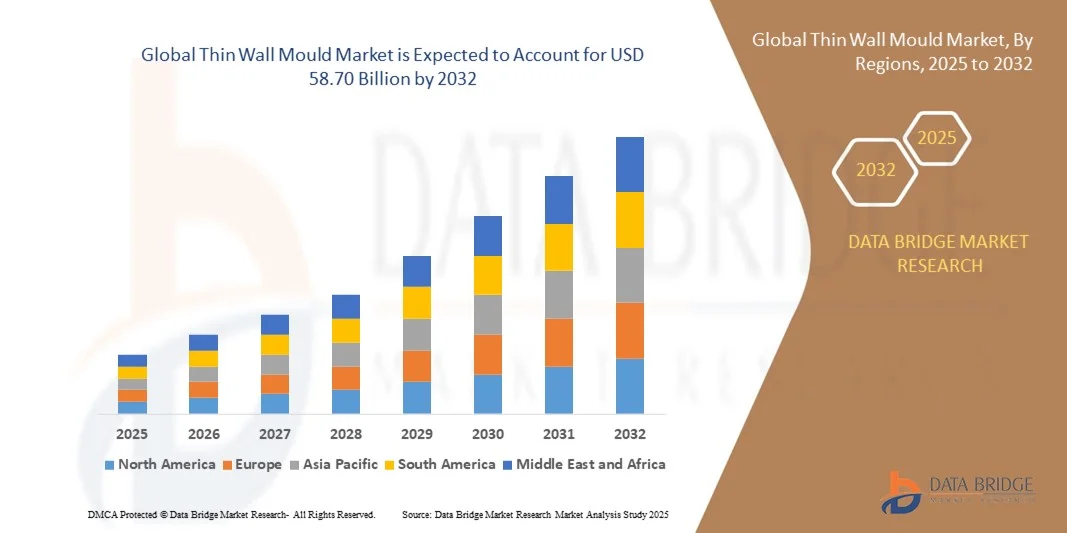
Thin Wall Mould Market Size
- The global thin wall mould market size was valued at USD 41.60 billion in 2024 and is expected to reach USD 58.70 billion by 2032, at a CAGR of 4.40% during the forecast period
- The market growth is largely fuelled by the rising demand for lightweight and durable packaging solutions across the food and beverage industry, where thin wall moulds enable high-speed production and reduced material usage
- Increasing adoption of injection moulding technologies for producing thin-walled containers and components in sectors such as consumer goods and healthcare is further contributing to market expansion
Thin Wall Mould Market Analysis
- The global thin wall mould market is witnessing steady growth driven by technological innovations, rising automation in moulding processes, and the shift toward sustainable and lightweight packaging materials
- • Manufacturers are focusing on precision tooling, multi-cavity moulds, and high-performance steel grades to achieve shorter production cycles and improved product quality
- North America dominated the thin wall mould market with the largest revenue share of 40.62% in 2024, driven by strong demand for lightweight, durable, and sustainable packaging solutions across food, beverage, and consumer goods industries
- Asia-Pacific region is expected to witness the highest growth rate in the global thin wall mould market, driven by increasing demand for sustainable and cost-efficient packaging, expanding production capacity, and technological advancements in moulding equipment
- The box segment held the largest market revenue share in 2024, driven by the rising demand for durable, lightweight, and cost-efficient packaging solutions across food, beverage, and consumer goods sectors. Thin wall moulded boxes offer superior stacking strength, reduced material usage, and faster production cycles, making them a preferred choice for large-scale packaging manufacturers
Report Scope and Thin Wall Mould Market Segmentation
|
Attributes |
Thin Wall Mould Key Market Insights |
|
Segments Covered |
|
|
Countries Covered |
North America
Europe
Asia-Pacific
Middle East and Africa
South America
|
|
Key Market Players |
|
|
Market Opportunities |
|
|
Value Added Data Infosets |
In addition to the insights on market scenarios such as market value, growth rate, segmentation, geographical coverage, and major players, the market reports curated by the Data Bridge Market Research also include import export analysis, production capacity overview, production consumption analysis, price trend analysis, climate change scenario, supply chain analysis, value chain analysis, raw material/consumables overview, vendor selection criteria, PESTLE Analysis, Porter Analysis, and regulatory framework. |
Thin Wall Mould Market Trends
Growing Adoption of Lightweight and Sustainable Packaging Solutions
- The rising demand for lightweight and environmentally friendly packaging is reshaping the thin wall mould market. Manufacturers are increasingly adopting thin wall moulding to produce high-performance containers with reduced material usage and faster cycle times. This not only cuts production costs but also aligns with global sustainability and waste reduction goals, helping industries comply with stricter environmental regulations and carbon footprint reduction targets across major economies
- The shift toward recyclable and biodegradable materials is accelerating innovation in thin wall mould design and tooling technology. Companies are investing in precision moulding systems capable of handling advanced polymers such as PP and PET while maintaining durability and flexibility for food and beverage packaging applications. This technological evolution enables the production of thinner yet stronger products, reducing plastic dependency and enhancing recyclability across supply chains
- The trend is further strengthened by consumer preference for convenient and eco-friendly packaging solutions in sectors such as dairy, ready-to-eat meals, and personal care. Thin wall moulds enable faster production of lightweight, stackable, and cost-efficient packaging that meets both aesthetic and functional requirements. This shift toward sustainable materials also helps companies achieve brand differentiation and appeal to environmentally conscious customers
- For instance, in 2023, several European packaging manufacturers transitioned to thin wall mould technology for yogurt and takeaway containers, reducing material consumption by over 15% while maintaining product integrity. This shift supported both sustainability initiatives and cost optimization efforts across production lines. The transition also allowed companies to meet regulatory compliance under EU plastic reduction directives, enhancing their competitive advantage in green packaging markets
- While thin wall moulding offers significant advantages in performance and sustainability, continuous technological advancements and material innovations are crucial to improve production efficiency and meet evolving packaging standards across global markets. Collaboration between material suppliers, mould designers, and manufacturers will be vital in driving performance optimization, reducing waste, and achieving large-scale adoption across industries such as FMCG, food service, and healthcare packaging
Thin Wall Mould Market Dynamics
Driver
Increasing Demand for High-Speed and Energy-Efficient Moulding Solutions
- The growing need for faster production cycles and reduced energy consumption is driving adoption of advanced thin wall moulding systems. Manufacturers across packaging and consumer goods sectors are investing in high-cavity moulds that enable quick cooling and high-volume output. These systems significantly improve operational throughput while maintaining consistent product quality, allowing companies to scale efficiently in high-demand environments
- The expansion of the food packaging industry, particularly in emerging economies, is fuelling demand for lightweight, durable, and cost-effective moulded products. Thin wall moulds offer significant advantages in cycle time reduction, material efficiency, and improved part quality, making them ideal for mass production. Increased consumption of convenience food and beverages in countries such as China, India, and Indonesia is further propelling the demand for thin wall packaging solutions
- Technological innovations such as multi-cavity systems and advanced cooling mechanisms are enhancing overall productivity and lowering operational costs. These improvements are making thin wall moulding a preferred choice for producers aiming to balance performance with sustainability. Furthermore, digital monitoring systems and AI-driven process control are improving efficiency and reducing downtime in automated manufacturing facilities
- For instance, in 2022, several injection moulding companies in Asia adopted hybrid moulding machines to achieve faster cycle times and energy savings of up to 30%, supporting large-scale packaging production with minimal environmental impact. These advancements allowed producers to expand output without compromising product consistency, especially in high-demand markets such as food containers and beverage lids
- While the demand for high-speed moulding continues to grow, manufacturers must maintain precision engineering and adopt predictive maintenance solutions to ensure consistent quality and operational efficiency. Integrating smart factory technologies, including IoT-enabled systems, will further enhance process transparency, optimize performance, and reduce production costs across the value chain
Restraint/Challenge
High Initial Investment and Complexity in Mould Design
- Despite its growing popularity, the high initial investment required for thin wall moulding machinery and tooling remains a major restraint, particularly for small and mid-sized manufacturers. The need for precision-engineered components and advanced cooling systems adds to the overall capital cost. High tooling costs can slow market entry and limit participation of smaller enterprises in the competitive global packaging industry
- The complexity of designing and maintaining thin wall moulds also poses significant challenges. These moulds require exacting tolerances, specialized materials, and advanced machining to achieve optimal performance and longevity. Any minor deviation can lead to part defects, higher rejection rates, or reduced mould lifespan, thereby increasing maintenance costs and downtime for manufacturers
- Moreover, manufacturers face difficulties in achieving uniform wall thickness and preventing warpage during high-speed injection cycles. The technical expertise required for process optimization and maintenance often limits adoption in regions with less-developed manufacturing infrastructure. The lack of skilled personnel also impacts quality assurance and prolongs setup times, reducing production efficiency
- For instance, in 2023, packaging producers in Latin America reported delays in adopting thin wall mould technology due to high tooling costs and limited access to skilled engineers capable of managing complex moulding operations. This has hindered local manufacturers from competing effectively with global suppliers equipped with advanced moulding technologies and automation capabilities
- Although technological advancements are gradually addressing these barriers, future market growth will depend on increased automation, improved training programs, and cost-effective manufacturing solutions to make thin wall moulding more accessible to a wider range of producers. Strategic partnerships, regional skill development initiatives, and government incentives for sustainable manufacturing could significantly accelerate adoption across emerging markets
Thin Wall Mould Market Scope
The thin wall mould market is segmented on the basis of product type, manufacturing process, and end user.
- By Product Type
On the basis of product type, the thin wall mould market is segmented into box, cup, bowl, plate, tray, bucket, pail, and other. The box segment held the largest market revenue share in 2024, driven by the rising demand for durable, lightweight, and cost-efficient packaging solutions across food, beverage, and consumer goods sectors. Thin wall moulded boxes offer superior stacking strength, reduced material usage, and faster production cycles, making them a preferred choice for large-scale packaging manufacturers.
The cup segment is expected to witness the fastest growth rate from 2025 to 2032, fuelled by the growing consumption of on-the-go beverages and ready-to-eat food products. Thin wall moulded cups provide high dimensional accuracy and uniform wall thickness, ensuring both durability and material efficiency. Their increasing adoption in quick-service restaurants (QSRs) and dairy packaging is further enhancing segment growth globally.
- By Manufacturing Process
On the basis of manufacturing process, the thin wall mould market is segmented into thermoforming and injection moulding. The injection moulding segment held the largest market revenue share in 2024, driven by its ability to produce complex, high-precision designs with minimal cycle times. The process ensures excellent surface finish, consistency, and repeatability, making it ideal for mass production in industries such as food packaging and consumer goods.
The thermoforming segment is expected to witness the fastest growth rate from 2025 to 2032, attributed to its flexibility in producing lightweight, recyclable, and cost-effective packaging products. The process is gaining traction due to its lower tooling costs and suitability for medium-volume production runs, especially in applications such as trays, cups, and disposable containers.
- By End User
On the basis of end user, the thin wall mould market is segmented into food, beverages, electrical and electronics, pharmaceutical and health care, automotive, consumer products, and minerals and chemicals. The food segment accounted for the largest market revenue share in 2024, primarily due to the high demand for thin wall moulded containers and packaging solutions that ensure hygiene, convenience, and extended shelf life. The growing preference for single-use and recyclable food packaging is further driving adoption in this segment.
The pharmaceutical and health care segment is expected to witness the fastest growth rate from 2025 to 2032, driven by the increasing need for sterile, lightweight, and tamper-resistant packaging. Thin wall moulds are being increasingly used for producing medical trays, containers, and diagnostic packaging that meet stringent safety and regulatory standards, supporting the growing healthcare packaging market worldwide.
Thin Wall Mould Market Regional Analysis
- North America dominated the thin wall mould market with the largest revenue share of 40.62% in 2024, driven by strong demand for lightweight, durable, and sustainable packaging solutions across food, beverage, and consumer goods industries
- The region’s advanced manufacturing infrastructure, combined with rapid technological innovation in injection moulding systems, supports large-scale production efficiency and product quality
- Growing awareness of environmental sustainability and increased adoption of recyclable packaging materials are further propelling market growth across both the U.S. and Canada
U.S. Thin Wall Mould Market Insight
The U.S. thin wall mould market captured the largest revenue share in 2024 within North America, fuelled by the growing need for high-speed production and energy-efficient packaging technologies. Increasing investment in automation, robotics, and digital manufacturing is enabling producers to enhance output while reducing costs. Moreover, rising consumer preference for sustainable, convenient packaging in sectors such as dairy, ready meals, and beverages is driving the adoption of thin wall moulding solutions nationwide.
Europe Thin Wall Mould Market Insight
The Europe thin wall mould market accounted for a substantial share in 2024, driven by the region’s commitment to sustainability, circular economy initiatives, and strict packaging regulations. Countries such as Germany, France, and the U.K. are leading the adoption of lightweight moulding systems to minimize material waste and energy consumption. The demand for high-quality, precision-engineered packaging for food, healthcare, and consumer applications is further accelerating market expansion.
U.K. Thin Wall Mould Market Insight
The U.K. thin wall mould market is expected to witness significant growth from 2025 to 2032, driven by the rising demand for sustainable and recyclable packaging materials across food and beverage industries. The country’s strong focus on reducing plastic waste, coupled with government-backed initiatives to promote circular economy practices, is accelerating the adoption of thin wall moulding technology. In addition, advancements in automation and precision moulding systems are enabling manufacturers to enhance productivity while meeting stringent environmental standards.
Germany Thin Wall Mould Market Insight
The Germany thin wall mould market is expected to witness notable growth from 2025 to 2032, driven by advanced manufacturing capabilities and a strong focus on sustainable production. German manufacturers are investing in energy-efficient moulding systems and high-precision tooling to enhance product quality and performance. The integration of digital technologies such as predictive maintenance and process automation is improving operational efficiency and reducing downtime.
Asia-Pacific Thin Wall Mould Market Insight
The Asia-Pacific thin wall mould market is projected to experience robust growth from 2025 to 2032, fuelled by rapid industrialization, urbanization, and increasing disposable incomes in countries such as China, India, and Japan. The expanding food packaging and consumer goods sectors are major drivers, alongside the shift toward lightweight and recyclable plastic solutions. In addition, government initiatives supporting sustainable manufacturing and domestic production capabilities are strengthening the region’s position in the global market.
China Thin Wall Mould Market Insight
The China thin wall mould market held a significant share in 2024, supported by the country’s large-scale manufacturing ecosystem and rising demand for efficient packaging solutions. Continuous advancements in injection moulding machinery and local innovation in polymer materials are enabling faster and more sustainable production. Moreover, China’s strong export orientation and rapid development of smart manufacturing facilities continue to fuel the adoption of thin wall moulding technologies.
Japan Thin Wall Mould Market Insight
The Japan thin wall mould market is anticipated to experience steady growth from 2025 to 2032, supported by the country’s advanced manufacturing infrastructure and growing preference for high-quality, lightweight packaging. Japanese producers are increasingly incorporating energy-efficient moulding systems to meet both sustainability goals and consumer demand for convenient, space-saving packaging solutions. Furthermore, innovations in polymer materials and high-speed injection technologies are enabling enhanced production efficiency and precision, strengthening Japan’s position as a key player in the Asia-Pacific thin wall mould market.
Thin Wall Mould Market Share
The Thin Wall Mould industry is primarily led by well-established companies, including:
• AERO MOULD (China)
• Taizhou Huangyan Rhein Plastic Mould Co., Ltd. (China)
• Comtec IPE (U.K.)
• STACKTECK INC. (Canada)
• TOPWORKS Plastic Mold (China)
• Micon Plastic Mould Factory (China)
• Vraj Industries (India)
• LIHAO MOULD CO., LTD. (China)
• Mantz Automation Inc. (U.S.)
• Amcor plc (U.K.)
• Taizhou Huangyan Aoxu Mould Technology Co., Ltd. (China)
• ISM Design & Mould Co. Ltd. (China)
• voestalpine High Performance Metals International GmbH (Austria)
• Taizhou Huangyan Zhilian Mould Co., Ltd. (China)
• Otto Hofstetter AG (Switzerland)
• EVCO Plastics (U.S.)
• HQ Mould (China)
• Omni Mold Ltd. (Singapore)
• GROUPE GUILLIN (France)
• Dampack International B.V. (Netherlands)

- Interactive Data Analysis Dashboard
- Company Analysis Dashboard for high growth potential opportunities
- Research Analyst Access for customization & queries
- Competitor Analysis with Interactive dashboard
- Latest News, Updates & Trend analysis
- Harness the Power of Benchmark Analysis for Comprehensive Competitor Tracking
Global Thin Wall Mould Market, Supply Chain Analysis and Ecosystem Framework
To support market growth and help clients navigate the impact of geopolitical shifts, DBMR has integrated in-depth supply chain analysis into its Global Thin Wall Mould Market research reports. This addition empowers clients to respond effectively to global changes affecting their industries. The supply chain analysis section includes detailed insights such as Global Thin Wall Mould Market consumption and production by country, price trend analysis, the impact of tariffs and geopolitical developments, and import and export trends by country and HSN code. It also highlights major suppliers with data on production capacity and company profiles, as well as key importers and exporters. In addition to research, DBMR offers specialized supply chain consulting services backed by over a decade of experience, providing solutions like supplier discovery, supplier risk assessment, price trend analysis, impact evaluation of inflation and trade route changes, and comprehensive market trend analysis.
Data collection and base year analysis are done using data collection modules with large sample sizes. The stage includes obtaining market information or related data through various sources and strategies. It includes examining and planning all the data acquired from the past in advance. It likewise envelops the examination of information inconsistencies seen across different information sources. The market data is analysed and estimated using market statistical and coherent models. Also, market share analysis and key trend analysis are the major success factors in the market report. To know more, please request an analyst call or drop down your inquiry.
The key research methodology used by DBMR research team is data triangulation which involves data mining, analysis of the impact of data variables on the market and primary (industry expert) validation. Data models include Vendor Positioning Grid, Market Time Line Analysis, Market Overview and Guide, Company Positioning Grid, Patent Analysis, Pricing Analysis, Company Market Share Analysis, Standards of Measurement, Global versus Regional and Vendor Share Analysis. To know more about the research methodology, drop in an inquiry to speak to our industry experts.
Data Bridge Market Research is a leader in advanced formative research. We take pride in servicing our existing and new customers with data and analysis that match and suits their goal. The report can be customized to include price trend analysis of target brands understanding the market for additional countries (ask for the list of countries), clinical trial results data, literature review, refurbished market and product base analysis. Market analysis of target competitors can be analyzed from technology-based analysis to market portfolio strategies. We can add as many competitors that you require data about in the format and data style you are looking for. Our team of analysts can also provide you data in crude raw excel files pivot tables (Fact book) or can assist you in creating presentations from the data sets available in the report.













