What is the Global Thiram Pesticides Market Size and Growth Rate?
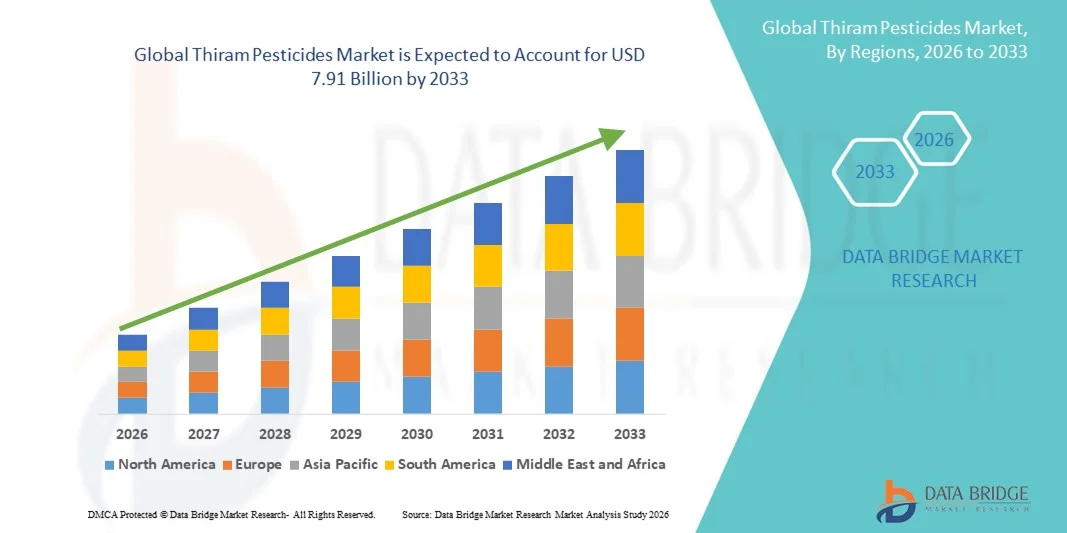
- The global thiram pesticides market size was valued at USD 5.87 billion in 2025 and is expected to reach USD 7.91 billion by 2033, at a CAGR of 3.80% during the forecast period
- The decline in arable land across the globe acts as one of the major factors driving the growth of thiram pesticides market. The increase in demand for thiram pesticides as they are highly effective against damping off, neck rot of onion, smut of millet, and stem gall of coriander, among others, and increase in emphasis on integrated pest management solutions accelerate the market growth
Market Size & Forecast
- Global Market Value (2025): USD 5.87 billion
- Expected Market Value (2033): USD 7.91 billion
- Forecast CAGR (2025–2033): 3.80%
What are the Major Takeaways of Thiram Pesticides Market?
- The surge in the government and public organizations supporting agricultural activities and increase in the concerns regarding food safety worldwide further influence the market
- In addition, rise in population, increase in pest attacks and expansion of agriculture sector positively affect the thiram pesticides market. Furthermore, research and development for enhancing the pesticide extend profitable opportunities to the market players
- North America dominated the thiram pesticides market with an estimated 39.36% revenue share in 2025, driven by extensive adoption of fungicides across large-scale commercial farming, seed treatment operations, and advanced agricultural practices in the U.S. and Canada
- Asia-Pacific is projected to register the fastest CAGR of 8.9% from 2026 to 2033, driven by rapid semiconductor expansion, strong electronics manufacturing ecosystems, 5G deployment, and rising adoption of embedded systems across China, Japan, India, South Korea, and Southeast Asia
- The 50% WP segment dominated the market with an estimated 58.6% share in 2025, owing to its widespread usage in seed treatment and foliar applications across cereals, oilseeds, and horticultural crops
 Report Scope and Thiram Pesticides Market Segmentation
|
Attributes |
Thiram Pesticides Key Market Insights |
|
Segments Covered |
|
|
Countries Covered |
North America
Europe
Asia-Pacific
Middle East and Africa
South America
|
|
Key Market Players |
|
|
Market Opportunities |
|
|
Value Added Data Infosets |
|
What is the Key Trend in the Thiram Pesticides Market?
Increasing Shift Toward Safer, Integrated, and Regulation-Compliant Thiram Formulations
- The thiram pesticides market is witnessing a growing shift toward low-dust, seed-treatment, and combination fungicide formulations to improve application safety and efficacy
- Manufacturers are focusing on improved formulation technologies that enhance adhesion, uniform coating, and prolonged protection against fungal diseases
- Rising emphasis on integrated pest management (IPM) practices is driving demand for Thiram as a preventive fungicide in seed treatment programs
- For instance, leading agrochemical companies are optimizing Thiram blends for use with other contact fungicides to broaden disease control spectrum
- Increasing regulatory scrutiny is encouraging the development of controlled-dose and compliant application methods
- As sustainable agriculture gains momentum, Thiram Pesticides will remain important for seed protection, disease prevention, and crop yield stability
What are the Key Drivers of Thiram Pesticides Market?
- Rising demand for effective seed treatment fungicides to protect crops during early growth stages
- For instance, in 2024–2025, several agrochemical manufacturers expanded Thiram-based seed protection solutions for cereals, oilseeds, fruits, and vegetables
- Growing cultivation of high-value crops and hybrid seeds is boosting the use of preventive fungicides
- Increasing awareness about crop loss prevention and yield improvement supports market demand
- Expansion of commercial agriculture in Asia-Pacific, Latin America, and Africa is accelerating Thiram adoption
- Supported by expanding agricultural inputs markets and food security initiatives, the Thiram Pesticides market is expected to witness steady long-term growth
Which Factor is Challenging the Growth of the Thiram Pesticides Market?
- Stringent environmental and regulatory restrictions on dithiocarbamate fungicides limit market expansion in certain regions
- For instance, during 2024–2025, tighter residue limits and safety regulations impacted Thiram usage in parts of Europe and North America
- Rising concerns regarding toxicity, environmental persistence, and worker safety create compliance challenges
- Increasing availability of bio-based and alternative fungicides intensifies competitive pressure
- Price sensitivity among small farmers in developing regions affects consistent adoption
- To address these challenges, companies are focusing on regulatory-compliant formulations, safer application methods, and combination products to sustain market presence
How is the Thiram Pesticides Market Segmented?
The market is segmented on the basis of type and application.
- By Type
On the basis of type, the thiram pesticides market is segmented into 50% WP and <50% WP. The 50% WP segment dominated the market with an estimated 58.6% share in 2025, owing to its widespread usage in seed treatment and foliar applications across cereals, oilseeds, and horticultural crops. This formulation offers higher concentration, better efficacy against fungal pathogens, and cost efficiency for large-scale agricultural use. Farmers prefer 50% WP due to its proven performance, ease of mixing, and compatibility with integrated pest management practices.
The <50% WP segment is expected to grow at the fastest CAGR from 2026 to 2033, driven by rising regulatory focus on controlled dosage, reduced chemical exposure, and safer handling. Increasing adoption among smallholder farmers and growing preference for lower-concentration formulations in sensitive crops further support segment growth.
- By Application
On the basis of application, the thiram pesticides market is segmented into Crops, Fruits, Vegetables, and Other applications. The Crops segment dominated the market with a 46.9% share in 2025, supported by extensive use of Thiram in seed treatment for cereals, pulses, oilseeds, and commercial crops. Its effectiveness in preventing seed-borne and soil-borne fungal diseases makes it a preferred choice for large-scale crop protection programs. Rising demand for yield stability and early-stage crop protection further strengthens this segment.
The Fruits and Vegetables segment is projected to register the fastest CAGR from 2026 to 2033, driven by increasing cultivation of high-value produce, growing awareness of fungal disease management, and rising adoption of preventive fungicide treatments. Expansion of horticulture farming and export-oriented production continues to accelerate demand in this segment.
Which Region Holds the Largest Share of the Thiram Pesticides Market?
- North America dominated the thiram pesticides market with an estimated 39.36% revenue share in 2025, driven by extensive adoption of fungicides across large-scale commercial farming, seed treatment operations, and advanced agricultural practices in the U.S. and Canada. High awareness of crop protection, strong regulatory compliance, and widespread use of certified seeds continue to support strong demand for Thiram-based formulations across cereals, oilseeds, fruits, and vegetables
- Leading agrochemical companies in North America are investing in improved Thiram formulations with enhanced efficacy, better dispersion, and reduced environmental impact, strengthening regional market leadership
- Well-established distribution networks, high mechanization in agriculture, and strong farmer purchasing power further reinforce North America’s dominant market position
U.S. Thiram Pesticides Market Insight
In the U.S., Thiram pesticides dominate seed treatment and foliar applications across corn, wheat, soybean, and horticultural crops. High adoption is driven by modern farming practices, regulatory compliance, and emphasis on yield protection. Large-scale commercial farms, strong agrochemical R&D, and well-established distribution channels further fuel market growth. Farmers increasingly rely on Thiram formulations for disease prevention and quality crop output, strengthening the U.S.’s contribution to North America’s market leadership.
Canada Thiram Pesticides Market Insight
In Canada, Thiram pesticides are widely used in cereal, oilseed, and vegetable cultivation, driven by large grain farming and disease-prone climates. Adoption is supported by government-backed agricultural programs, rising awareness of seed treatment benefits, and increasing mechanization. Strong distribution networks and high-quality agricultural inputs enable consistent application of Thiram products, boosting crop protection efficiency and reinforcing Canada’s significant role in the North American Thiram pesticides market.
Asia-Pacific Thiram Pesticides Market
Asia-Pacific is projected to register the fastest CAGR of 8.9% from 2026 to 2033, driven by rapid semiconductor expansion, strong electronics manufacturing ecosystems, 5G deployment, and rising adoption of embedded systems across China, Japan, India, South Korea, and Southeast Asia. High-volume production of consumer electronics, automotive ECUs, PCBs, and IoT devices increases demand for efficient signal analysis tools. Growth in AI hardware, smart devices, industrial automation, and digital infrastructure continues to accelerate the need for portable, high-accuracy logic analyzers across engineering and manufacturing applications.
China Thiram Pesticides Market Insight
In China, Thiram pesticides are extensively applied to cereals, fruits, and vegetables to protect yields from fungal infections. Large-scale agriculture, strong domestic production of agrochemicals, and rising demand for food security drive market growth. Government incentives for modern farming and quality produce encourage widespread adoption of Thiram formulations. Continuous investment in agrochemical innovation and growing awareness of disease prevention further solidifies China’s dominant position within Asia-Pacific.
Japan Thiram Pesticides Market Insight
In Japan, Thiram pesticides see steady demand across horticultural and specialty crops, supported by precision farming and strict agricultural regulations. The market is driven by a focus on quality produce, disease prevention, and environmental compliance. Farmers adopt advanced Thiram formulations to maintain crop health and yield consistency. Innovation in application technologies and continued emphasis on sustainable crop protection ensure stable growth in Japan’s Thiram pesticides market.
India Thiram Pesticides Market Insight
In India, Thiram pesticides are widely used for cereals, fruits, and vegetable crops to combat fungal diseases. Growth is driven by expanding cultivated area, government initiatives for agricultural productivity, and rising farmer awareness about seed treatment and crop protection. Increasing adoption of modern agrochemicals and mechanized farming techniques fuels demand. India is emerging as a key high-growth market within Asia-Pacific for Thiram pesticides.
South Korea Thiram Pesticides Market Insight
In South Korea, Thiram pesticides are used extensively in high-value crops such as fruits and vegetables to prevent fungal infections. Adoption is driven by advanced agricultural practices, government support for crop protection, and growing focus on food safety and quality. Farmers increasingly rely on Thiram formulations for effective disease management, while technological innovations in application methods enhance efficiency. South Korea plays a key role in strengthening Asia-Pacific’s fast-growing Thiram pesticides market.
Which are the Top Companies in Thiram Pesticides Market?
The thiram pesticides industry is primarily led by well-established companies, including:
- BASF SE (Germany)
- Bayer AG (Germany)
- Corteva, Inc. (U.S.)
- Syngenta AG (Switzerland)
- FMC Corporation (U.S.)
- UPL Ltd. (India)
- Sumitomo Chemical Co., Ltd. (Japan)
- Nippon Soda Co. Ltd. (Japan)
- ADAMA Agricultural Solutions Ltd. (Israel)
- Nissan Chemical Corporation (Japan)
- Marrone Bio Innovations, Inc. (U.S.)
- Koppert Biological Systems (Netherlands)
- Bioworks, Inc. (U.S.)
- STK Bio-ag Technologies (Israel)
- Verdesian Life Sciences (U.S.)
- Seipasa S.A. (Spain)
- Ishihara Sangyo Kaisha, Ltd. (Japan)

- Interactive Data Analysis Dashboard
- Company Analysis Dashboard for high growth potential opportunities
- Research Analyst Access for customization & queries
- Competitor Analysis with Interactive dashboard
- Latest News, Updates & Trend analysis
- Harness the Power of Benchmark Analysis for Comprehensive Competitor Tracking
Data collection and base year analysis are done using data collection modules with large sample sizes. The stage includes obtaining market information or related data through various sources and strategies. It includes examining and planning all the data acquired from the past in advance. It likewise envelops the examination of information inconsistencies seen across different information sources. The market data is analysed and estimated using market statistical and coherent models. Also, market share analysis and key trend analysis are the major success factors in the market report. To know more, please request an analyst call or drop down your inquiry.
The key research methodology used by DBMR research team is data triangulation which involves data mining, analysis of the impact of data variables on the market and primary (industry expert) validation. Data models include Vendor Positioning Grid, Market Time Line Analysis, Market Overview and Guide, Company Positioning Grid, Patent Analysis, Pricing Analysis, Company Market Share Analysis, Standards of Measurement, Global versus Regional and Vendor Share Analysis. To know more about the research methodology, drop in an inquiry to speak to our industry experts.
Data Bridge Market Research is a leader in advanced formative research. We take pride in servicing our existing and new customers with data and analysis that match and suits their goal. The report can be customized to include price trend analysis of target brands understanding the market for additional countries (ask for the list of countries), clinical trial results data, literature review, refurbished market and product base analysis. Market analysis of target competitors can be analyzed from technology-based analysis to market portfolio strategies. We can add as many competitors that you require data about in the format and data style you are looking for. Our team of analysts can also provide you data in crude raw excel files pivot tables (Fact book) or can assist you in creating presentations from the data sets available in the report.