


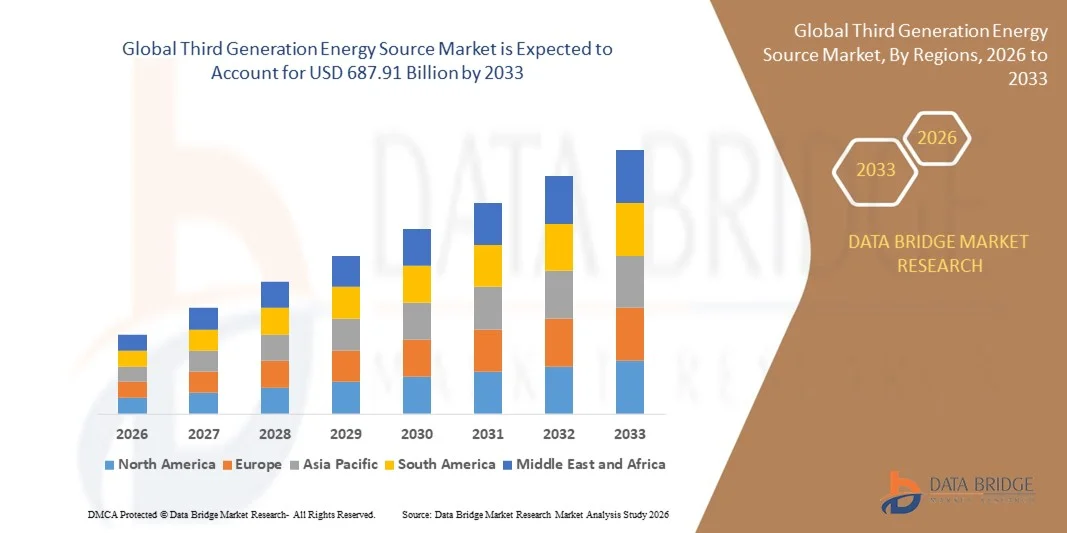
Global Third Generation Energy Source Market Size
- The global Third Generation Energy Source Market size was valued at USD 46.08 billion in 2025 and is projected to reach USD 687.91 billion by 2033, growing at a CAGR of 40.20% during the forecast period.
- The market expansion is primarily driven by increasing investments in advanced energy technologies and growing adoption of sustainable and renewable energy solutions across industrial, commercial, and residential sectors.
- Additionally, supportive government policies, rising environmental concerns, and the shift toward low-carbon energy sources are encouraging innovation and deployment of third-generation energy systems, thereby accelerating market growth and adoption worldwide.
Global Third Generation Energy Source Market Analysis
- Third Generation Energy Sources, encompassing advanced nuclear, concentrated solar, and next-generation bioenergy technologies, are becoming critical components of the global energy mix due to their enhanced efficiency, lower carbon emissions, and ability to support grid stability across industrial, commercial, and residential applications.
- The rising demand for third-generation energy solutions is primarily driven by increasing emphasis on sustainable energy adoption, stringent environmental regulations, and growing investments in decarbonization initiatives across both developed and emerging economies.
- North America dominated the Global Third Generation Energy Source Market with the largest revenue share of 35.4% in 2025, supported by early adoption of advanced energy technologies, strong R&D infrastructure, and government incentives for clean energy projects, with the U.S. witnessing significant deployment of next-generation nuclear and solar technologies backed by both established energy companies and innovative startups.
- Asia-Pacific is expected to be the fastest-growing region in the Global Third Generation Energy Source Market during the forecast period, driven by rapid industrialization, increasing energy demand, and proactive government policies promoting renewable and low-carbon energy solutions.
- The bioethanol segment dominated the market with the largest revenue share of 42.5% in 2025, driven by its widespread adoption in transportation fuels, compatibility with existing fuel infrastructure, and strong governmental support in regions like North America and Europe.
Report Scope and Global Third Generation Energy Source Market Segmentation
|
Attributes |
Third Generation Energy Source Key Market Insights |
|
Segments Covered |
|
|
Countries Covered |
North America
Europe
Asia-Pacific
Middle East and Africa
South America
|
|
Key Market Players |
|
|
Market Opportunities |
|
|
Value Added Data Infosets |
In addition to the insights on market scenarios such as market value, growth rate, segmentation, geographical coverage, and major players, the market reports curated by the Data Bridge Market Research also include import export analysis, production capacity overview, production consumption analysis, price trend analysis, climate change scenario, supply chain analysis, value chain analysis, raw material/consumables overview, vendor selection criteria, PESTLE Analysis, Porter Analysis, and regulatory framework. |
Global Third Generation Energy Source Market Trends
Enhanced Efficiency Through AI and Smart Grid Integration
- A significant and accelerating trend in the Global Third Generation Energy Source Market is the deepening integration with artificial intelligence (AI) and advanced smart grid management systems. This convergence is significantly enhancing operational efficiency, predictive maintenance, and real-time energy optimization across industrial, commercial, and residential applications.
- For instance, AI-powered energy management platforms can optimize the output of next-generation nuclear plants or concentrated solar installations, adjusting generation schedules based on real-time demand, weather patterns, and grid conditions. Similarly, predictive algorithms enable bioenergy facilities to manage feedstock usage more efficiently, reducing waste and operational costs.
- AI integration in third-generation energy systems enables features such as predictive maintenance to minimize downtime, real-time performance analytics to optimize energy output, and anomaly detection to prevent equipment failures. For example, some advanced nuclear facilities use AI to monitor reactor conditions and improve safety protocols, while smart solar farms employ machine learning to maximize energy capture under variable weather conditions.
- The seamless integration of third-generation energy sources with smart grids and digital energy platforms facilitates centralized monitoring and control across multiple generation sites. Through a single interface, operators can manage energy production, storage, and distribution, creating a more resilient and automated energy network.
- This trend toward more intelligent, interconnected, and optimized energy systems is fundamentally reshaping expectations for efficiency, reliability, and sustainability. Consequently, companies such as GE Hitachi, Westinghouse, and Siemens Energy are developing AI-enabled energy solutions with predictive analytics, automated control systems, and smart grid compatibility.
- The demand for third-generation energy solutions that incorporate AI and smart grid integration is growing rapidly across global markets, as governments, utilities, and industrial operators increasingly prioritize operational efficiency, sustainability, and grid stability.
Global Third Generation Energy Source Market Dynamics
Driver
Growing Need Due to Rising Energy Demand and Sustainability Goals
- The increasing global energy demand, combined with heightened emphasis on sustainability and decarbonization, is a significant driver for the heightened adoption of third-generation energy sources.
- For instance, in 2025, EDF Energy announced the expansion of its next-generation nuclear projects in Europe, aiming to integrate advanced safety systems and digital monitoring technologies. Such strategic initiatives by leading companies are expected to drive the growth of the third-generation energy market during the forecast period.
- As governments, utilities, and industries seek cleaner and more efficient energy alternatives, third-generation energy sources—such as advanced nuclear, concentrated solar power, and next-generation bioenergy—offer high efficiency, lower carbon emissions, and grid stability benefits, providing a compelling advantage over conventional fossil fuel-based systems.
- Furthermore, the global push for energy security, climate change mitigation, and compliance with stricter environmental regulations is accelerating the deployment of third-generation energy technologies. Integration with smart grids and energy storage systems enhances their operational flexibility and reliability, making them increasingly attractive for both developed and emerging economies.
- The scalability, long-term cost benefits, and potential for integration with renewable and distributed energy systems are key factors propelling the adoption of third-generation energy sources across industrial, commercial, and residential sectors. Initiatives supporting public-private partnerships, subsidies, and government incentives further strengthen market growth prospects.
Restraint/Challenge
High Initial Investment Costs and Regulatory Hurdles
-
High capital expenditures required for deploying third-generation energy systems, particularly advanced nuclear and concentrated solar installations, pose a significant challenge to broader market adoption. The need for specialized infrastructure, safety measures, and skilled labor adds to the initial cost burden.
- For instance, new nuclear projects in Europe and North America often face budget overruns and extended construction timelines due to stringent safety regulations and licensing requirements, making investors cautious about immediate returns.
- Addressing these financial and regulatory challenges through government subsidies, financing mechanisms, and streamlined permitting processes is crucial for market growth. Companies such as Westinghouse, GE Hitachi, and Siemens Energy emphasize modular designs, digital monitoring, and automation to reduce construction and operational costs over time.
- Additionally, public perception and policy barriers related to nuclear energy safety and large-scale energy projects can slow adoption, particularly in regions with stringent regulatory frameworks or low public acceptance.
- Overcoming these challenges through technological innovation, cost optimization, regulatory support, and public awareness campaigns will be vital to sustaining the long-term growth of the third-generation energy source market.
Global Third Generation Energy Source Market Scope
The third generation energy source market is segmented on the basis of biofuel type, feedstock and application.
- By Biofuel Type
On the basis of biofuel type, the Global Third Generation Energy Source Market is segmented into bioethanol, biodiesel, biobutanol, and bio-DME. The bioethanol segment dominated the market with the largest revenue share of 42.5% in 2025, driven by its widespread adoption in transportation fuels, compatibility with existing fuel infrastructure, and strong governmental support in regions like North America and Europe. Bioethanol is favored for its ability to reduce greenhouse gas emissions while maintaining engine performance, making it a preferred choice among automotive manufacturers and fuel suppliers.
The biodiesel segment is anticipated to witness the fastest CAGR of 22.3% from 2026 to 2033, fueled by growing demand for renewable diesel alternatives in the transportation and industrial sectors. Increasing awareness of carbon reduction and incentives for cleaner fuels in emerging economies are expected to drive rapid adoption of biodiesel technologies globally.
- By Feedstock
On the basis of feedstock, the Global Third Generation Energy Source Market is segmented into simple lignocellulose, syngas and biomass, complex lignocellulose, and algae. The simple lignocellulose segment held the largest market revenue share of 38.7% in 2025, supported by its abundance, cost-effectiveness, and well-established conversion technologies for producing biofuels and energy. Simple lignocellulosic feedstocks such as sugarcane bagasse, corn stover, and wheat straw are widely utilized in both industrial and transportation biofuel production, making them a dominant choice for commercial deployment.
The algae feedstock segment is expected to witness the fastest CAGR of 24.1% from 2026 to 2033, driven by its high energy yield, rapid growth potential, and ability to capture CO₂ emissions during cultivation. Advances in algae cultivation, extraction technologies, and bio-refinery integration are expected to fuel significant growth in this segment, particularly for sustainable fuel production in regions with limited agricultural land.
- By Application
On the basis of application, the Global Third Generation Energy Source Market is segmented into transportation and power generation. The transportation segment dominated the market with the largest revenue share of 56.3% in 2025, supported by strong adoption of biofuels as an alternative to conventional fossil fuels, government mandates for ethanol and biodiesel blending, and growing demand for low-emission fuels in commercial and passenger vehicles. Biofuels provide a direct and scalable solution to reduce carbon emissions in the transportation sector, particularly in countries with high vehicle density and strong regulatory frameworks.
The power generation segment is expected to witness the fastest CAGR of 21.5% from 2026 to 2033, driven by increasing deployment of biomass-to-power plants, distributed energy generation solutions, and the integration of bioenergy with smart grids. Rising global electricity demand, coupled with the push for renewable power solutions, is expected to accelerate the adoption of third-generation bioenergy technologies in the power sector.
Global Third Generation Energy Source Market Regional Analysis
- North America dominated the Global Third Generation Energy Source Market with the largest revenue share of 35.4% in 2025, driven by strong investments in advanced energy technologies, supportive government policies, and increasing demand for low-carbon and renewable energy solutions.
- Energy producers and utilities in the region are rapidly adopting third-generation energy sources such as advanced nuclear, concentrated solar power, and next-generation bioenergy due to their efficiency, reliability, and compatibility with modern grid infrastructure.
- This widespread adoption is further supported by well-established research and development ecosystems, high technological expertise, and substantial financial resources, enabling large-scale deployment of innovative energy solutions. The focus on sustainability, energy security, and decarbonization positions North America as a leading market for third-generation energy technologies across industrial, commercial, and residential sectors.
U.S. Third Generation Energy Source Market Insight
The U.S. third-generation energy source market captured the largest revenue share of 82% in North America in 2025, driven by strong government support for low-carbon technologies, significant investments in advanced nuclear and bioenergy projects, and increasing adoption of renewable energy sources across industrial, commercial, and residential sectors. Utilities and energy producers are prioritizing cleaner, efficient, and reliable energy solutions to meet sustainability goals and regulatory mandates. The integration of advanced monitoring, digital control systems, and smart grid technologies further enhances the market growth, enabling optimized energy management and reducing operational costs.
Europe Third Generation Energy Source Market Insight
The Europe third-generation energy source market is projected to expand at a substantial CAGR throughout the forecast period, fueled by strict environmental regulations, strong decarbonization policies, and increasing investments in next-generation nuclear, biomass, and solar energy projects. Growing awareness of climate change and energy efficiency, coupled with government incentives for renewable and low-emission energy, is driving adoption across residential, industrial, and commercial applications. Countries such as France, Spain, and Italy are witnessing significant deployment of bioenergy and advanced nuclear technologies to achieve their renewable energy targets.
U.K. Third Generation Energy Source Market Insight
The U.K. third-generation energy source market is anticipated to grow at a noteworthy CAGR during the forecast period, supported by the nation’s commitment to net-zero targets, decarbonization initiatives, and increasing deployment of advanced biofuels and nuclear energy projects. Rising demand for reliable and low-emission energy solutions, combined with investments in research, innovation, and digital energy infrastructure, is driving market expansion. The U.K.’s strong regulatory framework and focus on sustainability are encouraging energy producers to adopt third-generation energy technologies across power generation and transportation applications.
Germany Third Generation Energy Source Market Insight
The Germany third-generation energy source market is expected to expand at a considerable CAGR during the forecast period, driven by the country’s emphasis on sustainable energy, renewable integration, and energy security. Advanced nuclear and bioenergy technologies are increasingly being adopted to reduce reliance on fossil fuels, meet regulatory targets, and support industrial and commercial energy needs. Germany’s focus on innovation, environmental responsibility, and digital energy management promotes large-scale deployment of third-generation energy solutions, particularly in smart grids and distributed power systems.
Asia-Pacific Third Generation Energy Source Market Insight
The Asia-Pacific third-generation energy source market is poised to grow at the fastest CAGR of 24% during 2026–2033, driven by rising energy demand, rapid industrialization, and urbanization in countries such as China, India, and Japan. Increasing government investments in renewable energy projects, sustainable infrastructure development, and digital energy solutions are supporting the adoption of third-generation energy sources. The region’s expanding manufacturing capabilities for biofuels, solar technologies, and next-generation nuclear components are improving affordability and accessibility, further boosting market growth.
Japan Third Generation Energy Source Market Insight
The Japan third-generation energy source market is gaining momentum due to the country’s advanced technological capabilities, strong focus on energy security, and commitment to reducing carbon emissions. Japan is actively investing in next-generation nuclear and bioenergy projects, integrating smart grid technologies, and promoting digital energy management systems. Rising urbanization and the increasing need for reliable, efficient, and low-emission energy sources in residential, industrial, and commercial sectors are further fueling market adoption.
China Third Generation Energy Source Market Insight
The China third-generation energy source market accounted for the largest market revenue share in Asia-Pacific in 2025, driven by the country’s rapidly growing energy demand, expanding industrial base, and strong government policies supporting renewable and low-carbon energy solutions. China’s push for smart cities, renewable integration, and large-scale deployment of advanced biofuels and nuclear technologies is accelerating market growth. Strong domestic manufacturing capabilities, coupled with increasing urbanization and investments in sustainable energy infrastructure, are key factors driving the market in China.
Global Third Generation Energy Source Market Share
The Third Generation Energy Source industry is primarily led by well-established companies, including:
• GE Renewable Energy (U.S.)
• Siemens Energy (Germany)
• Neste Corporation (Finland)
• Shell Energy (Netherlands)
• TotalEnergies (France)
• BP Biofuels (U.K.)
• NextGen Biofuels Inc. (U.S.)
• Vattenfall AB (Sweden)
• Enel Green Power (Italy)
• Invenergy (U.S.)
• ACWA Power (Saudi Arabia)
• China National Offshore Oil Corporation – Bioenergy Division (China)
• BYD Energy (China)
• ReNew Power (India)
• Tata Power Renewable Energy (India)
• Orsted (Denmark)
• Climeworks (Switzerland)
• ENGIE (France)
• Ørsted Bioenergy Solutions (Denmark)
• Jiangsu Guotai International Group – Bio-DME Division (China)
What are the Recent Developments in Global Third Generation Energy Source Market?
- In April 2024, GE Renewable Energy, a global leader in advanced energy solutions, launched a strategic initiative in South Africa to deploy its next-generation bioenergy and concentrated solar power systems. This initiative emphasizes GE’s commitment to delivering reliable, sustainable energy solutions tailored to the unique energy demands of emerging markets. By leveraging its global expertise and advanced technologies, GE is addressing regional energy challenges while strengthening its position in the rapidly growing global third-generation energy source market.
- In March 2024, NextGen Biofuels Inc., a U.S.-based clean energy company, introduced its advanced bioethanol production platform, specifically designed to supply transportation and industrial sectors with low-carbon, high-efficiency fuel. The innovative system aims to reduce greenhouse gas emissions while meeting rising energy demands, highlighting NextGen’s commitment to advancing sustainable energy technologies globally.
- In March 2024, Siemens Energy successfully deployed the Bengaluru Smart Energy Project, aimed at integrating advanced nuclear and renewable energy solutions into urban power infrastructure. This initiative leverages cutting-edge energy management systems and digital grid technologies to enhance reliability, efficiency, and sustainability, demonstrating Siemens’ dedication to shaping resilient, low-carbon urban energy networks.
- In February 2024, Neste Corporation, a global leader in renewable fuels, announced a strategic partnership with the European Clean Energy Association to expand the distribution of sustainable biofuels across key industrial and transportation hubs. This collaboration is designed to enhance energy accessibility, reduce carbon emissions, and support regional sustainability targets, reinforcing Neste’s commitment to innovative energy solutions.
- In January 2024, Shell Energy unveiled its Next-Gen Hydrogen and Bio-DME Pilot Program at the World Energy Congress 2024. The project focuses on providing high-efficiency, low-emission energy solutions for industrial and transportation applications. By integrating advanced production and distribution technologies, Shell is offering scalable and sustainable alternatives to conventional fossil fuels, demonstrating its commitment to accelerating the adoption of third-generation energy sources worldwide.

- Interactive Data Analysis Dashboard
- Company Analysis Dashboard for high growth potential opportunities
- Research Analyst Access for customization & queries
- Competitor Analysis with Interactive dashboard
- Latest News, Updates & Trend analysis
- Harness the Power of Benchmark Analysis for Comprehensive Competitor Tracking
Global Third Generation Energy Source Market, Supply Chain Analysis and Ecosystem Framework
To support market growth and help clients navigate the impact of geopolitical shifts, DBMR has integrated in-depth supply chain analysis into its Global Third Generation Energy Source Market research reports. This addition empowers clients to respond effectively to global changes affecting their industries. The supply chain analysis section includes detailed insights such as Global Third Generation Energy Source Market consumption and production by country, price trend analysis, the impact of tariffs and geopolitical developments, and import and export trends by country and HSN code. It also highlights major suppliers with data on production capacity and company profiles, as well as key importers and exporters. In addition to research, DBMR offers specialized supply chain consulting services backed by over a decade of experience, providing solutions like supplier discovery, supplier risk assessment, price trend analysis, impact evaluation of inflation and trade route changes, and comprehensive market trend analysis.
Data collection and base year analysis are done using data collection modules with large sample sizes. The stage includes obtaining market information or related data through various sources and strategies. It includes examining and planning all the data acquired from the past in advance. It likewise envelops the examination of information inconsistencies seen across different information sources. The market data is analysed and estimated using market statistical and coherent models. Also, market share analysis and key trend analysis are the major success factors in the market report. To know more, please request an analyst call or drop down your inquiry.
The key research methodology used by DBMR research team is data triangulation which involves data mining, analysis of the impact of data variables on the market and primary (industry expert) validation. Data models include Vendor Positioning Grid, Market Time Line Analysis, Market Overview and Guide, Company Positioning Grid, Patent Analysis, Pricing Analysis, Company Market Share Analysis, Standards of Measurement, Global versus Regional and Vendor Share Analysis. To know more about the research methodology, drop in an inquiry to speak to our industry experts.
Data Bridge Market Research is a leader in advanced formative research. We take pride in servicing our existing and new customers with data and analysis that match and suits their goal. The report can be customized to include price trend analysis of target brands understanding the market for additional countries (ask for the list of countries), clinical trial results data, literature review, refurbished market and product base analysis. Market analysis of target competitors can be analyzed from technology-based analysis to market portfolio strategies. We can add as many competitors that you require data about in the format and data style you are looking for. Our team of analysts can also provide you data in crude raw excel files pivot tables (Fact book) or can assist you in creating presentations from the data sets available in the report.













