


Thoracic Drainage Devices Market Overview
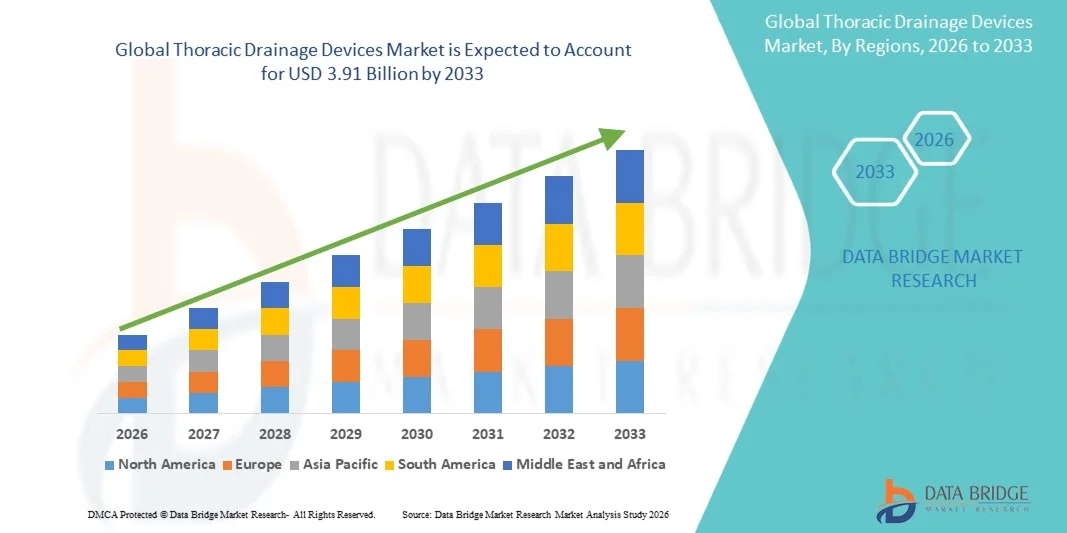
The Thoracic Drainage Devices Market was valued at USD 1.97 billion in 2025 and is projected to reach USD 3.91 billion by 2033, growing at a CAGR of 8.95% from 2026 to 2033. The Thoracic Drainage Devices Market is experiencing steady growth driven by the rising prevalence of respiratory disorders, increasing number of thoracic and cardiovascular surgeries, and growing demand for effective pleural fluid and air drainage management solutions across hospitals and emergency care settings.
The increasing incidence of chronic pulmonary diseases, traumatic chest injuries, pleural effusion, pneumothorax, and lung cancer globally, combined with the growing aging population and expanding surgical volumes, is accelerating the adoption of advanced thoracic drainage devices. Healthcare providers are increasingly utilizing digital thoracic drainage systems and minimally invasive drainage technologies to improve patient monitoring, reduce hospital stay duration, and enhance post-operative recovery outcomes. In addition, advancements in portable drainage systems, rising investments in critical care infrastructure, and increasing adoption of technologically advanced drainage solutions across developed and emerging healthcare markets continue to support market expansion.
Key Market Trends & Insights
- North America dominated the Thoracic Drainage Devices Market with the largest revenue share of 39.12% in 2025, supported by advanced critical care infrastructure, high volume of thoracic and cardiovascular surgeries, strong adoption of digital drainage systems, and increasing prevalence of chronic respiratory diseases and trauma cases across the United States and Canada.
- The Thoracic Drainage System segment dominated the market with a 38.92% share in 2025, owing to its widespread use in hospital-based emergency care, post-surgical fluid management, and intensive care unit (ICU) procedures
- Asia-Pacific is expected to be the fastest-growing region at a CAGR of 7.6% from 2026 to 2033, fueled by rising healthcare expenditure, expanding hospital infrastructure, increasing burden of respiratory diseases, and growing access to advanced surgical care across China, India, and Japan.
- The Thoracic Drainage System segment dominated the market by product type with a 34.85% revenue share in 2025, owing to its widespread use in post-operative chest drainage, trauma care, and management of pleural effusion and pneumothorax in hospital settings.
- The Hospitals and Specialty Clinics segment led the market by end use with a 52.41% share in 2025, supported by high patient inflow for thoracic surgeries, availability of skilled healthcare professionals, and increasing adoption of advanced drainage and monitoring systems in critical care units.
- The Thoracic Surgery and Pulmonology segment dominated the market by application with a 46.28% revenue share in 2025, driven by rising incidence of lung cancer, COPD-related complications, and increasing number of thoracic surgical procedures globally.
- The Ambulatory Surgery Centers segment is expected to be the fastest-growing end-use category, registering a CAGR of 7.9% from 2026 to 2033, due to the growing shift toward outpatient procedures, cost-effective surgical care, and faster patient recovery models.
Market Size & Forecast
- Global Market Value (2025): USD 1.97 Billion
- Expected Market Value (2033): USD 3.91 Billion
- Forecast CAGR (2026–2033): 8.95%
- Leading Region in 2025: North America
- Fastest Growing Region: Asia-Pacific
Report Scope and Thoracic Drainage Devices Market Segmentation
|
Attributes |
Thoracic Drainage Devices Key Market Insights |
|
Segments Covered |
|
|
Countries Covered |
North America · U.S. · Canada · Mexico Europe · Germany · France · U.K. · Netherlands · Switzerland · Belgium · Russia · Italy · Spain · Turkey · Rest of Europe Asia-Pacific · China · Japan · India · South Korea · Singapore · Malaysia · Australia · Thailand · Indonesia · Philippines · Rest of Asia-Pacific Middle East and Africa · Saudi Arabia · U.A.E. · South Africa · Egypt · Israel · Rest of Middle East and Africa South America · Brazil · Argentina · Rest of South America |
|
Key Market Players |
• Medtronic plc (Ireland) |
|
Market Opportunities |
· Rising adoption of digital thoracic drainage systems · Growth in minimally invasive thoracic procedures · Expanding critical care and emergency infrastructure in emerging markets |
|
Value Added Data Infosets |
In addition to the insights on market scenarios such as market value, growth rate, segmentation, geographical coverage, and major players, the market reports curated by the Data Bridge Market Research also include in-depth expert analysis, geographically represented company-wise production and capacity, network layouts of distributors and partners, detailed and updated price trend analysis and deficit analysis of supply chain and demand. |
Thoracic Drainage Devices Market Trends
Trend: Rising Adoption of Advanced Thoracic Drainage Systems in Critical Care & Surgical Management
Hospitals and specialty clinics are increasingly adopting advanced thoracic drainage devices, including digital drainage systems and closed suction technologies, to improve patient monitoring and reduce post-operative complications in thoracic surgery and intensive care units. The growing burden of pleural effusion, pneumothorax, lung cancer surgeries, and trauma-related chest injuries is significantly driving device utilization. According to global clinical estimates, pleural diseases affect millions of patients annually, while lung cancer remains one of the leading causes of cancer-related mortality, accounting for nearly 1.8 million deaths worldwide each year (WHO). This has led to increased reliance on thoracic drainage systems for effective fluid and air evacuation, improved lung re-expansion, and reduced hospital stay durations. In addition, the integration of digital suction control, closed drainage systems, and portable post-operative kits is enhancing patient safety and clinical efficiency across developed and emerging healthcare markets.
Thoracic Drainage Devices Market Dynamics
Key Market Driver: Rising Burden of Respiratory Diseases and Increasing Surgical Interventions
The global demand for thoracic drainage devices is primarily driven by the increasing prevalence of chronic respiratory diseases such as COPD, pleural effusion, pneumonia complications, and lung cancer. According to the World Health Organization (WHO), COPD is responsible for over 3.5 million deaths annually, making it a leading cause of mortality worldwide. In addition, rising trauma cases from road accidents and emergency chest injuries are further increasing the need for rapid and effective pleural drainage solutions in emergency medicine. The growing number of thoracic and cardiac surgical procedures globally—estimated in tens of millions annually across hospital systems—has strengthened the adoption of thoracic drainage systems as a standard post-operative care component. Furthermore, increasing geriatric population, expanding ICU infrastructure, and rising awareness about minimally invasive post-surgical care are accelerating market growth across North America, Europe, and Asia-Pacific.
Key Restraint/Challenge: High Cost and Limited Access in Emerging Healthcare Systems
A major restraint in the Thoracic Drainage Devices Market is the high cost associated with advanced drainage systems, particularly digital and automated suction-controlled devices. These systems require specialized components, continuous maintenance, and trained clinical personnel, increasing overall treatment costs for healthcare providers. In low- and middle-income countries, limited healthcare funding, inadequate ICU infrastructure, and lack of trained thoracic care specialists restrict widespread adoption. For example, many hospitals in emerging markets still rely on conventional chest tube drainage systems due to affordability constraints, despite the availability of more advanced digital alternatives. In addition, reimbursement limitations and inconsistent procurement policies in public healthcare systems further slow market penetration, particularly for premium and technologically advanced drainage devices.
Key Market Opportunity: Advancements in Digital Drainage Systems and Portable Home-Care Solutions
The development of digital thoracic drainage systems, smart suction control devices, and portable drainage kits presents a significant growth opportunity in the global market. These systems enable real-time monitoring of air leaks, fluid output, and pressure levels, improving post-operative decision-making and reducing complications such as prolonged air leaks and infections. Companies are increasingly focusing on lightweight, ambulatory drainage solutions that allow early patient mobility and faster discharge from hospitals. The rising shift toward outpatient surgical procedures and home-based post-operative care is expected to significantly boost demand for compact and user-friendly drainage devices. Additionally, increasing investments in critical care infrastructure across Asia-Pacific countries such as India and China, along with rising adoption of minimally invasive thoracic surgery techniques globally, are expected to create strong long-term growth opportunities for market players.
Thoracic Drainage Devices Market Scope
The Thoracic Drainage Devices market is segmented on the basis of product type, end use, and application.
By Product Type
On the basis of product type, the Thoracic Drainage Devices Market is segmented into thoracic drainage system, trocar drain, unsecured needle, secured needle, pleural drainage catheter, and thoracic drainage kit. The Thoracic Drainage System segment dominated the market with a 38.92% share in 2025, owing to its widespread use in hospital-based emergency care, post-surgical fluid management, and intensive care unit (ICU) procedures. These systems are preferred due to their ability to provide continuous and controlled removal of air, blood, or fluid from the pleural cavity, reducing complications such as pneumothorax and pleural effusion. Increasing incidence of trauma cases, rising number of thoracic surgeries, and growing hospital admissions for respiratory disorders are further driving segment demand. In addition, technological advancements such as closed drainage systems, digital monitoring, and improved suction control mechanisms are enhancing clinical efficiency and patient safety. Growing adoption in emergency medicine and critical care settings, particularly in developed healthcare systems, is reinforcing the dominance of thoracic drainage systems globally.
The Pleural Drainage Catheter segment is expected to witness the fastest CAGR of 7.5% from 2026 to 2033, driven by increasing preference for minimally invasive thoracic procedures and growing use in outpatient and home-based care settings. Rising prevalence of pleural effusion, lung infections, and malignancy-related fluid accumulation is significantly boosting demand for catheter-based drainage solutions. Technological advancements in flexible, biocompatible catheter materials and image-guided insertion techniques are improving procedural success rates and reducing patient discomfort. In addition, expanding use in oncology and chronic respiratory disease management is accelerating adoption. Increasing healthcare investments in ambulatory care services and the shift toward early discharge protocols are further supporting market growth for pleural drainage catheters.
By End Use
On the basis of end use, the Thoracic Drainage Devices Market is segmented into ambulance services, hospitals and specialty clinics, urgent care, ambulatory surgery centers, and military surgeons. The Hospitals and Specialty Clinics segment dominated the market with a 52.14% share in 2025 due to the high volume of thoracic surgeries, trauma cases, and critical care procedures performed in these settings. Hospitals serve as the primary centers for emergency chest drainage procedures, post-operative fluid management, and respiratory complication treatment. Increasing prevalence of chronic respiratory diseases, rising number of surgical interventions, and strong availability of skilled healthcare professionals are supporting segment growth. In addition, the presence of advanced ICU infrastructure, access to imaging-guided procedures, and availability of emergency response systems further strengthen hospital dominance. Growing investments in healthcare infrastructure and expanding specialty respiratory care units are also contributing to sustained market expansion.
The Ambulatory Surgery Centers segment is projected to register the fastest CAGR of 7.2% from 2026 to 2033, driven by the growing shift toward minimally invasive procedures and cost-efficient outpatient care. Increasing preference for same-day surgical procedures, reduced hospital stay durations, and improved recovery outcomes are accelerating adoption of thoracic drainage devices in ambulatory settings. Technological advancements in portable drainage systems and simplified catheter-based procedures are enabling safer use outside traditional hospital environments. In addition, rising healthcare cost pressures and increasing insurance coverage for outpatient surgeries are further supporting segment growth. Expansion of ambulatory care infrastructure, particularly in developed markets, is expected to significantly boost demand during the forecast period.
By Application
On the basis of application, the Thoracic Drainage Devices Market is segmented into thoracic surgery and pulmonology, cardiac surgery, general intensive care and emergency medicine, infectious disease, oncology and pain management, and military medicine. The General Intensive Care and Emergency Medicine segment dominated the market with a 34.78% share in 2025 due to the high incidence of trauma cases, respiratory emergencies, and post-operative complications requiring immediate pleural drainage. Thoracic drainage devices are widely used in ICUs and emergency departments to manage pneumothorax, hemothorax, and pleural effusion effectively. Increasing road accidents, rising surgical procedures, and growing burden of respiratory disorders are further driving segment demand. In addition, advancements in emergency care infrastructure, availability of rapid-response medical devices, and increasing adoption of standardized trauma protocols are strengthening market growth in this segment.
The Oncology and Pain Management segment is expected to witness the fastest CAGR of 7.3% from 2026 to 2033, driven by increasing cancer prevalence and higher incidence of malignant pleural effusion. Thoracic drainage devices play a critical role in managing fluid accumulation associated with lung cancer, mesothelioma, and metastatic tumors, improving patient comfort and quality of life. Rising adoption of palliative care services and increasing focus on symptom management in advanced cancer cases are supporting segment expansion. In addition, growing integration of minimally invasive drainage techniques and home-based oncology care solutions is enhancing treatment accessibility. Expanding oncology infrastructure and increasing investments in cancer care programs globally are further accelerating growth in this segment.
Thoracic Drainage Devices Market Regional Analysis
North America dominated the Thoracic Drainage Devices Market with the largest revenue share of 39.12% in 2025, supported by advanced critical care infrastructure, high volume of thoracic and cardiovascular surgeries, strong adoption of digital drainage systems, and increasing prevalence of chronic respiratory diseases and trauma cases across the United States and Canada. The region benefits from well-established hospital networks, rapid adoption of minimally invasive thoracic procedures, and strong integration of technologically advanced drainage solutions in intensive care and emergency settings. In addition, rising healthcare expenditure and continuous upgrades in surgical and post-operative care infrastructure are further strengthening regional dominance in the global market.
U.S. Thoracic Drainage Devices Market Insight
The U.S. Thoracic Drainage Devices market is witnessing strong growth due to a high burden of respiratory disorders such as COPD, lung cancer, and pleural effusion, along with a large number of thoracic and cardiac surgical procedures performed annually. According to healthcare utilization estimates, hundreds of thousands of thoracic surgeries and related interventions are conducted each year in the U.S., driving consistent demand for advanced drainage systems in hospitals and trauma centers. The country’s strong presence of leading medical device manufacturers, rapid adoption of digital and portable drainage systems, and well-developed reimbursement frameworks further support market expansion across critical care and emergency medicine applications.
Europe Thoracic Drainage Devices Market Insight
The Europe Thoracic Drainage Devices market remains a significant contributor to global revenue, driven by strong public healthcare systems, high surgical volumes, and increasing prevalence of chronic respiratory conditions among the aging population. Countries such as Germany, France, and the U.K. are witnessing growing adoption of closed drainage systems and digital monitoring-enabled devices in intensive care units and surgical recovery settings. In addition, stringent clinical guidelines issued by European healthcare authorities and increasing focus on reducing hospital-acquired complications are supporting widespread adoption of advanced thoracic drainage technologies across the region.
U.K. Thoracic Drainage Devices Market Insight
The U.K. Thoracic Drainage Devices market is growing steadily due to rising hospital admissions for respiratory and cardiovascular diseases, along with increasing thoracic surgery volumes across NHS and private healthcare facilities. The adoption of standardized chest drainage protocols and increasing use of compact, portable drainage systems in emergency and trauma care are supporting market expansion. Furthermore, integration of digital monitoring features for improved post-operative care and patient safety is enhancing clinical efficiency across U.K. hospitals.
Germany Thoracic Drainage Devices Market Insight
The Germany Thoracic Drainage Devices market is expanding due to the country’s strong surgical infrastructure, high prevalence of chronic respiratory diseases, and increasing adoption of advanced post-operative care systems. German hospitals are increasingly integrating vacuum-assisted and digital drainage systems in thoracic and cardiac surgeries to improve recovery outcomes and reduce complications. Continuous investments in hospital modernization and a strong focus on precision medicine and surgical innovation are further driving demand in the country.
Asia-Pacific Thoracic Drainage Devices Market Insight
The Asia-Pacific Thoracic Drainage Devices market is expected to witness the fastest growth at a CAGR of 7.6% from 2026 to 2033, fueled by rising healthcare expenditure, expanding hospital infrastructure, increasing burden of respiratory diseases, and growing access to advanced surgical care across China, India, and Japan. Rapid urbanization, improving healthcare insurance coverage, and government initiatives to strengthen critical care services are further accelerating adoption. In addition, the increasing number of surgical procedures and trauma cases is creating strong demand for cost-effective and technologically advanced thoracic drainage systems across the region.
Japan Thoracic Drainage Devices Market Insight
The Japan Thoracic Drainage Devices market is witnessing steady growth due to a rapidly aging population, high incidence of respiratory diseases, and strong focus on advanced surgical care. Japanese hospitals are increasingly adopting minimally invasive thoracic procedures and digital drainage systems that enhance precision and reduce post-operative complications. Strong healthcare infrastructure and continuous innovation in medical device technology further support market growth.
China Thoracic Drainage Devices Market Insight
The China Thoracic Drainage Devices market is growing rapidly due to expanding healthcare infrastructure, rising prevalence of respiratory diseases, and increasing volume of thoracic and emergency surgeries. Government investments in hospital modernization and improved access to advanced surgical care are significantly boosting demand. In addition, growing adoption of digital drainage systems and increasing awareness regarding post-operative patient management are positioning China as one of the fastest-growing markets globally.
Thoracic Drainage Devices Market Share
The Thoracic Drainage Devices industry is primarily led by well-established companies, including:
- Medtronic plc (Ireland)
- Getinge AB (Sweden)
- Smiths Medical (U.S.)
- Teleflex Incorporated (U.S.)
- BD (Becton, Dickinson and Company) (U.S.)
- Cardinal Health (U.S.)
- ConvaTec Group plc (U.K.)
- PAHSCO (Taiwan)
- Huaren Pharmaceutical Co., Ltd. (China)
- Redax S.p.A. (Italy)
- Sorin Group (Italy)
- SunMed (U.S.)
- UreSil, LLC (U.S.)
- Utah Medical Products Inc. (U.S.)
- Silmag S.A. (Poland)
- Medela AG (Switzerland)
- Poly Medicure Ltd. (India)
- Vygon SA (France)
- Well Lead Medical Co., Ltd. (China)
- Besco Medical Limited (China)
- Andocor NV (Belgium)
- Intersurgical Ltd. (U.K.)
- Hsiner Co., Ltd. (Taiwan)
- Simplimedica (Germany)
- Argon Medical Devices, Inc. (U.S.)
- Merit Medical Systems, Inc. (U.S.)
- Cook Medical (U.S.)
- Shanghai Kindly Enterprise Development Group Co., Ltd. (China)
- CardioMed Supplies Inc. (Canada)
- Innova Medical (U.S.)
- Dispomedica GmbH (Germany)
- LivaNova PLC (U.K.)
Latest Developments in Thoracic Drainage Devices Market
- In March 2022, Medela AG expanded the clinical adoption of its Thopaz+ digital chest drainage system across major hospital networks in Europe and North America, strengthening the shift from traditional water-seal drainage systems toward digital, portable, and regulated negative-pressure therapy solutions. The system’s growing integration in post-operative thoracic and cardiac care units improved clinical standardization and enhanced real-time monitoring of air leaks and fluid management
- In November 2022, Teleflex Incorporated enhanced its thoracic drainage portfolio through upgrades to its traditional chest drainage systems used in intensive care and emergency settings, focusing on improved safety valves, infection control features, and compatibility with hospital suction infrastructure. These enhancements supported broader adoption in trauma and surgical recovery departments across developed healthcare markets
- In June 2023, Getinge AB expanded its critical care offerings by strengthening its chest drainage and surgical recovery ecosystem within intensive care units, supporting hospitals with improved workflow integration and post-thoracic surgery management solutions. The company’s focus on connected hospital infrastructure further supported demand for advanced drainage and monitoring systems
- In February 2024, several leading hospitals across the U.S. and Europe increasingly adopted digitally connected thoracic drainage systems integrated with hospital electronic medical record (EMR) platforms, enabling real-time tracking of pleural air leaks, fluid output, and patient recovery parameters. This shift marked a strong transition toward data-driven post-operative care and reduced complication rates in thoracic surgery patients
- In October 2024, Medtech manufacturers accelerated development of smart thoracic drainage solutions incorporating sensor-based monitoring, alarm systems, and early complication detection features, improving patient safety in ICU and post-surgical environments. These systems are increasingly being evaluated for integration with AI-assisted clinical decision-support tools
- In May 2025, the thoracic drainage devices market witnessed growing pilot deployments of next-generation portable digital drainage systems designed for enhanced mobility, reduced hospital stay duration, and improved patient comfort, particularly in ambulatory surgery centers and home-based post-operative care settings

- Interactive Data Analysis Dashboard
- Company Analysis Dashboard for high growth potential opportunities
- Research Analyst Access for customization & queries
- Competitor Analysis with Interactive dashboard
- Latest News, Updates & Trend analysis
- Harness the Power of Benchmark Analysis for Comprehensive Competitor Tracking
Data collection and base year analysis are done using data collection modules with large sample sizes. The stage includes obtaining market information or related data through various sources and strategies. It includes examining and planning all the data acquired from the past in advance. It likewise envelops the examination of information inconsistencies seen across different information sources. The market data is analysed and estimated using market statistical and coherent models. Also, market share analysis and key trend analysis are the major success factors in the market report. To know more, please request an analyst call or drop down your inquiry.
The key research methodology used by DBMR research team is data triangulation which involves data mining, analysis of the impact of data variables on the market and primary (industry expert) validation. Data models include Vendor Positioning Grid, Market Time Line Analysis, Market Overview and Guide, Company Positioning Grid, Patent Analysis, Pricing Analysis, Company Market Share Analysis, Standards of Measurement, Global versus Regional and Vendor Share Analysis. To know more about the research methodology, drop in an inquiry to speak to our industry experts.
Data Bridge Market Research is a leader in advanced formative research. We take pride in servicing our existing and new customers with data and analysis that match and suits their goal. The report can be customized to include price trend analysis of target brands understanding the market for additional countries (ask for the list of countries), clinical trial results data, literature review, refurbished market and product base analysis. Market analysis of target competitors can be analyzed from technology-based analysis to market portfolio strategies. We can add as many competitors that you require data about in the format and data style you are looking for. Our team of analysts can also provide you data in crude raw excel files pivot tables (Fact book) or can assist you in creating presentations from the data sets available in the report.













