


Thrombocythemia Market Size
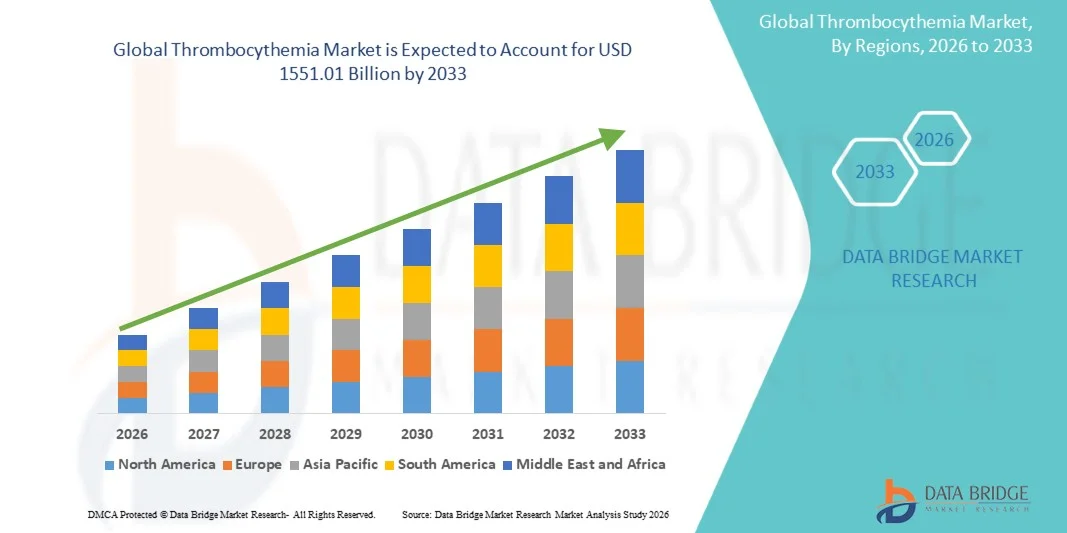
- The global Thrombocythemia market size was valued at USD 965.81 billion in 2025and is expected to reach USD 1551.01 billion by 2033, at a CAGR of 6.10% during the forecast period
- The market growth is largely fueled by the increasing prevalence of myeloproliferative disorders, including essential thrombocythemia, along with advancements in hematology diagnostics and molecular testing, leading to earlier and more accurate disease identification
- Furthermore, rising adoption of targeted therapies, growing use of JAK inhibitors and cytoreductive agents, and increasing focus on personalized treatment approaches are establishing thrombocythemia management solutions as essential components of modern hematologic care. These converging factors are accelerating the uptake of thrombocythemia treatment solutions, thereby significantly boosting the industry's growth
Thrombocythemia Market Analysis
- Thrombocythemia (especially essential thrombocythemia), a myeloproliferative neoplasm, is increasingly managed through targeted therapies, cytoreductive agents, and advanced molecular diagnostic approaches due to improved understanding of JAK-STAT pathway mutations and disease progression
- The escalating demand for thrombocythemia treatment is primarily fueled by rising prevalence of myeloproliferative disorders, increasing adoption of precision medicine, growing awareness of early diagnosis, and advancements in hematology research and targeted drug development
- North America dominated the thrombocythemia market with the largest revenue share of 39.1% in 2025, characterized by advanced hematology care infrastructure, high adoption of novel targeted therapies, strong presence of key pharmaceutical companies, and increasing clinical research activities in rare blood disorders
- Asia-Pacific is expected to be the fastest growing region in the thrombocythemia market during the forecast period due to improving healthcare infrastructure, rising awareness of rare hematological conditions, increasing diagnostic capabilities, and growing access to advanced treatment options
- The Oral segment held the largest market revenue share of 72.6% in 2025, driven by ease of administration and high patient compliance in long-term disease management
Report Scope and Thrombocythemia Market Segmentation
|
Attributes |
Thrombocythemia Key Market Insights |
|
Segments Covered |
· By Treatment: Anti-Platelet Treatment, Platelet-Lowering, Antineoplastic Agent, and Others · By Route of Administration: Oral and Injectable · By End-Users: Hospitals, Homecare, Specialty Clinics, and Others · By Distribution Channel: Hospital Pharmacy, Online Pharmacy, and Retail Pharmacy |
|
Countries Covered |
North America · U.S. · Canada · Mexico Europe · Germany · France · U.K. · Netherlands · Switzerland · Belgium · Russia · Italy · Spain · Turkey · Rest of Europe Asia-Pacific · China · Japan · India · South Korea · Singapore · Malaysia · Australia · Thailand · Indonesia · Philippines · Rest of Asia-Pacific Middle East and Africa · Saudi Arabia · U.A.E. · South Africa · Egypt · Israel · Rest of Middle East and Africa South America · Brazil · Argentina · Rest of South America |
|
Key Market Players |
· Novartis AG (Switzerland) · Bristol-Myers Squibb Company (U.S.) · Pfizer Inc. (U.S.) · Eli Lilly and Company (U.S.) · Roche Holding AG (Switzerland) · Merck & Co., Inc. (U.S.) · AstraZeneca plc (U.K.) · Incyte Corporation (U.S.) · AbbVie Inc. (U.S.) · Amgen Inc. (U.S.) · Sanofi S.A. (France) · Takeda Pharmaceutical Company Limited (Japan) · Teva Pharmaceutical Industries Ltd. (Israel) · Sun Pharmaceutical Industries Ltd. (India) · Dr. Reddy’s Laboratories Ltd. (India) · Cipla Limited (India) · Lupin Limited (India) · Zydus Lifesciences Ltd. (India) · Hikma Pharmaceuticals plc (U.K.) · Boehringer Ingelheim International GmbH (Germany) |
|
Market Opportunities |
· Advancements in targeted therapies and JAK inhibitors · Growing adoption of genetic and molecular diagnostics |
|
Value Added Data Infosets |
In addition to the insights on market scenarios such as market value, growth rate, segmentation, geographical coverage, and major players, the market reports curated by the Data Bridge Market Research also include in-depth expert analysis, patient epidemiology, pipeline analysis, pricing analysis, and regulatory framework. |
Thrombocythemia Market Trends
“Advancements in Precision Medicine and Molecular Diagnostics”
- A significant and accelerating trend in the global Thrombocythemia market is the increasing adoption of precision medicine approaches, driven by deeper understanding of molecular mutations such as JAK2, CALR, and MPL. These advancements are enabling more accurate disease classification, risk stratification, and individualized treatment planning
- For instance, molecular diagnostic testing is increasingly being used in clinical practice to differentiate essential thrombocythemia from other myeloproliferative neoplasms. This improves diagnostic accuracy and supports early initiation of targeted therapy, reducing the risk of thrombotic complications
- The integration of next-generation sequencing (NGS) in hematology diagnostics is further enhancing the ability to detect multiple genetic abnormalities simultaneously. This allows clinicians to better understand disease progression patterns and personalize therapeutic interventions based on genetic profiles
- In addition, advanced laboratory automation and digital pathology tools are improving workflow efficiency in hematology labs, enabling faster turnaround times for diagnostic results and more consistent interpretation of bone marrow findings
- This growing shift toward genomics-driven clinical decision-making is fundamentally transforming thrombocythemia management, as treatment strategies are increasingly tailored based on molecular and clinical risk factors rather than generalized protocols
Thrombocythemia Market Dynamics
Driver
“Rising Prevalence of Myeloproliferative Disorders and Expanding Diagnostic Capabilities”
- The increasing global incidence of myeloproliferative neoplasms, including essential thrombocythemia, is a major driver supporting market growth. Improved awareness and better diagnostic infrastructure are leading to higher detection rates worldwide
- For instance, the growing use of routine complete blood count (CBC) testing has significantly improved early identification of elevated platelet counts, prompting further diagnostic evaluation for thrombocythemia in asymptomatic patient
- Expanding access to molecular testing in both developed and emerging healthcare systems is further strengthening early and accurate diagnosis. This is helping clinicians initiate risk-adapted treatment strategies earlier in the disease course, reducing complications such as thrombosis and hemorrhage
- Increasing adoption of targeted therapies such as JAK inhibitors and cytoreductive agents is also contributing to improved disease management outcomes. These therapies are particularly important for high-risk patients who require long-term platelet control
- Furthermore, growing investment in hematology research and clinical trials is accelerating the development of novel therapeutic approaches aimed at improving survival outcomes and reducing treatment-related complications
Restraint/Challenge
“Long-Term Disease Management Burden and Limited Curative Options”
- A key challenge in the thrombocythemia market is the chronic nature of the disease, which requires long-term monitoring and continuous treatment rather than curative intervention. This creates a sustained clinical and economic burden for patients and healthcare systems
- For instance, patients often require lifelong cytoreductive therapy and regular blood monitoring to manage platelet levels and prevent thrombotic events. This ongoing treatment cycle increases healthcare utilization and associated costs over time
- Another major challenge is the lack of definitive curative therapies for essential thrombocythemia, as most current treatment options focus on symptom control and complication prevention rather than disease eradication
- In addition, variability in disease progression among patients makes standardized treatment approaches difficult, requiring highly individualized management strategies that can be resource-intensive
- Limited awareness in some regions and delayed diagnosis due to nonspecific early symptoms further contribute to suboptimal disease management outcomes, particularly in low-resource healthcare settings
- Addressing these challenges through improved early detection, expanded access to molecular diagnostics, and continued therapeutic innovation will be essential for improving long-term patient outcomes in thrombocythemia management
Thrombocythemia Market Scope
The market is segmented on the basis of type, treatment, route of administration, end-users, and distribution channel.
- By Treatment
On the basis of treatment, the Thrombocythemia market is segmented into Anti-Platelet Treatment, Platelet-Lowering, Antineoplastic Agent, and Others. The Anti-Platelet Treatment segment dominated the largest market revenue share of 46.8% in 2025, driven by its extensive use as a first-line therapy to prevent thrombotic complications associated with elevated platelet levels. Increasing prevalence of cardiovascular risks linked with thrombocythemia further strengthens demand. Physicians widely prescribe aspirin-based therapies due to their proven efficacy and safety profile. Growing awareness regarding early disease management supports adoption. Expanding geriatric population globally contributes to higher incidence rates. Strong clinical guidelines and standardized treatment protocols reinforce its dominance. Improved access to hematology care services enhances treatment penetration. In addition, cost-effectiveness and long-term patient compliance further sustain segment leadership.
The Platelet-Lowering segment is expected to witness the fastest CAGR of 23.5% from 2026 to 2033, driven by increasing diagnosis of essential thrombocythemia requiring cytoreductive therapy. Rising use of hydroxyurea and targeted therapies is supporting market expansion. Growing prevalence of high-risk patients accelerates treatment demand. Advancements in precision medicine enable personalized therapeutic approaches. Increasing clinical trials focused on myeloproliferative disorders enhance innovation. Expanding awareness among healthcare professionals improves early intervention rates. Rising adoption of advanced hematology treatments in specialty centers further drives growth.
- By Route of Administration
On the basis of route of administration, the Thrombocythemia market is segmented into Oral and Injectable. The Oral segment held the largest market revenue share of 72.6% in 2025, driven by ease of administration and high patient compliance in long-term disease management. Oral therapies are preferred due to convenience and non-invasive nature. Widespread availability of oral platelet-reducing drugs supports dominance. Reduced hospitalization requirements further enhance adoption. Increasing shift toward outpatient treatment models strengthens usage. Cost-effectiveness compared to injectable alternatives also supports market leadership. Improved drug formulations enhance bioavailability and therapeutic outcomes. Growing global access to oral hematology medications further boosts segment growth.
The Injectable segment is expected to witness the fastest CAGR of 21.4% from 2026 to 2033, driven by increasing use in severe and drug-resistant thrombocythemia cases. Injectable therapies provide rapid and controlled platelet reduction in high-risk patients. Hospital-based administration ensures better clinical monitoring and safety. Rising incidence of complicated hematological conditions supports demand. Advancements in biologic and targeted injectable therapies enhance treatment effectiveness. Increasing preference for precision-based therapies further accelerates adoption. Expanding oncology and hematology infrastructure in emerging markets contributes to growth.
- By End-Users
On the basis of end-users, the Thrombocythemia market is segmented into Hospitals, Homecare, Specialty Clinics, and Others. The Hospitals segment accounted for the largest market revenue share of 55.1% in 2025, driven by strong availability of advanced diagnostic infrastructure and specialized hematology care units. Hospitals serve as primary centers for diagnosis and treatment initiation. Presence of skilled hematologists ensures effective disease management. Increasing hospitalization rates for blood disorders supports segment dominance. Government healthcare programs also promote hospital-based treatment. Access to advanced therapeutic options strengthens adoption. Growing awareness of early diagnosis improves patient inflow. Integration of multidisciplinary care further enhances hospital preference.
The Specialty Clinics segment is expected to witness the fastest CAGR of 22.8% from 2026 to 2033, driven by rising demand for personalized and focused hematology care. These clinics provide specialized monitoring and long-term disease management. Increasing prevalence of rare blood disorders supports growth. Availability of advanced diagnostic tools improves treatment accuracy. Growing patient preference for outpatient specialty care enhances adoption. Expansion of hematology-focused healthcare facilities further accelerates growth. Rising awareness about early disease management contributes significantly to segment expansion.
- By Distribution Channel
On the basis of distribution channel, the Thrombocythemia market is segmented into Hospital Pharmacy, Online Pharmacy, and Retail Pharmacy. The Hospital Pharmacy segment held the largest market revenue share of 49.3% in 2025, driven by strong integration with hospital-based treatment systems and physician-led drug dispensing. Hospital pharmacies ensure controlled distribution of critical hematology medications. High dependency on inpatient treatment supports dominance. Government-supported healthcare systems strengthen hospital pharmacy networks. Increasing hospitalization rates for blood disorders further boost demand. Presence of standardized treatment protocols ensures consistent drug supply. Strong regulatory oversight enhances safety and compliance.
The Online Pharmacy segment is expected to witness the fastest CAGR of 24.1% from 2026 to 2033, driven by rising digital healthcare adoption and increasing preference for home delivery of chronic medications. Expanding telemedicine platforms improve prescription accessibility. Growing smartphone penetration and internet usage support adoption. Patients prefer online platforms for convenience and privacy. Competitive pricing and discounts further attract users. Partnerships between e-pharmacy platforms and healthcare providers enhance distribution efficiency. Expanding digital health infrastructure globally accelerates segment growth.
Thrombocythemia Market Regional Analysis
- North America dominated the thrombocythemia market with the largest revenue share of 39.1% in 2025, characterized by advanced hematology care infrastructure, high adoption of novel targeted therapies, strong presence of key pharmaceutical companies, and increasing clinical research activities in rare blood disorders
- The region benefits from well-established diagnostic capabilities, strong reimbursement frameworks, and rapid uptake of innovative treatment approaches. In addition, continuous advancements in molecular diagnostics and personalized medicine are further strengthening market growth, with the U.S. leading due to robust research pipelines and expanding access to specialized hematology care
- Patients and healthcare providers in the region highly value early and accurate diagnosis, access to advanced treatment regimens, and availability of long-term disease management options for thrombocythemia. The increasing use of genetic testing and targeted therapies is improving clinical outcomes and supporting better disease monitoring. This is further reinforced by strong healthcare spending, active clinical trial participation, and growing awareness of rare hematological disorders
U.S. Thrombocythemia Market Insight
The U.S. thrombocythemia market captured the largest revenue share in 2025 within North America, driven by high diagnosis rates, strong presence of leading pharmaceutical companies, and continuous innovation in hematology therapeutics. The country is witnessing increasing use of targeted therapies and JAK inhibitors for managing essential thrombocythemia and related myeloproliferative disorders. In addition, favorable reimbursement policies, advanced research infrastructure, and growing participation in clinical trials are significantly supporting market expansion.
Europe Thrombocythemia Market Insight
The Europe thrombocythemia market is projected to expand at a substantial CAGR throughout the forecast period, primarily driven by increasing awareness of rare blood disorders, strong healthcare systems, and expanding access to advanced diagnostic and treatment options. The region’s emphasis on early detection and personalized medicine is supporting improved disease management. Furthermore, growing investments in hematology research and cross-border collaboration in rare disease studies are contributing to market development.
U.K. Thrombocythemia Market Insight
The U.K. thrombocythemia market is anticipated to grow at a noteworthy CAGR during the forecast period, driven by improved diagnostic capabilities, rising awareness of hematological disorders, and strong support from the National Health Service (NHS). The increasing availability of specialized hematology services and adoption of advanced treatment protocols are enhancing patient outcomes. In addition, ongoing research in rare blood diseases is supporting market growth.
Germany Thrombocythemia Market Insight
The Germany thrombocythemia market is expected to expand at a considerable CAGR during the forecast period, supported by advanced healthcare infrastructure, strong focus on clinical research, and high adoption of innovative treatment approaches. The country’s emphasis on precision medicine and early diagnosis is driving demand for advanced therapeutic options. Moreover, increasing participation in hematology clinical trials is further contributing to market expansion.
Asia-Pacific Thrombocythemia Market Insight
The Asia-Pacific thrombocythemia market is expected to be the fastest growing region during the forecast period, driven by improving healthcare infrastructure, rising awareness of rare hematological conditions, increasing diagnostic capabilities, and growing access to advanced treatment options. Expanding healthcare investments and government initiatives to strengthen rare disease management are significantly supporting regional growth.
Japan Thrombocythemia Market Insight
The Japan thrombocythemia market is gaining momentum due to its advanced healthcare system, increasing focus on early disease detection, and strong adoption of precision medicine approaches. The availability of advanced diagnostic tools and targeted therapies is improving disease management. In addition, Japan’s aging population is contributing to higher demand for specialized hematology care services.
China Thrombocythemia Market Insight
The China thrombocythemia market accounted for the largest market revenue share in Asia Pacific in 2025, attributed to expanding healthcare infrastructure, increasing awareness of rare blood disorders, and growing access to advanced diagnostic technologies. The country is witnessing rising adoption of targeted therapies and improved disease management practices. Government support for healthcare modernization and the presence of domestic pharmaceutical companies are key factors driving market growth in China.
Thrombocythemia Market Share
The Thrombocythemia industry is primarily led by well-established companies, including:
- Novartis AG (Switzerland)
- Bristol-Myers Squibb Company (U.S.)
- Pfizer Inc. (U.S.)
- Eli Lilly and Company (U.S.)
- Roche Holding AG (Switzerland)
- Merck & Co., Inc. (U.S.)
- AstraZeneca plc (U.K.)
- Incyte Corporation (U.S.)
- AbbVie Inc. (U.S.)
- Amgen Inc. (U.S.)
- Sanofi S.A. (France)
- Takeda Pharmaceutical Company Limited (Japan)
- Teva Pharmaceutical Industries Ltd. (Israel)
- Sun Pharmaceutical Industries Ltd. (India)
- Reddy’s Laboratories Ltd. (India)
- Cipla Limited (India)
- Lupin Limited (India)
- Zydus Lifesciences Ltd. (India)
- Hikma Pharmaceuticals plc (U.K.)
Latest Developments in Global Thrombocythemia Market
- In March 2021, ongoing global tuberculosis treatment programs increasingly adopted bedaquiline-based regimens as part of multidrug-resistant tuberculosis (MDR-TB) care, marking a continued transition from older injectable therapies to fully oral treatment strategies that improve patient compliance and outcomes
- In June 2022, the World Health Organization updated its global TB treatment recommendations, strongly supporting shorter all-oral regimens containing bedaquiline, pretomanid, and linezolid, including the BPaL and BPaLM combinations, significantly reducing treatment duration from up to 18 months to approximately 6 months for eligible MDR/RR-TB patients
- In August 2022, clinical trial findings from the ZeNix study demonstrated that bedaquiline–pretomanid–linezolid regimens achieved high cure rates in drug-resistant TB, reinforcing the effectiveness of nitroimidazole-based combination therapies and accelerating global guideline updates
- In June 2023, WHO issued updated guidance expanding the use of bedaquiline and delamanid in children and adolescents with drug-resistant tuberculosis, enabling wider adoption of all-oral regimens across pediatric populations and improving treatment accessibility globally
- In June 2024, global TB programs further strengthened adoption of bedaquiline-containing short-course oral regimens, reflecting growing reliance on simplified combination therapies to improve treatment adherence and reduce hospitalization rates in MDR-TB management
- In January 2025, updated clinical treatment guidelines recommended continued use of 6-month BPaL and BPaLM regimens (bedaquiline, pretomanid, linezolid ± moxifloxacin) as preferred treatment options for rifampicin-resistant tuberculosis, reinforcing the shift toward standardized short-course oral therapies
- In November 2025, emerging clinical data highlighted ongoing expansion of pretomanid-based regimens in pediatric and adult populations, with improved formulations and dosing strategies supporting broader global rollout of drug-resistant TB treatment programs

- Interactive Data Analysis Dashboard
- Company Analysis Dashboard for high growth potential opportunities
- Research Analyst Access for customization & queries
- Competitor Analysis with Interactive dashboard
- Latest News, Updates & Trend analysis
- Harness the Power of Benchmark Analysis for Comprehensive Competitor Tracking
Data collection and base year analysis are done using data collection modules with large sample sizes. The stage includes obtaining market information or related data through various sources and strategies. It includes examining and planning all the data acquired from the past in advance. It likewise envelops the examination of information inconsistencies seen across different information sources. The market data is analysed and estimated using market statistical and coherent models. Also, market share analysis and key trend analysis are the major success factors in the market report. To know more, please request an analyst call or drop down your inquiry.
The key research methodology used by DBMR research team is data triangulation which involves data mining, analysis of the impact of data variables on the market and primary (industry expert) validation. Data models include Vendor Positioning Grid, Market Time Line Analysis, Market Overview and Guide, Company Positioning Grid, Patent Analysis, Pricing Analysis, Company Market Share Analysis, Standards of Measurement, Global versus Regional and Vendor Share Analysis. To know more about the research methodology, drop in an inquiry to speak to our industry experts.
Data Bridge Market Research is a leader in advanced formative research. We take pride in servicing our existing and new customers with data and analysis that match and suits their goal. The report can be customized to include price trend analysis of target brands understanding the market for additional countries (ask for the list of countries), clinical trial results data, literature review, refurbished market and product base analysis. Market analysis of target competitors can be analyzed from technology-based analysis to market portfolio strategies. We can add as many competitors that you require data about in the format and data style you are looking for. Our team of analysts can also provide you data in crude raw excel files pivot tables (Fact book) or can assist you in creating presentations from the data sets available in the report.












