


What is the Thymoquinone Market Size and Growth Rate?
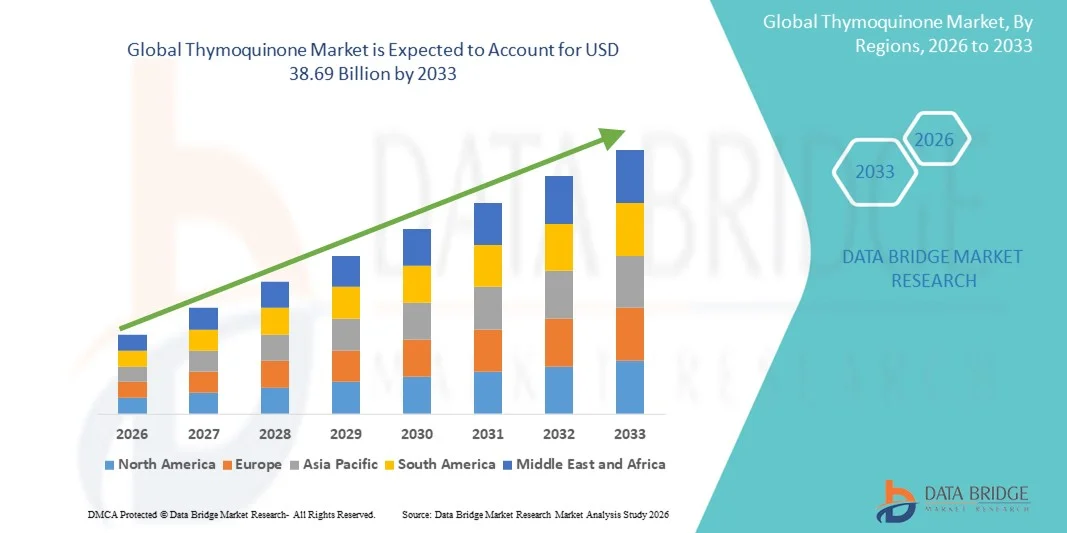
- The global thymoquinone market size was valued at USD 27.21 billion in 2025 and is expected to reach USD 38.69 billion by 2033, at a CAGR of 4.50% during the forecast period
- The market growth is largely fueled by increasing research on natural bioactive compounds and rising interest in plant-derived therapeutics for chronic and inflammatory diseases, leading to wider adoption of Thymoquinone solutions across pharmaceutical and nutraceutical applications
- Furthermore, growing awareness of the health benefits of Thymoquinone, coupled with advancements in formulation and delivery technologies, is driving product innovation and expanding its use in dietary supplements, functional foods, and pharmaceutical preparations, thereby significantly boosting the industry's growth
What are the Major Takeaways of Thymoquinone Market?
- Thymoquinone, a bioactive compound derived from Nigella sativa, is increasingly gaining attention for its therapeutic and nutraceutical applications due to its anti-inflammatory, antioxidant, and anticancer properties, driving research and adoption across pharmaceutical and dietary supplement sectors
- The escalating demand for thymoquinone is primarily driven by its increasing use in pharmaceuticals and nutraceuticals, growing awareness of its health benefits, and rising consumer preference for natural and plant-derived bioactive compounds
- North America dominated the thymoquinone market with the largest revenue share of 42% in 2025, characterized by advanced research infrastructure, strong pharmaceutical and nutraceutical industries, and high adoption of bioactive compounds, with the U.S. witnessing substantial growth in Thymoquinone consumption due to increasing clinical research and nutraceutical product launches
- Asia-Pacific is expected to be the fastest-growing region in the thymoquinone market during the forecast period, registering a CAGR driven by rising health awareness, increasing investment in natural product research, and expanding dietary supplement markets in countries such as China, India, and Japan
- The Pharmaceutical segment held the largest market share of 58.6% in 2025, driven by the extensive use of Thymoquinone in developing anti-inflammatory, anti-diabetic, and neuroprotective formulations
Report Scope and Thymoquinone Market Segmentation
|
Attributes |
Thymoquinone Key Market Insights |
|
Segments Covered |
|
|
Countries Covered |
North America
Europe
Asia-Pacific
Middle East and Africa
South America
|
|
Key Market Players |
|
|
Market Opportunities |
|
|
Value Added Data Infosets |
In addition to the insights on market scenarios such as market value, growth rate, segmentation, geographical coverage, and major players, the market reports curated by the Data Bridge Market Research also include in-depth expert analysis, patient epidemiology, pipeline analysis, pricing analysis, and regulatory framework. |
What is the Key Trend in the Thymoquinone Market?
Rising Interest in Health and Therapeutic Applications
- A significant and accelerating trend in the global thymoquinone market is the expanding exploration of its therapeutic potential in modern medicine and nutraceutical applications. thymoquinone, a key bioactive compound derived from Nigella sativa (black seed), is being extensively studied for its antioxidant, anti-inflammatory, antimicrobial, and anticancer properties
- Increasing clinical and preclinical research activities are highlighting thymoquinone’s role in mitigating oxidative stress and regulating inflammatory pathways, positioning it as a promising candidate for managing chronic diseases
- For instance, in March 2024, researchers at King Saud University published findings demonstrating that Thymoquinone supplementation significantly reduced oxidative damage markers in experimental models of diabetes, thereby attracting further interest from pharmaceutical firms
- Companies are actively investing in developing innovative thymoquinone formulations with improved bioavailability—such as nanoencapsulation and liposomal delivery systems—to enhance therapeutic efficacy
- Furthermore, the rising demand for plant-derived, clean-label ingredients in nutraceuticals and functional foods is amplifying the commercial potential of Thymoquinone
- Collectively, these advancements are establishing Thymoquinone as a key ingredient in the evolving field of natural therapeutic agents, supporting its broader integration into healthcare and wellness product portfolios
Thymoquinone Market Dynamics
What are the Key Drivers of Thymoquinone Market?
Increasing Demand Due to Rising Health Awareness and Chronic Disease Incidence
- The growing global burden of chronic diseases such as cardiovascular disorders, diabetes, obesity, and cancer is fueling demand for safe, natural compounds with proven therapeutic effects—driving the adoption of Thymoquinone-based products
- Consumers are increasingly turning toward preventive and holistic health management approaches, prioritizing natural remedies over synthetic alternatives. Thymoquinone’s scientifically supported benefits are aligning well with this shift toward wellness-oriented lifestyles
- For instance, in July 2023, Sabinsa Corporation introduced a Thymoquinone-enriched black seed extract formulation targeting cardiovascular and metabolic health, underscoring the commercial expansion of this bioactive compound in global nutraceutical markets
- In addition, advancements in extraction technologies—such as supercritical CO₂ extraction—have enabled the production of high-purity Thymoquinone, improving its therapeutic reliability and accessibility for large-scale applications
- The synergy of rising health awareness, ongoing product innovations, and supportive research outcomes is collectively propelling the demand for Thymoquinone across pharmaceutical, nutraceutical, and dietary supplement industries
Restraint/Challenge
Limited Clinical Evidence and Production Challenges
- Despite its promising pharmacological profile, the widespread clinical adoption of Thymoquinone remains constrained due to limited large-scale human trials and incomplete understanding of its pharmacokinetics and long-term safety
- Moreover, production-related challenges—such as inconsistent raw material quality, limited yields, and complex purification processes—pose significant barriers to standardization and mass commercialization
- For instance, a 2022 report by the Journal of Ethnopharmacology highlighted variability in Thymoquinone concentrations across different Nigella sativa cultivars, which can lead to inconsistent therapeutic outcomes and complicate regulatory approvals
- In addition, high extraction costs and the need for advanced purification infrastructure make large-scale production economically demanding, particularly for emerging market players
- Regulatory bodies such as the U.S. FDA and EMA also require comprehensive safety and efficacy data before granting approvals for medical or dietary use, delaying commercialization timelines
- Addressing these challenges through standardized extraction protocols, clinical validation, and collaborative research initiatives between academia and industry will be essential to unlocking Thymoquinone’s full market potential
How is the Thymoquinone Market Segmented?
The market is segmented on the basis of purity, type, application, and distribution channel.
- By Purity
On the basis of purity, the Thymoquinone market is segmented into <98%, 98%–99%, >99%, and Others. The >99% purity segment dominated the market with the largest revenue share of 46.8% in 2025, driven by its extensive utilization in pharmaceutical-grade formulations, clinical research, and high-end nutraceutical applications. This purity level is preferred for its superior bioactivity, consistency, and compliance with stringent pharmaceutical standards. Manufacturers focusing on drug development and therapeutic studies rely heavily on >99% purity Thymoquinone for reproducibility and efficacy assurance. The rise in demand for pure, lab-validated bioactives from both pharmaceutical and research institutions continues to anchor this segment’s market leadership. Moreover, global players are investing in advanced purification technologies such as supercritical CO₂ extraction and HPLC refinement to ensure consistent high-purity output, further strengthening this segment’s dominance.
The 98%–99% purity segment is projected to witness the fastest CAGR of 22.3% from 2026 to 2033, fueled by its increasing application in dietary supplements, functional foods, and preventive healthcare products. This grade provides a cost-effective balance between purity and affordability, making it attractive for large-scale nutraceutical manufacturers. The segment’s growth is also supported by the rising consumer shift toward natural and semi-purified plant extracts offering health benefits without excessive cost. Continuous product innovations by mid-scale manufacturers, particularly in Asia-Pacific and Europe, and the incorporation of 98%–99% purity Thymoquinone in formulations targeting oxidative stress and inflammation management, will further accelerate this segment’s expansion over the forecast period.
- By Type
On the basis of type, the Thymoquinone market is segmented into Anti-oxidant, Anti-inflammatory, Anti-cancer, and Others. The Anti-oxidant segment dominated the market with a revenue share of 42.5% in 2025, primarily due to Thymoquinone’s strong free radical scavenging properties and its increasing integration into nutraceutical and cosmetic formulations. The antioxidant applications of Thymoquinone have gained traction for preventing oxidative stress-related disorders, including cardiovascular diseases and aging-related conditions. Growing inclusion in dietary supplements and functional beverages is contributing to steady growth. Furthermore, several studies have validated Thymoquinone’s capability to enhance cellular defense mechanisms, boosting demand from wellness-focused consumers. Pharmaceutical research targeting oxidative damage mitigation is also strengthening this segment’s foothold globally, supported by expanding awareness of the health benefits of antioxidants derived from Nigella sativa.
The Anti-cancer segment is anticipated to register the fastest CAGR of 24.1% from 2026 to 2033, driven by increasing R&D focused on Thymoquinone’s potential role in cancer prevention and adjunct therapy. Ongoing clinical and preclinical trials have revealed promising anti-proliferative and apoptosis-inducing effects of Thymoquinone in various cancers, including breast, colon, and liver cancers. Pharmaceutical companies and academic research centers are increasingly investing in nano-formulations and targeted delivery systems to enhance its bioavailability and therapeutic efficiency. For instance, studies published in 2024 by the University of Alexandria demonstrated that Thymoquinone nanoparticles significantly improved tumor suppression rates in animal models. The rising global focus on natural oncology solutions and supportive regulatory frameworks for plant-based research will further propel this segment’s rapid expansion.
- By Application
On the basis of application, the Thymoquinone market is segmented into Pharmaceutical, Chemicals, and Others. The Pharmaceutical segment held the largest market share of 58.6% in 2025, driven by the extensive use of Thymoquinone in developing anti-inflammatory, anti-diabetic, and neuroprotective formulations. Its broad pharmacological activity profile—spanning antioxidant, immunomodulatory, and anticancer effects—has positioned it as a versatile compound in drug discovery pipelines. Pharmaceutical manufacturers are increasingly investing in Thymoquinone for its potential role in chronic disease management, including metabolic disorders and autoimmune conditions. For example, in April 2024, BioExtract Laboratories announced its partnership with a European biotech firm to co-develop Thymoquinone-based therapeutics targeting oxidative stress pathways. These developments, combined with regulatory support for herbal-based clinical research, are reinforcing the pharmaceutical sector’s dominant contribution to market revenue.
The Chemicals segment is projected to witness the fastest CAGR of 20.9% from 2026 to 2033, driven by its growing adoption as an intermediate in the synthesis of organic compounds and as a bio-based antioxidant additive in polymers and coatings. Increasing interest in sustainable chemistry and green alternatives is encouraging manufacturers to replace synthetic stabilizers with naturally derived Thymoquinone. Its effectiveness as a stabilizing and protective agent in chemical formulations enhances durability and environmental compliance. Furthermore, advancements in chemical engineering processes that enable efficient Thymoquinone extraction from Nigella sativa seeds are reducing costs and supporting wider industrial use. The segment’s growing relevance in specialty chemical manufacturing is expected to sustain its strong growth trajectory through the forecast period.
- By Distribution Channel
On the basis of distribution channel, the Thymoquinone market is segmented into Hospital Pharmacy, Retail Pharmacy, and Online Pharmacy. The Hospital Pharmacy segment accounted for the largest market share of 45.7% in 2025, supported by the rising use of Thymoquinone-based therapeutic products and supplements prescribed for clinical management of chronic and metabolic conditions. Hospitals and healthcare centers increasingly favor Thymoquinone products for their proven efficacy in inflammation reduction and immune modulation. Institutional purchases for patient care, ongoing clinical trials, and availability of pharmaceutical-grade formulations contribute significantly to this segment’s dominance. The inclusion of Thymoquinone as a supportive therapy in certain oncology and cardiology treatments is further driving its hospital-based demand, especially in developed healthcare systems across North America and Europe.
The Online Pharmacy segment is expected to record the fastest CAGR of 23.4% from 2026 to 2033, propelled by the rapid expansion of e-commerce platforms, consumer preference for convenience, and the growing global trend of purchasing nutraceuticals and herbal products online. The COVID-19 pandemic accelerated digital transformation in the pharmaceutical supply chain, enabling consumers to access Thymoquinone supplements and health products directly from verified online portals. Additionally, aggressive online marketing campaigns and discount-based subscription models are attracting health-conscious consumers worldwide. The increasing presence of certified digital health stores and regulatory support for online sales of nutraceuticals in regions like Asia-Pacific and Europe are expected to further drive this segment’s impressive growth.
Which Region Holds the Largest Share of the Thymoquinone Market?
- The North America thymoquinone market dominated with the largest revenue share of 42% in 2025
- Characterized by advanced research infrastructure, strong pharmaceutical and nutraceutical industries, and high adoption of bioactive compounds
- The market particularly witnessed substantial growth in Thymoquinone consumption due to increasing clinical research activities, product launches in nutraceuticals, and rising awareness about natural health supplements
U.S. Thymoquinone Market Insight
The U.S. thymoquinone market captured the largest revenue share of 81% in 2025 within North America, fueled by the expansion of nutraceutical products, clinical trials, and growing incorporation of bioactive compounds in dietary supplements. The rising consumer focus on natural remedies and health-promoting compounds is further driving market adoption, while strong research infrastructure and investments in functional food innovation are accelerating growth.
Europe Thymoquinone Market Insight
The Europe thymoquinone market is projected to expand at a substantial CAGR throughout the forecast period, driven by increasing adoption of natural health supplements, rising awareness of preventive healthcare, and supportive regulatory frameworks. Countries such as Germany, France, and the U.K. are witnessing growth due to strong nutraceutical markets and the integration of bioactive compounds in functional food products.
U.K. Thymoquinone Market Insight
The U.K. thymoquinone market is anticipated to grow at a noteworthy CAGR during the forecast period, fueled by the increasing consumer preference for dietary supplements, preventive healthcare measures, and rising interest in herbal and natural bioactive compounds. Strong retail and e-commerce penetration further supports market growth.
Germany Thymoquinone Market Insight
The Germany thymoquinone market is expected to expand at a considerable CAGR during the forecast period, driven by rising research initiatives in natural compounds, increasing demand for nutraceuticals, and consumer awareness of preventive health solutions. Germany’s robust pharmaceutical and nutraceutical infrastructure supports the integration of Thymoquinone in a variety of products.
Asia-Pacific Thymoquinone Market Insight
The Asia-Pacific thymoquinone market is poised to grow at the fastest CAGR of 25% during the forecast period of 2026 to 2033, driven by rising health awareness, increasing investment in natural product research, and expanding dietary supplement markets in countries such as China, India, and Japan. The growing focus on preventive healthcare and adoption of herbal bioactive compounds is significantly boosting market penetration.
Japan Thymoquinone Market Insight
The Japan thymoquinone market is gaining momentum due to increasing demand for dietary supplements, high health consciousness, and a preference for natural therapeutic compounds. Rising investment in functional foods and research on bioactive components is driving adoption in both residential and commercial health sectors.
China Thymoquinone Market Insight
The China thymoquinone market accounted for the largest revenue share in Asia-Pacific in 2025, attributed to rapid growth in the nutraceutical sector, rising consumer awareness of natural bioactive compounds, and strong research and development in herbal therapeutics. Government initiatives promoting health supplements and the increasing availability of affordable Thymoquinone-based products are key factors propelling market growth.
Which are the Top Companies in Thymoquinone Market?
The Thymoquinone industry is primarily led by well-established companies, including:
- Sigma-Aldrich (U.S.)
- Cayman Chemical (U.S.)
- TCI Chemicals (Japan)
- Hunan Sunfull Bio-technology Co., Ltd. (China)
- Thermo fisher (U.S.)
- BioVision (U.S.)
- Herbalife Nutrition (U.S.)
- Xi’an Sobea Biotechnology Co., Ltd. (China)
- Indena S.p.A. (Italy)
- Sinopharm Chemical Reagent Co., Ltd. (China)
What are Latest Developments in Thymoquinone Market?
- In September 2022, TriNutra received a U.S. patent for its orally deliverable product ThymoQuin, a formulation combining thymoquinone extracted from black seed (Nigella sativa) with omega-3. This development expanded its proprietary portfolio and strengthened its competitive position in the nutraceutical market
- In June 2023, TriNutra announced the launch of its ThymoQuin® black seed oil standardized to 3% thymoquinone with ultra-low free fatty acids as a USP-grade product. The launch aimed to enhance product purity, stability, and application in premium dietary supplement formulations
- In August 2025, NUTRITUNES partnered with TriNutra to launch a premium black seed oil dietary supplement under the ThymoQuin brand on Amazon, marking a strategic expansion into direct-to-consumer retail and increasing global accessibility of thymoquinone-based products

- Interactive Data Analysis Dashboard
- Company Analysis Dashboard for high growth potential opportunities
- Research Analyst Access for customization & queries
- Competitor Analysis with Interactive dashboard
- Latest News, Updates & Trend analysis
- Harness the Power of Benchmark Analysis for Comprehensive Competitor Tracking
Data collection and base year analysis are done using data collection modules with large sample sizes. The stage includes obtaining market information or related data through various sources and strategies. It includes examining and planning all the data acquired from the past in advance. It likewise envelops the examination of information inconsistencies seen across different information sources. The market data is analysed and estimated using market statistical and coherent models. Also, market share analysis and key trend analysis are the major success factors in the market report. To know more, please request an analyst call or drop down your inquiry.
The key research methodology used by DBMR research team is data triangulation which involves data mining, analysis of the impact of data variables on the market and primary (industry expert) validation. Data models include Vendor Positioning Grid, Market Time Line Analysis, Market Overview and Guide, Company Positioning Grid, Patent Analysis, Pricing Analysis, Company Market Share Analysis, Standards of Measurement, Global versus Regional and Vendor Share Analysis. To know more about the research methodology, drop in an inquiry to speak to our industry experts.
Data Bridge Market Research is a leader in advanced formative research. We take pride in servicing our existing and new customers with data and analysis that match and suits their goal. The report can be customized to include price trend analysis of target brands understanding the market for additional countries (ask for the list of countries), clinical trial results data, literature review, refurbished market and product base analysis. Market analysis of target competitors can be analyzed from technology-based analysis to market portfolio strategies. We can add as many competitors that you require data about in the format and data style you are looking for. Our team of analysts can also provide you data in crude raw excel files pivot tables (Fact book) or can assist you in creating presentations from the data sets available in the report.












