What is the Thyristor Discrete Semiconductor Market Size and Growth Rate?
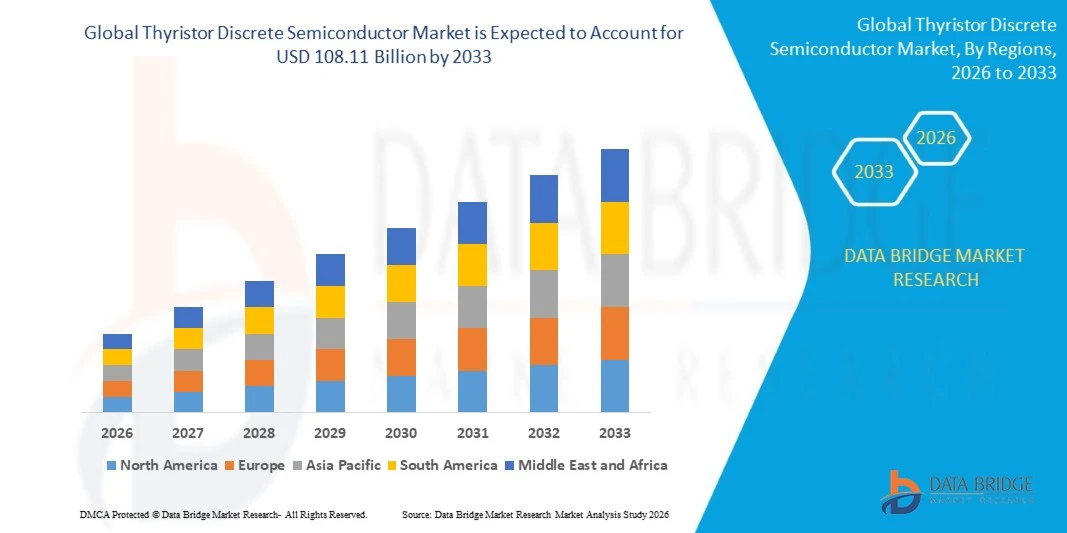
- As per Data Bridge Market Research analysis, the thyristor discrete semiconductor market was valued at USD 60.62 billion in 2025 and is projected to reach USD 108.11 billion by 2033, growing at a CAGR of 7.50% from 2026 to 2033, across power control applications.
- The market is experiencing consistent growth driven by rising investment in power transmission, increasing adoption of motor drives and industrial automation, and expanding applications across energy, appliances, transportation, telecom, and consumer electronics sectors.
- The increasing shift toward efficient power control, grid modernization, and renewable energy integration, combined with growing demand for rugged, high-voltage switching devices in industrial and utility systems, is supporting market adoption. Thyristors are being applied across motor starters, rectifiers, static var compensators, appliance controls, and HVDC transmission converters, offering high surge capability, reliability, and efficient switching through discrete semiconductor devices.
Market Size & Forecast
- Global Market Value (2025): USD 60.62 Billion
- Expected Market Value (2033): USD 108.11 Billion
- Forecast CAGR (2026–2033): 7.50%
- Leading Region in 2025: Asia-Pacific
- Fastest Growing Region: Middle East and Africa
What are the Major Takeaways of the Thyristor Discrete Semiconductor Market?
- Asia-Pacific dominated the thyristor discrete semiconductor market with the largest revenue share of 46.40% in 2025, supported by large industrial manufacturing, power infrastructure investment, and strong electronics and appliance production across the region and neighboring markets.
- Middle East and Africa is expected to be the fastest-growing region at a CAGR of 9.10% from 2026 to 2033, fueled by expanding power grids, industrial development, and growing renewable energy projects across emerging economies.
- The SCR segment led the market with a 41.3% share in 2025, driven by extensive use in motor drives, rectifiers, and power control equipment across industries and regions.
- IGCTs are the fastest-growing product type, projected to register a CAGR of 9.4%, reflecting the surge in demand for high-power, low-loss switching in transmission and industrial drives and long-distance power transfer.
- The low voltage segment dominated the voltage rating category with a 46.2% revenue share in 2025, led by extensive use in appliances and industrial controls and small motor drives.
- Motor drives and control accounted for 34.7% of the market share in 2025, preferred by increasing industrial automation and soft-starting demand across factories and utilities.
- The energy and utilities segment is the fastest-growing end-user category, with a CAGR of 8.8%, driven by increasing grid investment and renewable integration.
Report Scope and Thyristor Discrete Semiconductor Market Segmentation
|
Attributes |
Thyristor Discrete Semiconductor Key Market Insights |
|
Segments Covered |
|
|
Countries Covered |
North America
Europe
Asia-Pacific
Middle East and Africa
South America
|
|
Key Market Players |
|
|
Market Opportunities |
|
|
Value Added Data Infosets |
In addition to the insights on market scenarios such as market value, growth rate, segmentation, geographical coverage, and major players, the market reports curated by the Data Bridge Market Research also include in-depth expert analysis, geographically represented company-wise production and capacity, network layouts of distributors and partners, detailed and updated price trend analysis and deficit analysis of supply chain and demand. |
What is the Key Trend in the Thyristor Discrete Semiconductor Market?
- Manufacturers are increasingly shifting toward higher-rated, lower-loss, and more compact thyristor products, combining improved silicon processing, robust packaging, and integrated driver solutions to serve HVDC, industrial drive, and appliance control applications.
- For instance, in September 2025, Hitachi Energy showcased new thyristor products at PCIM Asia 2025, with a lineup that also covered variants for HVDC and heavy industrial conversion systems, reflecting continued innovation in high-power devices, as utilities and industrial customers seek thyristor-based converters that meet strict reliability and safety standards for long-distance power transfer and heavy-duty operation.
- Space-constrained designs are increasing demand for integrated solutions, including thyristors paired with isolated gate drivers and protection thyristors that offer improved surge endurance in small packages.
- Utilities and industrial users are favoring proven thyristor technology for long-distance power transfer, reactive power compensation, and heavy-duty conversion where robustness and long service life matter.
- For instance, in February 2026, STMicroelectronics introduced the STSID140, an ultra-compact thyristor gate driver with an integrated isolation transformer for space-constrained AC appliances, supporting zero-cross and phase-angle control of larger thyristors, TRIACs, and solid-state relays while reducing board space and simplifying isolated triggering in compact appliance designs.
- As grid investment, electrification, and industrial automation continue to expand, thyristors are expected to remain essential high-power control devices while evolving toward higher ratings, better integration, and greater efficiency worldwide.
What are the Key Drivers of the Thyristor Discrete Semiconductor Market?
- Rising investment in grid infrastructure and renewable power systems supports demand for thyristors in high-power conversion, voltage regulation, and transmission applications.
- For instance, in July 2023, Infineon Technologies published the datasheet for its STT1400N18P55 thyristor soft-starter module, rated at 1,800 V and 1,400 A, designed for motor-control applications.
- Increasing adoption of industrial drives and soft starters is supporting demand for rugged, high-current thyristor modules in heavy machinery and manufacturing equipment.
- For instance, in March 2026, the Hitachi Energy company presented at APEC 2026 a large phase control thyristor rated 8,500 V and 4,500 A for HVDC Classic, industrial, and renewable energy applications, along with a 6.5 kV device offering 30% more performance.
- For instance, in March 2023, Infineon Technologies published the datasheet for its DD380N22K power module, designed for motor control and uninterruptible power supply applications.
- With stricter energy efficiency regulations and growing appliance output, thyristors and TRIACs offer cost-effective power control that supports adoption across household and commercial equipment.
What Factors Are Challenging the Growth of the Thyristor Discrete Semiconductor Market?
- Thyristors face competition from IGBTs, MOSFETs, and wide-bandgap devices in some applications, while raw material, silicon wafer, and packaging costs can pressure supplier margins.
- For instance, in March 2026, according to Hitachi Energy, the company also presented next-generation TSPT+ IGBT modules at APEC 2026, illustrating how alternative power semiconductors compete for many medium and high-power conversion designs, even as thyristors retain advantages in very high-voltage, high-current, and surge-tolerant systems.
- Thyristors are not fully controllable in the way transistor devices are, which can limit use in high-frequency or advanced converter designs that require fast turn-off and compact magnetics.
- Growing miniaturization and surge-protection requirements can require redesign, qualification, and new packaging, raising development costs for manufacturers serving telecom, consumer, and industrial customers, particularly when new housings, gate drivers, and protection features must be validated across several end applications.
- For instance, in July 2025, Littelfuse introduced its Pxxx0S3H SIDACtor protection thyristor series targeting smaller designs with improved surge endurance, underscoring the pressure on suppliers to deliver more compact and robust devices while meeting demanding telecom, industrial, and consumer equipment requirements, with protection thyristors helping safeguard equipment from lightning surges and transients.
- The combination of competition from advanced switches, cost pressure, miniaturization needs, and complex qualification can limit expansion among smaller suppliers, particularly where customers prefer newer transistor-based topologies or where compact packaging and fast switching are priorities.
How is the Thyristor Discrete Semiconductor Market Segmented?
The thyristor discrete semiconductor market is segmented on the basis of product, voltage rating, application, and end user across regions.
- By Product
On the basis of product, the thyristor discrete semiconductor market is segmented into SCR, TRIAC, GTO, IGCT, and others. The SCR segment dominated the market with 41.3% share in 2025, supported by extensive use in motor drives, rectifiers, battery chargers, and power control equipment. SCRs provide robust switching, high surge capability, and simple control for AC and DC systems. They are widely used across industrial, utility, and appliance applications. Improvements in silicon processing, gate sensitivity, and package design are further strengthening demand. Integration with isolated drivers and protection circuits also enables easier design across power control equipment.
The IGCT segment is projected to record the fastest growth at a CAGR of 9.4% from 2026 to 2033, driven by increasing demand for high-power, low-loss switching in transmission and industrial drives. Integrated gate-commutated thyristors combine high blocking voltage with low conduction losses and controlled turn-off. Their applications include medium-voltage drives, HVDC, and large industrial converters. Increasing investment in grid and heavy industry is creating additional opportunities across utilities and equipment makers. Improvements in ratings, such as 6,500 V and 6,000 A devices, are enhancing performance. Compact converter designs are also expanding commercial use. IGCT platforms also benefit from experience in rail traction and industrial drives, where thyristor-based locomotive and drive systems have long histories.
- By Voltage Rating
On the basis of voltage rating, the thyristor discrete semiconductor market is segmented into low voltage, medium voltage, and high voltage. The low voltage segment dominated the market with 46.2% share in 2025, supported by extensive use in appliances, industrial controls, lighting, and small motor drives. This range offers a balanced combination of cost, availability, and ease of integration for high-volume manufacturing. Its availability across multiple package types and suppliers expands the potential customer base. Designers use low voltage devices for dimmers, heaters, soft starters, and protection circuits. The segment also benefits from established supply chains and standardized components.
The high voltage segment is projected to record the fastest growth at a CAGR of 9.1% from 2026 to 2033, supported by increasing adoption in HVDC converters, reactive power compensation, and heavy industrial systems. High voltage thyristors enable efficient power transmission over long distances with low losses and proven reliability. Utilities and equipment makers are specifying devices with higher voltage and current ratings. Manufacturers are developing large-diameter silicon devices with improved thermal performance and surge capability. Advances in explosion-protected housings and press-pack designs further strengthen the segment’s attractiveness. Long qualification cycles remain important considerations for expansion.
- By Application
On the basis of application, the thyristor discrete semiconductor market is segmented into motor drives & control, power conversion & rectification, power transmission, and others. The motor drives and control segment dominated the application category with 34.7% share in 2025, supported by increasing industrial automation and soft-starting demand. Thyristors provide smooth starting, speed control, and protection for motors. Energy efficiency goals are increasing the use of controlled drives. Growth in manufacturing, pumps, compressors, and conveyors further strengthens demand. Users are also seeking devices that combine rugged construction, long service life, and easy maintenance for demanding industrial environments, which supports replacement demand as well as new installations.
The power transmission segment is projected to record the fastest growth at a CAGR of 8.9% from 2026 to 2033, driven by increasing HVDC projects, grid interconnections, and renewable energy integration. Thyristor valves and converters enable efficient transfer of large power volumes across long distances. Utilities in Asia-Pacific, Europe, and the Middle East are investing in transmission upgrades. Large renewable projects are creating additional opportunities. Reliability and proven performance make thyristor-based solutions particularly attractive for critical infrastructure. Supportive grid policies can further improve project visibility across regions. Thyristor-based HVDC Classic systems remain a trusted option for bulk power transfer between distant generation hubs and load centres.
- By End User
On the basis of end user, the thyristor discrete semiconductor market is segmented into industrial, energy & utilities, consumer electronics & appliances, automotive & transportation, telecom & IT, and others. The industrial segment dominated the end-user category with 37.8% share in 2025, supported by increasing requirements for motor control, welding, heating, and power conversion. Manufacturers rely on thyristors for reliable, high-current switching in demanding environments. The segment includes drives, rectifiers, furnaces, and process equipment. Increasing automation investment is creating further opportunities. Long equipment lifecycles also make durability and supplier support important considerations in procurement decisions for plant operators and equipment makers.
The energy and utilities segment is projected to record the fastest growth at CAGR of 8.8% from 2026 to 2033, driven by increasing grid expansion, HVDC projects, and renewable energy integration. Utilities require robust, high-power semiconductors for converter stations, reactive power compensation, and power quality systems. Equipment makers are expanding capacity and upgrading product platforms for high-voltage applications. Closer collaboration between semiconductor suppliers and grid equipment makers is accelerating development of tailored devices. Rising electrification is further supporting adoption. Reliability, certification, and long-term supply remain important considerations for deployment across projects and regions.
Which Region Holds the Largest Share of the Thyristor Discrete Semiconductor Market?
- Asia-Pacific dominated the thyristor discrete semiconductor market with the largest revenue share of 46.40% in 2025, supported by large industrial manufacturing, power infrastructure investment, and strong electronics and appliance production across the region and neighboring markets.
- The region also benefits from large-scale grid investment, extensive electronics manufacturing, and the presence of established power semiconductor suppliers, along with strong demand for industrial equipment and appliances. Increasing electrification, renewable projects, and local production continue to strengthen Asia-Pacific’s position in the global market, supported by large manufacturing clusters and expanding transmission networks.
China Thyristor Discrete Semiconductor Market Insight
The China thyristor discrete semiconductor market is witnessing consistent growth due to rising investments in HVDC transmission, industrial automation, and local power semiconductor manufacturing. Utilities, equipment makers, and device suppliers are increasingly focusing on high-power devices. Moreover, large grid projects and continued expansion of domestic appliance and motor production, supported by strong local supply chains, are further contributing to market growth in China, particularly across HVDC, rail, and industrial projects.
India Thyristor Discrete Semiconductor Market Insight
The India thyristor discrete semiconductor market is growing steadily, driven by expanding power infrastructure, rising industrial output, and increasing investment in domestic electronics manufacturing. Growing use of thyristors in motor control, rectifiers, and railways is boosting market demand. In addition, the country’s focus on electrification, grid upgrades, and local manufacturing, including expansion plans by domestic rectifier makers, are positioning India as an important market across Asia-Pacific, supported by policy initiatives and long-term railway and utility modernization programs.
Middle East and Africa Thyristor Discrete Semiconductor Market Insight
The Middle East and Africa thyristor discrete semiconductor market is expected to witness rapid growth, driven by expanding power grids, industrial development, and increasing renewable energy projects across countries such as Saudi Arabia, the U.A.E., South Africa, and Egypt. Growing electrification, infrastructure investment, and interconnection projects are supporting regional market expansion. In addition, the region’s demand for reliable transmission equipment and industrial motor control is accelerating demand for thyristor-based solutions across utilities, mining, oil and gas, and heavy industry.
South Africa Thyristor Discrete Semiconductor Market Insight
South Africa’s thyristor discrete semiconductor market is supported by demand for efficient power control in industrial equipment, renewable energy systems, motor drives, and power conversion applications. Infrastructure modernization and investments in solar energy create opportunities for thyristors in inverters, rectifiers, and electrical protection systems. Industrial automation and mining operations also contribute to demand for reliable, high-power semiconductor devices. International suppliers such as Infineon Technologies, STMicroelectronics, and onsemi serve this market. Growing investment in energy infrastructure, equipment modernization, and power management is expected to create further opportunities for discrete thyristor semiconductor solutions.
UAE Thyristor Discrete Semiconductor Market Insight
The UAE market remains heavily reliant on imported semiconductor components, making supplier partnerships, local distribution, and maintenance services important competitive advantages. Key challenges include price fluctuations, supply-chain disruptions, and competition from alternative power devices. Growing investment in renewable energy, grid modernization, and industrial infrastructure is expected to create sustained opportunities for thyristor discrete semiconductor suppliers.
Which are the Top Companies in Thyristor Discrete Semiconductor Market?
The thyristor discrete semiconductor industry is primarily led by well-established companies, including:
- Infineon Technologies AG (Germany)
- STMicroelectronics N.V. (Switzerland)
- Littelfuse, Inc. (U.S.)
- Vishay Intertechnology, Inc. (U.S.)
- Hitachi Energy Ltd (Switzerland)
- onsemi (U.S.)
- Mitsubishi Electric Corporation (Japan)
- Toshiba Corporation (Japan)
- Fuji Electric Co., Ltd. (Japan)
- Semikron Danfoss (Germany)
- Sanken Electric Co., Ltd. (Japan)
- Bourns, Inc. (U.S.)
- Eaton Corporation plc (Ireland)
- WeEn Semiconductors Co., Ltd. (China)
- Nexperia B.V. (Netherlands)
- Hind Rectifiers Limited (India)
- Dynex Semiconductor Limited (U.K.)
- Powerex, Inc. (U.S.)
- SanRex Corporation (Japan)
- Central Semiconductor Corp. (U.S.)
What are Latest Developments in Thyristor Discrete Semiconductor Market?
- In March 2026, Hitachi Energy presented its latest semiconductor lineup at APEC 2026 in San Antonio, including a 6,500 V, 3,800 A phase control thyristor in an explosion-protected housing offering 30% more performance, an 8,500 V, 4,500 A device for HVDC Classic, a 1,800 V, 1,800 A small-size high-power thyristor, and a 6,500 V, 6,000 A asymmetric IGCT.
- In February 2026, STMicroelectronics introduced the STSID140, an ultra-compact thyristor gate driver that integrates an isolation transformer for space-constrained AC appliances, reducing board space while supporting zero-cross and phase-angle control of larger thyristors, TRIACs, and solid-state relays, and providing robust isolation, noise immunity, and reliable triggering for household and industrial AC applications, supporting designers of space-constrained appliances and control boards.
- In January 2026, Hind Rectifiers reaffirmed its expansion and diversification plans through public updates, signaling continued investment by Indian power semiconductor manufacturers in thyristors, rectifiers, and related products to serve railway, industrial, and power infrastructure customers in a growing domestic market, while supporting broader goals for local manufacturing and supply security and industrial growth.
- In September 2025, Hitachi Energy showcased new thyristor products at PCIM Asia 2025, with a lineup covering variants for HVDC and heavy industrial conversion systems, underscoring continued focus on reliable, advanced high-power semiconductors for transmission, industrial drives, and renewable energy applications, and strengthening its presence among power electronics customers in Asia-Pacific markets and long-term utility customers.
- In July 2025, Littelfuse introduced the Pxxx0S3H SIDACtor protection thyristor series, targeting smaller designs with improved surge endurance, and strengthening its portfolio of overvoltage protection thyristors for telecom, industrial, and consumer equipment that must withstand lightning, power-line transients, and other electrical disturbances in communications networks, industrial controls, and home electronics.
- Interactive Data Analysis Dashboard
- Company Analysis Dashboard for high growth potential opportunities
- Research Analyst Access for customization & queries
- Competitor Analysis with Interactive dashboard
- Latest News, Updates & Trend analysis
- Harness the Power of Benchmark Analysis for Comprehensive Competitor Tracking
Global Thyristor Discrete Semiconductor Market, Supply Chain Analysis and Ecosystem Framework
To support market growth and help clients navigate the impact of geopolitical shifts, DBMR has integrated in-depth supply chain analysis into its Global Thyristor Discrete Semiconductor Market research reports. This addition empowers clients to respond effectively to global changes affecting their industries. The supply chain analysis section includes detailed insights such as Global Thyristor Discrete Semiconductor Market consumption and production by country, price trend analysis, the impact of tariffs and geopolitical developments, and import and export trends by country and HSN code. It also highlights major suppliers with data on production capacity and company profiles, as well as key importers and exporters. In addition to research, DBMR offers specialized supply chain consulting services backed by over a decade of experience, providing solutions like supplier discovery, supplier risk assessment, price trend analysis, impact evaluation of inflation and trade route changes, and comprehensive market trend analysis.
Data collection and base year analysis are done using data collection modules with large sample sizes. The stage includes obtaining market information or related data through various sources and strategies. It includes examining and planning all the data acquired from the past in advance. It likewise envelops the examination of information inconsistencies seen across different information sources. The market data is analysed and estimated using market statistical and coherent models. Also, market share analysis and key trend analysis are the major success factors in the market report. To know more, please request an analyst call or drop down your inquiry.
The key research methodology used by DBMR research team is data triangulation which involves data mining, analysis of the impact of data variables on the market and primary (industry expert) validation. Data models include Vendor Positioning Grid, Market Time Line Analysis, Market Overview and Guide, Company Positioning Grid, Patent Analysis, Pricing Analysis, Company Market Share Analysis, Standards of Measurement, Global versus Regional and Vendor Share Analysis. To know more about the research methodology, drop in an inquiry to speak to our industry experts.
Data Bridge Market Research is a leader in advanced formative research. We take pride in servicing our existing and new customers with data and analysis that match and suits their goal. The report can be customized to include price trend analysis of target brands understanding the market for additional countries (ask for the list of countries), clinical trial results data, literature review, refurbished market and product base analysis. Market analysis of target competitors can be analyzed from technology-based analysis to market portfolio strategies. We can add as many competitors that you require data about in the format and data style you are looking for. Our team of analysts can also provide you data in crude raw excel files pivot tables (Fact book) or can assist you in creating presentations from the data sets available in the report.