


What is the Global Thyroid Ultrasonography Market Size and Growth Rate?
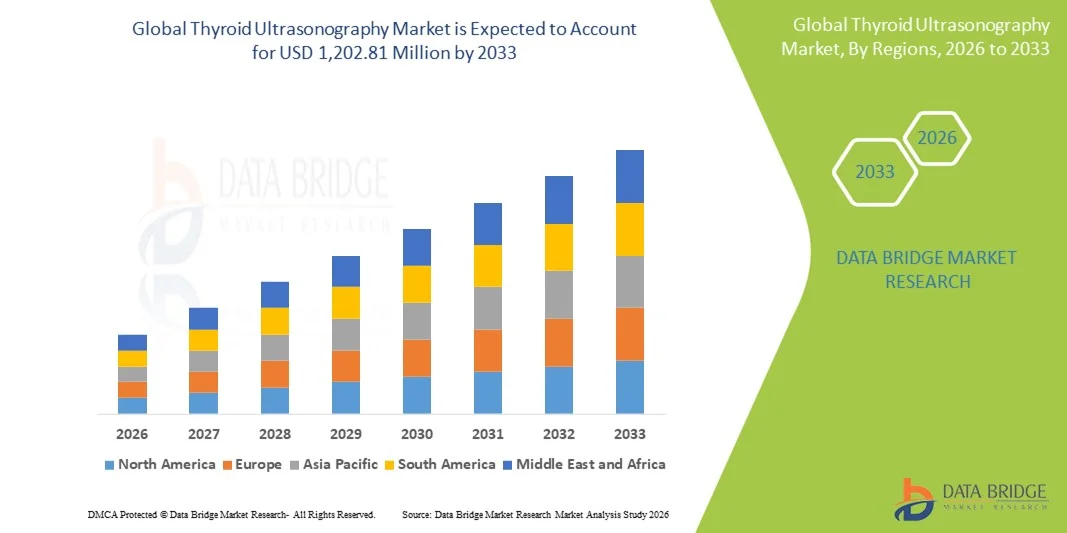
- As per Data Bridge Market Research analysis that the global thyroid ultrasonography market size was valued at USD 799.37 million in 2025 and is expected to reach USD 1,202.81 million by 2033, at a CAGR of 5.24% during the forecast period
- The market growth is largely driven by the rising prevalence of thyroid disorders, increasing awareness of early diagnosis, and continuous technological advancements in ultrasound imaging systems, supporting wider adoption across hospitals, diagnostic centers, and specialty clinics
- Furthermore, growing preference for non-invasive, radiation-free, cost-effective diagnostic procedures, along with expanding use of high-resolution and portable ultrasound devices, is positioning thyroid ultrasonography as a first-line diagnostic tool, thereby significantly accelerating overall market growth
Market Size & Forecast
Global Market Value (2025): USD 799.37 million
Expected Market Value (2033): USD 1,202.81 million
Forecast CAGR (2026–2033): 5.24%
Thyroid Ultrasonography Market Analysis
- Thyroid ultrasonography, a non-invasive imaging modality used for the evaluation of thyroid carcinomas and related abnormalities, plays a critical role in clinical decision-making across hospitals, diagnostic centers, and specialty care settings due to its safety, real-time visualization, and high diagnostic accuracy
- The growing demand for thyroid ultrasonography is primarily driven by the increasing incidence of thyroid cancers, particularly papillary and follicular carcinoma, rising awareness of early-stage detection, and the expanding use of advanced ultrasound technologies in routine thyroid assessment
- North America dominated the thyroid ultrasonography market with the largest revenue share of 38.6% in 2025, supported by well-established healthcare infrastructure, high diagnostic imaging adoption, and a strong presence of leading ultrasound system manufacturers, with the U.S. experiencing substantial procedural volumes due to routine screening and early cancer diagnosis practices
- Asia-Pacific is expected to be the fastest-growing region in the thyroid ultrasonography market during the forecast period due to improving healthcare accessibility, increasing diagnostic investments, and a growing prevalence of thyroid disorders and cancers in populous countries such as China and India
- The diagnostic ultrasound segment dominated the thyroid ultrasonography market with a market share of 64.3% in 2025, driven by its widespread clinical application for initial diagnosis, disease monitoring, and follow-up, along with strong adoption across hospitals, surgical centers, and diagnostic imaging facilities
Report Scope and Thyroid Ultrasonography Market Segmentation
|
Attributes |
Thyroid Ultrasonography Key Market Insights |
|
Segments Covered |
|
|
Countries Covered |
North America
Europe
Asia-Pacific
Middle East and Africa
South America
|
|
Key Market Players |
|
|
Market Opportunities |
|
|
Value Added Data Infosets |
In addition to the insights on market scenarios such as market value, growth rate, segmentation, geographical coverage, and major players, the market reports curated by the Data Bridge Market Research also include in-depth expert analysis, patient epidemiology, pipeline analysis, pricing analysis, and regulatory framework |
What is the Key Trend in the Thyroid Ultrasonography Market?
Integration of Advanced Imaging and AI-Assisted Diagnostics
- A significant and accelerating trend in the global thyroid ultrasonography market is the integration of advanced imaging technologies, including AI-assisted diagnostics and high-resolution ultrasound systems, aimed at improving thyroid nodule characterization and diagnostic confidence
- For instance, leading ultrasound manufacturers such as GE HealthCare and Siemens Healthineers have introduced AI-enabled thyroid imaging tools that assist clinicians in automated nodule detection, risk stratification, and reporting consistency during ultrasound examinations
- The incorporation of AI algorithms in thyroid ultrasonography supports enhanced image interpretation by reducing operator dependency, improving reproducibility, and assisting less-experienced clinicians in identifying suspicious thyroid lesions more accurately
- Advanced imaging features such as elastography and Doppler ultrasound are increasingly being integrated into thyroid ultrasonography systems, enabling better assessment of tissue stiffness and vascularity, which are critical parameters in differentiating benign and malignant thyroid nodules
- The seamless integration of thyroid ultrasonography systems with hospital information systems and electronic medical records allows centralized data management, streamlined workflows, and improved longitudinal monitoring of thyroid disease progression
- This shift toward more intelligent, precise, and workflow-optimized thyroid imaging solutions is reshaping diagnostic standards, prompting companies to invest heavily in next-generation ultrasound platforms tailored specifically for thyroid applications
- Increasing regulatory approvals and clinical validation of AI-based thyroid imaging software are accelerating their commercial adoption across global healthcare markets
Thyroid Ultrasonography Market Dynamics
Driver
Rising Prevalence of Thyroid Disorders and Demand for Early Diagnosis
- The increasing global prevalence of thyroid disorders, including thyroid nodules, goiter, and thyroid cancer, combined with the growing emphasis on early and accurate diagnosis, is a major driver fueling demand for thyroid ultrasonography
- For instance, in recent years, several countries have reported a steady rise in thyroid cancer incidence, encouraging healthcare providers to adopt routine thyroid ultrasound screening as a first-line diagnostic approach
- Thyroid ultrasonography offers a non-invasive, radiation-free, and cost-effective diagnostic solution, making it highly suitable for repeated use in disease monitoring and follow-up, thereby driving widespread clinical adoption
- Furthermore, growing awareness among patients and physicians regarding the benefits of early thyroid disease detection is increasing ultrasound utilization across hospitals, diagnostic centers, and ambulatory care settings
- The expansion of healthcare infrastructure, along with increasing availability of advanced diagnostic ultrasound systems in both developed and emerging economies, continues to propel market growth
- Favorable reimbursement policies for diagnostic imaging procedures in several developed markets are supporting higher thyroid ultrasound procedure volumes
- Rising investments by public and private healthcare providers in diagnostic imaging equipment are further accelerating market demand
Restraint/Challenge
Operator Dependency and Limited Diagnostic Specificity
- A key challenge restraining the global thyroid ultrasonography market is the high level of operator dependency, as diagnostic accuracy largely relies on the skill and experience of the sonographer performing and interpreting the examination
- For instance, variability in image acquisition and interpretation across different healthcare settings can lead to inconsistent diagnostic outcomes, particularly in low-resource or understaffed facilities
- Despite technological advancements, thyroid ultrasonography has limited specificity in definitively distinguishing benign from malignant nodules, often necessitating additional diagnostic procedures such as fine-needle aspiration biopsies
- The need for specialized training and continuous skill development for clinicians and sonographers increases operational costs for healthcare providers, posing adoption challenges in cost-constrained environments
- Addressing these limitations through standardized imaging protocols, expanded training programs, and broader implementation of AI-assisted decision-support tools will be critical for overcoming diagnostic variability and sustaining long-term market growth
- Limited access to advanced ultrasound systems in rural and underserved regions restricts equitable market expansion
- Budget constraints in public healthcare systems can delay equipment upgrades and slow adoption of next-generation thyroid ultrasonography technologies
How is the Thyroid Ultrasonography Market Segmented?
The market is segmented on the basis of type, technology, device display, portability, and end user.
- By Type
On the basis of type, the global thyroid ultrasonography market is segmented into papillary carcinoma and follicular carcinoma. The papillary carcinoma segment dominated the market with the largest revenue share in 2025, driven by the high global prevalence of papillary thyroid cancer, which accounts for the majority of diagnosed thyroid malignancies. Thyroid ultrasonography is the primary imaging modality used for detecting papillary carcinoma due to its ability to clearly visualize microcalcifications, irregular margins, and hypoechoic nodules. Routine thyroid screening programs and increased incidental detection through neck imaging further support segment dominance. Strong clinical guidelines recommend ultrasound-based evaluation and long-term surveillance of papillary carcinoma patients. High diagnostic sensitivity and widespread physician familiarity reinforce sustained adoption. These factors collectively position papillary carcinoma as the dominant subsegment.
The follicular carcinoma segment is expected to witness the fastest growth during the forecast period, owing to increasing diagnostic focus on less common thyroid malignancies. Follicular carcinoma presents diagnostic challenges, requiring advanced ultrasound techniques such as Doppler and elastography, which are increasingly available. Rising adoption of AI-assisted ultrasound tools is improving lesion characterization and supporting early detection. Growing awareness among clinicians regarding follicular variants is driving more frequent ultrasound use. Increasing surgical intervention rates also require accurate preoperative imaging. These trends are accelerating segment growth.
- By Technology
On the basis of technology, the market is segmented into diagnostic ultrasound and therapeutic ultrasound. The diagnostic ultrasound segment dominated the market in 2025 with a market share of 64.3% due to its extensive use in the detection, classification, and monitoring of thyroid disorders. It is widely preferred for its non-invasive nature, absence of ionizing radiation, and real-time imaging capabilities. Diagnostic ultrasound is routinely used as the first-line modality for thyroid nodule evaluation and biopsy guidance. Continuous improvements in image resolution and software functionality further strengthen clinical adoption. High procedure volumes in hospitals and diagnostic centers support revenue dominance. Strong reimbursement support in several regions further sustains growth.
The therapeutic ultrasound segment is anticipated to grow at the fastest rate over the forecast period, driven by the emergence of minimally invasive thyroid treatment options. Ultrasound-guided ablation therapies are gaining acceptance for managing benign nodules and selected thyroid lesions. Growing patient preference for non-surgical alternatives is fueling adoption. Increasing clinical validation and favorable treatment outcomes support expanding use. Advancements in therapeutic ultrasound equipment are improving precision and safety. These developments are driving rapid segment growth.
- By Device Display
On the basis of device display, the market is segmented into color ultrasound and B/W ultrasound. The color ultrasound segment held the largest market share in 2025, driven by its superior ability to assess blood flow and vascular patterns within thyroid nodules. Color Doppler imaging enhances differentiation between benign and malignant lesions. Its widespread availability in hospitals and diagnostic imaging centers supports segment dominance. Physicians increasingly rely on color ultrasound for comprehensive thyroid assessments. Continuous technological advancements are improving image clarity and diagnostic confidence. These factors collectively support sustained leadership.
The B/W ultrasound segment is expected to witness the fastest growth during the forecast period due to its cost-effectiveness and ease of use. B/W systems are widely deployed in primary care and resource-limited settings. Increasing demand for early thyroid screening in rural and outpatient environments is driving adoption. Technological improvements are enhancing grayscale imaging quality. Lower capital investment requirements make these systems attractive to smaller facilities. These drivers support rapid growth.
- By Portability
On the basis of portability, the market is segmented into trolley and cart-based ultrasound systems, compact/handheld ultrasound systems, and point-of-care (PoC) ultrasound systems. The trolley and cart-based ultrasound systems segment dominated the market in 2025 due to their advanced imaging capabilities and integration with hospital workflows. These systems offer high-resolution imaging and support advanced diagnostic features. Large hospitals and diagnostic centers prefer them for handling high patient volumes. Their reliability and versatility support widespread clinical use. Continuous capital investment in hospital imaging infrastructure sustains dominance. Established presence across developed healthcare systems reinforces leadership.
The point-of-care (PoC) ultrasound systems segment is expected to grow at the fastest rate during the forecast period. Increasing emphasis on decentralized healthcare delivery is driving demand for portable solutions. PoC systems enable rapid thyroid assessment at the bedside or in outpatient settings. Their compact design and improving image quality support broader adoption. Growing use in ambulatory and emergency care environments further accelerates growth. Declining device costs also contribute to rapid uptake.
- By End User
On the basis of end user, the market is segmented into hospitals, surgical centers, and diagnostic centers, ambulatory care centers, research institutes, and others. The hospitals, surgical centers, and diagnostic centers segment dominated the market in 2025, driven by high patient volumes and advanced diagnostic infrastructure. These facilities conduct the majority of thyroid ultrasound examinations globally. Availability of skilled radiologists and endocrinologists supports extensive utilization. Routine screening, preoperative evaluation, and post-treatment monitoring drive consistent demand. Strong reimbursement frameworks in hospital settings further support dominance. Continued infrastructure investment sustains leadership.
The ambulatory care centers segment is expected to witness the fastest growth during the forecast period. The rising preference for outpatient diagnostic services is shifting thyroid imaging toward ambulatory settings. These centers increasingly adopt compact and PoC ultrasound systems. The shorter patient waiting time and the lower procedure costs enhance attractiveness. The expanding ambulatory care networks is supporting globally adoption. These factors are collectively driving rapid growth of the segment.
Thyroid Ultrasonography Market Regional Analysis
- North America dominated the thyroid ultrasonography market with the largest revenue share of 38.6% in 2025, supported by well-established healthcare infrastructure, high diagnostic imaging adoption, and a strong presence of leading ultrasound system manufacturers
- Healthcare providers in the region place strong emphasis on early and accurate diagnosis, favoring thyroid ultrasonography for its non-invasive nature, high diagnostic accuracy, and suitability for routine screening and long-term disease monitoring
- This widespread adoption is further supported by favorable reimbursement policies, availability of skilled radiologists and endocrinologists, and continuous technological advancements in ultrasound systems, establishing thyroid ultrasonography as a preferred diagnostic modality across hospitals, diagnostic centers, and ambulatory care facilities
U.S. Thyroid Ultrasonography Market Insight
The U.S. thyroid ultrasonography market captured the largest revenue share within North America in 2025, driven by the high prevalence of thyroid disorders and strong emphasis on early disease detection. Healthcare providers increasingly prioritize non-invasive and radiation-free diagnostic tools, making ultrasound a preferred first-line modality. Widespread access to advanced imaging infrastructure and routine screening practices further support market growth. The strong presence of leading ultrasound manufacturers and rapid adoption of AI-assisted diagnostic tools continue to enhance clinical efficiency. Moreover, favorable reimbursement policies and high awareness among patients significantly contribute to sustained market expansion.
Europe Thyroid Ultrasonography Market Insight
The Europe thyroid ultrasonography market is projected to expand at a substantial CAGR throughout the forecast period, primarily driven by increasing awareness of thyroid health and rising diagnostic screening rates. Aging populations and growing incidence of thyroid disorders are encouraging greater use of ultrasound-based evaluation. European healthcare systems emphasize cost-effective and safe diagnostic solutions, supporting ultrasound adoption. The market is witnessing steady growth across hospitals and diagnostic centers. Technological advancements and standardization of diagnostic protocols further promote market development across the region.
U.K. Thyroid Ultrasonography Market Insight
The U.K. thyroid ultrasonography market is anticipated to grow at a noteworthy CAGR during the forecast period, supported by rising demand for early diagnosis and preventive healthcare. Increasing awareness of thyroid-related conditions among patients and clinicians is boosting ultrasound utilization. The National Health Service’s focus on efficient, non-invasive diagnostic pathways further supports adoption. Expansion of outpatient and diagnostic imaging services is also contributing to market growth. Continuous upgrades of ultrasound equipment across healthcare facilities are reinforcing demand.
Germany Thyroid Ultrasonography Market Insight
The Germany thyroid ultrasonography market is expected to expand at a considerable CAGR during the forecast period, driven by a strong healthcare infrastructure and high diagnostic standards. Germany’s emphasis on precision diagnostics and early disease detection supports widespread ultrasound usage. Increasing investments in advanced medical imaging technologies further fuel growth. Hospitals and diagnostic centers are rapidly adopting high-resolution and Doppler ultrasound systems. The integration of digital health solutions and AI-based imaging tools aligns well with Germany’s innovation-driven healthcare ecosystem.
Asia-Pacific Thyroid Ultrasonography Market Insight
The Asia-Pacific thyroid ultrasonography market is poised to grow at the fastest CAGR during the forecast period of 2026 to 2033, driven by rising healthcare expenditure, large patient populations, and increasing prevalence of thyroid disorders. Rapid urbanization and improving access to diagnostic services are accelerating market growth. Governments across the region are investing in healthcare infrastructure and early screening programs. Growing adoption of portable and point-of-care ultrasound systems is expanding reach into rural and semi-urban areas. These factors collectively position Asia-Pacific as the fastest-growing regional market.
Japan Thyroid Ultrasonography Market Insight
The Japan thyroid ultrasonography market is gaining momentum due to the country’s advanced healthcare system and high focus on early diagnosis. Japan’s aging population significantly increases demand for routine thyroid screening and monitoring. The widespread availability of advanced ultrasound technologies supports high adoption rates. Integration of ultrasound with digital health systems enhances diagnostic accuracy and workflow efficiency. In addition, strong clinical awareness and regular health check-up practices continue to stimulate market growth.
India Thyroid Ultrasonography Market Insight
The India thyroid ultrasonography market accounted for the largest revenue share in Asia-Pacific in 2025, attributed to the high prevalence of thyroid disorders and expanding diagnostic infrastructure. Rapid urbanization and increasing healthcare awareness are driving demand for early and affordable diagnostic solutions. Growth in private diagnostic centers and hospitals is significantly boosting ultrasound adoption. Government initiatives aimed at improving access to diagnostic services further support market expansion. The availability of cost-effective ultrasound systems and a growing pool of trained professionals are key factors propelling market growth in India.
Thyroid Ultrasonography Market Share
The Thyroid Ultrasonography industry is primarily led by well-established companies, including:
- GE HealthCare (U.S.)
- Koninklijke Philips N.V. (Netherlands)
- Siemens Healthineers AG (Germany)
- CANON MEDICAL SYSTEMS CORPORATION (U.S.)
- Samsung Medison Co., Ltd. (South Korea)
- FUJIFILM Sonosite, Inc. (U.S.)
- Esaote SPA (Italy)
- Hologic, Inc. (U.S.)
- Mindray Medical International Ltd. (China)
- Hitachi Medical Systems (Japan)
- Fukuda Denshi Co., Ltd. (Japan)
- Olympus Corporation (Japan)
- Trivitron Healthcare (India)
- Daxsonics Ultrasound, Inc. (U.S.)
- Sonacare Medical (U.S.)
- EchoNous, Inc. (U.S.)
- Butterfly Network, Inc. (U.S.)
- Clarius Mobile Health (Canada)
- NovaSignal Corp. (U.S.)
- First Medical Company (U.S.)
What are the Recent Developments in Global Thyroid Ultrasonography Market?
- In November 2025, SimonMed Imaging launched Ultrasound+, an AI‑enhanced ultrasound program powered by FDA‑cleared Koios DS software designed to assist radiologists in real‑time detection and classification of breast and thyroid cancers, expanding advanced imaging capabilities nationwide
- In August 2025, researchers from the Chinese Academy of Sciences developed a deep learning model combining B‑mode ultrasound and elastography to enhance malignancy prediction accuracy for high‑risk TI‑RADS 4 thyroid nodules, achieving high AUC performance and reducing misdiagnosis
- In June 2025, RadNet, Inc. acquired See‑Mode Technologies, integrating AI‑based thyroid ultrasound detection and characterization solutions into its DeepHealth diagnostics portfolio to improve clinical workflow efficiency and diagnostic accuracy across imaging centers
- In September 2024, See‑Mode Technologies received 510(k) clearance from the U.S. Food and Drug Administration (FDA) for its AI‑powered thyroid ultrasound analysis and reporting software, enabling automated TI‑RADS classification and streamlined workflow for thyroid nodule detection and characterization
- In May 2021, Medo.ai received FDA approval for its AI‑based thyroid ultrasound tool (Medo‑Thyroid), aimed at simplifying scanning workflows and providing automated measurement and nodule characterization to support clinicians, marking one of the first regulatory clearances for AI assistance in thyroid ultrasonography

- Interactive Data Analysis Dashboard
- Company Analysis Dashboard for high growth potential opportunities
- Research Analyst Access for customization & queries
- Competitor Analysis with Interactive dashboard
- Latest News, Updates & Trend analysis
- Harness the Power of Benchmark Analysis for Comprehensive Competitor Tracking
Data collection and base year analysis are done using data collection modules with large sample sizes. The stage includes obtaining market information or related data through various sources and strategies. It includes examining and planning all the data acquired from the past in advance. It likewise envelops the examination of information inconsistencies seen across different information sources. The market data is analysed and estimated using market statistical and coherent models. Also, market share analysis and key trend analysis are the major success factors in the market report. To know more, please request an analyst call or drop down your inquiry.
The key research methodology used by DBMR research team is data triangulation which involves data mining, analysis of the impact of data variables on the market and primary (industry expert) validation. Data models include Vendor Positioning Grid, Market Time Line Analysis, Market Overview and Guide, Company Positioning Grid, Patent Analysis, Pricing Analysis, Company Market Share Analysis, Standards of Measurement, Global versus Regional and Vendor Share Analysis. To know more about the research methodology, drop in an inquiry to speak to our industry experts.
Data Bridge Market Research is a leader in advanced formative research. We take pride in servicing our existing and new customers with data and analysis that match and suits their goal. The report can be customized to include price trend analysis of target brands understanding the market for additional countries (ask for the list of countries), clinical trial results data, literature review, refurbished market and product base analysis. Market analysis of target competitors can be analyzed from technology-based analysis to market portfolio strategies. We can add as many competitors that you require data about in the format and data style you are looking for. Our team of analysts can also provide you data in crude raw excel files pivot tables (Fact book) or can assist you in creating presentations from the data sets available in the report.













