


Ticket Machine Market Size
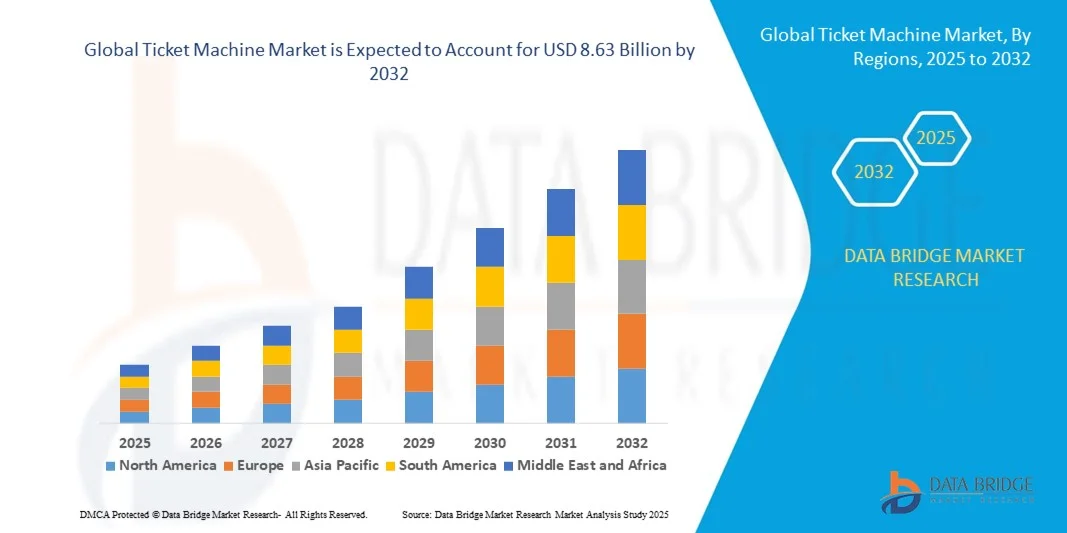
- The global ticket machine market size was valued at USD 4.0 billion in 2024 and is expected to reach USD 8.63 billion by 2032, at a CAGR of 10.10% during the forecast period
- The market growth is largely fueled by the increasing adoption of automated ticketing systems across transportation, parking, and entertainment sectors, coupled with technological advancements in self-service kiosks, smart card integration, and mobile payment solutions. These developments are driving the shift from manual ticketing to digital and contactless systems, enhancing operational efficiency and reducing human error
- Furthermore, rising demand for user-friendly, secure, and fast ticketing solutions is establishing automated and mobile-enabled ticket machines as the preferred choice for public transport authorities, parking operators, and event organizers. The convergence of cashless payments, QR code-based ticketing, and real-time transaction monitoring is accelerating adoption, thereby significantly boosting market growth
Ticket Machine Market Analysis
- Ticket machines, offering automated issuance of tickets and seamless payment options, are increasingly essential for modern transportation and entertainment infrastructure due to their convenience, speed, and ability to integrate with digital platforms and smart city initiatives
- The escalating demand for ticket machines is primarily fueled by the growth of urban public transport networks, rising commuter volumes, and the push towards cashless and contactless transactions, along with government initiatives promoting smart mobility and digital infrastructure
- North America dominated the ticket machine market with a share of 43.19% in 2024, due to the increasing adoption of automated ticketing systems across transportation, parking, and entertainment sectors
- Asia-Pacific is expected to be the fastest growing region in the ticket machine market during the forecast period due to rapid urbanization, rising disposable incomes, and increasing technological adoption in countries such as China, Japan, and India
- Software segment dominated the market with a market share of 52.5% in 2024, due to its role in enabling advanced ticketing features such as dynamic pricing, multi-mode payment processing, real-time reporting, and integration with customer management systems. Software solutions allow operators to update ticketing options, track usage analytics, and improve the overall efficiency of transportation or entertainment services. The rising emphasis on digitalization and smart city initiatives further supports the dominance of software-driven ticketing systems
Report Scope and Ticket Machine Market Segmentation
|
Attributes |
Ticket Machine Key Market Insights |
|
Segments Covered |
|
|
Countries Covered |
North America
Europe
Asia-Pacific
Middle East and Africa
South America
|
|
Key Market Players |
|
|
Market Opportunities |
|
|
Value Added Data Infosets |
In addition to the insights on market scenarios such as market value, growth rate, segmentation, geographical coverage, and major players, the market reports curated by the Data Bridge Market Research also include in-depth expert analysis, geographically represented company-wise production and capacity, network layouts of distributors and partners, detailed and updated price trend analysis and deficit analysis of supply chain and demand. |
Ticket Machine Market Trends
Growing Use of Mobile and Contactless Ticketing
- The global ticket machine market is witnessing a significant transformation driven by the widespread adoption of mobile and contactless ticketing solutions. This shift is reshaping commuter behavior and transportation infrastructure, as passengers increasingly seek convenience, faster transactions, and minimal physical interaction during travel
- For instance, Cubic Transportation Systems introduced contactless payment-enabled ticket machines across major transport networks such as London Underground and New York’s MTA. These systems allow passengers to tap smart cards or smartphones to purchase or validate tickets, reducing queues and promoting efficient passenger flow
- Public transportation agencies are increasingly modernizing their infrastructure to support contactless ticketing using NFC, QR codes, and mobile wallet integrations. Such technologies improve passenger experience by allowing seamless payments through widely used platforms such as Apple Pay or Google Pay, while reducing dependence on paper-based tickets
- In addition, the integration of real-time data analytics into ticketing systems enhances operational efficiency by enabling transport authorities to track usage patterns and manage peak-hour demands. This trend is boosting data-driven decision-making and service optimization across smart city projects
- The adoption of mobile ticketing also supports sustainability initiatives by minimizing paper waste and maintenance costs associated with traditional vending machines. As urban transit networks expand, the focus on environmentally responsible and digital-first solutions continues to rise
- Overall, the growing use of mobile and contactless ticketing systems is transforming passenger convenience and also defining the next phase of transportation modernization. The trend is expected to strengthen as more cities and operators transition to cashless and automated mobility solutions globally
Ticket Machine Market Dynamics
Driver
Rising Demand for Automated and Secure Ticketing Systems
- The rising need for efficient, secure, and time-saving transit systems is a primary driver for the growth of the ticket machine market. Increasing passenger traffic in urban transportation, airports, and railway networks is encouraging authorities to invest in automated solutions for faster operations and reduced manual dependency
- For instance, Scheidt & Bachmann GmbH has deployed advanced self-service ticketing machines integrated with cloud-based back-end systems across European rail networks. This innovation enhances payment security, minimizes operational errors, and improves ticket validation accuracy, demonstrating a major shift toward automation in public transport systems
- Automated ticket machines are enhancing customer satisfaction through features such as multi-payment compatibility, touchscreen interfaces, and multi-language support. These solutions reduce human interference and also ensure high transaction integrity and data security for passengers
- In addition, government initiatives promoting smart transportation and digital fare collection are further supporting market expansion. Many cities worldwide are embracing automated ticketing as part of broader digital infrastructure projects aimed at streamlining mobility services
- The increasing adoption of these systems ensures faster throughput, lower operational costs, and better integration with contactless payment networks. Consequently, the market for automated and secure ticketing machines is positioned for continued growth across both developed and emerging nations
Restraint/Challenge
High Initial and Maintenance Costs
- High initial investment requirements and ongoing maintenance costs present a significant challenge to the widespread deployment of advanced ticket machines. These systems involve expenses related to hardware setup, software integration, and regular technical upgrades, which can strain the budgets of small transit operators
- For instance, many regional bus and train operators in developing economies face financial limitations when adopting modern ticketing systems offered by companies such as Parkeon and Flowbird Group. These operators often delay or scale down implementation due to limited funding or infrastructure compatibility issues
- Maintaining ticket machines with advanced features such as contactless readers, display touchscreens, and networked interfaces requires skilled technicians and consistent software updates. Any technical downtime directly affects passenger experience and fare collection efficiency
- In addition, rising costs associated with cybersecurity measures and compliance with data protection standards further elevate ownership costs. Manufacturers are under pressure to deliver high performance while keeping total cost of ownership manageable for transit authorities
- Ultimately, controlling installation and maintenance expenses will be crucial for ensuring sustainable adoption of modern ticket machines. The market’s long-term success depends on developing cost-efficient, durable, and modular solutions suited to both high-capacity urban networks and cost-sensitive regional transport systems
Ticket Machine Market Scope
The market is segmented on the basis of product type, component type, application, and payment type.
- By Product Type
On the basis of product type, the ticket machine market is segmented into kiosk counter, vending machine, and hand-held electronic ticket machine. The kiosk counter segment dominated the market with the largest revenue share in 2024, attributed to its high throughput and user-friendly interface for multiple simultaneous transactions. Kiosk counters are widely deployed in railways, bus stations, and parking areas due to their ability to reduce queues, provide detailed ticketing options, and integrate seamlessly with digital payment solutions. Their robust design, reliability in high-traffic environments, and compatibility with software systems further reinforce their dominance in public transportation and commercial applications.
The hand-held electronic ticket machine segment is anticipated to witness the fastest growth rate from 2025 to 2032, fueled by the need for portable, flexible, and on-the-go ticketing solutions. These devices are increasingly adopted in buses, sports venues, and event management for quick issuance of tickets, ease of operation by staff, and seamless mobile or smart card payment integration. Their compact design and real-time connectivity with central systems enhance operational efficiency, making them a preferred choice for modern transportation and entertainment services.
- By Component Type
On the basis of component type, the ticket machine market is segmented into software and hardware. The software segment held the largest market revenue share of 52.5% in 2024, driven by its role in enabling advanced ticketing features such as dynamic pricing, multi-mode payment processing, real-time reporting, and integration with customer management systems. Software solutions allow operators to update ticketing options, track usage analytics, and improve the overall efficiency of transportation or entertainment services. The rising emphasis on digitalization and smart city initiatives further supports the dominance of software-driven ticketing systems.
The hardware segment is expected to witness the fastest CAGR from 2025 to 2032, driven by the increasing demand for durable, reliable, and portable devices that can withstand high-frequency usage and diverse environmental conditions. Hardware innovations, including touchscreens, thermal printers, and secure card readers, are facilitating faster transaction processing and better user experiences. The integration of hardware with software platforms ensures comprehensive ticketing solutions across railways, buses, parking areas, and entertainment venues.
- By Application
On the basis of application, the ticket machine market is segmented into railways, buses, parking areas, entertainment, sports, and others. The railways segment dominated the market in 2024, owing to the high volume of daily commuters, the need for efficient ticketing management, and government initiatives to digitalize railway ticketing systems. Railways increasingly rely on both kiosk counters and software-driven ticketing solutions to minimize queues, reduce operational costs, and enable cashless transactions for a smoother passenger experience.
The parking area segment is anticipated to witness the fastest growth rate from 2025 to 2032, driven by urbanization and rising demand for automated parking management systems. Ticket machines in parking lots streamline vehicle entry and exit, support mobile and smart card payments, and reduce manual intervention. Integration with mobile apps and IoT-enabled solutions further boosts operational efficiency and provides convenience to drivers, creating high adoption potential in urban centers and commercial complexes.
- By Payment Type
On the basis of payment type, the ticket machine market is segmented into smart card payment, cash payment, and mobile payment. The cash payment segment dominated the market in 2024 due to its longstanding presence and universal acceptance in public transportation and entertainment venues. Cash-based ticket machines offer simplicity for operators and passengers, ensuring accessibility even for users without digital payment methods, and are widely trusted for reliability in high-traffic areas.
The mobile payment segment is expected to witness the fastest CAGR from 2025 to 2032, fueled by the growing adoption of smartphones, contactless payment solutions, and mobile wallets. Mobile-enabled ticket machines provide enhanced convenience, faster transactions, and integration with loyalty programs or digital ticketing apps. This trend is particularly prominent in railways, buses, sports, and entertainment venues where seamless, cashless ticketing improves operational efficiency and the overall user experience.
Ticket Machine Market Regional Analysis
- North America dominated the ticket machine market with the largest revenue share of 43.19% in 2024, driven by the increasing adoption of automated ticketing systems across transportation, parking, and entertainment sectors
- Consumers and operators in the region highly value efficiency, accuracy, and reduced manual intervention offered by modern ticket machines
- This widespread adoption is supported by high disposable incomes, advanced infrastructure, and a technologically inclined population. The growing demand for cashless, contactless, and mobile-enabled solutions further establishes ticket machines as a preferred choice for both public and private services
U.S. Ticket Machine Market Insight
The U.S. ticket machine market captured the largest revenue share in North America in 2024, fueled by the rapid adoption of smart, automated solutions in railways, buses, parking areas, and entertainment venues. Operators increasingly prioritize efficiency, real-time transaction tracking, and integration with mobile and smart card payments. The growing trend of cashless transactions and the deployment of IoT-enabled machines are significantly contributing to the market’s expansion.
Europe Ticket Machine Market Insight
The Europe ticket machine market is projected to expand at a substantial CAGR during the forecast period, primarily driven by modernization of public transportation systems, rising urbanization, and government initiatives promoting automation. European consumers and operators are adopting ticket machines for convenience, improved operational efficiency, and multi-mode payment support. The market growth is further supported by the integration of advanced software solutions, such as centralized ticket management and analytics, across railways, buses, and parking applications.
U.K. Ticket Machine Market Insight
The U.K. ticket machine market is anticipated to grow at a noteworthy CAGR, driven by the increasing deployment of smart ticketing solutions across transport and entertainment sectors. The adoption of contactless payments, mobile ticketing apps, and user-friendly interfaces encourages operators and end-users to shift towards automated systems. Rising concerns for efficiency, accuracy, and convenience in high-traffic locations further propel market growth.
Germany Ticket Machine Market Insight
The Germany ticket machine market is expected to expand at a considerable CAGR, fueled by growing urbanization, advanced public transportation networks, and emphasis on digital infrastructure. Germany’s focus on innovation and technology adoption supports the use of software-driven ticketing solutions, enabling real-time monitoring and enhanced operational efficiency. Ticket machines are increasingly integrated with cashless payments and smart card systems, particularly in railways, parking areas, and commercial entertainment venues.
Asia-Pacific Ticket Machine Market Insight
The Asia-Pacific ticket machine market is poised to grow at the fastest CAGR during the forecast period of 2025 to 2032, driven by rapid urbanization, rising disposable incomes, and increasing technological adoption in countries such as China, Japan, and India. The region’s focus on smart city initiatives and modernization of public transport networks is driving ticket machine deployment. Furthermore, cost-effective solutions, strong manufacturing capabilities, and the expansion of railways, bus networks, and parking infrastructure are fueling market adoption across both urban and semi-urban areas.
Japan Ticket Machine Market Insight
The Japan ticket machine market is gaining momentum due to a technologically advanced culture, high urban population density, and the need for efficient ticketing solutions in railways, buses, and entertainment venues. Mobile ticketing, contactless payments, and IoT-enabled machines are increasingly preferred, enhancing convenience for commuters and event attendees.
China Ticket Machine Market Insight
The China ticket machine market accounted for the largest revenue share in Asia-Pacific in 2024, driven by rapid urbanization, a growing middle class, and high adoption of automated public transport and parking systems. The push for smart city projects, coupled with the availability of affordable, locally manufactured machines, is boosting market penetration. Ticket machines are widely deployed across railways, buses, parking areas, and entertainment facilities, ensuring efficiency and reducing dependency on manual operations.
Ticket Machine Market Share
The ticket machine industry is primarily led by well-established companies, including:
- Shenzhen Lean Kiosk Systems Co.,Ltd (China)
- OMRON Corporation (Japan)
- Scheidt & Bachmann GmbH (Germany)
- Sigma S.p.A. (Italy)
- Genfare (U.S.)
- Ampetronic (U.K.)
- Softland India Ltd. (India)
- METRIC Group Ltd (U.K.)
- MicorFx (U.S.)
- Flowbird Smart City UK Limited (U.K.)
- Baanto International Ltd. (Canada)
- Xerox Corporation (U.S.)
- ICA (Italy)
- IER (France)
- DUCATI Energia Spa (Italy)
- GRGBanking (China)
- AEP TICKETING SOLUTION s.r.l (Italy)
- Swiss Federal Railways SBB (Switzerland)
- HID Global Corporation (U.S.)
- Almex Transport (U.K.)
- Infineon Technologies AG (Germany)
Latest Developments in Global Ticket Machine Market
- In September 2025, Chennai Metro Rail Limited (CMRL) announced the removal of all ticket vending machines across its 41 metro stations. This decision follows the earlier discontinuation of tokens and smartcards, pushing commuters towards mobile-based digital ticketing platforms. While this move aims to streamline operations and reduce maintenance costs, it has raised concerns about increased queues at ticket counters, especially during peak hours at busy stations, impacting the convenience for passengers and operational efficiency
- In May 2025, the Bangalore Metro Rail Corporation Limited (BMRCL) launched ten advanced self-service ticket machines at Baiyappanahalli Metro Station. These machines issue QR code-based paper tickets and accept digital payments, offering a quicker alternative to traditional token kiosks and mobile app purchases. This initiative aims to enhance passenger convenience, reduce wait times, and promote cashless transactions, aligning with the city's push towards smart urban mobility solutions and boosting the adoption of automated ticketing systems
- In April 2025, Mastercard and Infosys announced a strategic partnership aimed at revolutionizing cross-border payments. The collaboration enables financial institutions to gain enhanced access to Mastercard Move, Mastercard’s suite of money movement services. This initiative is expected to scale and streamline global payment processes, indirectly supporting ticket machine operators by facilitating secure and efficient mobile and digital payment transactions integrated into ticketing platforms
- In February 2025, the Sonepur division of East Central Railway introduced smart cards for use with Automatic Ticket Vending Machines (ATVMs). These cards offer a 3% discount on unreserved tickets and are designed to improve the travel experience across major stations in the region. The initiative promotes digital ticketing, reduces queues at counters, and enhances operational efficiency, supporting broader market adoption of automated ticket machines
- In May 2020, Parkeon launched a new range of Automatic Ticket Vending Machines (ATVMs) incorporating advanced security features. These machines are designed to provide safer transactions and modernize ticket vending solutions across various regions. This development strengthens market confidence in automated ticketing solutions and encourages adoption by addressing security concerns and operational reliability

- Interactive Data Analysis Dashboard
- Company Analysis Dashboard for high growth potential opportunities
- Research Analyst Access for customization & queries
- Competitor Analysis with Interactive dashboard
- Latest News, Updates & Trend analysis
- Harness the Power of Benchmark Analysis for Comprehensive Competitor Tracking
Global Ticket Machine Market, Supply Chain Analysis and Ecosystem Framework
To support market growth and help clients navigate the impact of geopolitical shifts, DBMR has integrated in-depth supply chain analysis into its Global Ticket Machine Market research reports. This addition empowers clients to respond effectively to global changes affecting their industries. The supply chain analysis section includes detailed insights such as Global Ticket Machine Market consumption and production by country, price trend analysis, the impact of tariffs and geopolitical developments, and import and export trends by country and HSN code. It also highlights major suppliers with data on production capacity and company profiles, as well as key importers and exporters. In addition to research, DBMR offers specialized supply chain consulting services backed by over a decade of experience, providing solutions like supplier discovery, supplier risk assessment, price trend analysis, impact evaluation of inflation and trade route changes, and comprehensive market trend analysis.
Data collection and base year analysis are done using data collection modules with large sample sizes. The stage includes obtaining market information or related data through various sources and strategies. It includes examining and planning all the data acquired from the past in advance. It likewise envelops the examination of information inconsistencies seen across different information sources. The market data is analysed and estimated using market statistical and coherent models. Also, market share analysis and key trend analysis are the major success factors in the market report. To know more, please request an analyst call or drop down your inquiry.
The key research methodology used by DBMR research team is data triangulation which involves data mining, analysis of the impact of data variables on the market and primary (industry expert) validation. Data models include Vendor Positioning Grid, Market Time Line Analysis, Market Overview and Guide, Company Positioning Grid, Patent Analysis, Pricing Analysis, Company Market Share Analysis, Standards of Measurement, Global versus Regional and Vendor Share Analysis. To know more about the research methodology, drop in an inquiry to speak to our industry experts.
Data Bridge Market Research is a leader in advanced formative research. We take pride in servicing our existing and new customers with data and analysis that match and suits their goal. The report can be customized to include price trend analysis of target brands understanding the market for additional countries (ask for the list of countries), clinical trial results data, literature review, refurbished market and product base analysis. Market analysis of target competitors can be analyzed from technology-based analysis to market portfolio strategies. We can add as many competitors that you require data about in the format and data style you are looking for. Our team of analysts can also provide you data in crude raw excel files pivot tables (Fact book) or can assist you in creating presentations from the data sets available in the report.













