


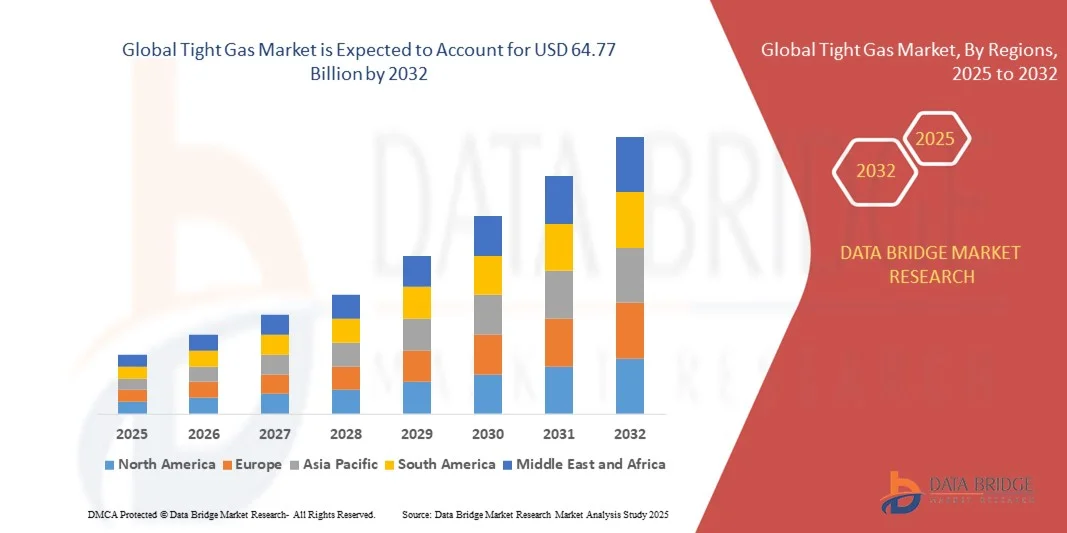
What is the Global Tight Gas Market Size and Growth Rate?
- The global tight gas market size was valued at USD 42.14 billion in 2024 and is expected to reach USD 64.77 billion by 2032, at a CAGR of 5.52% during the forecast period
- The rise in expenditure due to the expansion of oil and gas industry and advancement in the extraction process of hydraulic fracturing are the major drivers that will influence the growth of the tight gas market
- Furthermore, lower extraction, processing and commercialization costs associated with this gas variant will accelerate the tight growth of the gas market
What are the Major Takeaways of Tight Gas Market?
- Growing focus of many regional authorities on the increasing use of renewable source of energy and fossil fuels alternatives will provide beneficial opportunities for the tight gas market growth
- However, the presence of a variety of hazardous chemicals used in gas extraction will hamper the growth of the tight gas market. Availability of alternative energy modes for instance shale gas will challenge the tight gas market growth rate
- North America dominated the tight gas market with the largest revenue share of 42.8% in 2024, primarily driven by the region’s substantial shale gas reserves, advanced drilling technologies, and supportive government regulations promoting unconventional gas extraction
- The Asia-Pacific tight gas market is poised to grow at the fastest CAGR of 9.8% from 2025 to 2032, driven by escalating energy demand, rapid industrialization, and increasing investments in unconventional gas extraction technologies
- The Power Generation segment dominated the market in 2024, accounting for a market revenue share of 47.3%, primarily driven by the growing use of natural gas as a cleaner alternative to coal for electricity generation
Report Scope and Tight Gas Market Segmentation
|
Attributes |
Tight Gas Key Market Insights |
|
Segments Covered |
|
|
Countries Covered |
North America
Europe
Asia-Pacific
Middle East and Africa
South America
|
|
Key Market Players |
|
|
Market Opportunities |
|
|
Value Added Data Infosets |
In addition to the insights on market scenarios such as market value, growth rate, segmentation, geographical coverage, and major players, the market reports curated by the Data Bridge Market Research also include in-depth expert analysis, pricing analysis, brand share analysis, consumer survey, demography analysis, supply chain analysis, value chain analysis, raw material/consumables overview, vendor selection criteria, PESTLE Analysis, Porter Analysis, and regulatory framework. |
What is the Key Trend in the Tight Gas Market?
Technological Advancements in Hydraulic Fracturing and Horizontal Drilling
- A major trend shaping the global tight gas market is the increasing adoption of advanced hydraulic fracturing and horizontal drilling technologies to boost extraction efficiency from low-permeability reservoirs. These innovations have significantly improved well productivity, reduced operational costs, and extended the economic life of tight gas fields
- For instance, companies such as Halliburton and Schlumberger are introducing next-generation completion tools and data-driven fracturing techniques that enable precise control of fracture geometry and fluid placement. This allows operators to optimize recovery rates and reduce environmental impact
- The integration of real-time reservoir monitoring, AI-based predictive analytics, and automated drilling systems is revolutionizing field operations, enhancing safety, and minimizing downtime
- In addition, digital twins and IoT-based well management systems are enabling predictive maintenance and efficient resource allocation, further improving production economics.
- This trend is fundamentally transforming the competitiveness of the tight gas sector, driving a shift toward smarter, more sustainable extraction models. Companies such as BP p.l.c. and Chevron Corporation are investing heavily in digitalization and energy-efficient fracturing fluids to strengthen their operational footprint
- The ongoing technological evolution is expected to position tight gas as a crucial contributor to the global energy mix, balancing supply security with environmental responsibility
What are the Key Drivers of Tight Gas Market?
- The rising global energy demand and the depletion of conventional gas reserves are primary drivers fueling the expansion of the Tight Gas market. With governments and industries emphasizing energy security, the exploitation of unconventional gas reservoirs has become essential to meet growing consumption
- For instance, in June 2024, ExxonMobil initiated large-scale tight gas exploration in China’s Sichuan Basin, targeting domestic production growth to reduce import dependency. Similarly, PetroChina Company Limited has accelerated drilling in its Ordos Basin projects using advanced fracturing fluids and 3D seismic mapping
- The continuous improvement in hydraulic fracturing, microseismic imaging, and proppant technologies enhances gas recovery efficiency, making tight gas extraction increasingly economically viable
- Favorable government policies, such as tax incentives and exploration subsidies in the U.S., China, and Canada, are further propelling investment in unconventional gas projects.
- In addition, the global shift toward cleaner energy alternatives has increased the attractiveness of natural gas as a transition fuel, stimulating exploration and production
- The combination of technological innovation, supportive regulation, and robust energy demand positions the tight gas sector for sustained long-term growth across key producing regions
Which Factor is Challenging the Growth of the Tight Gas Market?
- Despite its growth potential, the tight gas market faces challenges stemming from high exploration and production costs, environmental concerns, and water management issues associated with hydraulic fracturing. The requirement for multiple well stimulations increases overall expenditure, often limiting profitability in low-price environments
- For instance, environmental groups in Canada and the U.S. have raised concerns about water contamination and induced seismicity linked to fracturing operations, prompting stricter regulatory oversight and community opposition
- Another key restraint is the volatility of natural gas prices, which directly impacts investment decisions and project feasibility, particularly in developing markets
- Addressing these challenges requires ongoing advancements in sustainable drilling technologies, water recycling systems, and low-emission fracturing fluids. Companies such as TotalEnergies and Occidental Petroleum Corporation are investing in carbon capture and storage (CCS) integration to mitigate the environmental footprint of tight gas extraction
- Moreover, the scarcity of skilled labor and the complexity of subsurface geology in emerging fields add to operational uncertainty and cost pressure
- Overcoming these hurdles through innovation, environmental compliance, and efficient cost management will be essential to ensure the long-term competitiveness of the global tight gas industry
How is the Tight Gas Market Segmented?
The market is segmented on the basis of application and end-user.
- By Application
On the basis of application, the tight gas market is segmented into Residential, Commercial, Industrial, Power Generation, and Transportation. The Power Generation segment dominated the market in 2024, accounting for a market revenue share of 47.3%, primarily driven by the growing use of natural gas as a cleaner alternative to coal for electricity generation. Tight gas serves as a key energy source for thermal power plants, offering low carbon emissions and high efficiency. Many developed economies, such as the U.S., Canada, and China, are increasingly relying on tight gas to ensure energy security and achieve emission targets.
The Industrial segment is projected to witness the fastest growth rate of 19.6% during 2025–2032, fueled by the rising demand from manufacturing and chemical industries for feedstock and process heating. The increased adoption of tight gas across diverse industrial processes, coupled with government incentives for low-emission fuel use, is expected to accelerate this trend further.
- By End-User
Based on end-user, the tight gas market is categorized into Power and Others. The Power segment held the largest revenue share of 61.2% in 2024, supported by the increasing global transition toward cleaner energy sources and the expanding gas-fired power generation infrastructure. Tight gas is emerging as a critical energy component in nations focused on reducing carbon footprints while maintaining steady energy supply. The abundance of tight gas reserves and technological advancements in extraction methods have made it a reliable and cost-effective energy source for large-scale power utilities.
The Others segment, encompassing residential heating, commercial facilities, and small industrial units, is expected to register the fastest CAGR of 17.4% from 2025 to 2032. This growth is driven by the rising demand for decentralized energy systems and increased adoption of natural gas in urban infrastructure. The growing preference for environmentally sustainable energy solutions will continue to strengthen this segment’s expansion.
Which Region Holds the Largest Share of the Tight Gas Market?
- North America dominated the tight gas market with the largest revenue share of 42.8% in 2024, primarily driven by the region’s substantial shale gas reserves, advanced drilling technologies, and supportive government regulations promoting unconventional gas extraction. The strong presence of key energy players and extensive exploration activities in formations such as the Barnett, Marcellus, and Haynesville shales further boost production
- The growing focus on energy independence, combined with favorable pricing structures and rising investments in horizontal drilling and hydraulic fracturing, has strengthened the region’s market leadership. In addition, innovations in well completion and reservoir stimulation are enabling producers to maximize output while reducing costs
U.S. Tight Gas Market Insight
The U.S. tight gas market captured the largest share of 85% within North America in 2024, driven by the country’s dominant position in global natural gas production and its ongoing shift toward cleaner energy sources. The development of unconventional gas fields across Texas, Pennsylvania, and Oklahoma continues to attract substantial investments from major companies such as ExxonMobil, Chevron, and Occidental Petroleum. Furthermore, government policies encouraging low-carbon energy solutions and LNG exports are fueling the expansion of the tight gas sector. Enhanced recovery techniques and digital well monitoring systems are expected to sustain production growth across key basins over the coming years.
Europe Tight Gas Market Insight
The Europe tight gas market is anticipated to grow steadily throughout the forecast period, supported by the continent’s strategic initiatives to diversify energy supply and reduce dependence on imported natural gas. Countries such as Poland, the U.K., and Germany are actively exploring tight gas reserves to enhance domestic production capabilities. The rising energy demand across residential and industrial sectors, coupled with stringent carbon reduction targets, is prompting governments to invest in unconventional gas development. In addition, technological collaborations and partnerships between European and North American companies are accelerating the adoption of advanced drilling and completion methods. The integration of environmental regulations with sustainable extraction technologies is expected to shape the regional market trajectory positively.
U.K. Tight Gas Market Insight
The U.K. tight gas market is projected to record a healthy CAGR during 2025–2032, fueled by growing efforts to improve energy self-sufficiency amid volatile global energy prices. The government’s supportive stance on responsible shale and tight gas extraction, alongside its push for renewable-natural gas integration, is stimulating investments in the sector. Moreover, advancements in hydraulic fracturing and seismic imaging technologies are enabling efficient resource identification and extraction, particularly across the Bowland Shale region.
Germany Tight Gas Market Insight
The Germany tight gas market is expected to witness considerable expansion driven by the rising demand for cleaner, domestically produced energy. Although environmental regulations remain strict, innovations in low-impact fracking and carbon capture technologies are making tight gas development increasingly feasible. Germany’s focus on achieving long-term energy transition goals (Energiewende) and reducing reliance on imported gas is expected to bolster investments in unconventional reserves, especially in Lower Saxony and North Rhine-Westphalia.
Which Region is the Fastest Growing Region in the Tight Gas Market?
The Asia-Pacific tight gas market is poised to grow at the fastest CAGR of 9.8% from 2025 to 2032, driven by escalating energy demand, rapid industrialization, and increasing investments in unconventional gas extraction technologies. Countries such as China, India, and Australia are at the forefront of regional development, leveraging technological advancements to enhance drilling efficiency and production rates. The region’s strong focus on reducing coal dependency and promoting cleaner fuels is also a critical growth driver.
China Tight Gas Market Insight
The China tight gas market held the largest share in the Asia-Pacific region in 2024, supported by massive government initiatives to develop unconventional gas reserves across the Ordos and Sichuan basins. With national energy policies emphasizing energy diversification and emission reduction, China continues to expand its production capacity through partnerships with state-owned and private enterprises. Increasing investments in hydraulic fracturing and digital reservoir management technologies are further propelling market growth.
India Tight Gas Market Insight
The India tight gas market is projected to expand rapidly during the forecast period, driven by government-backed exploration policies and rising demand for natural gas across industrial and power generation sectors. The Indian government’s efforts under the Hydrocarbon Exploration and Licensing Policy (HELP) and foreign investment inflows are improving the country’s unconventional gas prospects. Furthermore, the development of supportive infrastructure, such as pipelines and LNG terminals, is expected to strengthen market accessibility and production scalability.
Which are the Top Companies in Tight Gas Market?
The tight gas industry is primarily led by well-established companies, including:
- BP p.l.c. (U.K.)
- TotalEnergies (France)
- Occidental Petroleum Corporation (U.S.)
- Canadian Natural (Canada)
- Chevron Corporation (U.S.)
- Exxon Mobil Corporation (U.S.)
- PetroChina Company Limited (China)
- Royal Dutch Shell (U.K.)
- China Petrochemical Corporation (China)
- YPF (Argentina)
- MARATHON OIL COMPANY (U.S.)
- Ensign Natural Resources (U.S.)
- DEVON ENERGY CORPORATION (U.S.)
- EOG Resources, Inc. (U.S.)
What are the Recent Developments in Global Tight Gas Market?
- In April 2025, EQT Corporation announced the acquisition of Olympus Energy in a deal valued at USD 1.8 billion, expanding its asset base by 90,000 net acres and adding 500 MMcfd of production capacity in the Marcellus Shale. This strategic move enhances EQT’s operational scale and strengthens its dominance in U.S. natural gas production, positioning the company for greater efficiency and long-term growth
- In March 2025, Schlumberger secured a major contract to drill 18 ultra-deepwater wells for Woodside’s Trion Project, utilizing AI-driven drilling technology to optimize accuracy and performance. This initiative demonstrates Schlumberger’s commitment to advancing digital integration and operational excellence in deepwater exploration, reinforcing its leadership in next-generation energy technologies
- In January 2025, Diversified Energy completed a USD 1.275 billion acquisition of Maverick Natural Resources, significantly increasing its combined output to 1,200 MMcfd. The acquisition strengthens Diversified Energy’s portfolio and production capabilities, reinforcing its strategic objective of sustainable expansion and enhanced operational efficiency
- In October 2023, ExxonMobil completed a transformative merger with Pioneer Natural Resources through an all-stock transaction, effectively doubling its footprint in the Permian Basin and creating an estimated 16 billion barrels of oil equivalent. This merger is designed to accelerate production efficiency, support net-zero emission goals, and bolster U.S. energy security and resilience
- In August 2023, Sinopec achieved a breakthrough in its Project Deep Earth, discovering 30.55 billion cubic meters of proven geological reserves at the Bazhong gas field in Sichuan, China, primarily comprising tight sandstone gas at depths of 4,550 to 5,225 meters. This milestone underscores Sinopec’s technological expertise and ongoing commitment to enhancing domestic gas production and resource self-sufficiency in China

- Interactive Data Analysis Dashboard
- Company Analysis Dashboard for high growth potential opportunities
- Research Analyst Access for customization & queries
- Competitor Analysis with Interactive dashboard
- Latest News, Updates & Trend analysis
- Harness the Power of Benchmark Analysis for Comprehensive Competitor Tracking
Global Tight Gas Market, Supply Chain Analysis and Ecosystem Framework
To support market growth and help clients navigate the impact of geopolitical shifts, DBMR has integrated in-depth supply chain analysis into its Global Tight Gas Market research reports. This addition empowers clients to respond effectively to global changes affecting their industries. The supply chain analysis section includes detailed insights such as Global Tight Gas Market consumption and production by country, price trend analysis, the impact of tariffs and geopolitical developments, and import and export trends by country and HSN code. It also highlights major suppliers with data on production capacity and company profiles, as well as key importers and exporters. In addition to research, DBMR offers specialized supply chain consulting services backed by over a decade of experience, providing solutions like supplier discovery, supplier risk assessment, price trend analysis, impact evaluation of inflation and trade route changes, and comprehensive market trend analysis.
Data collection and base year analysis are done using data collection modules with large sample sizes. The stage includes obtaining market information or related data through various sources and strategies. It includes examining and planning all the data acquired from the past in advance. It likewise envelops the examination of information inconsistencies seen across different information sources. The market data is analysed and estimated using market statistical and coherent models. Also, market share analysis and key trend analysis are the major success factors in the market report. To know more, please request an analyst call or drop down your inquiry.
The key research methodology used by DBMR research team is data triangulation which involves data mining, analysis of the impact of data variables on the market and primary (industry expert) validation. Data models include Vendor Positioning Grid, Market Time Line Analysis, Market Overview and Guide, Company Positioning Grid, Patent Analysis, Pricing Analysis, Company Market Share Analysis, Standards of Measurement, Global versus Regional and Vendor Share Analysis. To know more about the research methodology, drop in an inquiry to speak to our industry experts.
Data Bridge Market Research is a leader in advanced formative research. We take pride in servicing our existing and new customers with data and analysis that match and suits their goal. The report can be customized to include price trend analysis of target brands understanding the market for additional countries (ask for the list of countries), clinical trial results data, literature review, refurbished market and product base analysis. Market analysis of target competitors can be analyzed from technology-based analysis to market portfolio strategies. We can add as many competitors that you require data about in the format and data style you are looking for. Our team of analysts can also provide you data in crude raw excel files pivot tables (Fact book) or can assist you in creating presentations from the data sets available in the report.













