


Global Tilt Sensor Market
Market Size in USD Million
CAGR :
% 
 USD
319.93 Million
USD
605.45 Million
2025
2033
USD
319.93 Million
USD
605.45 Million
2025
2033
 Forecast Period Forecast Period |
2026 –2033 |
 Market Size (Base Year) Market Size (Base Year) |
USD 319.93 Million |
 Market Size (Forecast Year) Market Size (Forecast Year) |
USD 605.45 Million |
 CAGR CAGR |
% |
| Major Markets Players |
|
Tilt Sensor Market Size
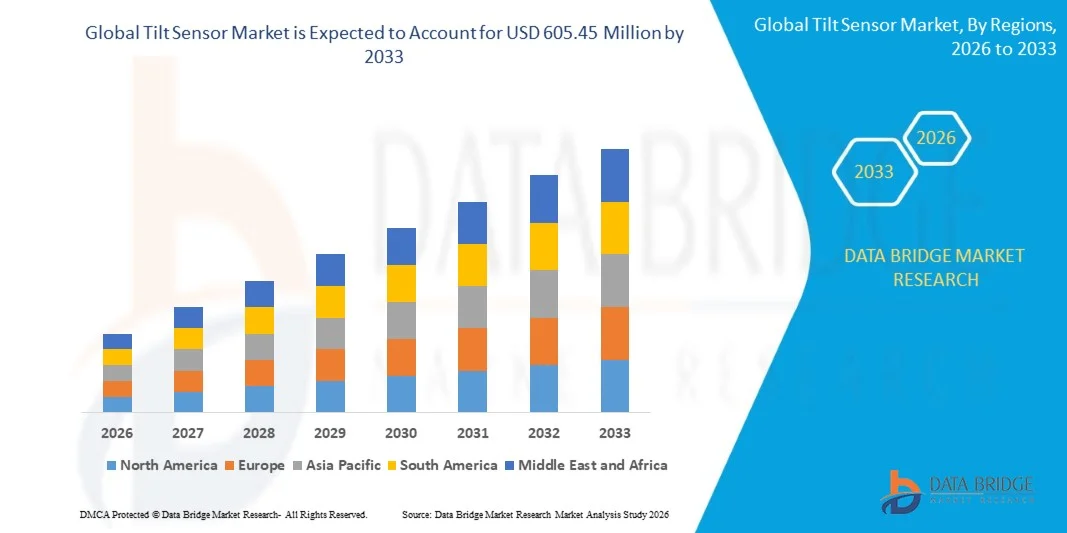
- The global tilt sensor market size was valued at USD 319.93 million in 2025 and is expected to reach USD 605.45 million by 2033, at a CAGR of 8.30% during the forecast period
- The market growth is largely fueled by the increasing adoption of automation and industrial IoT technologies across sectors such as automotive, construction, aerospace, and robotics, leading to higher demand for precise tilt measurement and orientation monitoring
- Furthermore, rising requirements for safety-critical applications, real-time monitoring, and enhanced operational efficiency are positioning tilt sensors as essential components in modern machinery and smart equipment. These converging factors are accelerating the integration of tilt sensors across industrial and consumer applications, thereby significantly boosting market growth
Tilt Sensor Market Analysis
- Tilt sensors, capable of detecting angular displacement and orientation, are increasingly vital in automotive stability systems, industrial machinery, construction equipment, aerospace navigation, and consumer electronics due to their precision, reliability, and ability to support automation
- The escalating demand for tilt sensors is primarily driven by technological advancements in MEMS and fluid-filled sensor designs, growing focus on operational safety, and the rising adoption of connected and autonomous systems that require accurate tilt monitoring for efficient performance
- Asia-Pacific dominated the tilt sensor market with a share of 53.6% in 2025, due to rapid industrialization, expanding automotive production, and growing adoption of automation technologies across manufacturing and construction sectors
- North America is expected to be the fastest growing region in the tilt sensor market during the forecast period due to high adoption of tilt sensors in automotive safety systems, aerospace, and industrial automation
- Metal segment dominated the market with a market share of 66.82% in 2025, due to its superior durability, mechanical strength, and resistance to harsh environmental conditions. Metal-based tilt sensors are widely deployed in automotive, aerospace, and heavy machinery applications where reliability under extreme conditions is critical. Their robust construction ensures consistent performance, even under high vibration, temperature, and mechanical stress
Report Scope and Tilt Sensor Market Segmentation
|
Attributes |
Tilt Sensor Key Market Insights |
|
Segments Covered |
|
|
Countries Covered |
North America
Europe
Asia-Pacific
Middle East and Africa
South America
|
|
Key Market Players |
|
|
Market Opportunities |
|
|
Value Added Data Infosets |
In addition to the insights on market scenarios such as market value, growth rate, segmentation, geographical coverage, and major players, the market reports curated by the Data Bridge Market Research also include in-depth expert analysis, geographically represented company-wise production and capacity, network layouts of distributors and partners, detailed and updated price trend analysis and deficit analysis of supply chain and demand. |
Tilt Sensor Market Trends
“Rising Adoption of MEMS and Advanced Tilt Sensor Technologies”
- A significant trend in the tilt sensor market is the increasing adoption of MEMS, fluid-filled, and proportional tilt sensor technologies across automotive, industrial, and consumer applications. This trend is driven by the growing need for precise orientation and angular measurement in automation, safety-critical systems, and connected devices, positioning tilt sensors as integral components in modern machinery and electronics
- For instance, Murata Manufacturing Co., Ltd. introduced the SCH1633-D01 6DoF sensor, enhancing vehicle stability and safety in ADAS and autonomous driving systems. Such MEMS-based sensors provide high accuracy and real-time monitoring, enabling manufacturers to integrate advanced safety and control systems into vehicles
- Tilt sensors are increasingly used in industrial machinery and construction equipment to support automation, slope compensation, and load monitoring. Companies such as elobau with their N6 static and N7 dynamic sensors are enabling precise inclination detection in mobile machinery, improving operational safety and efficiency
- The renewable energy sector is integrating tilt sensors to monitor wind turbine orientation and structural stability. For instance, Resensys LLC deployed wireless tilt networks across 250 European wind turbines, demonstrating the critical role of tilt sensors in predictive maintenance and energy optimization
- Robotics and aerospace applications are also driving adoption, where tilt sensors assist in navigation, stabilization, and precise motion control. MEMS and force-balance sensors provide the required reliability and compact form factor for drones, UAVs, and autonomous robotics
- The increasing miniaturization of consumer electronics and gaming controllers is creating demand for compact, high-precision tilt sensors. TE Connectivity’s AXISENSE-G series delivers 0.1° accuracy during motion for autonomous construction equipment, illustrating the integration of advanced tilt sensing into modern smart systems
Tilt Sensor Market Dynamics
Driver
“Growing Industrial Automation and Safety-Critical Applications”
- The tilt sensor market is being driven by the rising adoption of industrial automation, connected machinery, and safety-critical systems across automotive, aerospace, and construction sectors. These applications require accurate real-time tilt and orientation monitoring to ensure operational safety, efficiency, and compliance with stringent industry standards
- For instance, elobau’s N6 and N7 tilt sensors enable slope compensation and cab level monitoring in heavy machinery, enhancing operator safety and productivity in mining and construction environments. Such adoption of tilt sensors in industrial automation is fueling market growth
- In the automotive industry, tilt sensors are critical for airbag deployment, vehicle stability control, and autonomous driving systems. Murata’s SCH1633-D01 6DoF MEMS sensor provides precise orientation data for ADAS, demonstrating how tilt sensors are becoming essential in modern vehicle safety architectures
- The rise of smart robotics, drones, and autonomous vehicles is further boosting demand, as tilt sensors provide necessary feedback for navigation, motion stabilization, and environmental interaction. MEMS-based tilt sensors are increasingly favored for their compact size, accuracy, and reliability
- Renewable energy monitoring presents a growing driver, where tilt sensors ensure optimal positioning and structural safety for wind turbines and solar tracking systems. Resensys LLC’s wireless tilt networks in Europe highlight the expanding applications in energy infrastructure
Restraint/Challenge
“High Cost of Precision Tilt Sensors”
- The tilt sensor market faces challenges due to the high costs associated with precision MEMS, fluid-filled, and proportional tilt sensors, which require sophisticated materials, advanced fabrication technologies, and stringent calibration procedures. These factors increase production costs and can limit adoption in cost-sensitive applications
- For instance, Murata’s 6DoF SCH1633-D01 and TE Connectivity’s AXISENSE-G series involve advanced MEMS manufacturing and calibration, which elevates unit costs compared to simpler mechanical tilt sensors. High costs can impact pricing strategies and limit penetration in mid-range consumer or industrial equipment
- Producing tilt sensors for automotive, aerospace, and industrial sectors involves rigorous quality control and certification to ensure reliability under extreme conditions, further increasing operational expenses. The reliance on specialized components and skilled labor adds complexity to the supply chain
- Scaling production while maintaining accuracy and durability remains a constraint for manufacturers. Companies must balance high precision, reliability, and cost-effectiveness to meet market demand while sustaining competitiveness
- The market continues to encounter limitations in widespread deployment across emerging regions or low-cost applications due to these high sensor costs, creating a barrier for broader adoption despite strong demand from industrial automation and safety-critical sectors
Tilt Sensor Market Scope
The market is segmented on the basis of type, material type, technology, application, and vertical.
• By Type
On the basis of type, the tilt sensor market is segmented into switch based, proportional, and optical. The switch-based segment dominated the market with the largest revenue share in 2025, driven by its simple design, cost-effectiveness, and reliability in detecting angular displacement. Switch-based sensors are widely used in automotive and industrial applications where robustness and durability are crucial, offering straightforward integration into existing systems. Their widespread adoption is also fueled by low maintenance requirements and compatibility with diverse control systems. Users often prefer switch-based tilt sensors for applications demanding basic tilt detection without the need for complex signal processing. The segment continues to benefit from established manufacturing practices and extensive availability across regions.
The proportional type is expected to witness the fastest growth rate from 2026 to 2033, fueled by increasing demand in precision-sensitive applications such as aircraft flight controls and construction equipment. Proportional sensors provide continuous output corresponding to tilt angle, offering higher accuracy than switch-based types. Their rising popularity is driven by advancements in sensor electronics and integration with IoT-enabled monitoring systems. Industries requiring real-time tilt measurements for safety and operational efficiency are increasingly adopting proportional sensors. The segment also benefits from enhanced calibration capabilities and expanding industrial automation trends.
• By Material Type
On the basis of material type, the tilt sensor market is segmented into metal and non-metal. The metal segment dominated the market with the largest share of 66.82% in 2025, owing to its superior durability, mechanical strength, and resistance to harsh environmental conditions. Metal-based tilt sensors are widely deployed in automotive, aerospace, and heavy machinery applications where reliability under extreme conditions is critical. Their robust construction ensures consistent performance, even under high vibration, temperature, and mechanical stress. Manufacturers favor metal sensors for their long lifespan and proven track record in industrial and defense applications. The segment continues to benefit from ongoing investments in rugged sensor solutions for mission-critical operations.
The non-metal segment is projected to witness the fastest growth during 2026–2033, driven by lightweight design requirements in consumer electronics, gaming devices, and robotics. Non-metal sensors are favored for applications demanding compact form factors and reduced energy consumption. Their growing adoption is supported by advances in polymer and composite materials that enhance sensor flexibility and responsiveness. Industries such as digital cameras, thermostats, and video game controllers are increasingly integrating non-metal tilt sensors for portability and cost efficiency. The segment also benefits from easier manufacturing and integration with MEMS technology.
• By Technology
On the basis of technology, the tilt sensor market is segmented into force balance, MEMS, and fluid-filled. The MEMS segment dominated the market in 2025 due to its miniaturized size, high precision, and suitability for integration with electronic devices and IoT systems. MEMS tilt sensors are widely used in automotive airbag deployment systems, mobile devices, and robotic technology for accurate and reliable tilt measurement. Their low power consumption and scalable production processes make them highly desirable for both consumer electronics and industrial applications. MEMS technology also offers enhanced signal processing capabilities, enabling seamless integration with modern automation and safety systems. The segment continues to expand with increasing adoption in smart devices and industrial automation.
The fluid-filled segment is anticipated to witness the fastest CAGR from 2026 to 2033, driven by applications requiring high sensitivity and ruggedness in dynamic environments, such as construction equipment and aerospace. Fluid-filled tilt sensors offer precise tilt detection through liquid displacement, providing stable performance under vibration and shock. Industries requiring accurate orientation and leveling measurements are increasingly adopting fluid-filled types. The segment benefits from innovations improving temperature stability and responsiveness. Growing demand for safety-critical applications in industrial machinery and aviation further accelerates the adoption of fluid-filled tilt sensors.
• By Application
On the basis of application, the tilt sensor market is segmented into digital and video cameras, aircraft flight controls, construction equipment, robotic technology, automobile airbags, video game controllers, thermostats, and automobile security systems. The automobile airbag segment dominated the market in 2025, owing to stringent safety regulations and the critical need for precise tilt detection during vehicle collisions. Tilt sensors play a key role in triggering airbags at the right moment, ensuring passenger safety and reducing accident fatalities. Automotive manufacturers rely on highly reliable tilt sensors integrated with advanced vehicle safety systems. The segment also benefits from increasing adoption of smart and connected vehicles requiring enhanced sensor solutions.
The aircraft flight controls segment is expected to witness the fastest growth during 2026–2033, fueled by rising demand for avionics automation and precision navigation systems. Tilt sensors in aircraft enable accurate monitoring of aircraft orientation, stability, and control, enhancing flight safety and operational efficiency. The growth is supported by investments in next-generation aircraft and unmanned aerial vehicles requiring high-precision sensors. Advances in MEMS and fluid-filled technologies further boost the adoption of tilt sensors in aviation. Increased focus on automated and AI-driven flight systems accelerates the need for precise tilt monitoring solutions.
• By Vertical
On the basis of vertical, the tilt sensor market is segmented into mining and construction, automotive and transportation, telecommunications, aerospace and defense, gaming, and others. The automotive and transportation segment dominated the market in 2025 due to extensive adoption of tilt sensors in vehicle safety systems, navigation, and electronic stability control. Sensors are critical for ensuring safety compliance, vehicle performance monitoring, and integration with connected car technologies. The segment continues to benefit from growing automotive production and the rising incorporation of advanced driver-assistance systems (ADAS) that rely on precise tilt measurement. Automotive manufacturers prioritize tilt sensors for durability, reliability, and long-term operational efficiency.
The aerospace and defense vertical is projected to witness the fastest growth from 2026 to 2033, driven by increasing demand for high-precision sensors in aircraft, UAVs, and defense equipment. Tilt sensors in this vertical provide crucial data for orientation, targeting, and stabilization systems, enhancing operational safety and mission efficiency. Growth is fueled by defense modernization programs and expanding aerospace projects requiring robust sensor technologies. MEMS and fluid-filled sensors are increasingly adopted for their high accuracy and resilience under extreme conditions. Rising investments in smart defense systems and autonomous aerial vehicles further support the segment’s expansion.
Tilt Sensor Market Regional Analysis
- Asia-Pacific dominated the tilt sensor market with the largest revenue share of 53.6% in 2025, driven by rapid industrialization, expanding automotive production, and growing adoption of automation technologies across manufacturing and construction sectors
- The region’s cost-effective manufacturing landscape, increasing investments in electronics and sensor production, and availability of skilled labor are accelerating market growth
- Favorable government policies promoting smart manufacturing, aerospace, and defense initiatives, along with rising demand for industrial safety and automation, are contributing to increased tilt sensor adoption
China Tilt Sensor Market Insight
China held the largest share in the Asia-Pacific tilt sensor market in 2025, owing to its strong automotive, electronics, and industrial equipment manufacturing base. The country’s focus on industrial automation, extensive production capabilities, and supportive government initiatives for high-tech manufacturing are major growth drivers. Rising investments in MEMS and fluid-filled sensor technologies, along with growing aerospace and defense projects, further strengthen market demand.
India Tilt Sensor Market Insight
India is witnessing the fastest growth in the Asia-Pacific region, fueled by increasing adoption of automation in construction, mining, and automotive sectors. Government initiatives such as “Make in India” and infrastructure development programs are boosting the manufacturing and industrial sectors. Growing demand for precision tilt measurement in safety-critical applications, coupled with expansion of industrial robotics and smart devices, is accelerating market growth.
Europe Tilt Sensor Market Insight
The Europe tilt sensor market is expanding steadily, supported by strong aerospace, automotive, and industrial automation industries. The region emphasizes high-quality sensor production, regulatory compliance, and adoption of advanced MEMS and proportional technologies. Growing demand for tilt sensors in safety systems, precision equipment, and industrial machinery is driving regional growth.
Germany Tilt Sensor Market Insight
Germany’s tilt sensor market is driven by its leadership in automotive engineering, industrial automation, and aerospace manufacturing. Strong R&D infrastructure, partnerships between academic institutions and industry, and high demand for precision sensors in safety and control applications foster market growth. Tilt sensors are increasingly used in advanced vehicles, industrial machinery, and automation systems.
U.K. Tilt Sensor Market Insight
The U.K. market is supported by a mature aerospace, defense, and automotive industry, growing focus on R&D, and adoption of smart industrial equipment. Increasing investments in MEMS and force balance tilt sensors for robotics, automotive safety, and automation systems contribute to market expansion. Collaboration between universities and technology companies is strengthening innovation in sensor applications.
North America Tilt Sensor Market Insight
North America is projected to grow at the fastest CAGR from 2026 to 2033, driven by high adoption of tilt sensors in automotive safety systems, aerospace, and industrial automation. Increasing investments in MEMS and fluid-filled technologies, coupled with industrial IoT and smart manufacturing trends, are accelerating market demand. Rising reshoring of electronics and sensor manufacturing and collaborations between automotive and aerospace companies further support growth.
U.S. Tilt Sensor Market Insight
The U.S. accounted for the largest share in the North America market in 2025, underpinned by its strong automotive, aerospace, and industrial automation sectors. The country’s focus on precision sensor technologies, regulatory compliance, and smart manufacturing adoption is boosting tilt sensor usage. Presence of leading tilt sensor manufacturers, robust R&D infrastructure, and growing demand for high-reliability sensors in safety and automation applications solidify the U.S.’s dominant position.
Tilt Sensor Market Share
The tilt sensor industry is primarily led by well-established companies, including:
- Variohm EuroSensor (U.K.)
- TE Connectivity (Switzerland)
- Curtiss-Wright (U.S.)
- ASM GmbH (Germany)
- Balluff GmbH (Germany)
- Murata Manufacturing Co., Ltd. (Japan)
- Pepperl+Fuchs (Germany)
- The Fredericks Company (U.S.)
- SICK AG (Germany)
- Omron Corporation (Japan)
- di-soric GmbH & Co. KG (Germany)
- GEOKON (U.S.)
- Rieker Inc. (U.S.)
- WYLER AG Baumer (U.S.)
- DIS Sensors bv (Netherlands)
- elobau GmbH & Co. KG (Germany)
- Gefran (Italy)
- ifm electronic gmbh (Germany)
- Level Developments (U.K.)
- Jewell Instruments (U.S.)
- Meggitt PLC (U.K.)
- MEMSIC, Inc (U.S.)
Latest Developments in Global Tilt Sensor Market
- In May 2025, TE Connectivity launched the AXISENSE-G series of dynamic-condition tilt sensors, offering 0.1° accuracy during motion, specifically for autonomous construction equipment. This innovation is expected to strengthen the adoption of high-precision tilt sensors in construction automation, improving operational safety and efficiency. By enabling precise monitoring of equipment orientation in real-time, TE Connectivity is positioning itself to capture a growing share of the tilt sensor market in industrial automation and smart machinery applications
- In April 2025, Calypso Instruments introduced a combined wind and tilt measurement device for renewable energy monitoring. This integration allows operators to simultaneously track structural tilt and environmental conditions, enhancing predictive maintenance and operational efficiency in wind turbines. The launch is anticipated to boost tilt sensor adoption in the renewable energy sector, creating opportunities for multifunctional sensing solutions in energy infrastructure
- In March 2025, Resensys LLC secured a USD 15 million contract to deploy wireless tilt networks across 250 European wind turbines. This project demonstrates the critical role of tilt sensors in large-scale energy infrastructure monitoring and is likely to accelerate market demand for wireless and networked tilt sensing technologies. The contract positions Resensys as a key player in the renewable energy tilt sensor segment, highlighting the expanding application of tilt sensors in smart grid and predictive maintenance solutions
- In June 2024, elobau launched its N6 static and N7 dynamic tilt sensors for the off-highway sector, utilizing non-contact MEMS technology to accurately monitor angles of inclination. The sensors, featuring cab level control and automatic slope compensation, enhance safety and productivity in mobile machinery. This launch is expected to drive adoption of MEMS-based tilt sensors in construction, agriculture, and industrial equipment, where precision and durability are critical for operational efficiency
- In November 2024, Murata Manufacturing Co., Ltd. unveiled the SCH1633-D01, a Six-Degrees-of-Freedom (6DoF) sensor with tilt sensing capabilities for automotive applications. Designed for systems such as Autonomous Driving and ADAS, this sensor provides accurate orientation data, improving vehicle stability and safety. The introduction of SCH1633-D01 is likely to reinforce Murata’s position in the automotive tilt sensor market and encourage broader adoption of advanced tilt sensing solutions in connected and autonomous vehicles
SKU-
Get online access to the report on the World's First Market Intelligence Cloud

- Interactive Data Analysis Dashboard
- Company Analysis Dashboard for high growth potential opportunities
- Research Analyst Access for customization & queries
- Competitor Analysis with Interactive dashboard
- Latest News, Updates & Trend analysis
- Harness the Power of Benchmark Analysis for Comprehensive Competitor Tracking
Global Tilt Sensor Market, Supply Chain Analysis and Ecosystem Framework
To support market growth and help clients navigate the impact of geopolitical shifts, DBMR has integrated in-depth supply chain analysis into its Global Tilt Sensor Market research reports. This addition empowers clients to respond effectively to global changes affecting their industries. The supply chain analysis section includes detailed insights such as Global Tilt Sensor Market consumption and production by country, price trend analysis, the impact of tariffs and geopolitical developments, and import and export trends by country and HSN code. It also highlights major suppliers with data on production capacity and company profiles, as well as key importers and exporters. In addition to research, DBMR offers specialized supply chain consulting services backed by over a decade of experience, providing solutions like supplier discovery, supplier risk assessment, price trend analysis, impact evaluation of inflation and trade route changes, and comprehensive market trend analysis.
Research Methodology
Data collection and base year analysis are done using data collection modules with large sample sizes. The stage includes obtaining market information or related data through various sources and strategies. It includes examining and planning all the data acquired from the past in advance. It likewise envelops the examination of information inconsistencies seen across different information sources. The market data is analysed and estimated using market statistical and coherent models. Also, market share analysis and key trend analysis are the major success factors in the market report. To know more, please request an analyst call or drop down your inquiry.
The key research methodology used by DBMR research team is data triangulation which involves data mining, analysis of the impact of data variables on the market and primary (industry expert) validation. Data models include Vendor Positioning Grid, Market Time Line Analysis, Market Overview and Guide, Company Positioning Grid, Patent Analysis, Pricing Analysis, Company Market Share Analysis, Standards of Measurement, Global versus Regional and Vendor Share Analysis. To know more about the research methodology, drop in an inquiry to speak to our industry experts.
Customization Available
Data Bridge Market Research is a leader in advanced formative research. We take pride in servicing our existing and new customers with data and analysis that match and suits their goal. The report can be customized to include price trend analysis of target brands understanding the market for additional countries (ask for the list of countries), clinical trial results data, literature review, refurbished market and product base analysis. Market analysis of target competitors can be analyzed from technology-based analysis to market portfolio strategies. We can add as many competitors that you require data about in the format and data style you are looking for. Our team of analysts can also provide you data in crude raw excel files pivot tables (Fact book) or can assist you in creating presentations from the data sets available in the report.












