


What is the Tilt Sensor Market Size and Growth Rate?
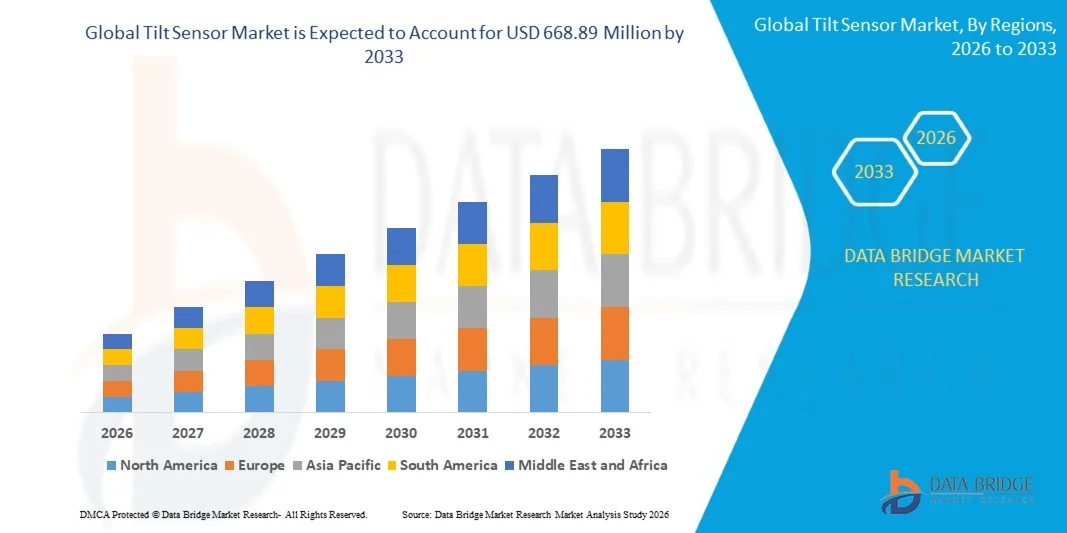
- As per Data Bridge Market Research analysis, the tilt sensor market was valued at USD 280.00 million in 2025 and is projected to reach USD 668.89 million by 2033, growing at a CAGR of 11.50% from 2026 to 2033.
- The market is experiencing consistent growth driven by rising demand for tilt sensors in automotive and transportation, increasing industrial automation, and advancements in MEMS technology that enable compact, accurate, and low-power orientation sensing across a wide range of applications.
- The increasing adoption of automated construction and mining equipment, combined with growing requirements for equipment stability, vehicle safety, and real-time orientation monitoring, is compelling industries to deploy advanced tilt-sensing technologies. MEMS-based and fluid-filled tilt sensors are increasingly being integrated into automotive systems, heavy machinery, industrial equipment, and connected devices, providing accurate angle measurement, enhanced operational safety, and reliable performance in demanding environments.
Market Size & Forecast
- Global Market Value (2025): USD 280.00 Million
- Expected Market Value (2033): USD 668.89 Million
- Forecast CAGR (2026–2033): 11.50%
- Leading Region in 2025: North America
- Fastest Growing Region: Asia Pacific
What are the Major Takeaways of the Tilt Sensor Market?
- North America dominated the tilt sensor market with the largest revenue share of 34.6% in 2025, supported by advanced industrial automation, strong automotive and aerospace industries, and increasing adoption of precision sensing technologies.
- Asia-Pacific is expected to be the fastest-growing region at a CAGR of 8.5% from 2026 to 2033, fueled by rapid industrialization, infrastructure development, expanding automotive production, and increasing adoption of tilt sensors in industrial automation across China, Japan, and India.
- The switch-based segment led the market with a 45% share in 2025, driven by its simple operating mechanism, cost-effectiveness, and reliable tilt detection capabilities.
- Proportional are the fastest-growing type, projected to register a CAGR of 9.5%, reflecting the surge in demand for continuous and precise inclination measurement.
- The non-metal segment dominated the housing material category with a 67.1% revenue share in 2025, led by its lightweight construction, ease of installation, and suitability for compact sensor designs.
- MEMS accounted for 79.1% of the market share in 2025, preferred by its compact size, high sensitivity, low power requirements, and broad integration capabilities.
- The automotive & transportation segment is the fastest-growing application category, with a CAGR of 12.7%, driven by increasing integration of tilt sensors into vehicle stability, safety, and electronic control systems.
Report Scope and Tilt Sensor Market Segmentation
|
Attributes |
Tilt Sensor Key Market Insights |
|
Segments Covered |
|
|
Countries Covered |
North America
Europe
Asia-Pacific
Middle East and Africa
South America
|
|
Key Market Players |
|
|
Market Opportunities |
|
|
Value Added Data Infosets |
In addition to the insights on market scenarios such as market value, growth rate, segmentation, geographical coverage, and major players, the market reports curated by the Data Bridge Market Research also include in-depth expert analysis, geographically represented company-wise production and capacity, network layouts of distributors and partners, detailed and updated price trend analysis and deficit analysis of supply chain and demand. |
What is the Key Trend in the Tilt Sensor Market?
- Tilt sensors are increasingly being integrated with MEMS-based, multi-axis sensing and digital interfaces to deliver compact, accurate, and maintenance-free angle measurement for industrial and mobile equipment.
- For instance, in March 2024, Turck introduced new QR20 inclinometer sensors with analog output that combine MEMS acceleration measurement with gyroscope signals. The sensor fusion improves resistance to shocks and vibration and supports single- and dual-axis measurement for moving and vibrating machinery
- The integration of CANopen, J1939, IO-Link, and other digital communication interfaces is enabling tilt sensors to exchange orientation data directly with industrial control systems and connected machinery.
- Industrial automation, construction machinery, solar tracking, and material-handling equipment are increasingly using single- and dual-axis tilt sensors for continuous positioning, leveling, and operational monitoring.
- For instance, in October 2024, POSITAL upgraded its Dynamic TILTIX inclinometers with enhanced signal-processing algorithms and acceleration compensation, combining MEMS accelerometers and gyroscopes to improve tilt measurement during rapid motion, shock, and vibration.
- As manufacturers increasingly combine MEMS sensing, digital connectivity, and ruggedized designs, the adoption of intelligent tilt sensors is expected to accelerate across industrial automation, mobile machinery, renewable energy, and infrastructure monitoring applications.
What are the Key Drivers of the Tilt Sensor Market?
- The rapid expansion of industrial automation and connected machinery is increasing demand for compact tilt sensors capable of continuously monitoring equipment orientation, leveling, and positioning in real time.
- For instance, in January 2024, Pepperl+Fuchs introduced the F99 mobile IMU inclination sensor for construction machinery and robots. The sensor combines acceleration and gyroscope measurements to provide stable inclination values, supporting orientation monitoring in mobile and automated equipment.
- Automotive, construction, mining, renewable-energy, and material-handling equipment manufacturers are integrating tilt sensors to improve machine stability, positioning accuracy, safety, and automated control.
- For instance, in March 2024, Turck expanded its QR20 inclinometer portfolio with analog-output sensors using fused MEMS acceleration and gyroscope signals. The technology is designed for moving applications and vibrating machines, including positioning and lifting applications, enabling more reliable real-time orientation measurement in industrial automation.
- With industrial equipment becoming increasingly automated and connected, the need for continuous orientation measurement and real-time machine-position feedback will remain a key driver of tilt sensor adoption across industrial and infrastructure applications.
Which Factors are Challenging the Growth of the Tilt Sensor Market?
- Accurate tilt measurement can be challenging in high-vibration and dynamically moving environments, where acceleration, shock, temperature variation, and vibration can introduce measurement errors.
- For instance, in June 2022, STMicroelectronics published its AN5551 application note on precise tilt sensing in industrial applications, explaining that external acceleration from movement, vibration, and shock introduces errors in static inclinometer measurements and that dynamic applications may require accelerometer–gyroscope sensor fusion to maintain reliable tilt measurements.
- These environmental effects can require advanced compensation, filtering, calibration, and higher-performance sensing components, increasing system complexity and potentially raising deployment costs.
- Industrial applications such as construction equipment, mining machinery, cranes, and mobile platforms can expose tilt sensors to continuous shock and vibration, creating additional requirements for ruggedization and signal processing.
- For instance, in April 2022, NXP Semiconductors published an application note explaining the use of its FXLS8967 and FXLS8974 3-axis accelerometers as inclinometers, highlighting the need for calibration and compensation to achieve accurate tilt measurements.
- The requirement for high accuracy under temperature fluctuations, vibration, and dynamic motion therefore continues to challenge manufacturers, particularly where applications require sub-degree precision and reliable long-term measurements.
How is the Tilt Sensor Market Segmented?
The tilt sensor market is segmented on the basis of type, housing material, technology, and application.
- By Type
On the basis of type, the tilt sensor market is segmented into switch-based, proportional, and optical. The switch-based segment dominated the market with 45% share in 2025, owing to its simple operating mechanism, cost-effectiveness, and reliable tilt detection capabilities. These sensors are widely used where a change in inclination needs to trigger a switching response. Their straightforward construction allows easy integration into automotive, industrial, safety, and equipment-control systems. Switch-based sensors generally require limited maintenance and can be deployed across applications with relatively uncomplicated sensing requirements. Their established use across conventional tilt-detection applications continues to support their leading position in the market
The proportional segment is projected to register the fastest growth at 9.5% CAGR from 2026 to 2033, driven by increasing demand for continuous and precise inclination measurement. Proportional tilt sensors generate an output that corresponds to the degree of tilt rather than simply indicating a threshold condition. This capability makes them suitable for applications requiring more detailed orientation information and real-time monitoring. Their use in construction equipment, aircraft systems, industrial machinery, and automated equipment is supporting adoption. Integration with electronic control systems and connected equipment is further increasing their application potential.
- By Housing Material
On the basis of housing material, the tilt sensor market is segmented into non-metal and metal. The non-metal segment dominated the market with a 67.1% share in 2025, supported by its lightweight construction, ease of installation, and suitability for compact sensor designs. Non-metal housings can provide effective protection while allowing manufacturers greater flexibility in sensor packaging. They are increasingly used in automotive, construction, robotics, and other applications requiring compact sensing solutions. Their compatibility with modern electronic and MEMS-based sensor designs further supports their adoption. Increasing automation and integration of sensors into connected equipment are creating additional demand for lightweight housing solutions.
The metal segment is projected to register the fastest growth at 10.0% CAGR from 2026 to 2033, driven by increasing demand for durable sensing solutions in demanding operating environments. Metal housings provide mechanical strength and enhanced protection for sensors exposed to vibration, impact, and harsh industrial conditions. They are particularly suitable for aerospace, industrial machinery, construction equipment, and other applications where robustness is important. The increasing deployment of tilt sensors in heavy-duty equipment is supporting demand for stronger housing configurations. Advances in sensor design are also improving the performance and application range of metal-housed products.
- By Technology
On the basis of technology, the tilt sensor market is segmented into MEMS, fluid-filled, and force balanced. The MEMS segment dominated the market with a 79.1% share in 2025, supported by its compact size, high sensitivity, low power requirements, and broad integration capabilities. MEMS technology allows tilt sensing functions to be incorporated into compact electronic systems and connected devices. It is widely applicable across automotive, industrial, robotics, and consumer-oriented electronic systems. Its compatibility with digital processing and modern control architectures further increases its usefulness in automated equipment. Continuous improvements in MEMS sensing performance are expanding its suitability across different operating environments.
The fluid-filled segment is projected to register the fastest growth at 10.8% CAGR from 2026 to 2033, driven by demand for sensitive and reliable inclination measurement in demanding applications. Fluid-filled sensors detect changes in inclination through fluid movement, providing a practical approach to tilt measurement. Their sensitivity and ability to operate in challenging environments make them suitable for industrial machinery and automotive applications. They can also be used in applications where dependable inclination detection is required under varying operating conditions. Advances in fluid-based sensing technologies are improving durability and measurement performance.
- By Application
On the basis of application, the tilt sensor market is segmented into construction & mining, automotive & transportation, aerospace & defense, telecommunications, and others. The construction & mining segment dominated the market with a 31.3% share in 2025, driven by extensive use of tilt sensors for equipment stability, positioning, and operational safety. Heavy machinery such as cranes, excavators, drilling equipment, and mining machinery requires accurate inclination monitoring during operation. Tilt sensors help monitor equipment angles and support safer operation on uneven or inclined surfaces. Increasing automation of construction and mining machinery is creating additional demand for real-time inclination information. Infrastructure development and modernization of heavy equipment are further supporting adoption.
The automotive & transportation segment is projected to register the fastest growth at a 12.7% CAGR from 2026 to 2033, driven by increasing integration of tilt sensors into vehicle stability, safety, and electronic control systems. Tilt sensors provide information about vehicle inclination and orientation that can support automated and safety-related functions. Growing adoption of advanced vehicle electronics is creating additional applications for compact inclination sensors. The expansion of electric, connected, and increasingly automated vehicles is further supporting demand for real-time orientation monitoring. Transportation infrastructure and railway applications also provide additional areas for tilt sensor deployment. Increasing emphasis on vehicle safety and automated control is expected to accelerate adoption.
Which Region Holds the Largest Share of the Tilt Sensor Market?
- North America dominated the tilt sensor market with the largest revenue share of 34.6% in 2025, supported by advanced industrial automation, strong automotive and aerospace industries, and increasing adoption of precision sensing technologies.
- The region also benefits from extensive deployment of tilt sensors across construction equipment, industrial machinery, automotive safety systems, and aerospace applications. Strong research and development capabilities, established sensor-manufacturing ecosystems, and growing integration of MEMS-based technologies are further supporting regional demand. Increasing adoption of automated machinery and smart equipment continues to strengthen North America’s position in the global market
U.S. Tilt Sensor Market Insight
The U.S. tilt sensor market is witnessing strong growth due to rising adoption of advanced sensing technologies across automotive, aerospace, construction, and industrial automation applications. The country’s mature manufacturing ecosystem, along with increasing integration of MEMS-based and precision sensing systems, is driving demand across vehicle safety, heavy machinery, robotics, and infrastructure applications. In addition, growing emphasis on equipment automation, real-time inclination monitoring, and operational safety is accelerating tilt sensor adoption across industrial and transportation sectors.
Asia-Pacific Tilt Sensor Market Insight
The Asia-Pacific tilt sensor market is expected to witness rapid growth, driven by increasing industrialization, expanding construction activities, and rising automotive production across countries such as China, India, and Japan. Growing adoption of automation technologies, smart machinery, and MEMS-based sensing solutions is supporting regional market expansion. In addition, increasing investments in infrastructure development, robotics, connected equipment, and vehicle safety systems are accelerating tilt sensor adoption across industrial, automotive, and transportation applications.
Japan Tilt Sensor Market Insight
The Japan tilt sensor market is witnessing consistent growth due to rising investments in automotive electronics, industrial automation, robotics, and advanced sensing technologies. Automotive manufacturers, robotics companies, and industrial equipment producers are increasingly adopting tilt sensors for orientation monitoring, equipment positioning, and safety applications. Moreover, increasing integration of MEMS technology and the country’s focus on precision manufacturing, automation, and efficient mobility solutions are further contributing to market growth.
China Tilt Sensor Market Insight
The China tilt sensor market is growing rapidly, driven by expanding construction and mining activities, increasing automotive production, and rising investments in industrial automation. Growing adoption of MEMS-based sensing systems across automotive, robotics, heavy machinery, and infrastructure applications is significantly boosting market demand. In addition, rising investments in smart manufacturing, connected equipment, vehicle safety systems, and advanced industrial technologies are positioning China as an important growth market for tilt sensors.
U.K. Tilt Sensor Market Insight
The U.K. tilt sensor market is experiencing steady growth, supported by rising adoption of precision sensing technologies in construction, automotive, aerospace, telecommunications, and industrial applications. Increasing investments in automated equipment and growing demand for reliable inclination-monitoring solutions are contributing to market growth. Furthermore, integration of MEMS-based sensors with connected machinery, robotics, and advanced control systems is improving monitoring capabilities and supporting the adoption of tilt sensors across the U.K.
Germany Tilt Sensor Market Insight
The Germany tilt sensor market is expanding steadily due to the country’s strong automotive manufacturing base, advanced industrial automation capabilities, and increasing adoption of precision sensing technologies. Automotive companies, industrial equipment manufacturers, and construction machinery producers are increasingly utilizing tilt sensors for positioning, inclination monitoring, and safety applications. Continuous advancements in MEMS technology, smart manufacturing, and connected machinery, along with strong emphasis on industrial innovation and automation, are further driving market growth in Germany.
Which are the Top Companies in Tilt Sensor Market?
The tilt sensor industry is primarily led by well-established companies, including:
- TE Connectivity Ltd. (U.S.)
- Murata Manufacturing Co., Ltd. (Japan)
- SICK AG (Germany)
- Pepperl+Fuchs SE (Germany)
- Level Developments Ltd. (U.K.)
- The Fredericks Company (U.S.)
- ifm electronic gmbh (Germany)
- Balluff GmbH (Germany)
- Jewell Instruments (U.S.)
- elobau GmbH & Co. KG (Germany)
- Gefran S.p.A. (Italy)
- MEMSIC Semiconductor Co., Ltd. (China)
- Analog Devices, Inc. (U.S.)
- Honeywell International Inc. (U.S.)
- Bosch Sensortec GmbH (Germany)
- Parker Hannifin Corporation (U.S.)
- OMRON Corporation (Japan)
- Sensata Technologies Holding plc (U.S.)
- TWK-ELEKTRONIK GmbH (Germany)
- RION Co., Ltd. (Japan)
What are Latest Developments in Tilt Sensor Market?
- In February 2025, Althen Sensors introduced its next-generation Ruby MEMS accelerometers and inclinometers, designed to provide enhanced precision, durability, and integration for industrial and structural applications. The new Ruby series was developed to replace several existing sensor families and incorporates improved performance, connectivity, and power options. The sensors feature an IP67-rated design and are intended for demanding industrial environments.
- In March 2024, Turck introduced new QR20 inclinometer sensors with conventional analog outputs, expanding its existing portfolio of IO-Link and switching-output inclination sensors. The sensors combine MEMS acceleration measurement with gyroscope signals to improve tilt measurement under shocks and vibrations. The new single- and dual-axis configurations are designed for static and moving applications, including positioning and lifting equipment. This development highlights the growing integration of sensor-fusion technologies into industrial tilt sensing.
- In November 2023, Althen Sensors & Controls introduced Jewell Instruments’ Ultra Precision Geo Tilt Sensors, designed for high-precision tilt measurement across applications including construction, geotechnical monitoring, and automotive safety systems. The development expanded the availability of precision inclination-monitoring solutions for applications requiring accurate measurement of surface and structural orientation.
- In March 2022, Murata Manufacturing announced the development of its SCL3400 high-grade two-axis MEMS inclinometer with a digital SPI interface, designed for industrial applications requiring high stability and reliable inclination measurement. The sensor incorporates a new MEMS structure and was developed for applications including structural-health monitoring, leveling, positioning, and guidance systems. The product was planned for mass production beginning in June 2022.
- In February 2021, Jewell Instruments expanded its JDI MEMS inclinometer series with additional output and connector options, including RS-232, MODBUS RS-485, and M12 connectivity. The expanded configuration was designed to support applications such as construction, aerospace equipment, structural monitoring, and platform leveling. The development improved the flexibility of digital tilt sensors for industrial and demanding environmental applications

- Interactive Data Analysis Dashboard
- Company Analysis Dashboard for high growth potential opportunities
- Research Analyst Access for customization & queries
- Competitor Analysis with Interactive dashboard
- Latest News, Updates & Trend analysis
- Harness the Power of Benchmark Analysis for Comprehensive Competitor Tracking
Global Tilt Sensor Market, Supply Chain Analysis and Ecosystem Framework
To support market growth and help clients navigate the impact of geopolitical shifts, DBMR has integrated in-depth supply chain analysis into its Global Tilt Sensor Market research reports. This addition empowers clients to respond effectively to global changes affecting their industries. The supply chain analysis section includes detailed insights such as Global Tilt Sensor Market consumption and production by country, price trend analysis, the impact of tariffs and geopolitical developments, and import and export trends by country and HSN code. It also highlights major suppliers with data on production capacity and company profiles, as well as key importers and exporters. In addition to research, DBMR offers specialized supply chain consulting services backed by over a decade of experience, providing solutions like supplier discovery, supplier risk assessment, price trend analysis, impact evaluation of inflation and trade route changes, and comprehensive market trend analysis.
Data collection and base year analysis are done using data collection modules with large sample sizes. The stage includes obtaining market information or related data through various sources and strategies. It includes examining and planning all the data acquired from the past in advance. It likewise envelops the examination of information inconsistencies seen across different information sources. The market data is analysed and estimated using market statistical and coherent models. Also, market share analysis and key trend analysis are the major success factors in the market report. To know more, please request an analyst call or drop down your inquiry.
The key research methodology used by DBMR research team is data triangulation which involves data mining, analysis of the impact of data variables on the market and primary (industry expert) validation. Data models include Vendor Positioning Grid, Market Time Line Analysis, Market Overview and Guide, Company Positioning Grid, Patent Analysis, Pricing Analysis, Company Market Share Analysis, Standards of Measurement, Global versus Regional and Vendor Share Analysis. To know more about the research methodology, drop in an inquiry to speak to our industry experts.
Data Bridge Market Research is a leader in advanced formative research. We take pride in servicing our existing and new customers with data and analysis that match and suits their goal. The report can be customized to include price trend analysis of target brands understanding the market for additional countries (ask for the list of countries), clinical trial results data, literature review, refurbished market and product base analysis. Market analysis of target competitors can be analyzed from technology-based analysis to market portfolio strategies. We can add as many competitors that you require data about in the format and data style you are looking for. Our team of analysts can also provide you data in crude raw excel files pivot tables (Fact book) or can assist you in creating presentations from the data sets available in the report.













