


Time-Sensitive Networking Market Overview
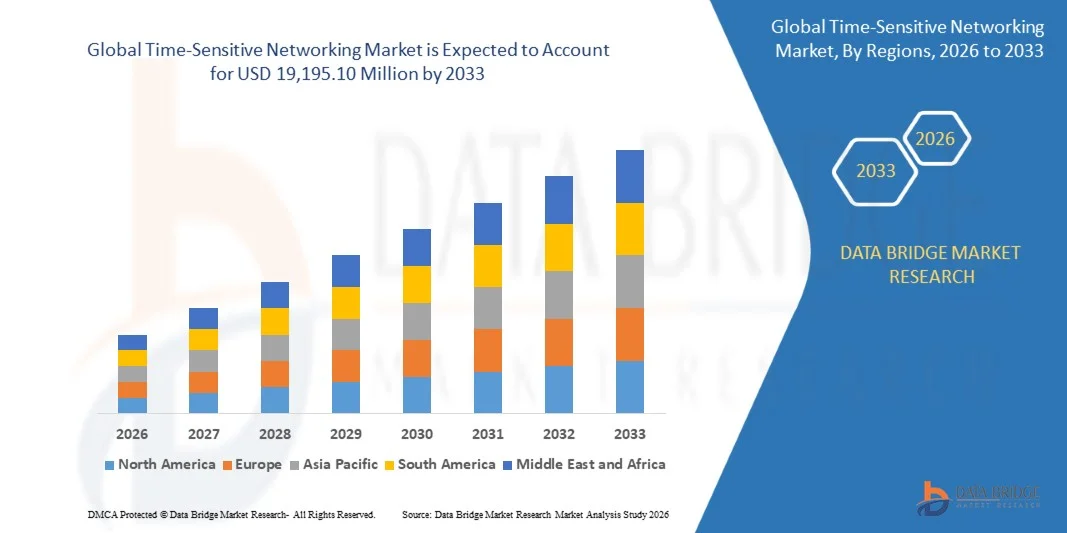
The Time-Sensitive Networking Market was valued at USD 644.94 million in 2025 and is projected to reach USD 19,195.10 million by 2033, growing at a CAGR of 52.83% from 2026 to 2033. The market is experiencing exceptional growth driven by increasing adoption of Industrial Internet of Things (IIoT) technologies, rising demand for deterministic real-time communication networks, and expanding deployment of Industry 4.0 automation systems across manufacturing, automotive, energy, and transportation sectors.
The growing need for synchronized, low-latency, and highly reliable data transmission is encouraging enterprises to transition from traditional industrial Ethernet networks to time-sensitive networking architectures. TSN enables seamless convergence of information technology (IT) and operational technology (OT) networks while ensuring guaranteed bandwidth, precise timing, and predictable communication performance. As industrial automation systems become increasingly interconnected and data-intensive, organizations are investing in TSN-enabled switches, controllers, gateways, and networking infrastructure to support mission-critical applications. Furthermore, the rapid expansion of smart factories, autonomous industrial systems, robotics, and advanced machine-to-machine communication networks is accelerating adoption, positioning time-sensitive networking as a foundational technology for next-generation digital industrial ecosystems.
Key Market Trends & Insights
- North America dominated the time-sensitive networking market with the largest revenue share of 38.7% in 2025, supported by strong investments in smart manufacturing infrastructure, widespread adoption of Industrial Internet of Things (IIoT) technologies, and the presence of major networking, semiconductor, and industrial automation companies actively developing TSN-enabled solutions.
- Asia-Pacific is expected to be the fastest-growing region, recording a CAGR of 56.4% from 2026 to 2033. Growth is driven by accelerating industrial digitalization, expanding manufacturing automation across China, Japan, South Korea, and India, and increasing investments in smart factories, robotics, and next-generation industrial communication networks.
- The Switches, Hubs, Routers, and Gateways segment held the largest market revenue share of approximately 34.7% in 2025 driven by their critical role in enabling deterministic communication, traffic scheduling, synchronization, and low-latency data transmission across industrial Ethernet networks. Growing deployment of Industry 4.0 infrastructure, smart factories, and real-time automation systems continues to support strong demand for TSN-enabled networking equipment.
- The Controllers and Processors segment is projected to register the fastest growth at a CAGR of 55.8% from 2026 to 2033, driven by increasing adoption of intelligent automation platforms, edge computing devices, and real-time industrial control systems. Rising deployment of autonomous manufacturing equipment, robotics, and machine-to-machine communication solutions is accelerating demand for advanced processing units capable of supporting TSN protocols and synchronized industrial operations.
- The Industrial Automation segment accounted for the largest market revenue share of approximately 41.9% in 2025 driven by widespread implementation of smart manufacturing technologies, industrial robotics, programmable logic controllers, and connected production environments. Manufacturers are increasingly adopting TSN-enabled networks to improve operational efficiency, reduce latency, and support deterministic communication across mission-critical industrial applications.
- The Automotive segment is expected to witness the fastest growth at a CAGR of 57.2% from 2026 to 2033, driven by increasing development of software-defined vehicles, advanced driver-assistance systems, autonomous driving technologies, and centralized vehicle architectures. Automotive manufacturers are actively integrating TSN standards to support high-speed, synchronized communication between sensors, controllers, cameras, and onboard computing platforms, accelerating market growth across the sector.
- The IEEE 802.1 AS segment held the largest market revenue share of approximately 27.6% in 2025 driven by its widespread adoption as the foundational timing and synchronization standard within TSN architectures. The standard plays a critical role in enabling precise clock synchronization among network devices, making it essential for industrial automation, transportation, and real-time communication environments.
- The IEEE 802.1 Qbv segment is projected to register the fastest growth at a CAGR of 58.4% from 2026 to 2033, driven by increasing demand for scheduled traffic management and deterministic network performance in latency-sensitive applications. Growing adoption across industrial automation systems, autonomous vehicles, and advanced manufacturing facilities is accelerating deployment of IEEE 802.1 Qbv as organizations seek guaranteed communication reliability and improved network efficiency.
Market Size & Forecast
- Global Market Value (2025): USD 644.94 Million
- Expected Market Value (2033): USD 19,195.10 Million
- Forecast CAGR (2026–2033): 52.83%
- Leading Region in 2025: North America
- Fastest Growing Region: Asia-Pacific
Report Scope and Time-Sensitive Networking Market Segmentation
|
Attributes |
Time-Sensitive Networking Key Market Insights |
|
Segments Covered |
· By Component: Switches, Hubs, Routers, and Gateways, Connectors, Communication Interfaces, Power Supply Devices, Controllers and Processors, Memory, Isolators and Converters, and Others · By Application: Industrial Automation, Power and Energy, Automotive, Transportation, Oil and Gas, Aerospace, and Others · By Standards: IEEE 802.1 AS, IEEE 802.1 AS-Rev, IEEE 802.1 Qbv, IEEE 802.1 Qca, IEEE 802.1 Qcc, IEEE 802.1 Qci, IEEE 802.1 Qch, IEEE 802.1 CM, and IEEE 802.1 CB |
|
Countries Covered |
North America · U.S. · Canada · Mexico Europe · Germany · France · U.K. · Netherlands · Switzerland · Belgium · Russia · Italy · Spain · Turkey · Rest of Europe Asia-Pacific · China · Japan · India · South Korea · Singapore · Malaysia · Australia · Thailand · Indonesia · Philippines · Rest of Asia-Pacific Middle East and Africa · Saudi Arabia · U.A.E. · South Africa · Egypt · Israel · Rest of Middle East and Africa South America · Brazil · Argentina · Rest of South America |
|
Key Market Players |
• Cisco Systems (U.S.) |
|
Market Opportunities |
• Expansion Of Industry 4.0 And Smart Manufacturing Networks • Increasing Adoption Of Time-Sensitive Networking In Autonomous Vehicles And Smart Transportation Systems |
|
Value Added Data Infosets |
In addition to the market insights such as market value, growth rate, market segments, geographical coverage, market players, and market scenario, the market report curated by the Data Bridge Market Research team includes in-depth expert analysis, import/export analysis, pricing analysis, production consumption analysis, and pestle analysis. |
Time-Sensitive Networking Market Trends
Trend: Rising Deployment Of Deterministic Ethernet Networks Across Industrial Automation And Smart Manufacturing
Increasing demand for real-time, synchronized, and highly reliable communication networks across manufacturing, automotive, energy, transportation, and industrial automation sectors is accelerating adoption of time-sensitive networking (TSN) technologies. Traditional Ethernet networks often experience latency variations and packet delivery uncertainties that can disrupt mission-critical industrial operations, encouraging enterprises to adopt deterministic networking solutions capable of guaranteeing precise data transmission and synchronization across connected devices.
In modern smart factories, manufacturers are integrating TSN-enabled industrial Ethernet infrastructure to support robotics, machine vision systems, programmable logic controllers, and autonomous production lines. For instance, leading automation providers such as Siemens, Schneider Electric, and Rockwell Automation are increasingly incorporating TSN capabilities into industrial networking equipment to improve interoperability and reduce communication delays. According to industrial automation deployment studies conducted during 2025, TSN-enabled networks reduced communication latency by up to 75% while improving synchronization accuracy to sub-microsecond levels in automated production environments.
The rapid expansion of Industry 4.0 initiatives, Industrial Internet of Things (IIoT) deployments, and edge computing infrastructure is further increasing demand for deterministic communication technologies capable of supporting massive machine-to-machine connectivity. In addition, automotive manufacturers are exploring TSN architectures for software-defined vehicles and advanced driver-assistance systems requiring real-time data exchange. Growing adoption across industrial pilot projects in Germany, Japan, and the U.S. during 2025 demonstrated network availability exceeding 99.99% in mission-critical automation environments utilizing TSN-enabled Ethernet infrastructure.
Time-Sensitive Networking Market Dynamics
Key Market Driver: Increasing Adoption Of Industry 4.0 And Industrial Automation Technologies
Industries worldwide are accelerating digital transformation initiatives to improve operational efficiency, production flexibility, and asset utilization. Modern manufacturing facilities increasingly depend on interconnected machines, sensors, robots, and control systems that require synchronized communication with minimal latency, creating strong demand for networking technologies capable of delivering deterministic performance.
Manufacturers across automotive, semiconductor, food processing, and electronics industries are deploying TSN-enabled industrial Ethernet networks to replace fragmented communication architectures and improve interoperability between operational technology and information technology systems. For instance, industrial automation facilities implementing TSN-based networking solutions have reported improvements of approximately 15–20% in production line efficiency through enhanced synchronization and reduced communication bottlenecks
Similarly, logistics centers, smart warehouses, and process manufacturing facilities are utilizing TSN technologies to support autonomous mobile robots, predictive maintenance systems, and real-time monitoring applications. Large-scale Industry 4.0 implementations across Germany, China, and South Korea during 2024 demonstrated measurable reductions in machine downtime ranging between 10–15% following deployment of TSN-enabled industrial communication infrastructure.
Key Restraint/Challenge: High Deployment Complexity And Legacy Infrastructure Integration Issues
Despite its technological advantages, implementation of time-sensitive networking requires significant upgrades to existing industrial communication infrastructure. Many manufacturing facilities continue to operate legacy industrial protocols and networking equipment that are not fully compatible with TSN standards, creating integration challenges and increasing deployment costs.
In addition, organizations often face difficulties associated with network design, configuration complexity, interoperability testing, and workforce training requirements. Upgrading switches, controllers, gateways, and industrial devices to support TSN capabilities can require substantial capital investment, particularly for small and medium-sized enterprises operating under budget constraints. Concerns regarding migration risks and operational disruptions further slow adoption in some industrial environments.
Industry assessments indicate that comprehensive TSN migration projects can increase initial network modernization expenditures by approximately 20–30% compared to conventional Ethernet upgrades. Furthermore, interoperability validation across multi-vendor industrial ecosystems remains a significant challenge, particularly in facilities utilizing diverse automation platforms and communication protocols.
Key Market Opportunity: Expansion Of Autonomous Systems And Next-Generation Connected Infrastructure
Autonomous manufacturing systems, intelligent transportation networks, software-defined vehicles, and advanced industrial robotics increasingly require ultra-reliable and time-synchronized communication architectures capable of supporting real-time decision-making. Conventional networking solutions often struggle to meet the stringent latency and synchronization requirements of these emerging applications, creating substantial opportunities for TSN deployment.
Automotive manufacturers are actively evaluating TSN architectures for autonomous driving systems, in-vehicle networking, and advanced driver-assistance technologies requiring deterministic communication between sensors, controllers, and computing platforms. For instance, several global automotive OEMs have initiated TSN-based vehicle network trials to support centralized computing architectures and high-bandwidth data transmission across next-generation electric vehicles.
In addition, smart grid operators, aerospace organizations, and telecommunications providers are exploring TSN technologies to support mission-critical communication environments. Advancements in 5G integration, edge computing, and cloud-managed industrial networks are further expanding commercial opportunities. Pilot deployments conducted during 2025 integrating TSN with private 5G industrial networks across manufacturing facilities in Europe and Asia demonstrated reductions in network response times of approximately 40–60%, supporting higher levels of automation and operational efficiency.
Time-Sensitive Networking Market Scope
The market is segmented on the basis of component, application, and standards.
- By Component
On the basis of component, the time-sensitive networking market is segmented into Switches, Hubs, Routers, and Gateways, Connectors, Communication Interfaces, Power Supply Devices, Controllers and Processors, Memory, Isolators and Converters, and Others. The Switches, Hubs, Routers, and Gateways segment held the largest market revenue share of approximately 34.7% in 2025 driven by their critical role in enabling deterministic communication, traffic scheduling, synchronization, and low-latency data transmission across industrial Ethernet networks. Growing deployment of Industry 4.0 infrastructure, smart factories, and real-time automation systems continues to support strong demand for TSN-enabled networking equipment.
The Controllers and Processors segment is projected to register the fastest growth at a CAGR of 55.8% from 2026 to 2033, driven by increasing adoption of intelligent automation platforms, edge computing devices, and real-time industrial control systems. Rising deployment of autonomous manufacturing equipment, robotics, and machine-to-machine communication solutions is accelerating demand for advanced processing units capable of supporting TSN protocols and synchronized industrial operations.
- By Application
On the basis of application, the time-sensitive networking market is segmented into Industrial Automation, Power and Energy, Automotive, Transportation, Oil and Gas, Aerospace, and Others. The Industrial Automation segment accounted for the largest market revenue share of approximately 41.9% in 2025 driven by widespread implementation of smart manufacturing technologies, industrial robotics, programmable logic controllers, and connected production environments. Manufacturers are increasingly adopting TSN-enabled networks to improve operational efficiency, reduce latency, and support deterministic communication across mission-critical industrial applications.
The Automotive segment is expected to witness the fastest growth at a CAGR of 57.2% from 2026 to 2033, driven by increasing development of software-defined vehicles, advanced driver-assistance systems, autonomous driving technologies, and centralized vehicle architectures. Automotive manufacturers are actively integrating TSN standards to support high-speed, synchronized communication between sensors, controllers, cameras, and onboard computing platforms, accelerating market growth across the sector.
- By Standards
On the basis of standards, the time-sensitive networking market is segmented into IEEE 802.1 AS, IEEE 802.1 AS-Rev, IEEE 802.1 Qbv, IEEE 802.1 Qca, IEEE 802.1 Qcc, IEEE 802.1 Qci, IEEE 802.1 Qch, IEEE 802.1 CM, and IEEE 802.1 CB. The IEEE 802.1 AS segment held the largest market revenue share of approximately 27.6% in 2025 driven by its widespread adoption as the foundational timing and synchronization standard within TSN architectures. The standard plays a critical role in enabling precise clock synchronization among network devices, making it essential for industrial automation, transportation, and real-time communication environments.
The IEEE 802.1 Qbv segment is projected to register the fastest growth at a CAGR of 58.4% from 2026 to 2033, driven by increasing demand for scheduled traffic management and deterministic network performance in latency-sensitive applications. Growing adoption across industrial automation systems, autonomous vehicles, and advanced manufacturing facilities is accelerating deployment of IEEE 802.1 Qbv as organizations seek guaranteed communication reliability and improved network efficiency.
Time-Sensitive Networking Market Regional Analysis
North America Time-Sensitive Networking Market Insight
North America dominated the time-sensitive networking market with the largest revenue share of 38.6% in 2025, supported by extensive adoption of industrial automation technologies, strong investments in Industry 4.0 initiatives, and the presence of leading networking and semiconductor companies. Enterprises across manufacturing, automotive, aerospace, and energy sectors are increasingly deploying TSN-enabled infrastructure to achieve deterministic communication and real-time operational control. The region's advanced digital infrastructure, combined with growing investments in smart factories and edge computing networks, continues to accelerate market adoption. Rising demand for reliable low-latency communication systems is further strengthening the market position of North America.
U.S. Time-Sensitive Networking Market Insight
The U.S. time-sensitive networking market captured the largest revenue share in 2025 within North America, fueled by rapid deployment of smart manufacturing facilities, increasing adoption of Industrial Internet of Things (IIoT) technologies, and strong investments in industrial digital transformation. Organizations are increasingly implementing TSN-enabled Ethernet networks to support robotics, autonomous systems, and mission-critical industrial applications. The growing integration of operational technology and information technology networks, combined with demand for real-time communication capabilities, continues to drive market expansion. Moreover, significant investments in semiconductor manufacturing, industrial automation, and advanced transportation systems are contributing to the industry's growth.
Europe Time-Sensitive Networking Market Insight
The Europe time-sensitive networking market is expected to witness the fastest growth rate from 2026 to 2033, primarily driven by increasing adoption of Industry 4.0 technologies, advanced manufacturing automation, and stringent operational efficiency requirements. The region's strong industrial base and emphasis on smart factory development are accelerating deployment of deterministic networking solutions. European manufacturers are increasingly adopting TSN technologies to improve machine interoperability, production efficiency, and real-time process control. Significant investments in industrial digitalization and connected infrastructure projects are further supporting market growth across the region.
U.K. Time-Sensitive Networking Market Insight
The U.K. time-sensitive networking market is expected to witness the fastest growth rate from 2026 to 2033, driven by growing investments in industrial automation, smart manufacturing, and digital infrastructure modernization. Organizations are increasingly adopting TSN-enabled communication networks to improve operational reliability and support real-time industrial applications. The expansion of advanced manufacturing facilities and increasing deployment of intelligent production systems are creating favorable conditions for market growth. Furthermore, rising adoption of connected industrial devices and edge computing solutions is expected to accelerate TSN implementation across multiple sectors.
Germany Time-Sensitive Networking Market Insight
The Germany time-sensitive networking market is expected to witness the fastest growth rate from 2026 to 2033, fueled by the country's leadership in industrial automation, automotive manufacturing, and Industry 4.0 innovation. Germany's advanced manufacturing ecosystem increasingly relies on deterministic communication networks to support robotics, machine vision systems, and autonomous production lines. The growing integration of TSN technologies into industrial Ethernet infrastructure is improving synchronization, operational efficiency, and network reliability. Strong government support for digital manufacturing initiatives continues to reinforce market expansion throughout the forecast period.
Asia-Pacific Time-Sensitive Networking Market Insight
The Asia-Pacific time-sensitive networking market is expected to witness the fastest growth rate from 2026 to 2033, supported by rapid industrialization, increasing adoption of smart manufacturing technologies, and significant investments in factory automation across China, Japan, South Korea, and India. The region's expanding manufacturing sector is generating strong demand for deterministic communication networks capable of supporting connected industrial environments. Government initiatives promoting industrial modernization and digital transformation are further accelerating TSN deployment. In addition, the region's growing semiconductor and electronics manufacturing industries are creating substantial opportunities for market growth.
Japan Time-Sensitive Networking Market Insight
The Japan time-sensitive networking market is expected to witness the fastest growth rate from 2026 to 2033 due to the country's advanced industrial automation capabilities, strong robotics industry, and emphasis on precision manufacturing. Japanese manufacturers are increasingly implementing TSN-enabled networks to support high-speed production systems, autonomous machinery, and real-time industrial communication. The integration of TSN with smart factory initiatives and industrial IoT platforms is contributing significantly to market development. Moreover, growing investments in next-generation manufacturing technologies are expected to further strengthen adoption across industrial sectors.
China Time-Sensitive Networking Market Insight
The China time-sensitive networking market accounted for the largest market revenue share in Asia-Pacific in 2025, attributed to the country's large-scale manufacturing base, rapid industrial digitalization, and extensive investments in smart factory development. China continues to accelerate adoption of industrial Ethernet and automation technologies to improve manufacturing efficiency and global competitiveness. The increasing deployment of connected production systems, industrial robots, and advanced process control technologies is driving strong demand for TSN-enabled infrastructure. Government-backed industrial modernization programs and expanding semiconductor manufacturing capabilities are key factors supporting market growth in China.
Time-Sensitive Networking Market Share
The Time-Sensitive Networking industry is primarily led by well-established companies, including:
• Cisco Systems (U.S.)
• NXP Semiconductors (Netherlands)
• Marvell Technology Group (U.S.)
• Microsemi (U.S.)
• Intel Corporation (U.S.)
• Xilinx (U.S.)
• National Instruments (U.S.)
• Analog Devices, Inc. (U.S.)
• Broadcom (U.S.)
• Belden Inc. (U.S.)
• Renesas Electronics Corporation (Japan)
• TTTech Computertechnik AG (Austria)
• Bosch Rexroth (Germany)
• B&R (Austria)
• Rockwell Automation, Inc. (U.S.)
• Schneider Electric (France)
• HARMAN International (U.S.)
• ABB (Switzerland)
Latest Developments in Time-Sensitive Networking Market
- In July 2024, Microchip Technology announced a strategic collaboration with NASA and key aerospace stakeholders to develop the PIC64-HPSC microprocessors, a product development initiative designed to enhance next-generation spaceflight computing capabilities. The processors combine RISC-V architecture, AI/ML acceleration, and Time-Sensitive Networking (TSN) functionality to deliver higher reliability, deterministic communication, and advanced onboard processing. This development is expected to strengthen the adoption of TSN-enabled technologies in aerospace and mission-critical applications, expanding the market potential for high-performance networking solutions.
- In June 2024, Moxa Inc. joined Mitsubishi Electric’s e-F@ctory Alliance Program through a partnership initiative aimed at improving industrial automation connectivity and interoperability. The collaboration focuses on integrating TSN-enabled networking infrastructure to support real-time communication across manufacturing environments, utilities, automotive production facilities, and semiconductor plants. This development is expected to accelerate industrial digital transformation and increase demand for TSN-based networking solutions globally.
- In January 2024, Microchip Technology launched the LAN969x Ethernet switch series, a new product innovation targeting industrial automation and smart manufacturing applications. The switches provide TSN capabilities, scalable bandwidths of up to 102 Gbps, and support High-availability Seamless Redundancy (HSR) and Parallel Redundancy Protocol (PRP) technologies to improve network resilience. The introduction of these advanced switches is expected to enhance deterministic industrial communication and support broader deployment of Industry 4.0 infrastructure.
- In March 2023, Mitsubishi Electric Automation introduced the iQ-R Series module with support for CC-Link IE TSN Plus, representing a product expansion focused on improving industrial network flexibility and operational efficiency. The solution enables seamless integration of multiple communication protocols while maintaining high-performance deterministic networking. This launch is expected to simplify system configuration, reduce deployment costs, and encourage wider adoption of TSN technologies across industrial automation environments.

- Interactive Data Analysis Dashboard
- Company Analysis Dashboard for high growth potential opportunities
- Research Analyst Access for customization & queries
- Competitor Analysis with Interactive dashboard
- Latest News, Updates & Trend analysis
- Harness the Power of Benchmark Analysis for Comprehensive Competitor Tracking
Data collection and base year analysis are done using data collection modules with large sample sizes. The stage includes obtaining market information or related data through various sources and strategies. It includes examining and planning all the data acquired from the past in advance. It likewise envelops the examination of information inconsistencies seen across different information sources. The market data is analysed and estimated using market statistical and coherent models. Also, market share analysis and key trend analysis are the major success factors in the market report. To know more, please request an analyst call or drop down your inquiry.
The key research methodology used by DBMR research team is data triangulation which involves data mining, analysis of the impact of data variables on the market and primary (industry expert) validation. Data models include Vendor Positioning Grid, Market Time Line Analysis, Market Overview and Guide, Company Positioning Grid, Patent Analysis, Pricing Analysis, Company Market Share Analysis, Standards of Measurement, Global versus Regional and Vendor Share Analysis. To know more about the research methodology, drop in an inquiry to speak to our industry experts.
Data Bridge Market Research is a leader in advanced formative research. We take pride in servicing our existing and new customers with data and analysis that match and suits their goal. The report can be customized to include price trend analysis of target brands understanding the market for additional countries (ask for the list of countries), clinical trial results data, literature review, refurbished market and product base analysis. Market analysis of target competitors can be analyzed from technology-based analysis to market portfolio strategies. We can add as many competitors that you require data about in the format and data style you are looking for. Our team of analysts can also provide you data in crude raw excel files pivot tables (Fact book) or can assist you in creating presentations from the data sets available in the report.













