


What is the Time Tracking Software Market Size and Growth Rate?
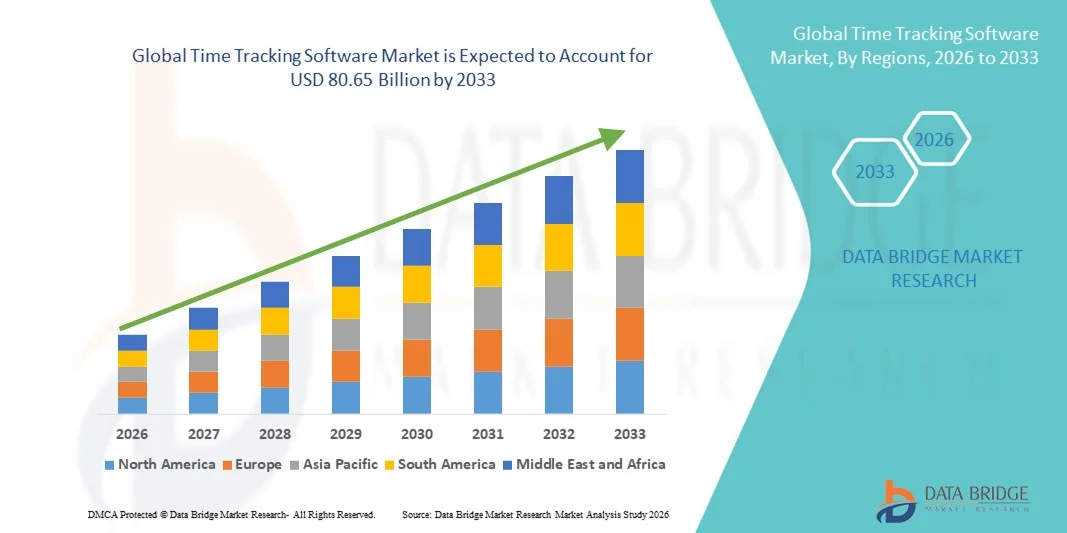
- As per Data Bridge Market Research Analysis the global time tracking software market size was valued at USD 18.26 billion in 2025 and is expected to reach USD 80.65 billion by 2033, at a CAGR of 20.40% during the forecast period
- The market growth is largely fuelled by the rising adoption of remote and hybrid work models across enterprises, increasing the need for accurate workforce productivity monitoring
- Growing emphasis on operational efficiency, project cost optimization, and compliance with labor regulations is further supporting market expansion
Market Size & Forecast
- Global Market Value (2025): USD 18.26 Billion
- Expected Market Value (2033): USD 80.65 Billion
- Forecast CAGR (2026–2033): 20.40%
Time Tracking Software Market Analysis
- The market is witnessing strong growth due to increasing demand for real-time employee monitoring, automated payroll processing, and project management integration
- Advancements in AI, analytics, and cloud technologies are enhancing software capabilities, enabling better insights into workforce utilization and performance
- North America dominated the time tracking software market with the largest revenue share in 2025, driven by widespread adoption of digital workforce management tools, high penetration of remote and hybrid work models, and strong demand for productivity and compliance solutions
- Asia-Pacific region is expected to witness the highest growth rate in the global time tracking software market, driven by
- The software segment held the largest market revenue share in 2025, driven by widespread adoption of automated time tracking tools, real-time dashboards, and integration with payroll and project management systems. Organizations increasingly rely on software solutions to improve workforce visibility, reduce manual errors, and enhance productivity monitoring across distributed teams
Report Scope and Time Tracking Software Market Segmentation
|
Attributes |
Time Tracking Software Key Market Insights |
|
Segments Covered |
|
|
Countries Covered |
North America
Europe
Asia-Pacific
Middle East and Africa
South America
|
|
Key Market Players |
|
|
Market Opportunities |
|
|
Value Added Data Infosets |
In addition to the market insights such as market value, growth rate, market segments, geographical coverage, market players, and market scenario, the market report curated by the Data Bridge Market Research team includes in-depth expert analysis, import/export analysis, pricing analysis, production consumption analysis, and pestle analysis. |
What is the Key Trend in the Time Tracking Software Market?
Rising Adoption Of Remote And Hybrid Work Models
- The increasing shift toward remote and hybrid work environments is significantly shaping the global time tracking software market, as organizations seek accurate tools to monitor employee productivity, work hours, and project timelines. Time tracking solutions are gaining traction due to their ability to provide real-time visibility, improve accountability, and support flexible work arrangements without compromising operational control. This trend is strengthening adoption across IT, professional services, healthcare, and consulting sectors, encouraging vendors to enhance cloud-based and mobile-friendly offerings
- Growing emphasis on workforce optimization and data-driven decision-making has accelerated the demand for time tracking software among enterprises of all sizes. Organizations are leveraging these tools to analyze productivity patterns, allocate resources efficiently, and manage distributed teams more effectively. This has also led to increased integration of time tracking solutions with project management, payroll, and HR systems to streamline workflows and reduce administrative burden
- Digital transformation initiatives are influencing purchasing decisions, with companies prioritizing automation, scalability, and seamless integration capabilities. Vendors are emphasizing user-friendly dashboards, AI-powered analytics, and compliance features to differentiate their offerings in a competitive market. These factors are also driving innovation in features such as idle time detection, automated reporting, and performance insights
- For instance, in 2024, Microsoft in the U.S. and Atlassian in Australia enhanced their workforce productivity platforms by integrating advanced time tracking and analytics features for remote and hybrid teams. These updates were introduced to support flexible work policies and improve project visibility across global teams, with adoption across enterprises and SMEs through cloud-based subscription models
- While demand for time tracking software continues to grow, sustained market expansion depends on continuous innovation, data security assurance, and maintaining ease of use. Vendors are focusing on improving user experience, ensuring compliance with data privacy regulations, and offering customizable solutions to address diverse organizational needs
Time Tracking Software Market Dynamics
Driver
Growing Need For Workforce Productivity And Cost Optimization
- Rising demand for improved workforce productivity and cost control is a major driver for the global time tracking software market. Organizations are increasingly adopting time tracking tools to gain accurate insights into employee work patterns, reduce time theft, and optimize labor costs. This trend is particularly strong among enterprises managing large, distributed, or project-based workforces
- Expanding applications across industries such as IT & telecom, healthcare, retail, manufacturing, and professional services are influencing market growth. Time tracking software helps organizations enhance project profitability, improve billing accuracy, and ensure compliance with labor laws, supporting its widespread adoption
- Employers are actively promoting time tracking solutions through digital workplace initiatives and performance management strategies. These efforts are supported by the growing acceptance of remote work and the need for transparent productivity measurement, encouraging partnerships between software vendors and enterprise platform providers
- For instance, in 2023, SAP in Germany and Oracle in the U.S. reported increased adoption of integrated time tracking and workforce management solutions among large enterprises. This growth was driven by rising demand for real-time analytics, automated payroll processing, and compliance management, strengthening customer retention and long-term contracts
- Although productivity optimization supports market growth, broader adoption depends on seamless integration with existing systems, employee acceptance, and data privacy compliance. Continued investment in AI-driven insights, user-centric design, and secure cloud infrastructure will be critical for sustaining market momentum
Restraint/Challenge
Data Privacy Concerns And Employee Resistance
- Growing concerns around data privacy and employee monitoring remain key challenges for the time tracking software market. Employees and labor organizations often perceive time tracking tools as intrusive, raising issues related to trust, transparency, and workplace morale. Compliance with data protection regulations further increases complexity for software providers
- Awareness and acceptance of time tracking solutions vary across regions and industries, particularly in organizations with less digital maturity. Limited understanding of the benefits beyond monitoring, such as productivity insights and workload balance, can slow adoption and create resistance among employees
- Implementation and integration challenges also impact market growth, especially for organizations using legacy systems. Customization requirements, training costs, and change management efforts can increase deployment timelines and operational expenses
- For instance, in 2024, mid-sized enterprises in France and India adopting time tracking tools from vendors such as Toggl and Clockify reported employee pushback and concerns over constant monitoring. Data localization requirements and regulatory compliance added to implementation challenges, delaying full-scale deployment
- Addressing these challenges will require transparent communication, ethical monitoring practices, and strong data security measures. Vendors focusing on privacy-first design, employee-friendly features, and education-driven adoption strategies will be better positioned to unlock long-term growth in the global time tracking software market
Time Tracking Software Market Scope
The market is segmented on the basis of component, deployment, organization size, and application.
- By Component
On the basis of component, the global time tracking software market is segmented into software and services. The software segment held the largest market revenue share in 2025, driven by widespread adoption of automated time tracking tools, real-time dashboards, and integration with payroll and project management systems. Organizations increasingly rely on software solutions to improve workforce visibility, reduce manual errors, and enhance productivity monitoring across distributed teams.
The services segment is expected to witness notable growth from 2026 to 2033, supported by rising demand for implementation, customization, training, and ongoing support services. Enterprises adopting advanced time tracking platforms are increasingly seeking professional services to ensure smooth deployment, system integration, and optimization aligned with business workflows.
- By Deployment
On the basis of deployment, the global time tracking software market is segmented into on-premise and cloud-based solutions. The cloud-based segment dominated the market in 2025, driven by its scalability, cost efficiency, and accessibility across remote and hybrid work environments. Cloud-based solutions enable real-time tracking, seamless updates, and easy integration with other enterprise applications, making them highly attractive to organizations of all sizes.
The on-premise segment is expected to witness the fastest growth from 2026 to 2033, primarily among large enterprises and regulated industries. These organizations prefer on-premise deployment for greater control over data security, compliance requirements, and internal IT infrastructure management.
- By Organization Size
On the basis of organization size, the market is segmented into large enterprises and small and medium enterprises. Large enterprises accounted for the largest revenue share in 2025, driven by complex workforce structures, multi-project operations, and the need for advanced reporting and compliance features. Time tracking software helps large organizations optimize labor costs, improve resource allocation, and maintain transparency across departments.
The small and medium enterprises segment is expected to witness the fastest growth from 2026 to 2033, supported by rapid digitalization and growing awareness of productivity management tools. SMEs are increasingly adopting cloud-based time tracking solutions to streamline operations, manage remote teams, and improve billing accuracy at affordable costs.
- By Application
On the basis of application, the global time tracking software market is segmented into tracking and reporting, project management, and payroll. The tracking and reporting segment held the largest market share in 2025, driven by the need for real-time visibility into employee work hours, attendance patterns, and productivity metrics. These features support data-driven decision-making and operational efficiency across industries.
The payroll segment is expected to witness the fastest growth from 2026 to 2033, fueled by increasing demand for automated wage calculation, compliance with labor laws, and error reduction in payroll processing. Integration of time tracking software with payroll systems is helping organizations simplify compensation management and improve overall workforce administration.
Time Tracking Software Market Regional Analysis
- North America dominated the time tracking software market with the largest revenue share in 2025, driven by widespread adoption of digital workforce management tools, high penetration of remote and hybrid work models, and strong demand for productivity and compliance solutions
- Organizations in the region highly value real-time visibility, automation, and seamless integration of time tracking software with payroll, HR, and project management systems
- This strong adoption is further supported by advanced IT infrastructure, high software spending, and the presence of major technology vendors, positioning time tracking solutions as essential tools across enterprises and SMEs
U.S. Time Tracking Software Market Insight
The U.S. time tracking software market captured the largest revenue share in 2025, supported by rapid digital transformation and the growing prevalence of remote and freelance work. Companies are increasingly prioritizing accurate time monitoring, labor cost optimization, and regulatory compliance. Strong demand for cloud-based platforms, AI-enabled analytics, and integration with enterprise systems such as ERP and HR software continues to propel market growth.
Europe Time Tracking Software Market Insight
The Europe time tracking software market is expected to witness steady growth from 2026 to 2033, driven by strict labor regulations, working-hour compliance requirements, and increasing focus on employee productivity. Organizations across the region are adopting automated time tracking tools to ensure transparency, optimize workforce utilization, and comply with regional labor laws.
U.K. Time Tracking Software Market Insight
The U.K. time tracking software market is expected to witness the fastest growth from 2026 to 2033, driven by the rising adoption of flexible work arrangements and increasing demand for compliance with working-time regulations. Businesses are increasingly deploying cloud-based time tracking solutions to manage distributed teams, improve billing accuracy, and enhance operational efficiency.
Germany Time Tracking Software Market Insight
The Germany time tracking software market is expected to grow steadily from 2026 to 2033, supported by strong regulatory emphasis on accurate working-hour documentation and employee rights. German enterprises are increasingly investing in secure, compliant, and highly integrated time tracking platforms to support structured workforce management and productivity optimization.
Asia-Pacific Time Tracking Software Market Insight
The Asia-Pacific time tracking software market is expected to witness the fastest growth rate from 2026 to 2033, driven by rapid digitalization, expanding IT and services sectors, and the growing adoption of remote work across emerging economies. Increasing awareness of productivity tools and cost management solutions is accelerating adoption across SMEs and large enterprises.
Japan Time Tracking Software Market Insight
The Japan time tracking software market is expected to witness the fastest growth from 2026 to 2033 due to increasing focus on work-hour transparency, employee well-being, and labor reforms. Organizations are adopting automated time tracking solutions to reduce overwork, improve compliance, and integrate workforce data with enterprise management systems.
China Time Tracking Software Market Insight
The China time tracking software market accounted for a significant revenue share in Asia-Pacific in 2025, driven by rapid enterprise digitalization, large workforce规模, and increasing adoption of cloud-based business applications. Strong growth in IT, manufacturing, and service industries, along with rising demand for productivity monitoring and payroll automation, continues to support market expansion in China.
Which are the Top Companies in Time Tracking Software Market?
The Time Tracking Software industry is primarily led by well-established companies, including:
- SAP (Germany)
- Clarizen (U.S.)
- ClickTime (U.S.)
- ConnectWise, LLC (U.S.)
- Kronos Incorporated (U.S.)
- Mavenlink, Inc. (U.S.)
- Wrike, Inc. (U.S.)
- Zoho Corporation Pvt. Ltd (India)
- Workfront, Inc. (U.S.)
- Toggl Track (Estonia)
- Time Doctor (U.S.)
- Harvest (U.S.)
- Hubstaff (U.S.)
- Replicon, Inc. (Canada)
Latest Developments in Global Time Tracking Software Market
- In August 2025, Toggl (U.S.) introduced an AI-driven analytics feature, marking a product innovation aimed at enhancing productivity insights for users. The new capability enables data-driven decision-making by analyzing work patterns and efficiency trends. This development improves user engagement and positions Toggl as a technology-forward player. It also reflects the broader market shift toward intelligent, insight-led time tracking solutions
- In September 2025, Harvest (U.S.) entered a strategic partnership with a leading project management platform to enable seamless software integration. This collaboration enhances workflow continuity and delivers greater convenience to end users seeking unified solutions. The partnership strengthens Harvest’s ecosystem and market appeal. It highlights the growing trend of platform interoperability in the time tracking software market
- In July 2025, Hubstaff (U.S.) expanded its operations into the European market as a geographic expansion strategy. The move targets remote and distributed teams with region-specific solutions. This expansion supports revenue diversification and strengthens Hubstaff’s global footprint. It underscores increasing demand for remote workforce management tools worldwide
- In July 2025, Tempo Software launched AI-powered timesheets as a product enhancement to automate time entry processes. The solution significantly reduces manual effort and improves accuracy for users, particularly Jira-centric teams. This development increases customer retention and opens upselling opportunities for advanced resource planning tools. It reinforces the role of automation in driving software adoption
- In June 2025, Laurel secured USD 100 million in Series C funding as a financial development to advance its machine-learning capabilities for the legal sector. The investment supports refinement of automation-first, industry-specific solutions. This funding round signals strong investor confidence in verticalized time tracking platforms. It also highlights growing market interest in specialized AI-enabled software
- In January 2025, Appfire expanded its portfolio by adding 7pace Timetracker to the Atlassian Marketplace through a product integration initiative. This move embeds time tracking into DevOps workflows and broadens cross-selling opportunities within Atlassian’s extensive customer base. The integration improves user accessibility and adoption. It demonstrates the value of ecosystem-driven growth strategies in the market
- In December 2024, Visma acquired TimeChimp as part of an inorganic growth strategy to strengthen its position in the European SMB segment. The acquisition integrates project billing and time tracking capabilities into Visma’s ERP offerings. This enhances its value proposition for small and medium enterprises. The move reflects ongoing market consolidation and expansion through acquisitions

- Interactive Data Analysis Dashboard
- Company Analysis Dashboard for high growth potential opportunities
- Research Analyst Access for customization & queries
- Competitor Analysis with Interactive dashboard
- Latest News, Updates & Trend analysis
- Harness the Power of Benchmark Analysis for Comprehensive Competitor Tracking
Data collection and base year analysis are done using data collection modules with large sample sizes. The stage includes obtaining market information or related data through various sources and strategies. It includes examining and planning all the data acquired from the past in advance. It likewise envelops the examination of information inconsistencies seen across different information sources. The market data is analysed and estimated using market statistical and coherent models. Also, market share analysis and key trend analysis are the major success factors in the market report. To know more, please request an analyst call or drop down your inquiry.
The key research methodology used by DBMR research team is data triangulation which involves data mining, analysis of the impact of data variables on the market and primary (industry expert) validation. Data models include Vendor Positioning Grid, Market Time Line Analysis, Market Overview and Guide, Company Positioning Grid, Patent Analysis, Pricing Analysis, Company Market Share Analysis, Standards of Measurement, Global versus Regional and Vendor Share Analysis. To know more about the research methodology, drop in an inquiry to speak to our industry experts.
Data Bridge Market Research is a leader in advanced formative research. We take pride in servicing our existing and new customers with data and analysis that match and suits their goal. The report can be customized to include price trend analysis of target brands understanding the market for additional countries (ask for the list of countries), clinical trial results data, literature review, refurbished market and product base analysis. Market analysis of target competitors can be analyzed from technology-based analysis to market portfolio strategies. We can add as many competitors that you require data about in the format and data style you are looking for. Our team of analysts can also provide you data in crude raw excel files pivot tables (Fact book) or can assist you in creating presentations from the data sets available in the report.













