


What is Titanium Alloys Market Size and Growth Rate ?
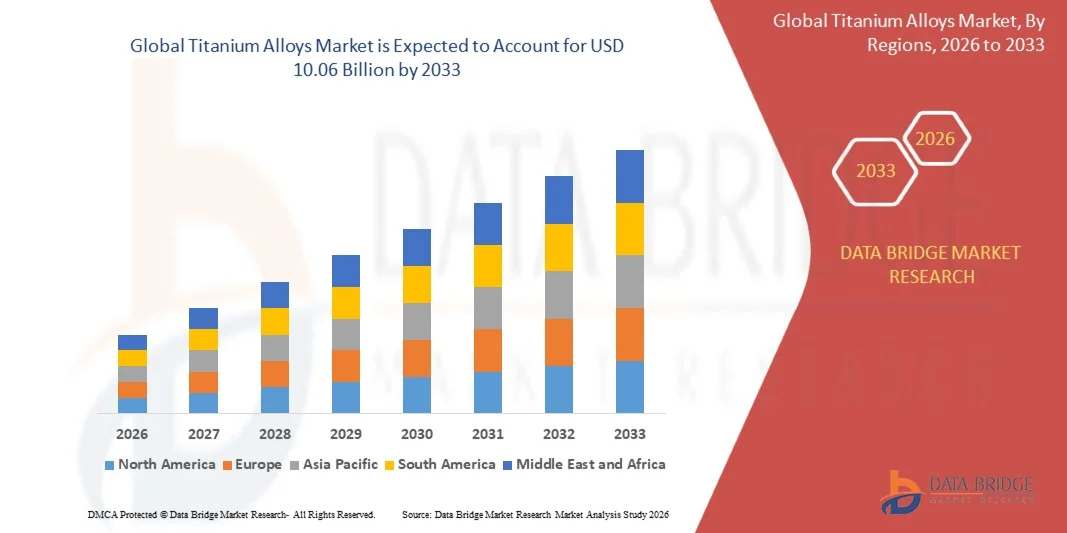
- As per Data Bridge Market Research Analysis the Global titanium alloys market size was valued at USD 6.47 billion in 2025 and is expected to reach USD 10.06 billion by 2033, at a CAGR of 5.68% during the forecast period
- The market growth is largely fueled by the increasing demand for lightweight, high-strength materials across aerospace, automotive, and industrial sectors, leading to enhanced focus on fuel efficiency and performance optimization. The superior strength-to-weight ratio, corrosion resistance, and durability of titanium alloys are driving their widespread adoption in critical applications, thereby significantly contributing to market expansion
- Furthermore, rising investments in advanced manufacturing technologies and growing demand from medical and defense sectors are establishing titanium alloys as a preferred material for high-performance and specialized applications. These converging factors are accelerating the adoption of titanium alloys, thereby significantly boosting the industry's growth
Market Size & Forecast
- Global Market Value (2025): USD 6.47 Billion
- Expected Market Value (2033): USD 10.06 Billion
- Forecast CAGR (2026–2033): 5.68%
What are the Major Takeaways of Titanium Alloys Market ?
- Titanium alloys are advanced metallic materials composed primarily of titanium combined with elements such as aluminum, vanadium, and molybdenum to enhance strength, corrosion resistance, and thermal stability. These alloys are widely used in aerospace components, medical implants, chemical processing equipment, and marine applications due to their exceptional mechanical and physical properties
- The escalating demand for titanium alloys is primarily fueled by the rapid expansion of aerospace and defense industries, increasing need for biocompatible materials in healthcare, and rising emphasis on energy efficiency and sustainability across industrial sectors
- Asia-Pacific dominated the titanium alloys market with a share of 41.52% in 2025, due to rapid industrialization, expanding aerospace manufacturing, and increasing demand for lightweight and high-strength materials across automotive and marine industries
- North America is expected to be the fastest growing region in the titanium alloys market during the forecast period due to strong demand from aerospace, defense, and medical implant industries
- Alpha-beta segment dominated the market with a market share of 51.62% in 2025, due to its balanced combination of strength, ductility, and corrosion resistance, making it highly versatile across multiple industrial applications. These alloys are widely used in aerospace, automotive, and industrial components due to their ability to perform effectively under varying temperature and stress conditions. Their adaptability to both heat treatment and fabrication processes enhances their usability in complex structural applications
Report Scope and Titanium Alloys Market Segmentation
|
Attributes |
Titanium Alloys Key Market Insights |
|
Segments Covered |
|
|
Countries Covered |
North America
Europe
Asia-Pacific
Middle East and Africa
South America
|
|
Key Market Players |
|
|
Market Opportunities |
|
|
Value Added Data Infosets |
In addition to the insights on market scenarios such as market value, growth rate, segmentation, geographical coverage, and major players, the market reports curated by the Data Bridge Market Research also include import export analysis, production capacity overview, production consumption analysis, price trend analysis, climate change scenario, supply chain analysis, value chain analysis, raw material/consumables overview, vendor selection criteria, PESTLE Analysis, Porter Analysis, and regulatory framework. |
What is the Key Trend in Titanium Alloys Market ?
“Rising Adoption of Titanium Alloys in Aerospace and Defense Applications”
- A significant trend in the titanium alloys market is the increasing adoption of these materials in aerospace and defense applications, driven by the need for lightweight structures, high strength, and exceptional corrosion resistance in critical components. This trend is reinforcing the importance of titanium alloys as essential materials for improving fuel efficiency and structural performance in modern aircraft and defense systems
- For instance, Boeing and Airbus extensively use titanium alloys in aircraft structures and engine components to reduce weight while maintaining durability under extreme conditions. This usage enhances aircraft efficiency and supports long-term operational reliability in demanding environments
- The expansion of commercial aviation and rising defense expenditures are increasing the demand for advanced materials that can withstand high temperatures and mechanical stress. Titanium alloys are being widely incorporated into airframes, jet engines, and military equipment to improve performance and longevity
- The growing development of next-generation aircraft and space exploration programs is further accelerating the integration of titanium alloys in structural and propulsion systems. These applications require materials capable of maintaining integrity under extreme pressure and temperature variations
- Manufacturers are focusing on improving alloy compositions and processing technologies to enhance machinability and reduce material waste during production. This is contributing to broader adoption across aerospace supply chains and improving overall manufacturing efficiency
- The continuous shift toward lightweight, fuel-efficient, and high-performance aerospace systems is reinforcing the long-term demand for titanium alloys. This trend is positioning the market for sustained growth as industries prioritize advanced materials for critical engineering applications
Titanium Alloys Market Dynamics
Driver
“Increasing Demand for Lightweight and High-Strength Materials in Industrial Sectors”
- The increasing demand for lightweight and high-strength materials across industrial sectors is driving the growth of the titanium alloys market as industries seek to improve efficiency, durability, and overall performance of their products. Titanium alloys offer a strong combination of low density and high mechanical strength, making them suitable for applications where weight reduction is critical
- For instance, General Electric utilizes titanium alloys in jet engines and power generation equipment to enhance performance while reducing overall system weight. This application supports improved fuel efficiency and operational effectiveness across energy and aviation sectors
- The automotive industry is increasingly incorporating titanium alloys in high-performance vehicles to reduce weight and improve fuel economy while maintaining structural integrity. This shift is supporting the transition toward more efficient and environmentally sustainable transportation solutions
- Industrial sectors such as chemical processing and marine engineering are adopting titanium alloys due to their superior corrosion resistance and long service life in harsh environments. These properties reduce maintenance requirements and improve asset longevity
- The growing emphasis on energy efficiency, durability, and performance optimization across industries continues to strengthen this driver. The need for materials that deliver long-term reliability while reducing operational costs is supporting sustained market expansion
Restraint/Challenge
“High Production Costs and Complex Processing of Titanium Alloys”
- The titanium alloys market faces challenges due to the high production costs and complex processing requirements associated with these materials, which involve energy-intensive extraction methods and specialized manufacturing techniques. These factors increase overall costs and limit widespread adoption in cost-sensitive industries
- For instance, TIMET employs advanced melting and refining processes to produce high-quality titanium alloys, which require significant energy input and sophisticated equipment. These complexities contribute to elevated production expenses and impact pricing competitiveness in the market
- Machining and forming titanium alloys require specialized tools and expertise due to their high strength and low thermal conductivity, which increases processing difficulty. This leads to longer production cycles and higher operational costs for manufacturers
- The dependence on limited raw material sources and energy-intensive extraction processes such as the Kroll process further adds to cost volatility. This creates supply chain challenges and affects pricing stability across global markets
- The market continues to face constraints in scaling production efficiently while maintaining high material quality and cost-effectiveness. These challenges collectively limit broader adoption and require continuous innovation to optimize manufacturing processes and reduce costs
Titanium Alloys Market Scope
The market is segmented on the basis of microstructure and end-user industry.
• By Microstructure
On the basis of microstructure, the titanium alloys market is segmented into alpha and near-alpha, alpha-beta, and beta. The alpha-beta segment dominated the largest market revenue share of 51.62% in 2025, driven by its balanced combination of strength, ductility, and corrosion resistance, making it highly versatile across multiple industrial applications. These alloys are widely used in aerospace, automotive, and industrial components due to their ability to perform effectively under varying temperature and stress conditions. Their adaptability to both heat treatment and fabrication processes enhances their usability in complex structural applications. In addition, alpha-beta alloys offer an optimal balance between performance and cost, making them a preferred choice among manufacturers. The increasing demand for lightweight and high-strength materials across advanced engineering sectors continues to support the strong market position of this segment
The beta segment is anticipated to witness the fastest growth rate from 2026 to 2033, fueled by its exceptional strength, high hardenability, and excellent formability compared to other titanium alloy types. Beta alloys can be heat-treated to achieve very high strength levels, making them suitable for high-stress structural components in aerospace and automotive sectors. Their improved ductility and ability to be formed into complex shapes enhance manufacturing flexibility and reduce production limitations. Increasing demand for advanced materials in next-generation aircraft and high-performance vehicles is accelerating their adoption. In addition, ongoing research and development activities aimed at enhancing beta alloy properties are expected to further support their rapid growth trajectory in the coming years.
• By End-User Industry
On the basis of end-user industry, the titanium alloys market is segmented into aerospace, automotive and shipbuilding, chemical processing, power and desalination, medical and dental implants, and others. The aerospace segment dominated the largest market revenue share in 2025, driven by the extensive use of titanium alloys in aircraft structures, engine components, and landing gear due to their high strength-to-weight ratio and excellent fatigue resistance. The increasing production of commercial and military aircraft, along with the growing focus on fuel efficiency, significantly boosts the demand for lightweight materials such as titanium alloys. Their resistance to corrosion and extreme temperatures further enhances their suitability for critical aerospace applications. In addition, continuous advancements in aerospace engineering and material technologies are driving higher consumption of titanium alloys. The strategic importance of weight reduction and performance optimization continues to sustain the dominance of the aerospace sector.
The medical and dental implants segment is expected to witness the fastest growth rate from 2026 to 2033, driven by the rising demand for biocompatible and corrosion-resistant materials in healthcare applications. Titanium alloys are extensively used in orthopedic implants, dental fixtures, and surgical instruments due to their excellent compatibility with the human body and resistance to bodily fluids. The increasing prevalence of chronic diseases, aging population, and growing number of surgical procedures are accelerating the demand for advanced implant materials. Their ability to promote osseointegration and long-term durability makes them highly preferred in medical applications. In addition, continuous innovations in medical technology and implant design are further supporting the rapid expansion of this segment.
Titanium Alloys Market Regional Analysis
- Asia-Pacific dominated the titanium alloys market with the largest revenue share of 41.52% in 2025, driven by rapid industrialization, expanding aerospace manufacturing, and increasing demand for lightweight and high-strength materials across automotive and marine industries
- The region’s cost-effective production capabilities, rising investments in advanced metallurgy, and growing demand from defense and energy sectors are accelerating market expansion
- The availability of abundant raw materials, skilled labor, and supportive government initiatives promoting domestic manufacturing are contributing to increased consumption of titanium alloys across diverse industrial applications
China Titanium Alloys Market Insight
China held the largest share in the Asia-Pacific titanium alloys market in 2025, owing to its strong manufacturing base, large-scale aerospace and defense production, and increasing investments in high-performance materials. The country’s well-established industrial ecosystem, along with government support for advanced materials development, is driving demand for titanium alloys. Growth is further supported by expanding applications in chemical processing, power generation, and marine industries.
India Titanium Alloys Market Insight
India is witnessing the fastest growth in the Asia-Pacific region, fueled by rising investments in aerospace, defense, and medical device manufacturing. Government initiatives such as “Make in India” and increasing focus on indigenous production of high-performance materials are boosting demand for titanium alloys. In addition, growing infrastructure development and expanding automotive sector are contributing to strong market growth.
Europe Titanium Alloys Market Insight
The Europe titanium alloys market is expanding steadily, supported by strong demand from aerospace, automotive, and medical industries along with stringent regulatory standards for high-performance and sustainable materials. The region emphasizes advanced engineering, material innovation, and environmental compliance, which is encouraging the use of titanium alloys. Increasing adoption in renewable energy and marine applications is further supporting market growth.
Germany Titanium Alloys Market Insight
Germany’s titanium alloys market is driven by its leadership in automotive engineering, aerospace manufacturing, and precision industrial applications. The country’s focus on innovation, high-quality production, and strong research infrastructure is supporting the development and use of advanced titanium materials. Demand is further strengthened by the presence of major manufacturing companies and export-oriented industrial activities.
U.K. Titanium Alloys Market Insight
The U.K. market is supported by a well-established aerospace sector, growing medical technology industry, and increasing focus on advanced material research. Investments in high-performance engineering materials and strong academic-industry collaborations are promoting the use of titanium alloys. The demand is also driven by applications in defense, healthcare, and specialized industrial sectors.
North America Titanium Alloys Market Insight
North America is projected to grow at the fastest CAGR from 2026 to 2033, driven by strong demand from aerospace, defense, and medical implant industries. Increasing investments in advanced manufacturing technologies, rising focus on lightweight materials, and growing adoption in high-performance applications are boosting market growth. In addition, ongoing research and development activities are supporting innovation in titanium alloy production and applications.
U.S. Titanium Alloys Market Insight
The U.S. accounted for the largest share in the North America market in 2025, underpinned by its advanced aerospace industry, strong defense sector, and extensive research and development capabilities. The country’s focus on technological innovation, high-performance materials, and sustainable manufacturing is driving the adoption of titanium alloys. Presence of key industry players and increasing investments in next-generation aircraft and medical technologies further strengthen the market position.
Titanium Alloys Market Share
The titanium alloys industry is primarily led by well-established companies, including:
- KOBE STEEL, LTD. (Japan)
- ATI (U.S.)
- Western Superconducting Technologies Co., Ltd. (China)
- Perryman Company (U.S.)
- Alleima (Sweden)
- TIMET (Precision Castparts Corp.) (U.S.)
- BAOTI Group Co., Ltd. (China)
- Hermith GmbH (Germany)
- CRS Holdings, LLC (U.S.)
- Toho Titanium Co., Ltd. (Japan)
- AMG (Netherlands)
- Howmet Aerospace (U.S.)
- OSAKA Titanium Technologies Co., Ltd. (Japan)
- Weber Metals (OTTO FUCHS Kommanditgesellschaft) (Germany)
- Corporation VSMPO-AVISMA (Russia)
- Daido Steel Co., Ltd. (Japan)
Latest Developments in Global Titanium Alloys Market
- In June 2025, ATI Inc. commissioned a state-of-the-art facility in Pageland, South Carolina for titanium alloy sheet production, which is expected to significantly enhance supply capabilities for aerospace applications where high-strength and durable materials are critical. This expansion addresses the growing demand from airframe manufacturers for technically complex titanium sheets used in structural components and assemblies. It also strengthens domestic production capacity, reduces dependency on imports, and supports supply chain resilience. As aerospace production rates increase globally, this development is likely to play a key role in stabilizing supply and accelerating overall market growth
- In March 2025, Tohoku University introduced a titanium-aluminum superelastic alloy functional from −269 °C to +127 °C, which is anticipated to open new opportunities in extreme environment applications such as space exploration and advanced medical technologies. The ability of this alloy to maintain elasticity across such a wide temperature range represents a significant breakthrough in material science. It enables new design possibilities for components exposed to harsh thermal conditions, including spacecraft systems and biomedical devices. This innovation is expected to expand the functional scope of titanium alloys and drive further research and commercialization in high-performance material segments
- In September 2024, Amnovis achieved the milestone delivery of over 50,000 3D-printed titanium implants since 2021, highlighting the rapid commercialization of additive manufacturing in the medical titanium segment. This achievement demonstrates the scalability and reliability of 3D printing technologies in producing complex, patient-specific implants. The growing adoption of such customized solutions is improving surgical outcomes and increasing demand for titanium-based biomaterials. It also reflects a broader shift toward digital manufacturing in healthcare, which is expected to significantly boost the titanium alloys market in medical applications
- In July 2024, MIT researchers in collaboration with ATI Specialty Materials developed titanium alloys that overcome the traditional strength-ductility trade-off through precise compositional and processing innovations. This advancement allows the material to achieve both high strength and improved flexibility, addressing a long-standing limitation in alloy design. Such enhanced mechanical properties are critical for aerospace, automotive, and defense applications where performance and reliability are essential. The breakthrough is expected to accelerate the adoption of next-generation titanium alloys and encourage further innovation in advanced material engineering
- In March 2024, ATI Inc. commissioned a 12,500-ton billet forging press at its Pennsylvania facility and secured a five-year titanium supply agreement with Airbus valued at over US$ 1 Bn, significantly strengthening its aerospace market presence. This large-scale forging capability enables the production of high-integrity titanium components required for critical aircraft structures. The long-term agreement with Airbus ensures stable demand and reinforces the strategic importance of titanium alloys in modern aviation. This development is expected to boost production capacity, enhance global competitiveness, and positively influence the growth trajectory of the titanium alloys market

- Interactive Data Analysis Dashboard
- Company Analysis Dashboard for high growth potential opportunities
- Research Analyst Access for customization & queries
- Competitor Analysis with Interactive dashboard
- Latest News, Updates & Trend analysis
- Harness the Power of Benchmark Analysis for Comprehensive Competitor Tracking
Global Titanium Alloys Market, Supply Chain Analysis and Ecosystem Framework
To support market growth and help clients navigate the impact of geopolitical shifts, DBMR has integrated in-depth supply chain analysis into its Global Titanium Alloys Market research reports. This addition empowers clients to respond effectively to global changes affecting their industries. The supply chain analysis section includes detailed insights such as Global Titanium Alloys Market consumption and production by country, price trend analysis, the impact of tariffs and geopolitical developments, and import and export trends by country and HSN code. It also highlights major suppliers with data on production capacity and company profiles, as well as key importers and exporters. In addition to research, DBMR offers specialized supply chain consulting services backed by over a decade of experience, providing solutions like supplier discovery, supplier risk assessment, price trend analysis, impact evaluation of inflation and trade route changes, and comprehensive market trend analysis.
Data collection and base year analysis are done using data collection modules with large sample sizes. The stage includes obtaining market information or related data through various sources and strategies. It includes examining and planning all the data acquired from the past in advance. It likewise envelops the examination of information inconsistencies seen across different information sources. The market data is analysed and estimated using market statistical and coherent models. Also, market share analysis and key trend analysis are the major success factors in the market report. To know more, please request an analyst call or drop down your inquiry.
The key research methodology used by DBMR research team is data triangulation which involves data mining, analysis of the impact of data variables on the market and primary (industry expert) validation. Data models include Vendor Positioning Grid, Market Time Line Analysis, Market Overview and Guide, Company Positioning Grid, Patent Analysis, Pricing Analysis, Company Market Share Analysis, Standards of Measurement, Global versus Regional and Vendor Share Analysis. To know more about the research methodology, drop in an inquiry to speak to our industry experts.
Data Bridge Market Research is a leader in advanced formative research. We take pride in servicing our existing and new customers with data and analysis that match and suits their goal. The report can be customized to include price trend analysis of target brands understanding the market for additional countries (ask for the list of countries), clinical trial results data, literature review, refurbished market and product base analysis. Market analysis of target competitors can be analyzed from technology-based analysis to market portfolio strategies. We can add as many competitors that you require data about in the format and data style you are looking for. Our team of analysts can also provide you data in crude raw excel files pivot tables (Fact book) or can assist you in creating presentations from the data sets available in the report.













