


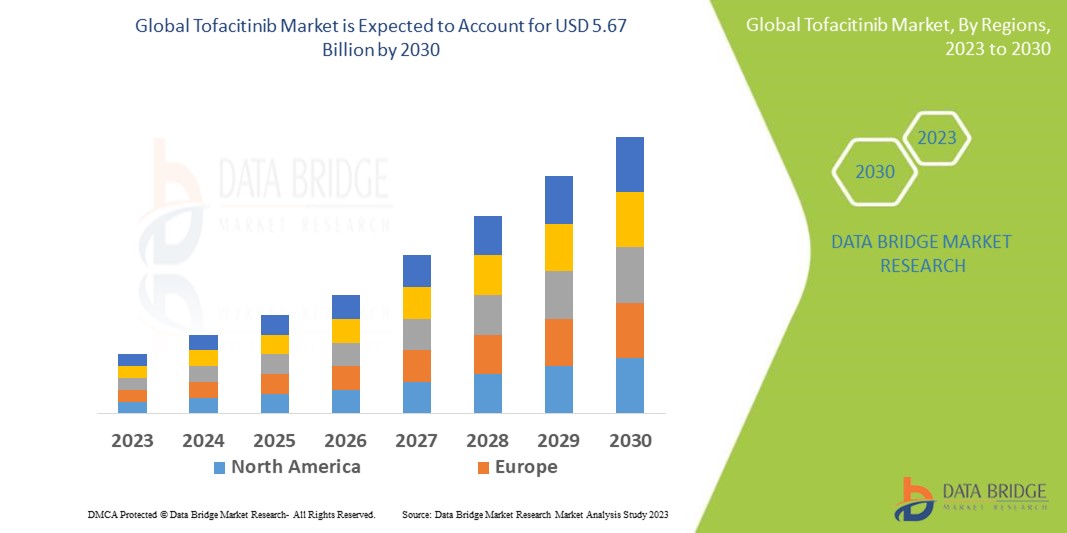
Tofacitinib Market Analysis and Size
Tofacitinib, commonly known as Xeljanz, belongs to the Janus Kinase (JAK) inhibitor class of drugs. It works by inhibiting the activity of Janus kinase enzymes, which are implicated in the inflammation that triggers rheumatoid and psoriatic arthritis symptoms. Tofacitinib is also used to treat moderate to severe ulcerative colitis in individuals who cannot take certain drugs or have failed to respond to other treatments.
Data Bridge Market Research analyses that the tofacitinib market, which was USD 2.34 billion in 2022, would rocket up to USD 5.67 billion by 2030 and is expected to undergo a CAGR of 4.7% during the forecast period of 2023 to 2030. “Antirheumatic” dominates the drug class segment of the market owing to the rise in the incidence of autoimmune disorders among the population.
In addition to the insights on market scenarios such as market value, growth rate, segmentation, geographical coverage, and major players, the market reports curated by the Data Bridge Market Research also include depth expert analysis, patient epidemiology, pipeline analysis, pricing analysis, and regulatory framework.
Tofacitinib Market Scope and Segmentation
|
Report Metric |
Details |
|
Forecast Period |
2023 to 2030 |
|
Base Year |
2022 |
|
Historic Years |
2021 (Customizable to 2015-2021) |
|
Quantitative Units |
Revenue in USD Million, Volumes in Units, Pricing in USD |
|
Segments Covered |
By Strength (5mg, 10mg, 11mg, and 22mg), Drug Class (Antirheumatic, Janus Kinase Inhibitor, and Immunosuppressant), Application (Ulcerative Colitis, Rheumatoid Arthritis, Psoriasis, and Others), Demographic (Adult, Pediatric, Geriatric), Dosage Form (Tablet, Solution, Tablet, Extended Release, and Others), Route of Administration (Oral and Others), End-Users (Clinic, Hospital, and Others), Distribution Channel (Hospital Pharmacy, Retail Pharmacy, and Online Pharmacy) |
|
Countries Covered |
U.S., Canada, Mexico, Brazil, Argentina, Peru, rest of South America, Germany, France, U.K., Netherlands, Switzerland, Belgium, Russia, Italy, Spain, Turkey, Hungary, Lithuania, Austria, Ireland, Norway, Poland, rest of Europe, China, Japan, India, South Korea, Singapore, Malaysia, Australia, Thailand, Indonesia, Philippines, Vietnam, rest of Asia-Pacific, Saudi Arabia, U.A.E, Egypt, Israel, Kuwait, South Africa, rest of Middle East and Africa |
|
Market Players Covered |
|
|
Market Opportunities |
|
Market Definition
The medications known as Janus Kinase (JAK) inhibitors include tofacitinib. It is used to treat several autoimmune conditions, most notably ulcerative colitis, psoriatic arthritis, and rheumatoid arthritis.
Tofacitinib Market Dynamics
Drivers
- Increasing prevalence of autoimmune diseases
The increased prevalence of autoimmune illnesses such as rheumatoid arthritis, psoriatic arthritis, and ulcerative colitis primarily drives the tofacitinib market. The demand for efficient medications such as tofacitinib keeps rising because these conditions impact a sizable section of the world's population.
- Rising geriatric population
As autoimmune illnesses are more common in the elderly, tofacitinib and other drugs used to treat these conditions are projected to be in high demand as the world's elderly population grows.
- Increasing R&D activities
The market for tofacitinib is growing due to ongoing research and development projects in the areas of autoimmune disorders and JAK inhibitors. Tofacitinib can be used to treat various autoimmune diseases, and pharmaceutical companies are exploring this possibility and investing in creating new formulations, which are expected to drive market growth.
Opportunities
- Growing demand for personalized medicine
Personalized medicine and genetics development presents prospects for modifying therapy for specific patients. The treatment plans can be created by identifying the genetic differences and biomarkers linked to the response to tofacitinib. Tofacitinib's effectiveness can be increased using personalized medicine strategies, which pharmaceutical companies can explore through partnerships and collaborations with diagnostic businesses.
- Rising technological advancements and innovation
It is envisaged that improvements in tofacitinib development will result in improved formulations, enhanced drug delivery methods, and novel methodologies. These developments are meant to increase medicine effectiveness, patient compliance, and administration convenience.
- Increasing awareness and early diagnosis
In recent years, autoimmune illnesses have received better diagnoses and more attention. As a result, more individuals are seeking medical care and getting accurate diagnoses, which raises the need for drugs like tofacitinib.
Challenges/ Restraints
- Strict regulations
Drug approval is subject to strict regulatory standards, particularly in terms of safety and efficacy. The time and money required to meet these regulatory requirements and get permits may delay market entry and limit market growth.
- Adverse effects and safety concerns
Tofacitinib has potential adverse effects, similar to any medication, including an increased risk of infections, changes in blood cell counts, abnormalities in liver enzymes, and elevated cholesterol levels. Tofacitinib's acceptance and uptake may be impacted by safety worries and adverse effects, particularly in patient demographics or among more risk-averse healthcare professionals.
- Reimbursement policies
Various nations and healthcare systems have different pricing and reimbursement practices. For pharmaceutical firms, establishing favorable pricing agreements and reimbursement coverage can be difficult, particularly in areas with healthcare systems that are cost-conscious. Pricing pressures may restrict market access and have an impact on tofacitinib usage.
- High Costs of Drugs
Tofacitinib's price and patients' capacity to pay it might be very difficult, especially in areas with insufficient healthcare resources or where reimbursement coverage is restricted. Access and adoption may be hampered by high treatment costs, especially in lower-income communities. For the market to expand, it is crucial to address cost issues and investigate pricing plans that balance accessibility and sustainability.
This tofacitinib market report provides details of new recent developments, trade regulations, import-export analysis, production analysis, value chain optimization, market share, impact of domestic and localized market players, analyses opportunities in terms of emerging revenue pockets, changes in market regulations, strategic market growth analysis, market size, category market growths, application niches and dominance, product approvals, product launches, geographic expansions, technological innovations in the market. To gain more info on the tofacitinib market contact Data Bridge Market Research for an Analyst Brief, our team will help you take an informed market decision to achieve market growth.
Global Tofacitinib Market Scope
The tofacitinib market is segmented on the basis of strength, drug class, application, demographic, dosage form, route of administration, end-users, and distribution channel. The growth amongst these segments will help you analyze meager growth segments in the industries, and provide the users with valuable market overview and market insights to help them in making strategic decisions for identification of core market applications.
Strength
- 5mg
- 10mg
- 11mg
- 22mg
Drug Class
- Antirheumatic
- Antirheumatic disease modifying
- Antirheumatic miscellaneous
- Janus kinase inhibitor
- Immunosuppressant
Application
- Ulcerative colitis
- Rheumatoid arthritis
- Psoriasis
- Others
Demographic
- Adult
- Pediatric
- Geriatric
Dosage form
- Tablet
- Solution
- Extended release
- Others
Route of Administration
- Oral
- Others
End Users
- Hospital
- Clinic
- Others
Distribution channel
- Hospital pharmacy
- Online pharmacy
- Retail pharmacy
Tofacitinib Market Regional Analysis/Insights
Tofacitinib market is analyzed and market size information is provided by the country, strength, drug class, application, demographic, dosage form, route of administration, end-users, and distribution channel as referenced above.
The countries covered in the tofacitinib market report are the U.S., Canada, Mexico, Brazil, Argentina, Peru, rest of South America, Germany, France, U.K., Netherlands, Switzerland, Belgium, Russia, Italy, Spain, Turkey, Hungary, Lithuania, Austria, Ireland, Norway, Poland, rest of Europe, China, Japan, India, South Korea, Singapore, Malaysia, Australia, Thailand, Indonesia, Philippines, Vietnam, rest of Asia-Pacific, Saudi Arabia, U.A.E, Egypt, Israel, Kuwait, South Africa, rest of Middle East and Africa.
North America is expected to dominate the market due to the presence of major key players, high disposable income, and well-developed healthcare infrastructure in this region.
Asia-Pacific is expected to grow during the forecast period of 2023-2030 due to the increasing research and development activities and the rise in the prevalence of rheumatoid arthritis in this region.
The country section of the report also provides individual market impacting factors and changes in regulations in the market domestically that impacts the current and future trends of the market. Data points such as new sales, replacement sales, country demographics, disease epidemiology and import-export tariffs are some of the major pointers used to forecast the market scenario for individual countries. Also, presence and availability of global brands and their challenges faced due to large or scarce competition from local and domestic brands, impact of sales channels are considered while providing forecast analysis of the country data.
Healthcare Infrastructure growth Installed base and New Technology Penetration
Tofacitinib market also provides you with detailed market analysis for patient analysis, prognosis and cures. Prevalence, incidence, mortality, adherence rates are some of the data variables that are available in the report. Direct or indirect impact analysis of epidemiology to market growth are analysed to create a more robust and cohort multivariate statistical model for forecasting the market in the growth period.
Competitive Landscape and Tofacitinib Market Share Analysis
Tofacitinib market competitive landscape provides details by competitor. Details included are company overview, company financials, revenue generated, market potential, investment in research and development, new market initiatives, global presence, production sites and facilities, company strengths and weaknesses, product launch, clinical trials pipelines, product approvals, patents, product width and breadth, application dominance, technology lifeline curve. The above data points provided are only related to the companies’ focus related to tofacitinib market research.
Some of the major players operating in the tofacitinib market are:
- Beacon Pharmaceuticals Limited (Bangladesh)
- Pfizer Inc. (U.S.)
- Globe Pharmaceuticals (Egypt)
- Delta Pharma Limited (Bangladesh)
- DRUG INTERNATIONAL LTD. (Bangladesh)
- Mediconlife, Dolphin Pharma (U.S.)
- Lancer Therapeuticals (India)
- Aprazer (India)
- Glenmark Pharmaceuticals Limited (India)
- Sun Pharmaceutical Industries Ltd. (India)
- Shandong Octagon Chemicals Limited (China)
- APINO PHARMA CO., LTD. (China)
- Zydus Cadila (India)
- Beijing Mesochem Technology Co., Ltd. (China)
- Olon S.p.A. (Italy)
- Unichem Laboratories (India)
- Esteve Química (France)

- Interactive Data Analysis Dashboard
- Company Analysis Dashboard for high growth potential opportunities
- Research Analyst Access for customization & queries
- Competitor Analysis with Interactive dashboard
- Latest News, Updates & Trend analysis
- Harness the Power of Benchmark Analysis for Comprehensive Competitor Tracking
Table of Content
1 INTRODUCTION
1.1 OBJECTIVES OF THE STUDY
1.2 MARKET DEFINITION
1.3 OVERVIEW OF GLOBAL TOFACITINIB MARKET
1.4 CURRENCY AND PRICING
1.5 LIMITATION
1.6 MARKETS COVERED
2 MARKET SEGMENTATION
2.1 KEY TAKEAWAYS
2.2 ARRIVING AT THE GLOBAL TOFACITINIB MARKET SIZE
2.2.1 VENDOR POSITIONING GRID
2.2.2 TECHNOLOGY LIFE LINE CURVE
2.2.3 TRIPOD DATA VALIDATION MODEL
2.2.4 MARKET GUIDE
2.2.5 MULTIVARIATE MODELLING
2.2.6 TOP TO BOTTOM ANALYSIS
2.2.7 CHALLENGE MATRIX
2.2.8 APPLICATION COVERAGE GRID
2.2.9 STANDARDS OF MEASUREMENT
2.2.10 VENDOR SHARE ANALYSIS
2.2.11 EPIDEMIOLOGY MODELING
2.2.12 DATA POINTS FROM KEY PRIMARY INTERVIEWS
2.2.13 DATA POINTS FROM KEY SECONDARY DATABASES
2.3 GLOBAL TOFACITINIB MARKET: RESEARCH SNAPSHOT
2.4 ASSUMPTIONS
3 EXECUTIVE SUMMARY
4 MARKET OVERVIEW
4.1 DRIVERS
4.2 RESTRAINS
4.3 OPPURTUNITY
4.4 CHALLENGES
5 PREMIUM INSIGHTS
5.1 PORTER'S 5 FORCES
5.2 PESTEL ANALYSIS
6 INDUSTRY INSIGHTS
6.1 PATENT ANALYSIS
6.1.1 PATENT LANDSCAPE
6.1.2 USPTO NUMBER
6.1.3 PATENT EXPIRY
6.1.4 EPIO NUMBER
6.1.5 PATENT STRENGTH AND QUALITY
6.1.6 PATENT CLAIMS
6.1.7 PATENT CITATIONS
6.1.8 PATENT LITIGATION AND LICENSING
6.1.9 FILE OF PATENT
6.1.10 PATENT RECEIVED CONTRIES
6.1.11 TECHNOLOGY BACKGROUND
6.2 DRUG TREATMENT RATE BY MATURED MARKETS
6.3 DEMOGRAPHIC TRENDS: IMPACTS ON ALL INCIDENCE RATES
6.4 PATIENT FLOW DIAGRAM
6.5 KEY PRICING STRATEGIES
6.6 KEY PATIENT ENROLLMENT STRATEGIES
6.7 INTERVIEWS WITH SPECIALIST
6.8 OTHER KOL SNAPSHOTS
7 EPIDEMIOLOGY
7.1 INCIDENCE OF ALL BY GENDER
7.2 TREATMENT RATE
7.3 MORTALITY RATE
7.4 DRUG ADHERENCE AND THERAPY SWITCH MODEL
7.5 PATIENT TREATMENT SUCCESS RATES
8 MERGERS AND ACQUISITION
8.1 LICENSING
8.2 COMMERCIALIZATION AGREEMENTS
9 REGULATORY FRAMEWORK
9.1 REGULATORY APPROVAL PROCESS
9.2 GEOGRAPHIES’ EASE OF REGULATORY APPROVAL
9.3 REGULATORY APPROVAL PATHWAYS
9.4 LICENSING AND REGISTRATION
9.5 POST-MARKETING SURVEILLANCE
9.6 GOOD MANUFACTURING PRACTICES (GMPS) GUIDELINES
10 PIPELINE ANALYSIS
10.1 CLINICAL TRIALS AND PHASE ANALYSIS
10.2 DRUG THERAPY PIPELINE
10.3 PHASE III CANDIDATES
10.4 PHASE II CANDIDATES
10.5 PHASE I CANDIDATES
10.6 OTHERS (PRE-CLINICAL AND RESEARCH)
TABLE 1 GLOBAL CLINICAL TRIAL MARKET FOR GLOBAL TOFACITINIB MARKET
Company Name Therapeutic Area
XX XX
XX XX
XX XX
XX XX
XX XX
XX XX
Sources: Press Releases, Annual Reports, SEC Filings, Investor Presentations, Other Government Sources, Analysis Based on Inputs from Secondary, Expert Interviews
TABLE 2 DISTRIBUTION OF PRODUCTS AND PROJECTS BY PHASE
Phase Number of Projects
Preclinical/Research Projects XX
Clinical Development XX
Phase I XX
Phase II XX
Phase III XX
U.S. Filed/Approved But Not Yest Marketed XX
Total XX
Sources: Press Releases, Annual Reports, SEC Filings, Investor Presentations, Other Government Sources, Analysis Based on Inputs from Secondary, Expert Interviews
TABLE 3 DISTRIBUTION OF PROJECTS BY THERAPEUTIC AREA AND PHASE
Therapeutic Area Preclinical/ Research Project
XX XX
XX XX
XX XX
XX XX
XX XX
Total Projects XX
Sources: Press Releases, Annual Reports, SEC Filings, Investor Presentations, Other Government Sources, Analysis Based on Inputs from Secondary, Expert Interviews
TABLE 4 DISTRIBUTION OF PROJECTS BY SCIENTIFIC APPROACH AND PHASE
Technology Preclinical/ Research Project
XX XX
XX XX
XX XX
XX XX
XX XX
Total Projects XX
Sources: Press Releases, Annual Reports, SEC Filings, Investor Presentations, Other Government Sources, Analysis Based on Inputs from Secondary, Expert Interviews
FIGURE 1 TOP ENTITIES BASED ON R&D GLANCE FOR GLOBAL TOFACITINIB MARKET
Sources: Press Releases, Annual Reports, SEC Filings, Investor Presentations, Other Government Sources, Analysis Based on Inputs from Secondary, Expert Interviews
11 MARKETED DRUG ANALYSIS
11.1 DRUG
11.1.1 BRAND NAME
11.1.2 GENERICS NAME
11.2 THERAPEUTIC INDIACTION
11.3 PHARACOLOGICAL CLASS OD THE DRUG
11.4 DRUG PRIMARY INDICATION
11.5 MARKET STATUS
11.6 MEDICATION TYPE
11.7 DRUG DOSAGES FORM
11.8 DOSAGES AVAILABILITY
11.9 PACKAGING TYPE
11.1 DRUG ROUTE OF ADMINISTRATION
11.11 DOSING FREQUENCY
11.12 DRUG INSIGHT
11.13 AN OVERVIEW OF THE DRUG DEVELOPMENT ACTIVITIES SUCH AS REGULATORY MILSTONE, SAFETY DATA AND EFFICACY DATA, MARKET EXCLUSIVITY DATA.
11.13.1 FORECAST MARKET OUTLOOK
11.13.2 CROSS COMPETITION
11.13.3 THERAPEUTIC PORTFOLIO
11.13.4 CURRENT DEVELOPMENT SCENARIO
12 MARKET ACCESS
12.1 10-YEAR MARKET FORECAST
12.2 CLINICAL TRIAL RECENT UPDATES
12.3 ANNUAL NEW FDA APPROVED DRUGS
12.4 DRUGS MANUFACTURER AND DEALS
12.5 MAJOR DRUG UPTAKE
12.6 CURRENT TREATMENT PRACTICES
12.7 IMPACT OF UPCOMING THERAPY
13 R & D ANALYSIS
13.1 COMPARATIVE ANALYSIS
13.2 DRUG DEVELOPMENTAL LANDSCAPE
13.3 IN-DEPTH INSIGHTS ON REGULATORY MILESTONES
13.4 THERAPEUTIC ASSESSMENT
13.5 ASSET-BASED COLLABORATIONS AND PARTNERSHIPS
14 GLOBAL TOFACITINIB MARKET, BY DOSAGE FORM
(MARKET SHARE, VOLUME & ASP ANALYSIS WILL BE PROVIDED FOR ALL PRODUCTS)
14.1 OVERVIEW
14.2 TABLET
14.2.1 BY TYPE
14.2.1.1. IMMEDIATE RELEASE
14.2.1.1.1. MARKET SIZE (USD)
14.2.1.1.2. MARKET VOLUME (UNIT)
14.2.1.1.3. AVERAGE SELLING PRICE (USD)
14.2.1.2. EXTENDED RELEASE
14.2.2 BY THERAPY
14.2.2.1. MONOTHERAPY
14.2.2.2. COMBINATION THERAPY
14.2.2.2.1. METHOTREXATE
14.2.2.2.2. CICLOSPORIN
14.2.2.2.3. CYCLOPHOSPHAMIDE
14.2.2.2.4. OTHERS
14.2.3 BY DOSE
14.2.3.1. 5MG
14.2.3.2. 10MG
14.2.3.3. 20 MG
14.2.3.4. OTHERS
14.3 ORAL SOLUTION
14.3.1 BY THERAPY
14.3.1.1. MONOTHERAPY
14.3.1.2. COMBINATION THERAPY
14.3.1.2.1. METHOTREXATE
14.3.1.2.2. CICLOSPORIN
14.3.1.2.3. CYCLOPHOSPHAMIDE
14.3.1.2.4. OTHERS
15 GLOBAL TOFACITINIB MARKET, BY INDICATION
15.1 OVERVIEW
15.2 RHEUMATOID ARTHRITIS
15.3 PSORIATIC ARTHRITIS
15.4 ANKYLOSING SPONDYLITIS
15.5 ALLERGIC RHINITIS
15.6 ULCERATIVE COLITIS
15.7 POLYARTICULAR COURSE JUVENILE IDIOPATHIC ARTHRITIS
15.8 COVID19
15.9 OTHERS
16 GLOBAL TOFACITINIB MARKET, BY PATIENT TYPE
16.1 OVERVIEW
16.2 CHILD
16.2.1 MALE
16.2.2 FEMALE
16.3 ADULT
16.3.1 MALE
16.3.2 FEMALE
16.4 GERIATRIC
16.4.1 MALE
16.4.2 FEMALE
17 GLOBAL TOFACITINIB MARKET, BY END USER
17.1 OVERVIEW
17.2 HOSPITAL
17.3 CLINICS
17.4 HOME HEALTHCARE
17.5 SPECIALITY CENTER
17.6 AMBULTORY CENTERS
17.7 OTHERS
18 GLOBAL TOFACITINIB MARKET, BY DISTRIBUTION CHANNEL
18.1 OVERVIEW
18.2 HOSPITAL PHARMACY
18.3 ONLINE PHARMACY
18.4 RETAIL PHARMACY
18.5 OTHERS
19 GLOBAL TOFACITINIB MARKET, BY GEOGRAPHY
19.1 GLOBAL TOFACITINIB MARKET, (ALL SEGMENTATION PROVIDED ABOVE IS REPRESENTED IN THIS CHAPTER BY COUNTRY)
19.2 NORTH AMERICA
19.2.1 U.S.
19.2.1.1. U.S. TOFACITINIB MARKET, BY DOSAGE FORM
19.2.1.2. U.S. TOFACITINIB MARKET, BY INDICATION
19.2.1.3. U.S. TOFACITINIB MARKET, BY PATIENT TYPE
19.2.1.4. U.S. TOFACITINIB MARKET, BY END USER
19.2.1.5. U.S. TOFACITINIB MARKET, BY DISTRIBUTION CHANNEL
19.2.2 CANADA
19.2.3 MEXICO
19.3 EUROPE
19.3.1 GERMANY
19.3.2 FRANCE
19.3.3 U.K.
19.3.4 HUNGARY
19.3.5 LITHUANIA
19.3.6 AUSTRIA
19.3.7 IRELAND
19.3.8 NORWAY
19.3.9 POLAND
19.3.10 ITALY
19.3.11 SPAIN
19.3.12 RUSSIA
19.3.13 TURKEY
19.3.14 NETHERLANDS
19.3.15 SWITZERLAND
19.3.16 REST OF EUROPE
19.4 ASIA-PACIFIC
19.4.1 JAPAN
19.4.2 CHINA
19.4.3 SOUTH KOREA
19.4.4 INDIA
19.4.5 AUSTRALIA
19.4.6 SINGAPORE
19.4.7 THAILAND
19.4.8 MALAYSIA
19.4.9 INDONESIA
19.4.10 PHILIPPINES
19.4.11 VIETNAM
19.4.12 REST OF ASIA-PACIFIC
19.5 SOUTH AMERICA
19.5.1 BRAZIL
19.5.2 ARGENTINA
19.5.3 PERU
19.5.4 REST OF SOUTH AMERICA
19.6 MIDDLE EAST AND AFRICA
19.6.1 SOUTH AFRICA
19.6.2 SAUDI ARABIA
19.6.3 UAE
19.6.4 EGYPT
19.6.5 KUWAIT
19.6.6 ISRAEL
19.6.7 REST OF MIDDLE EAST AND AFRICA
19.7 KEY PRIMARY INSIGHTS: BY MAJOR COUNTRIES
20 GLOBAL TOFACITINIB MARKET, SWOT AND DBMR ANALYSIS
21 GLOBAL TOFACITINIB MARKET, COMPANY LANDSCAPE
21.1 COMPANY SHARE ANALYSIS: GLOBAL
21.2 COMPANY SHARE ANALYSIS: NORTH AMERICA
21.3 COMPANY SHARE ANALYSIS: EUROPE
21.4 COMPANY SHARE ANALYSIS: ASIA-PACIFIC
21.5 MERGERS & ACQUISITIONS
21.6 NEW PRODUCT DEVELOPMENT & APPROVALS
21.7 EXPANSIONS
21.8 REGULATORY CHANGES
21.9 PARTNERSHIP AND OTHER STRATEGIC DEVELOPMENTS
22 GLOBAL TOFACITINIB MARKET, COMPANY PROFILE
22.1 MARKETED PRODUCTS
22.1.1 PFIZER INC.
22.1.1.1. COMPANY OVERVIEW
22.1.1.2. REVENUE ANALYSIS
22.1.1.3. GEOGRAPHIC PRESENCE
22.1.1.4. PRODUCT PORTFOLIO
22.1.1.5. RECENT DEVELOPMENTS
22.2 EMERGING AND PIPELINE COMPANIES AND SUPPLIER
22.2.1 BRECKENRIDGE PHARMS
22.2.1.1. COMPANY OVERVIEW
22.2.1.2. REVENUE ANALYSIS
22.2.1.3. GEOGRAPHIC PRESENCE
22.2.1.4. PRODUCT PORTFOLIO
22.2.1.5. RECENT DEVELOPMENTS
22.2.2 MICRO LABS LTD.
22.2.2.1. COMPANY OVERVIEW
22.2.2.2. REVENUE ANALYSIS
22.2.2.3. GEOGRAPHIC PRESENCE
22.2.2.4. PRODUCT PORTFOLIO
22.2.2.5. RECENT DEVELOPMENTS
22.2.3 SUN PHARMACEUTICAL INDUSTRIES LTD.
22.2.3.1. COMPANY OVERVIEW
22.2.3.2. REVENUE ANALYSIS
22.2.3.3. GEOGRAPHIC PRESENCE
22.2.3.4. PRODUCT PORTFOLIO
22.2.3.5. RECENT DEVELOPMENTS
22.2.4 PRINSTON PHARMACEUTICAL INC.
22.2.4.1. COMPANY OVERVIEW
22.2.4.2. REVENUE ANALYSIS
22.2.4.3. GEOGRAPHIC PRESENCE
22.2.4.4. PRODUCT PORTFOLIO
22.2.4.5. RECENT DEVELOPMENTS
22.2.5 ZYDUS
22.2.5.1. COMPANY OVERVIEW
22.2.5.2. REVENUE ANALYSIS
22.2.5.3. GEOGRAPHIC PRESENCE
22.2.5.4. PRODUCT PORTFOLIO
22.2.5.5. RECENT DEVELOPMENTS
22.2.6 BEACON PHARMACEUTICALS PLC
22.2.7 ESTEVE
22.2.7.1. COMPANY OVERVIEW
22.2.7.2. REVENUE ANALYSIS
22.2.7.3. GEOGRAPHIC PRESENCE
22.2.7.4. PRODUCT PORTFOLIO
22.2.7.5. RECENT DEVELOPMENTS
22.2.8 GLOBE PHARMACEUTICALS LTD.
22.2.8.1. COMPANY OVERVIEW
22.2.8.2. REVENUE ANALYSIS
22.2.8.3. GEOGRAPHIC PRESENCE
22.2.8.4. PRODUCT PORTFOLIO
22.2.8.5. RECENT DEVELOPMENTS
22.2.9 DELTA PHARMA LIMITED
22.2.9.1. COMPANY OVERVIEW
22.2.9.2. REVENUE ANALYSIS
22.2.9.3. GEOGRAPHIC PRESENCE
22.2.9.4. PRODUCT PORTFOLIO
22.2.9.5. RECENT DEVELOPMENTS
22.2.10 INTAS
22.2.10.1. COMPANY OVERVIEW
22.2.10.2. REVENUE ANALYSIS
22.2.10.3. GEOGRAPHIC PRESENCE
22.2.10.4. PRODUCT PORTFOLIO
22.2.10.5. RECENT DEVELOPMENTS
22.2.11 APRAZER
22.2.11.1. COMPANY OVERVIEW
22.2.11.2. REVENUE ANALYSIS
22.2.11.3. GEOGRAPHIC PRESENCE
22.2.11.4. PRODUCT PORTFOLIO
22.2.11.5. RECENT DEVELOPMENTS
NOTE: THE COMPANIES PROFILED IS NOT EXHAUSTIVE LIST AND IS AS PER OUR PREVIOUS CLIENT REQUIREMENT. WE PROFILE MORE THAN 100 COMPANIES IN OUR STUDY AND HENCE THE LIST OF COMPANIES CAN BE MODIFIED OR REPLACED ON REQUEST
23 RELATED REPORTS
24 CONCLUSION
25 QUESTIONNAIRE
26 ABOUT DATA BRIDGE MARKET RESEARCH

Data collection and base year analysis are done using data collection modules with large sample sizes. The stage includes obtaining market information or related data through various sources and strategies. It includes examining and planning all the data acquired from the past in advance. It likewise envelops the examination of information inconsistencies seen across different information sources. The market data is analysed and estimated using market statistical and coherent models. Also, market share analysis and key trend analysis are the major success factors in the market report. To know more, please request an analyst call or drop down your inquiry.
The key research methodology used by DBMR research team is data triangulation which involves data mining, analysis of the impact of data variables on the market and primary (industry expert) validation. Data models include Vendor Positioning Grid, Market Time Line Analysis, Market Overview and Guide, Company Positioning Grid, Patent Analysis, Pricing Analysis, Company Market Share Analysis, Standards of Measurement, Global versus Regional and Vendor Share Analysis. To know more about the research methodology, drop in an inquiry to speak to our industry experts.
Data Bridge Market Research is a leader in advanced formative research. We take pride in servicing our existing and new customers with data and analysis that match and suits their goal. The report can be customized to include price trend analysis of target brands understanding the market for additional countries (ask for the list of countries), clinical trial results data, literature review, refurbished market and product base analysis. Market analysis of target competitors can be analyzed from technology-based analysis to market portfolio strategies. We can add as many competitors that you require data about in the format and data style you are looking for. Our team of analysts can also provide you data in crude raw excel files pivot tables (Fact book) or can assist you in creating presentations from the data sets available in the report.












