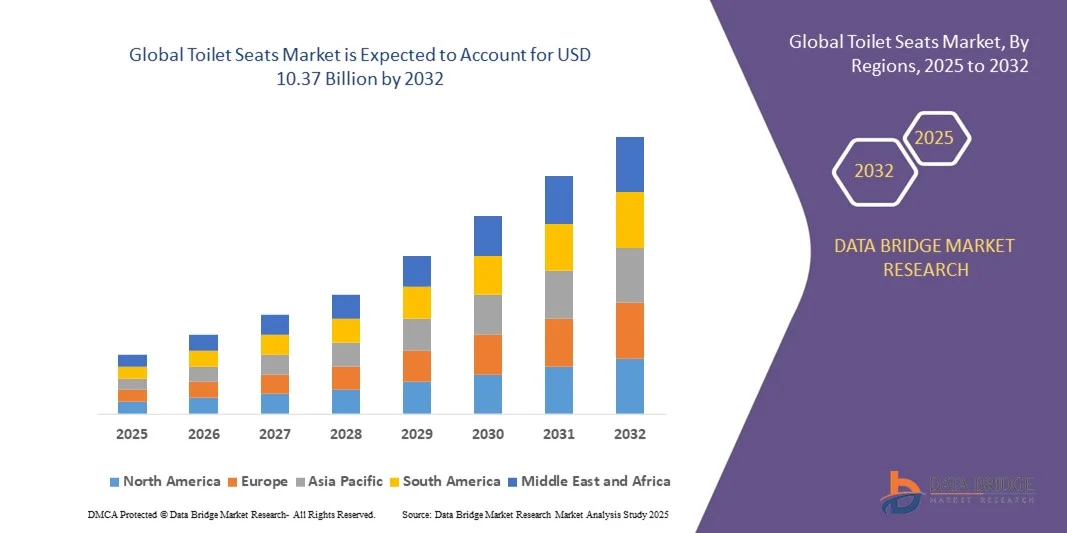
Toilet Seats Market Size
- The global toilet seats market size was valued at USD 6.51 billion in 2024 and is expected to reach USD 10.37 billion by 2032, at a CAGR of 6.00% during the forecast period
- The market growth is largely fueled by the increasing emphasis on hygiene, comfort, and convenience in residential and commercial spaces, along with the growing adoption of smart bathroom technologies. The integration of advanced features such as heated seats, bidet functions, automatic lids, and water-saving mechanisms is transforming traditional toilet seats into modern, tech-enabled sanitary solutions that cater to evolving consumer lifestyles
- Furthermore, rising consumer awareness regarding sanitation, coupled with expanding urbanization and increasing renovation activities, is boosting demand for both smart and ergonomic toilet seat designs. These factors, supported by continuous product innovations and government initiatives promoting water efficiency, are significantly accelerating market expansion across global regions
Toilet Seats Market Analysis
- Toilet seats, serving as essential components of bathroom infrastructure, are evolving with technological advancements that emphasize hygiene, efficiency, and user comfort. The market is witnessing a shift from conventional designs to smart, sensor-equipped, and eco-friendly models that align with sustainability goals and modern living standards
- The growing demand for intelligent bathroom solutions is driven by the proliferation of smart homes, increasing health awareness post-pandemic, and the preference for automated sanitary fixtures. Manufacturers are investing in innovative materials and connectivity features, positioning toilet seats as key contributors to the next generation of smart and sustainable bathroom environments
- Asia-Pacific dominated toilet seats market with a share of over 60% in 2024, due to rapid urbanization, rising disposable incomes, and increasing adoption of modern bathroom fixtures across residential and commercial sectors
- North America is expected to be the fastest growing region in the toilet seats market during the forecast period due to rising home renovation activities, expanding real estate development, and increasing adoption of smart bathroom technologies
- Residential segment dominated the market with a market share of 69.9% in 2024, due to increasing home improvement projects and consumer focus on bathroom comfort and hygiene. Households are replacing conventional toilet seats with upgraded versions that offer better durability and easy cleaning features. The rising number of housing units in emerging economies continues to sustain steady demand for residential toilet seats
Report Scope and Toilet Seats Market Segmentation
|
Attributes |
Toilet Seats Key Market Insights |
|
Segments Covered |
|
|
Countries Covered |
North America
Europe
Asia-Pacific
Middle East and Africa
South America
|
|
Key Market Players |
|
|
Market Opportunities |
|
|
Value Added Data Infosets |
In addition to the insights on market scenarios such as market value, growth rate, segmentation, geographical coverage, and major players, the market reports curated by the Data Bridge Market Research also include in-depth expert analysis, pricing analysis, brand share analysis, consumer survey, demography analysis, supply chain analysis, value chain analysis, raw material/consumables overview, vendor selection criteria, PESTLE Analysis, Porter Analysis, and regulatory framework. |
Toilet Seats Market Trends
Integration of Smart and IoT-Enabled Toilet Seats
- The toilet seats market is increasingly integrating smart and IoT-enabled technologies to provide enhanced hygiene, comfort, and user convenience. Features such as heated seats, bidet functionalities, automatic lid opening and closing, nightlights, and customizable settings accessible via mobile apps are transforming traditional bathroom experiences into personalized and hygienic environments
- For instance, Japan remains a pioneer in smart toilet technology adoption, with brands such as Toto and Panasonic leading the market. These companies offer IoT-integrated seats with remote controls, sensor-based hygiene maintenance, and health monitoring features, creating high consumer demand in technologically advanced and aging populations
- The smart toilet seats market is growing globally as consumers prioritize personal cleanliness and ease of use, especially in residential and hospitality sectors. This includes touchless operations and self-cleaning features that minimize contact points, addressing increased hygiene concerns following the COVID-19 pandemic
- The rise of smart home ecosystems is amplifying demand for IoT-compatible bathroom fixtures, with toilet seats now offering integration with voice assistants, home automation systems, and health apps. These innovations appeal to younger, digitally savvy consumers seeking seamless and connected lifestyles
- Growing urbanization, rising disposable incomes, and expanding home renovation trends continue to stimulate interest worldwide. Consumers look for products that enhance bathroom aesthetics, functionality, and sanitation, positioning smart toilet seats as a key element of modern bathroom upgrades
- This trend towards smart, connected, and user-centric toilet seats is driving ongoing R&D and market expansion. Manufacturers are expected to introduce even more advanced features focused on health monitoring and water efficiency, fueling broader adoption across global markets
Toilet Seats Market Dynamics
Driver
Rising Demand for Hygiene and Comfort-Oriented Bathroom Solutions
- Increasing consumer awareness of hygiene and personal comfort is driving the rising adoption of smart and high-functionality toilet seats. Features such as bidet washing, heated seating, deodorization, and automatic flushing systems address growing sanitation expectations and contribute to enhanced bathroom wellness
- For instance, reports indicate that markets with aging demographics, such as Japan and parts of Europe, are led by demands for comfort features that cater to elderly users and individuals with reduced mobility. Smart toilet seats improve quality of life by providing customized water temperature and pressure settings, reducing physical strain during use
- Post-pandemic focus on minimizing germ transmission has accelerated interest in touchless and self-cleaning solutions that reduce potential contamination in bathrooms. This has spurred innovation across residential and public restroom sectors, reinforcing hygiene as a top purchasing criterion
- In addition, the desire for bathroom luxury and relaxation is rising as consumers upgrade home amenities. Inflated disposable incomes and changing lifestyles motivate investments in smart toilet seats that offer premium comfort and a spa-like experience
- The integration of health and wellness features into smart toilet seats, such as sensors monitoring weight and urine analysis, is also creating new value propositions that appeal to health-conscious consumers and healthcare providers, broadening market potential
Restraint/Challenge
High Cost of Smart Toilet Seats
- The high price points of advanced smart toilet seats represent a significant barrier to widespread adoption, especially in developing countries and cost-sensitive consumer segments. These products often cost multiple times more than traditional seats due to the complex electronics, materials, and manufacturing processes involved
- For instance, in emerging markets such as India and Brazil, the premium pricing limits market penetration, with many consumers opting for standard models that do not offer smart functionalities. Price-sensitive buyers are less inclined to invest in costly bathroom upgrades despite the potential hygiene and comfort benefits
- The high initial investment, coupled with potential maintenance and repair costs, can deter consumers and slow the replacement cycle for conventional toilet seats. Warranty concerns and lack of after-sales service infrastructure contribute to adoption hesitancy in less urbanized areas
- In addition, the relatively slow pace of digital infrastructure rollout in some regions impedes the seamless integration of IoT features, reducing perceived value and limiting functionality for end-users without reliable connectivity
- To overcome these challenges, manufacturers and distributors are exploring cost-reduction pathways, modular product designs, and financing options aimed at expanding accessibility. As technology matures and economies of scale improve, prices are expected to decrease, paving the way for broader global acceptance and growth
Toilet Seats Market Scope
The market is segmented on the basis of type, raw material, bowl shape, application, and distribution channel.
- By Type
On the basis of type, the toilet seats market is segmented into smart toilet seats and ordinary toilet seats. The ordinary toilet seat segment dominated the market with the largest revenue share in 2024, primarily due to its widespread usage in residential and public restrooms. Ordinary seats are favored for their cost-effectiveness, ease of installation, and low maintenance requirements. Their compatibility with a variety of toilet designs and availability across multiple price ranges make them a practical choice for large-scale housing projects and budget-conscious consumers. Moreover, the steady demand from renovation and replacement activities continues to sustain the dominance of this segment globally.
The smart toilet seat segment is expected to witness the fastest growth rate from 2025 to 2032, driven by increasing consumer inclination toward hygiene and convenience-oriented bathroom solutions. Smart seats equipped with features such as automatic lid operation, heated surfaces, bidet functions, and deodorization systems are rapidly gaining popularity, particularly in premium households and hospitality sectors. Growing awareness of personal hygiene, combined with technological advancements and the integration of IoT, is transforming traditional bathroom setups into smart, connected environments. Countries such as Japan and South Korea are major contributors to the rising adoption of these advanced systems.
- By Raw Material
On the basis of raw material, the toilet seats market is segmented into plastic, ceramic, wood, urea molding compounds, and others. The plastic segment dominated the market with the largest share in 2024, owing to its durability, lightweight properties, and cost-effectiveness. Plastic toilet seats are widely preferred in both residential and commercial applications due to their resistance to moisture, easy maintenance, and availability in various designs. Their recyclability and affordability make them an ideal option for mass production and large-scale installations across emerging economies.
The urea molding compounds segment is projected to register the fastest growth rate from 2025 to 2032, attributed to its superior strength, stain resistance, and glossy finish, which enhances the visual appeal of modern bathroom interiors. This material provides a ceramic-like appearance with added durability, making it a preferred choice among premium toilet seat manufacturers. The growing trend toward luxury bathroom aesthetics and sustainability is further propelling the adoption of urea-based seats across residential and commercial establishments.
- By Bowl Shape
On the basis of bowl shape, the toilet seats market is segmented into elongated, round, and square. The elongated segment dominated the market with the largest share in 2024, supported by its ergonomic design that offers better comfort and hygiene. These seats are widely used in residential settings and high-end restrooms due to their modern appearance and compatibility with smart toilet systems. The growing shift toward comfort-focused bathroom fixtures in developed countries continues to support the segment’s leading position.
The square segment is expected to record the fastest growth rate from 2025 to 2032, driven by rising consumer preference for contemporary bathroom designs. Square-shaped toilet seats are increasingly adopted in modern apartments, hotels, and commercial spaces for their sleek appearance and compatibility with minimalist décor styles. The demand for design-centric sanitary products is encouraging manufacturers to expand offerings in this segment with enhanced materials and customizable aesthetics.
- By Application
On the basis of application, the toilet seats market is segmented into residential and commercial. The residential segment dominated the market with the largest revenue share of 69.9% in 2024, driven by increasing home improvement projects and consumer focus on bathroom comfort and hygiene. Households are replacing conventional toilet seats with upgraded versions that offer better durability and easy cleaning features. The rising number of housing units in emerging economies continues to sustain steady demand for residential toilet seats.
The commercial segment is anticipated to witness the fastest growth from 2025 to 2032, propelled by rapid infrastructure development across hospitality, healthcare, and corporate facilities. Commercial spaces are increasingly adopting durable and hygiene-centric toilet seat models that can withstand heavy usage while maintaining aesthetic appeal. The growing emphasis on sanitation standards in public and semi-public restrooms is further supporting market expansion in this segment.
- By Distribution Channel
On the basis of distribution channel, the toilet seats market is segmented into online and offline. The offline segment dominated the market with the largest share in 2024, owing to consumer preference for physical product inspection before purchase and the strong presence of retail networks. Home improvement stores, hardware outlets, and sanitary ware showrooms continue to drive significant sales volume, particularly in regions with traditional purchasing habits. The availability of installation support and after-sales services through offline channels further reinforces their dominance.
The online segment is projected to grow at the fastest pace from 2025 to 2032, driven by the rising penetration of e-commerce platforms and the convenience of doorstep delivery. Consumers increasingly prefer online platforms to compare prices, access a wide range of products, and benefit from promotional discounts. The expansion of digital retail infrastructure and increasing adoption of smart toilet seats among tech-savvy consumers are boosting the online sales channel globally.
Toilet Seats Market Regional Analysis
- Asia-Pacific dominated the toilet seats market with the largest revenue share of over 60% in 2024, driven by rapid urbanization, rising disposable incomes, and increasing adoption of modern bathroom fixtures across residential and commercial sectors
- The region’s expanding construction industry, government initiatives for improved sanitation, and growing demand for smart and hygiene-oriented bathroom solutions are propelling market growth
- Rising consumer awareness of health and hygiene, along with the growing presence of both domestic and international sanitary ware brands, continues to strengthen the region’s leadership in global market revenue
China Toilet Seats Market Insight
China held the largest share in the Asia-Pacific toilet seats market in 2024, owing to its extensive production capacity, strong consumer base, and robust infrastructure development. The growing trend toward smart homes and the rapid adoption of electronic toilet seats in urban households are key growth contributors. Domestic manufacturers are expanding their product portfolios with technologically advanced and affordable options, further enhancing China’s market dominance.
India Toilet Seats Market Insight
India is witnessing the fastest growth in the Asia-Pacific region, supported by rising sanitation awareness, government programs such as “Swachh Bharat Abhiyan,” and increasing construction of residential units. Growing middle-class income levels and a shift toward modern bathroom aesthetics are driving the demand for both smart and soft-close toilet seats. The expansion of e-commerce platforms and the availability of cost-effective domestic products are accelerating market adoption.
Europe Toilet Seats Market Insight
The Europe toilet seats market is growing steadily, supported by rising demand for premium sanitary ware, smart home integration, and sustainable bathroom designs. Consumers are increasingly favoring high-quality materials and ergonomic designs, boosting the adoption of elongated and soft-close toilet seats. The emphasis on eco-friendly materials and energy-efficient electronic models aligns with Europe’s strong environmental standards, driving consistent market growth.
Germany Toilet Seats Market Insight
Germany leads the European market due to its focus on design innovation, product quality, and technological integration in sanitary ware. The country’s strong housing sector, combined with consumer preference for durable and smart hygiene solutions, supports market expansion. German manufacturers are at the forefront of incorporating advanced features such as automatic lid opening, heated seats, and water-efficient flushing systems.
U.K. Toilet Seats Market Insight
The U.K. market benefits from a mature home improvement industry, growing emphasis on bathroom modernization, and increasing adoption of luxury sanitary fittings. Consumers are opting for design-centric and comfort-driven toilet seats with advanced functionality. The post-pandemic focus on hygiene and wellness has further fueled the demand for smart toilet seats in both residential and hospitality sectors.
North America Toilet Seats Market Insight
North America is projected to grow at the fastest CAGR from 2025 to 2032, driven by rising home renovation activities, expanding real estate development, and increasing adoption of smart bathroom technologies. Consumers in the region are willing to invest in comfort and hygiene-oriented fixtures, including electronic and heated toilet seats. The growing focus on sustainability and water conservation is encouraging the use of energy-efficient and sensor-based models.
U.S. Toilet Seats Market Insight
The U.S. accounted for the largest share in the North America market in 2024, backed by high consumer spending power, widespread adoption of smart home systems, and a thriving home improvement sector. Strong demand for luxury bathroom products and advanced sanitation technologies is fueling growth. Major industry players are focusing on innovative designs and connected features to cater to evolving consumer preferences, reinforcing the U.S.'s leading position in the region.
Toilet Seats Market Share
The toilet seats industry is primarily led by well-established companies, including:
- Hi-Tech Sweet Water Technologies Pvt. Ltd. (India)
- Kohler Co. (U.S.)
- Duravit AG (Germany)
- LIXIL Group Corporation (Japan)
- Panasonic Corporation (Japan)
- Jomoo Kitchen & Bath Co., Ltd. (China)
- Racy Toilet Seat (India)
- Huida Sanitary Ware Co., Ltd. (China)
- DELABIE (France)
- Amoy Brand (China)
- Hamberger Sanitary GmbH (Germany)
- MKW (Austria)
- TOTO Ltd. (Japan)
- BAGNODESIGN (U.K.)
- Bemis Manufacturing Company (U.S.)
- AXENT International (Switzerland)
- Pressalit A/S (Denmark)
- Spyware Sanitary LLP (India)
- Villeroy & Boch (Germany)
- Geberit International Sales AG (Switzerland)
Latest Developments in Global Toilet Seats Market
- In May 2025, the European Union passed new regulations mandating the installation of water-saving toilet seats in all new residential and commercial buildings, marking a major step toward environmental sustainability in the sanitary ware industry. This policy is expected to drive substantial growth in demand for eco-efficient toilet seats that minimize water usage while maintaining performance. Manufacturers across Europe are now investing heavily in research and development to meet compliance requirements and capitalize on the expanding market for green technologies. The regulation promotes innovation in sustainable design and strengthens Europe’s leadership in environmental responsibility and energy-efficient infrastructure, fostering long-term growth for the regional toilet seats market
- In January 2025, Dyson Ltd. secured a USD 100 million investment to develop its innovative ‘AirDog’ toilet seat, which uses jet-engine technology to create a high-efficiency flush system. This groundbreaking design aims to deliver superior hygiene standards, powerful waste removal, and minimal water consumption, positioning Dyson as a key disruptor in the premium sanitary ware market. The investment underscores the company’s commitment to applying its engineering expertise to household innovations, merging advanced aerodynamics with everyday functionality. The introduction of the AirDog seat is expected to accelerate technological competition, inspire new product development across the sector, and attract a wave of consumers seeking high-performance, eco-friendly, and futuristic bathroom solutions
- In 2023, Bemis Manufacturing Company announced plans to launch its Assist premium toilet seat at the 2023 KBIS Show in Las Vegas, emphasizing a focus on accessibility and ergonomic design. The seat’s integrated support arms provide enhanced stability and comfort, reducing the need for wall-mounted brackets and making it ideal for elderly users and those with limited mobility. Its compatibility with both round and elongated bowls, combined with Bemis’s Commercial STAY•TITE Installation System, ensures a secure and user-friendly installation experience. This innovation reinforces Bemis’s position as a leader in inclusive bathroom solutions, addressing the growing global demand for safety-focused, high-quality sanitary products in both residential and healthcare environments
- In 2023, Kohler Co. introduced its next-generation smart toilet, the Numi 2.0, representing a significant advancement in connected bathroom technologies. The product features built-in speakers, Alexa integration, an intuitive remote control, a heated seat, LED ambient lighting, and an automatic deodorizing mode, redefining the luxury bathroom experience. Designed for comfort and hygiene, it also includes hands-free operation and height adjustment, catering to health-conscious and accessibility-focused users. Kohler’s Numi 2.0 demonstrates the growing fusion of IoT and wellness in sanitary design, setting new benchmarks for premium bathroom products and reinforcing the company’s leadership in global smart sanitary innovation
- In March 2020, TOTO Ltd. announced the production of its electronic bidet toilet, which incorporates water jet hygiene, warm seating, soft illumination, and self-opening lids to enhance user comfort and cleanliness. This innovation solidified TOTO’s position as a pioneer in intelligent bathroom technology, blending functionality with luxury. By focusing on high-quality craftsmanship and cutting-edge automation, the company responded to rising consumer demand for hygiene and personalized bathroom experiences. TOTO’s continued investment in product innovation has significantly influenced global market trends, pushing other industry players toward the development of high-functionality and sustainable toilet seat solutions

- Interactive Data Analysis Dashboard
- Company Analysis Dashboard for high growth potential opportunities
- Research Analyst Access for customization & queries
- Competitor Analysis with Interactive dashboard
- Latest News, Updates & Trend analysis
- Harness the Power of Benchmark Analysis for Comprehensive Competitor Tracking
Data collection and base year analysis are done using data collection modules with large sample sizes. The stage includes obtaining market information or related data through various sources and strategies. It includes examining and planning all the data acquired from the past in advance. It likewise envelops the examination of information inconsistencies seen across different information sources. The market data is analysed and estimated using market statistical and coherent models. Also, market share analysis and key trend analysis are the major success factors in the market report. To know more, please request an analyst call or drop down your inquiry.
The key research methodology used by DBMR research team is data triangulation which involves data mining, analysis of the impact of data variables on the market and primary (industry expert) validation. Data models include Vendor Positioning Grid, Market Time Line Analysis, Market Overview and Guide, Company Positioning Grid, Patent Analysis, Pricing Analysis, Company Market Share Analysis, Standards of Measurement, Global versus Regional and Vendor Share Analysis. To know more about the research methodology, drop in an inquiry to speak to our industry experts.
Data Bridge Market Research is a leader in advanced formative research. We take pride in servicing our existing and new customers with data and analysis that match and suits their goal. The report can be customized to include price trend analysis of target brands understanding the market for additional countries (ask for the list of countries), clinical trial results data, literature review, refurbished market and product base analysis. Market analysis of target competitors can be analyzed from technology-based analysis to market portfolio strategies. We can add as many competitors that you require data about in the format and data style you are looking for. Our team of analysts can also provide you data in crude raw excel files pivot tables (Fact book) or can assist you in creating presentations from the data sets available in the report.